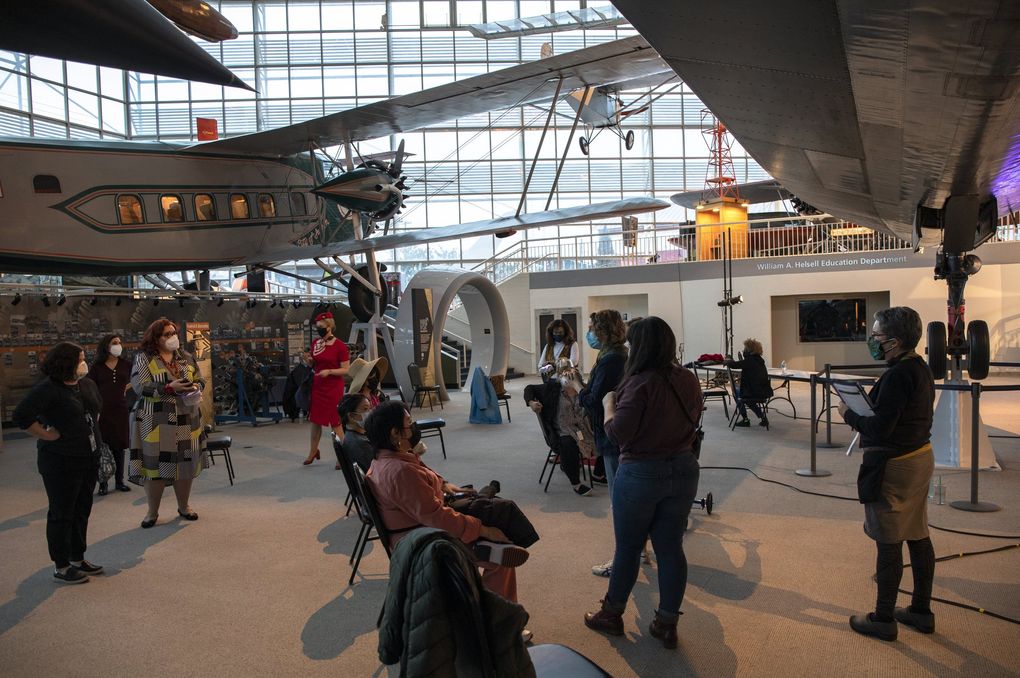
The familiar dread that accompanies air travel — Will my flight be delayed? Will I end up stranded? — has only become aggravated in the time of the coronavirus. But the reverse side to such anxieties is the promise of escape, which leads us ever onward. The resulting ambiguity gives airports their tremendous symbolic power.
The Spring Festival Tippet Rise on Tour from April 16 to 18 will premiere 10 short films featuring eclectic music performances, readings of poetry, and live discussions with musicians. Highlights of the Spring Festival include flutist Claire Chase giving the world premiere of a new work by Bora Yoon, an homage to Surrealism by pianist Pedja Mužijević, and performances by violinists Benjamin Beilman, Katie Hyun, and Tessa Lark, cellist Gabriel Cabezas, pianists Richard Goode, and Baritone Tyler Duncan. The performances were filmed in sculptor Joel Shapiro’s studio and in the DiMenna Center for the Arts in New York City.
The three-day event will also feature Canadian cellist Arlen Hlusko, who was recently appointed cellist of the Bang on a Can All-Stars. Arlen put an ask out on social media during lockdown to see if any composers would be interested in writing miniatures for solo cello that would be premiered on her Instagram in September 2020. This resulted in exhilarating collaborations with numerous composers and four of the works were subsequently filmed by Tippet Rise and will be offered during the Festival.
Each night of the Spring Festival will begin at 5:30PM MDT with a live backstage Zoom discussion before the evening’s performances.
Les Arts Florissants recorded its concert program Charpentier, Grands Motetsat the Royal Chapel at Versailles on 28 February following cancellation of two public performances (at Versailles and La Rochelle) due to the pandemic. The film will be available on Qwest TV starting on April 9
From the press release:
Les Arts Florissants collaborates for the very first time with Qwest TV, a global video platform, to offer the exclusive broadcast of the film Charpentier, Grands Motets recorded at Versailles’ Royal Chapel.
Digital Concert – public premiere Musical Direction: William Christie Choir and Ensemble: Les Arts Florissants Royal Chapel – Versailles Filmed on 28 February 20212 without a live audience
Coproduction Les Arts Florissants and Château de Versailles Spectacles
Qwest TV recently launched a “Classical” category on their premium SVOD platform, across which Charpentier, Grand Motets will be released.
SVOD broadcast (access by subscription, with 7 days free trial) For more details on how viewers can stream the film on Qwest, click here.
My review of this marvelous BMOP anthology of Robert Carl’s music for Gramophone has now been posted here.
Aficionados of contemporary music will already be familiar with the name Robert Carl as a writer. He has authored extensive reviews for Fanfare and a recent, thought-provoking collection of essays on the challenges faced by 21st-century composers…
If you haven’t yet experienced the Peter Sellars staging of J.S. Bach’s St. Matthew Passion, I can’t recommend it highly enough — and the Berliner Philharmoniker production with Simon Rattle is currently available to view for free (until Monday) at the Digital Concert Hall.
Meanwhile, Bach’sSt. John Passion will be performed by John Eliot Gardiner, the Monteverdi Choir, and the English Baroque Soloists. It can be viewed for a fee of 9.90 Euros on a Deutsche Grammophon Stage stream from the historic Sheldonian Theatre in Oxford, starting at 3pm CET on Good Friday, 2 April.
Remarks Gardiner: “I look forward to this performance for DG Stage of Bach’s St John Passion. “I recorded the piece for the first time for Archiv Produktion back in 1986 and it remains truly special to me. Bach conceived the piece as much as an act of worship as a work of religious art. Almost 300 years after it was heard for the first time, it continues to move listeners of all faiths and none.”
And here’s a performance from 2019 of the 1725 version of the St. John Passion (available for the next 48 hours) from Solomon’s Knot: recorded live at the Nikolaikirche, Bachfest Leipzig, on 19 June 2019. Dramatization by John La Bouchardière.
I reviewed the latest release from Imani Winds for Gramophone:
Musicians have felt an increasing urgency over the past year to become engaged with issues of social justice. Imani Winds were already there well before most, having devoted themselves to giving a platform to marginalised voices since they started out in 1997. So the moral focus of their new album, which addresses the effects of systemic racism, reflects much more than a current trend.
Sunday at 5PM PST, the Voices of Silicon Valley present a discussion of Stockhausen’s landmark work Stimmung.
Distinguished African American composer and media artist Pamela Z and Voices of Silicon Valley (VOSV) Artistic Director Cyril Deaconoff will discuss its cultural context, Stockhausen’s influence on the French spectral school (Gerard Grisey in particular), and the learning process and technique used by VOSV.
This discussion will be presented on VOSV’s Youtube channel here.
The 17-minute presentation was originally recorded for the digital Gala/ Orpheus album release party on 15 November 2020. After the re-broadcast this Sunday, it will stay on Youtube and may be viewed later. Stockhausen’s Stimmung appears on VOSV’s album Voices of Our Time, which features the first recording of this work by an American group.
On Sunday 28 March at 5pm PST, Port Angeles’s Music on the Strait — the Strait of Juan de Fuca, that is — presents Tribute to Clara Schumann from the shores of Lake Sutherland. The performers include co-artistic director James Garlick (violin), Saeunn Thorsteindottir (cello), Orion Weiss (piano), and Nathan Hughes (oboe). Violist and Music on the Strait co-artistic director Richard O’Neill, who just won the Best Classical Instrumental Solo Performance Grammy Award, will introduce. The concert can be accessed for free here.
Program:
Clara Schumann: Three Romances for Violin and Piano, Op 22
Robert Schumann: Three Romances for Oboe and Piano, Op 94
Johannes Brahms: Wiegenlied and Liebestreu arr. for Cello and Piano
Clara Schumann: Piano Trio, Op 17
My story for the New York Times on Clara Schumann’s 200th birthday can be read here.
For MaerzMusik 2021, Bang on a Can has curated a special edition of its online Bang on a Can Marathon: four hours of live performances from both sides of the Atlantic. Bang on a Can Marathon Live Online – MaerzMusik Edition will be presented by Berliner Festspiele on Sunday, 21 March 2021 from 3pm-7pm ET.
The Bang on a Can Marathon is one of many events taking place during the MaerzMusik Festival 2021, running March 19-28. MaerzMusik 2021 aims at providing a variety of online experiences: world premieres recorded with state-of-the-art 360° camera and 3D sound technology, binaural audio streams, live-streamed concerts, pre-produced concert films, music videos, documentaries, lectures and talks.
In addition to the artists of the Bang on a Can marathon, works by Jessie Cox, Halim El-Dabh, Jessica Ekomane, Beatriz Ferreyra, Carlos Guitérrez, Sofia Jernberg, Marisol Jiménez, Hannah Kendall, Daniel Kidane, Tania León, Bernard Parmegiani, Éliane Radigue, Manuel Rodríguez Valenzuela, and many others can be experienced.
These digital productions are connecting the physical locations Haus der Berliner Festspiele, Chamber Music Hall of the Philharmonie, Zeiss-Großplanetarium, SAVVY Contemporary, silent green, Wissenschaftskolleg zu Berlin, Université du Québec à Montréal, and Schloss Rheinsberg, as well as private apartments and studios around the world where music, language, and moving images are being created for this festival. The full festival programming is available here: www.berlinerfestspiele.de/maerzmusik-en
The Bang on a Can Marathon is free to watch, but viewers are encouraged to consider purchasing a ticket. Doing so helps Bang on a Can and MaerzMusik to pay more players, commission more composers, and make more music.
Bang on a Can Marathon Live Online – MaerzMusik Edition
Set times are approximate and subject to change.
3PM NEW YORK | 8PM BERLIN
Daniel Bernard Roumain Why Did They Kill Sandra Bland? performed by Arlen Hlusko
Arnold Dreyblatt
Mazz Swift
Rohan Chander△ or THE TRAGEDY OF HIKKOMORI LOVELESS from FINAL//FANTASY performed by Vicky Chow
4PM NEW YORK | 9PM BERLIN
Kristina WolfeListening to the Wind performed by Molly Barth
Miya Masaoka
Aeryn Santillandisconnect. performed by Ken Thomson
Adam Cuthbert
5PM NEW YORK | 10PM BERLIN
Ken ThomsonBirds and Ambulances performed by Robert Black
Tomeka ReidLamenting G.F., A.A., B.T., T.M. performed by Vicky Chow
Steve ReichVermont Counterpoint performed by Claire Chase
Some thoughts on the wonderful and irreplaceable Paul Taub. May his memory be a blessing.
An internationally acclaimed flutist and pioneer of Seattle’s new music community, Paul Taub died at his home in Seattle on March 13 after a heart attack. He was 68.
Paul Taub’s last performances were with the organist Joseph Adam, on 26 February 2021 as well as in the video shown above, which premiered online on 28 February but was prerecorded for a program titled Solo Flute Spectacular. For the latter program, he played from Barang I (1974) by Barbara Benary (1946-2019) and the Air in G Minor (1947) by Lou Harrison (1917–2003).
His very last live performance took place on 26 February at Seattle’s St. James Cathedral. For this live concert stream, titled A Musical Prayer, Paul and Joseph Adam performed the following program:
Jehan Alain, arr. Marie-Claire Alain: Trois Mouvements for flute and organ Alan Hovhaness: Sonata for Ryūteki and Shō, or Flute and Organ Julie Mandel: Every Monday for flute alone (world premiere) Anna Bon di Venezia: Sonata No. 1 in C major, Op. 1, No. 1 for flute and organ