Today marks the 400th anniversary of the birth of the extraordinary Isabella Leonarda, a versatile and prolific composer whose long life unfolded against a backdrop of dramatic transformation in the history of music.
She left behind a vast output of compositions, a musical treasure that defied the strictures of the patriarchy. Working within the confines of the Ursuline convent where she spent her life, Leonarda also became the first woman to publish instrumental sonatas.
PacificMusicWorks celebrates this fiercely creative woman with a concert hosted by Henry Lebedinsky and featuring special guest countertenor Reginald L. Mobley. Linked above, the concert will remain available through September.
In solidarity with those suffering from last month’s catastrophic explosion in Beirut, the New York-based violinist and composer Layale Chaker has created a pop-up store on her website as a relief campaign. She is donating proceeds from the sale of Inner Rhyme, her debut album with her ensemble Sarafand from now until 15 September.
100% of the sales will go to these efforts, which will be divided 50%-50% between Children’s Cancer Center in Lebanon and Beit el Baraka, which provides “housing, nutrition, medical support, sustainable agricultural initiatives, and different community engagement activities to respond to the multi-dimensional challenges faced by deprived communities.”
Of Inner Rhyme Chaker remarks: “I always thought of [the album] as a true labor of love. It is now time for it to pay it forward. I look forward to this direct interaction, to folding your packages and sending out my music in the world to find you, and to transmitting the outcome back to Lebanon. If so you choose, you will be updated with your donation every step of the way.”
Lorenzo Candelaria – Dean, Blair School of Music, Vanderbilt University
Gregorio Luke – Lecturer and author, specialist in Mexican Art and Culture
Ana Lara – Composer, Mexico City
Ix-Nic Iruegas – Executive Director, Mexican Cultural Institute, Embassy of Mexico
(47 minutes)
This second clip provides the historical context of Mexican cultural by John Tutino – Historian, Georgetown University (11 minutes).
Additional resources related to this chat:
Film:
To purchase PCE’s acclaimed Naxos DVD of Redes, with Revueltas’s soundtrack newly recorded by PostClassical Ensemble, click here: https://Naxos.lnk.to/2110372ID
Books:
Ix-Nic Iruegas, Executive Director of the Mexican Cultural Institute, recommended two books by one of Mexico’s most outstanding authors: Sergio Pitol: The Art of Flight (Deep Vellum Publishing, 2015); and The Magician from Vienna (Deep Vellum Publishing, 2017).
The latest installment in the PostClassical Ensemble’s (PCE) More than Music series takes up the issue of political art, with a focus on the landmark 1936 film Redes — and its powerful score by Silvestre Revueltas.
Some of the questions to be explored in PCE’s Zoom discussion on 2 September at 6.30pm EST: How did the Mexican Revolution galvanize political muralists and composers? Why was Mexico more hospitable to political art than the US? What’s the pertinence of political art today?
The Zoom-chat will feature Gregorio Luke’s presentations on Diego Rivera and the Mexican muralists, plus commentary by composer Ana Lara and by historians Roberto Kolb, John Tutino, and Lorenzo Candelaria, and Ix-Nic Iruegas Peon of the Mexican Cultural Institute. Registration is free: simply sign up here.
From Joseph Horowitz’s blog post “’Redes’ Lives! — The Iconic Film of the Mexican Revolution and What It Says to Us Today”:
“It’s a pity that Silvestre Revueltas is not at least as well known as Rivera. I would unhesitatingly call him the supreme political composer of concert and film music produced in the Americas. His music combines ideology with personal understanding…Revueltas’s peak achievements include his singularly arresting score for the film Redes (1936), in which impoverished Mexican fisherman unite to storm the bastions of power.”
More from Joe Horowitz:
On “The Artist and the State” in Mexico (where political art has greatly mattered) and the U.S. (where the artist remains an outsider):
More signs of musical life returning: on Tuesday evening at Pierre Boulez Saal in Berlin, Daniel Barenboim leads the Boulez Ensemble in the opening concert of the season: music by Schubert, Mozart, Berg, and Jörg Widmann, who also plays clarinet with the Ensemble. Widmann’s wild, far-ranging, at times terrifying new work Labyrinth IV — a continuation of his ongoing Labyrinth series, commissioned and premiered last year by Barenboim and the Boulez Ensemble, is the culminating work.
That premiere took place in June 2019, when Sir Peter Jonas and Daniel Barenboim curated the program celebrating the Wissenschaftszentrum Berlin für Sozialforschung’s (WZB) 50th anniversary at the Pierre Boulez Saal. Jonas had been closely associated with the WZB and the Pierre Boulez Saal for many years.
The opening concert is dedicated to the memory of Sir Peter Jonas, who died this year on 22 April at the age of 73.
Running 22-29 August, this year’s edition featured a production of Handel’s L’Allegro, il Penseroso ed il Moderato to open and included early J.S. Bach cantatas as well as sacred and profane music by Gesualdo. It ends today with a “pasticcio” titled Tell me the truth about love and featuring Lea Desandre and Jakub Józef Orliński.
William Christie, founder and artistic director of Les Arts Florissants, presents their summer festival on the grounds of a late-16th-century manor house that he has restored in the village of Thiré in Vendée. Because this special edition needed to accommodate health regulations, the evening concerts have been given in the Colonnades, in the northern part of the garden, against an enchantingly illuminated backdrop.
The garden setting has also been used in lieu of the usual candlelight concerts in the church, while a series of short “Meditation” concerts that had been recorded earlier in the summer — as well as contributions from students of Juilliard’s Historical Performance program — appear online.
Les Arts Florissants’ YouTube channel gathers highlights of the summer streaming series, which are also available on LAF’s website.
An impressive debut album from iSing Silicon Valley: titled Here I Stand (and released by Innova Recordings), this collectioncelebrates “the power of girls to change the world as they raise their voices in remembrance, in strength, and in the pure, shared delight of coming together to sing.”
The ISing ensemble, founded in 2013 and consisting of more than 300 singers from grades 1 through 12 in Silicon Valley, has collaborated with the likes of Meredith Monk as well as Voces8 and Cappella SF.
Here I Stand highlights iSing’s commitment to presenting newly commissioned works and premieres. iSing Artistic Directors Jennah Delp-Somers and Shane Troll conduct, with accompanists Anny Cheng and Anna Khaydarova and guest artists Emily Botel (violin), Ron Ho (violin), Lesley Robertson (viola), Warren Wu (cello), Kent Reed (percussion), and Meredith Clark (harp).
TRACK LISTING
1. Only in Sleep, Ēriks Ešenvalds
2. Ave Generosa, Ola Gjeilo, Ave Generosa
3. In Your Light, Daniel Elder (arr. iSing commission, 2019)*
4. 365, Daniel Elder (arr. iSing commission, 2019)*
5. Never Shall I Forget (Nos. 1-3), Adam Schoenberg (iSing commission, 2019)*
6. Like a Singing Bird, Bob Chilcott
7. Birds’ Lullaby, Sarah Quartel
8. Salut Printemps, Claude Debussy
9. Here I Stand, Karen Linford (iSing commission, 2016)*
As we in the USA continue to languish with no serious leadership from the federal government, no rational plan to combat the coronavirus pandemic and allow for a safe return to social activity, other countries are getting their feet back on the ground, however tentatively. Performances are slowly returning in Europe, an encouraging sign that we can still only admire from afar.
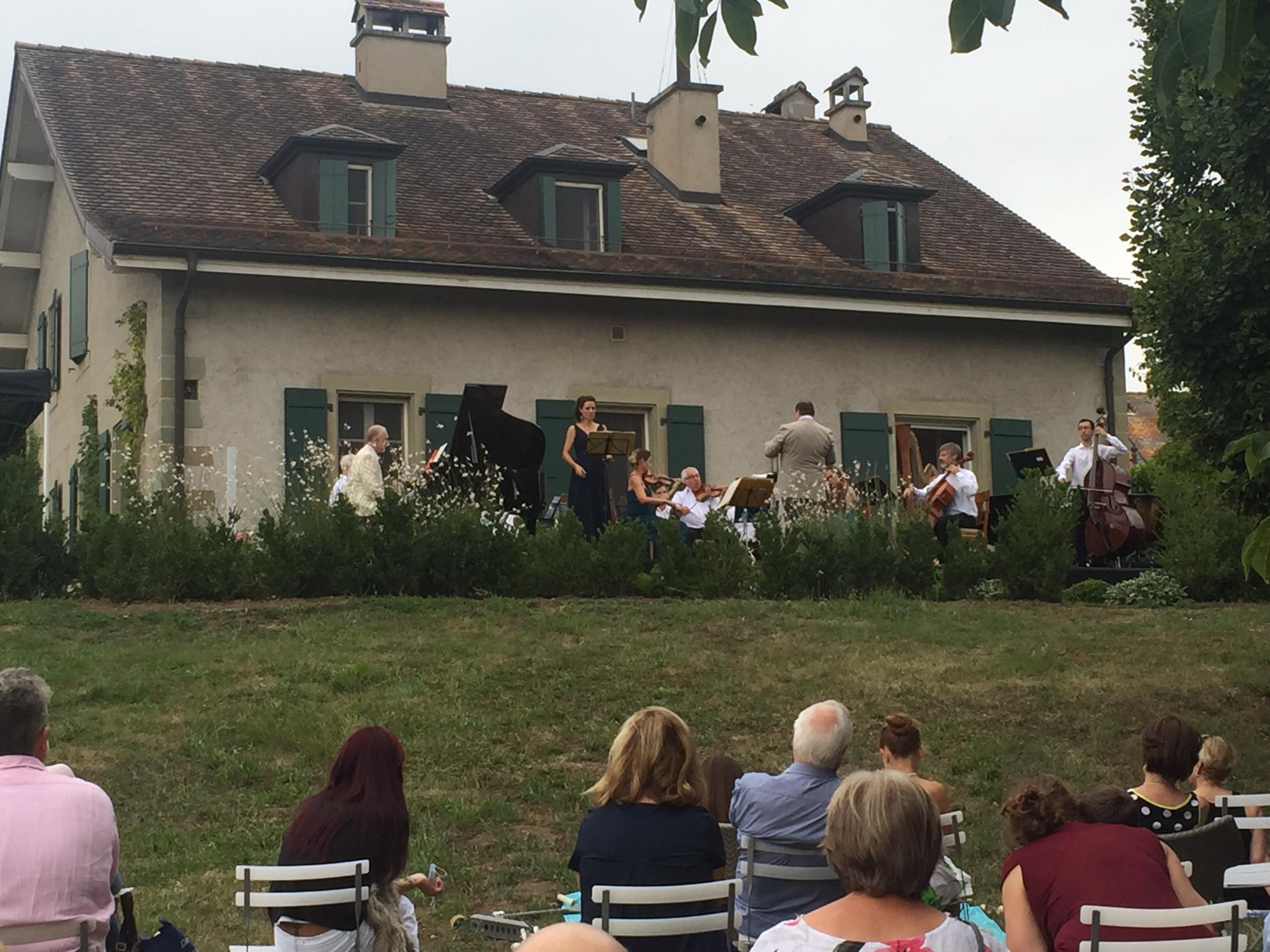
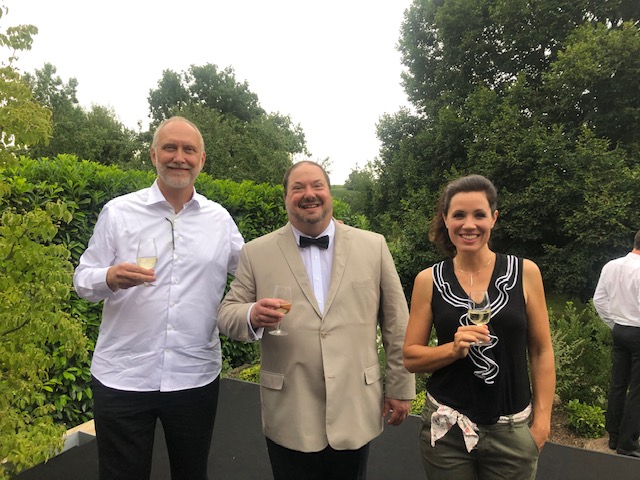
Recently my good friend Thaddeus Burns presented an open-air concert to a small group of guests at his home in Soral, just outside Geneva. The wonderful conductor John Fiore, who is based in Geneva and frequently appears at such venues as the Semperoper in Dresden and the Deutsche Oper Berlin, led a group of colleagues who call themselves ensemble d-cadences — comprising members of the l’Orchestre de la Suisse Romande. The lineup included the pianist Todd Camburn, a renowned lieder accompanist and vocal coach, and the elegant young soprano Clémence Tilquin.
Fiore put together a tasteful program of Mozart, Ravel, and Dukas (for which I contributed some comments — see below). A group of guests sat outdoors as the ensemble played on the patio. I’ve also embedded a few short excerpts into the program listing to share a little taste of this enchanting early evening of music and camaraderie.
Further to the east in Switzerland, Lucerne Festival had just opened its “Short Festival” — the replacement of its usual month-long festival, this time for ten days and in accordance with the country’s safety regulations. “Life is live” as Lucerne put it — and so is music as we most want to experience it.
Grand Concert de Déconfinement et Soutien John Fiore conductor
Todd Camburn piano
Clémence Tilquin soprano
Wolfgang Amadé Mozart (1756-91)
Overture to Der Schauspieldirektor (1786)
Second and Third movements from the Piano Concerto in C major, K. 467 (1785)
Todd Camburn
“Come Scoglio” from Così fan tutte, K. 588 (1789-90)
Clémence Tilquin
“Ch’io mi scordi di te? – Non temer, amato bene,” K. 505 (1786)
Clémence Tilquin and Todd Camburn
Encore: “Dove sono” from Le nozze di Figaro, K. 492
All Mozart arrangements for small orchestra by John Fiore
Interval
Maurice Ravel (1875-1937) Ma mère l’Oye (1910)
Arranged for chamber orchestra by Iain Farrington
Paul Dukas (1865-1935) L’âprenti sorcier (1897)
Arranged for chamber orchestra by Iain Farrington
left to right: Todd Camburn, John Fiore, Clémence Tilquin
Opera and Concerto: Mozart Finds Independence in Vienna
On the morning of 16 March 1781, Wolfgang Amadé Mozart arrived in Vienna for what was officially intended as a three-month stay. He had traveled to the capital at the request of Prince-Archbishop Hieronymus Colloredo, the ruler of Salzburg (as well as his employer), whose sizable entourage—including three musicians—he joined and with whom he was expected to return when the sojourn drew to a close.
Yet the 25-year-old Mozart was abuzz with plans of his own. Already on the evening of his arrival, despite having been on the road during the previous night, he performed for a gathering of prominent aristocrats. Wolfgang confided to his father that he found Vienna a “magnificent place—and for my métier the best place in the world.”
His ambitions precipitated a dramatic rupture with Colloredo, whose demeaning treatment brought the composer’s long-simmering resentment to a boil. Mozart was dismissed from the staff of the powerful man he derisively called “the arch-booby” and stayed in Vienna for the remaining decade of his all-too-short life.
One factor that made the Habsburg capital so attractive was the prospect that here Mozart could devote himself increasingly to opera. The confidence that enabled him to make this decisive leap into a freelance career had been bolstered by his recent experience in Munich with Idomeneo, a major creative breakthrough. Its unprecedented perspective on the moribund opera seria (“serious opera”) tradition already marked a kind of declaration of independence for the composer.
Within months of determining to stay in Vienna, Mozart was immersed in his comic opera Die Entführung aus dem Serail. It premiered in the summer of 1782 and scored a great success, eventually becoming his most popular work for the stage during his own lifetime. Abduction belongs to the genre of German Singspiel, a hybrid of music and spoken text that Emperor Joseph II had attempted to foster, though the style of Italian comic opera (opera buffa)—presided over by Antonio Salieri—won pride of place at the imperial court.
Der Schauspieldirektor (“The Impresario”) is Mozart’s only other contribution to the Singspiel genre before The Magic Flute from his final year. The composer described it as “a comedy with music,” and the part for which he was responsible—an overture, a pair of arias, a trio, and a sparkling quartet-finale—has long since been enjoyed for its own sake, detached from the brief comic play about jealous, rivaling prima donnas who audition for a struggling company.
Emperor Joseph asked Mozart to write the piece as part of the entertainment accompanying a private state visit at his palace in Schönbrunn. There it was first presented to the guests in a kind of competition with another one-act comic opera in Italian by Salieri (Prima la musica e poi le parole). Gottlieb Stephanie, who happened to be an actual impresario and had furnished the composer with the libretto for Abduction, penned the text.
Mozart dashed this music off in just two weeks early in 1786 while still working on Le nozze di Figaro, his brilliant reinvention of the opera buffa genre (to be premiered in the spring). The satirical framework of Der Schauspieldirektor is undeniably lightweight, but the score benefits from the inimitable panache and superb craft that Mozart had been perfecting in his recent Viennese compositions—above all, in the soon-to-be-unveiled Figaro. The effervescent Overture by itself comprises a virtual comedy-within-the-comedy, using mirthful contrasts to set the stage for the ensuing story of vainglorious artists who in the end find harmony.
Along with allowing him to pursue his passion for opera, Vienna represented what Mozart hailed as “the land of the clavier.” The keyboard became his alter ego. It kept him in the public eye through performances that—in addition to income from private lessons—provided a significant source of income once he chose the risky path of the freelance artist. Mozart developed the piano concerto into a remarkable synthesis combining artistic and popular appeal.
The Viennese piano concertos might also be seen as forming a bridge between Mozart’s advanced instrumental composition and his operas—a kind of laboratory where he experimented with ideas that animate his music for the stage. In his hands, the piano concerto became nothing less than a signature genre: Mozart used it to introduce his latest musical thoughts while simultaneously showcasing his personality as a performer. At the same time, he took pride in the commercial appeal of this music.
Mozart presented the K. 467 Concerto in C major in March 1785. The handbill advertising the concert drew attention to a special enhancement mechanism: “an especial large forte piano pedale will be used by him for improvising.” The Mozart expert Neal Zaslaw describes this as a custom-built, “legless fortepiano which lay on the floor underneath his regular piano… [and] was played by means of a pedalboard with the feet, as an organ is played … to reinforce the low notes.”
Mozart conceived the C major Concerto as a work of impressive architectural scope, with a symphonic richness of detail. The slow movement is all the more effective as a contrast to the bright, festive atmosphere of the movements surrounding it (we hear the finale following this Andante). Veiled strings and poignant harmonies intensify the aura of intimacy. Here, especially, we can imagine the soloist as the protagonist of a voiceless opera, entrusted with an aria that unspools at extravagant length.
Mozart’s biographer Maynard Solomon writes of “an entire movement of unrelieved, time-stopping beauty, blending chromatic pathos and measured tranquility … for something just short of eternity.” Mozart brings us back to earth with a scintillating finale built around a smile-inducing theme. The genial interplay between orchestra and piano reenacts the spell Mozart knew how to cast as a celebrity pianist in Vienna.
By 1790, when Così fan tutte was premiered, changes in the taste of the fickle Viennese public as well as a devastating economic fallout resulted in hard times for Mozart. The demand for new piano concertos had all but disappeared. The genesis of Così, his third and final collaboration with the librettist Lorenzo Da Ponte, remains mostly obscure. As court librettist until his abrupt dismissal in 1791, Da Ponte had collaborated with Salieri, who even had dibs on his libretto for Così but abandoned it after composing two trios.
Two years had passed since Mozart’s most recent commission for the stage, and he returned with a vengeance. Set in Naples, Così fan tutte stands apart even within the great Da Ponte trilogy of operas—arguably, it represents his most sophisticated achievement in music theater. This erotic comedy revolves around the wager two male friends take up to prove the existence of faithful love. They put this to the test by disguising themselves and attempting to seduce each other’s fiancées—a project that, to their mutual chagrin, proves all too successful. The opera’s sextet of characters interlock and recombine with the provocative, rueful geometry of a play by Tom Stoppard.
The more serious and steadfast of the two women, Fiordiligi is given a pair of character-defining arias (like the Contessa in Figaro). In the first of these, Come scoglio (“Like a rock”), she articulates her determination to remain faithful through Mozart’s intensely virtuosic vocal line, which calls for dramatic leaps over a treacherously wide range. So dramatic, indeed, that they parody the stock poses of serious opera. (Mozart was doubtless also indulging in some fun at the expense of Salieri’s mistress Adriana Ferrarese, who created the role of Fiordiligi.)
In March 1786, a month after the premiere of Der Schauspieldirektor, Mozart composed another aria on the topic of unwavering love, which was interpolated into a private revival in Vienna of Idomeneo. He reworked this material at the end of the year to fashion a stand-alone scena, the recitative and aria Ch’io mi scordi di te? – Non temer, amato bene (“Will I forget you? … Fear not, beloved”). The occasion was an upcoming farewell concert by the English soprano Nancy Storace. She had recently created the role of Susanna at the premiere in May of Le nozze di Figaro and was now leaving Vienna behind. Whether Storace and Mozart themselves became lovers is purely speculative, but the composer took pains to inscribe his personality into this spacious concert aria by creating a prominent part for solo piano, which offers an animated accompaniment to the beautifully ornamented vocal line.
“The Poetry of Childhood”: Music by Ravel and Dukas
“Mozart is absolute beauty, perfect purity,” Maurice Ravel once remarked about his favorite composer. He was proclaiming an essential aspect of his own credo: the quest for a perfectly crafted beauty, cherished for its own sake, lies at the heart of the French composer’s aesthetic. Ravel attributed a kind of pleasure principle to his idol: “What Mozart created for the enjoyment of the ear is perfect.” (Beethoven, in contrast, he cited as a misstep in the direction of subjectivity—the example of a composer who “overacts, dramatizes, and glorifies himself, thereby failing to achieve his goal.”)
Ravel associated such perfectionism with the innocence of childhood fantasy. As an adult, he felt a strong kinship with children and consciously tapped into fantasies of childhood as a source of musical poetry.Ma mère l’Oye (“Tales of Mother Goose”) in fact originated as a project intended specifically for children. The music alludes to classic fairy-tales as recounted Charles Perrault in his anthology of 1697 and by two other French authors. “It was my intention to awaken the poetry of childhood in these pieces,” the composer remarked, “and this naturally led me to simplify my style and to thin out my writing.”
Ravel befriended Ida and Cipa Godebski, a Polish couple whose salons attracted a striking array of Parisian artists. He also became close to their two children and between 1908 and 1910 wrote a sequence of five pieces for piano four-hands for them as a private gift—though it was not the Godebski children but two young girls who have the Paris premiere in 1910.
Ma mère l’Oye is best known in its later (1911) orchestral incarnation, which Ravel also expanded into a ballet. But the arrangement of the original for chamber orchestra by Iain Farrington that we hear suggests the prismatic nuance of the orchestrated version and at the same time conveys the forthright intimacy of the piano writing that was its starting point.
The solemn processional of the opening pavane of Sleeping Beauty ushers us, along with the stricken princess, into a dreamlike state. We sense the ambivalence of Ravel’s summoning of childhood: a past recaptured, nostalgically, by the knowing adult’s memory. Tom Thumb (Petit Poucet) tells of a poor woodcutter’s son who tries to plan a way out of the woods by dropping breadcrumbs, only to discover that birds have eaten them.
In Laideronnette, the Empress of the Pagodas, a princess has been made the ugliest woman in the world by a witch’s spell but finds herself transported into a magical kingdom where her miniature subjects, robed in gems, serenade her with an orchestra whose instruments are made of the shells of walnuts and almonds.
Ravel traces the unlikely duet of Beauty and the Beast as a Satie-like waltz that leads to another transformation—and a love that blossoms. Prince Charming himself arrives to awaken Sleeping Beauty in the final number, and the forest becomes an enchanted garden—the apotheosis of imaginative fantasy.
Although not written specifically for children, L’apprenti sorcier (“The Sorcerer’s Apprentice”) has become identified de facto with one of the best-loved classics for young ears thanks to the legacy of Walt Disney’s 1940 film Fantasia and its spinoffs. The cartoon animation of Paul Dukas’s symphonic poem from 1897 even served as the original prototype for the Fantasia idea. Its popularity has eclipsed the rest of the slender catalogue of works that the highly self-critical Dukas allowed to be published.
The source material for this “symphonic scherzo” was itself a version of an archetypal tale of magic power gone awry that similarly finds expression, say, in the legend of the golem. Dukas was inspired by the narrative Goethe etches with point and humor in his ballad Der Zauberlehrling, published in 1797. The zombie-like broom that keeps on fetching water because the young apprentice has not learned the spell to make it stop—it only redoubles its efforts after he splits it with an axe—has countless contemporary counterparts, as anyone frustrated by an errant “Alexa” or Roomba can attest.
The success of Dukas’s scherzo is closely allied to his orchestral wizardry, which even inspired a young Stravinsky. Still, Iain Farrington’s arrangement manages to channel the score’s wit and thrilling energy—at times echoing the frenzy of Wagner’s Ride of the Valkyries. After an “establishing shot” that conjures the sorcerer’s milieu with eerie harmonies, Dukas develops his engaging musical narrative from a simple but obstinate, rhythmically captivating motif. Notes on the Program by Thomas May (c)2020
Here’s a new release of contemporary music I’m very glad to have discovered: Claus-Steffen Mahnkopf Flute Music from the NEOS label, now available in the US and Canada on most of the common platforms (Apple Music, Spotify, Amazon Music, Naxos, Qobuz).
Mahnkopf is usually identified (or, tbh, pigeonholed) with the so-called New Complexity aesthetic — a catch-all label for composers like Brian Ferneyhough, who, as Christopher Fox puts it in Grove Online, have “sought to achieve in their work a complex, multi-layered interplay of evolutionary processes occurring simultaneously within every dimension of the musical material.”
But even without being aware of the intricate processes Mahnkopf deploys and manipulates, his music coaxes you into new, unaccustomed relationships with sound, each breath and articulation registering an unpredictable discovery — especially in these intensely committed performances by Shanna Pranaitis, here in her solo debut album.
Mahnkopf, who was born in 1962 in Mannheim, studied with Ferneyhough and with Klaus Huber (who also taught Ferneyhough), and he is also deeply committed to philosophy and was mentored by Jürgen Habermas. Along with his impressive musical distinctions — including an Ernst von Siemens Composer’s Prize — Mahnkopf wrote his dissertation on Schoenberg and has published writings on aesthetics and critical theory and a book titled Philosophie des Orgasmus.
The Chicago-based flutist Shanna Pranaitis, who studied with Amy Porter at the University of Michigan and Walfrid Kujala at Northwestern University, sees her mission as intensively experimental. In her own words, she “specializes in expanding the sonic possibility for my instruments.”
A founding member of Dal Niente and Collect Project Ensemble, she “integrates new and historically reimagined works with electronics, movement, and multi-disciplinary elements to create seamless, immersive concert experiences in collaboration with colleagues around the globe.”
One of those colleagues is Mahnkopf, with whom Pranaitis has worked closely over the past decade. This resulting portrait album presents Mahnkopf’s complete works for flute. He has also contributed important pieces to the contemporary oboe repertoire, remarking that both the flute and oboe hold “a special place” in his work. “What draws me to [the flute] is not simply the sound, but also its particular virtuosity, agility, and ease in crossing large sonic spaces,” writes Mahnkopf.
The album’s six pieces range from the composer’s student years to more recent achievements, in which his music has acquired what Pranaitis regards as “a more lyrical approach despite the continued complexity.” Three of the works on this album were written for Pranaitis, specifically taking into account her specially altered open-hole piccolo and open-hole Kingma System bass and alto flutes. These and one other track are all world-premiere recordings (tracks 1, 2, 4, and 6); two other tracks (3 and 5) are additionally the first studio-recorded versions.
Mahnkopf’s web of allusions is far-reaching. What especially fascinates me is his desire to integrate unique formal designs involving rhythmic and motivic processes — “absolute music,” so to speak — with inspirations from such sources as medieval mystical philosophy, the fractal geometry of Benoît Mandelbrot, or the prose of David Foster Wallace (Finite Jest, which also calls for soprano, performed here by Frauke Aulbert).
La terreur d’ange nouveau (1997-99), for example, unfolds from “sonic types” classifiable as “harmonic,” “melodic,” and “rhythmic-motivic” (the composer’s labels). At the same time, it’s part of the cycle comprising Angelus Novus, his music theater work based on Walter Benjamin, which premiered in 2000.
Or take coincidentia oppositorum for alto flute — the earliest piece here, from 1986. Its title refers to the dialectical mysticism of Nicholas of Cusa, a German philosopher/theologian from the transition between medieval and Renaissance thought. Mahnkopf explores this concept of “the unity of opposites” using “two diametrically opposed types of material that alternate abruptly, each following its own laws” but that are eventually “brought together to form a unity.” The process calls for an astonishing array of extended-playing techniques — various kinds of lip pizzicato, tongue clicks, articulating consonants into the instrument, to mention a few.
In these performances by Pranaitis, the resulting palette of sonorities is completely spellbinding, as if inviting us to partake of a rediscovered language and the secret knowledge it encodes. This is my impression above all in Kurtág-Cantus II for piccolo (2013), which closes the album. This is one of the pieces Mahnkopf wrote for Pranaitis (listen to the clip at the top).
Mahnkopf asks her to play sempre volante, quasi privo di gravità (“always flying, as if weightless”). It brings to mind — not musically, but existentially — the tight-rope walk of Der wahre Weg (“The True Path”), that incredible turning-point in Kurtág’s own Kafka Fragments.
List of tracks:
[01] atsiminimas for bass flute (2016) 13:58
[02] coincidentia oppositorum for alto flute (1986) 07:21
[03] La terreur d’ange nouveau for flute (1997-1999) 12:03
[04] Finite Jest for flute and soprano (2014) 10:52
[05] succolarity for flute (1989) 06:20
[06] Kurtág-Cantus II for piccolo (2013) 12:31
On 19 August 1950, at the age of 7, Daniel Barenboim gave his first public concert in his native Buenos Aires. Just 15 years later, on the same day, came his Salzburg Festival debut — also at the keyboard, when he was the soloist with the Vienna Philharmonic.
At Salzburg, Barenboim performed an all-Beethoven program on the 70th anniversary of his stage debut, including the Piano Sonata No. 31 in A-flat major, Op. 110, and the Diabelli Variations. The recital will be broadcast on Monday, 24 August, via arte.tv.
Earlier, at the Grosses Festspielhaus, Barenboim led his West-Eastern Divan Orchestra in a program of Wagner, Boulez, Schoenberg, and Beethoven. You can also catch a re-broadcast of this concert on arte.tv: available starting 22 August CET; it will also be broadcast on br-klassik on Monday, 7 September, at 18:05 CET.
Salzburg Festival’s President Helga Rabl-Stadler released this statement to mark the occasion” “The philosophy that led Max Reinhardt and Hugo von Hofmannsthal to found the Salzburg Festival 100 years ago also guides the life of the great artist and human being Daniel Barenboim. He is a crusader against the zeitgeist’s vacuity. He is a champion of peace, resisting all setbacks. His active conviction and faith in the power of the arts, particularly in difficult times, is especially inspiring to us in this centenary year.”
Glyndebourne is now streaming on its YouTube channel Hamlet, the opera by composer Brett Dean and librettist Matthew Jocelyn, who uses only words from Shakespeare’s original text.
Commenting on the score, Erica Jeal writes: “Dean’s music is many-layered, full of long, clear vocal lines propelled by repeated rhythmic figures in the orchestra, and has moments of delicate beauty – string harmonics tiptoe around Barbara Hannigan’s Ophelia as we first see her mad – and the chorus whispers almost as much as it sings.”
Richard Bratby compares Jocelyn’s approach to the Shakespeare original with what Boito did for Verdi. Richard Morrison gave a powerful rave in The Times, with quite the lede: “Forget Cumberbatch. Forget even Gielgud. I haven’t seen a more physically vivid, emotionally affecting or psychologically astute portrayal of the Prince of Denmark than Allan Clayton gives in this sensational production.”
Here is Brett Dean’s commentary:
There is no definitive version of Shakespeare’s Hamlet. There were at least three versions printed within his lifetime or shortly thereafter, and endless variations, including the most commonly used 1st Folio, and an incalculable number of conflated versions.
Our Hamlet relies heavily on Shakespeare’s verse, if not necessarily on the standard chronology of scenes. The opera concentrates primarily on the domestic drama, exploring the depths of Hamlet’s quest for both understanding and revenge, from the death of his father through to his own demise.
This quest is relayed through the fragmentary nature of his relationships with those in his inner circle. It is this very fragmentation – as well as the lack of a definitive text upon which to base the opera – that allows us to explore the most effective and poetically resonant assemblage of story-lines.
Allan Clayton and Barbara Hannigan as Hamlet and Ophelia lead the vast, which includes Rod Gilfrey (Claudius), Sarah Connolly (Gertrude), Kim Begley (Polonius), David Butt Philip (Laertes), and John Tomlinson as the Ghost/Gravedigger. Vladimir Jurosky conducts. Catch it before it goes offline on Sunday 23 August.