Here is a link to Conductor’s Perspective, a Facebook live conversation that took place today among these four American conductors: Roderick Cox, who hosted, Thomas Wilkins, Music Director of the Omaha Symphony and Hollywood Bowl Orchestra, Michael Morgan, Music Director of the Oakland Symphony, and Jonathon Heyward, the Nordwestdeutsche Philharmonie’s Chief Conductor Designate.
It’s an inspiring, cross-generational panel discussion that frankly covers the hurdles African-American musicians have faced — and continue to face — as well as the artistic passions that drive these outstandingly talented conductors.
PostClassical Ensemble — the “experimental orchestral laboratory” founded in 2003 by Joseph Horowitz and Angel Gil-Ordonez — has been reflecting on music’s role in society through a series called “More then Music,” which presents audio/video webcasts and associated zoom chats.
With the new challenges it poses to institutions we’ve taken for granted, the coronavirus pandemic has intensified the urgency of thinking about these issues of music and its social function — as opposed to abstracting the art into a “purely” aesthetic construct.
The latest edition of PCE’s More than Music series focuses on George Gershwin and a time of creative ferment that was tearing down conventional walls around self-described “serious” music.
PCE has just released the video linked above, The Russian Gershwin, featuring commentary by Joseph Horowitz (PCE Executive Producer) and Angel Gil-Ordóñez (PCE Music Director), with Bill McGlaughlin as the host.
There will be two follow-up zoom chats free and open to the public, both from 6 to 7pm EST. The first one, on 4 June, “A Gershwin Roundtable,” will be a discussion with Horowitz, Gil-Ordóñez, the pianist Genadi Zagor, and Mark Clague, director of the Gershwin Initiative at the University of Michigan. It will also include a live performance by the jazz artist Karrin Allyson.
The 10 June chat is titled “Porgy and Bess Roundtable: What’s It About and Who’s Singing It?” Along with Horowitz, Gil-Ordóñez, and Clague, special guests will include two pre-eminent singers who are authorities on Porgy and Bess: George Shirley, the first African-American tenor to sing lead roles at the Metropolitan Opera, and the bass-baritone Kevin Deas, one of the leading Porgys on today’s scene. Conrad L. Osborne, an expert in opera in performance, will also join in, and there will a discussion of historic Porgy recordings. Bill McGlaughlin hosts both zoom chats.
More details and sign-up links to the free zoom chats here.
The first concert on my list to cover that got cancelled by the pandemic was to have been the Seattle Symphony in a program featuring the Violin Concerto No. 2 by Florence Price. That now seems a lifetime away. Cellist Seth Parker Woods, who plays here, turns to the music of Price for the perfect suggestion for how to start the new week in these times.
The current offering from the Met’s streaming program is Verdi’s opera Ernani, based on a Victor Hugo play and premiered in 1844.
Here’s the program note I wrote long ago for this 2012 production, which stars Angela Meade, Marcello Giordani, Dmitri Hvorostovsky, and Ferruccio Furlanetto, with Marco Armiliato conducting.
More green shoots: on Sunday 24 May 2020, the Taiwan Philharmonic (aka National Symphony Orchestra) will begin performing live again in the first of a series of three concerts (to continue on 30 May and 12 June) at Taiwan’s National Theater and Concert Hall.
These three concerts will be live-streamed to a global audience on this YouTube channel. For the first concert — scheduled to begin on Sunday at 19:30 Taiwan time (12:30 CET/7:30 EDT) — music director Shao-Chia Lü will conduct a program of Dvořák/Serenade in D minor, Tchaikovsky/Serenade for Strings, and Tyzen Hsiao/Bang Chhun Hong (“Longing for the Spring Breeze”).
Taiwan has weathered the COVID pandemic especially well to date, without resorting to shutting businesses or implementing lockdowns. The hope is now to show a way back to being able to perform full-scale orchestral concerts again.
The government has allowed a live audience already for this first concert: a total of 500 in attendance, whose temperatures will be checked. Everyone will be required to wear masks, and other safety measures such as spaced seating will be followed. The orchestra envisions as many as 1,000 people who may be able to attend the upcoming concerts.
The performances will be archived afterward and available on the YouTube channel.
On its YouTube channel, Oper Frankfurt is now streaming archival performances of its Ring cycle directed by Vera Nemirova — “the first production of Wagner’s Ring staged by a woman to achieve commercial distribution.” This Ring has been part of the company’s repertoire since the production was first completely introduced in 2012. Frankfurt’s general music director Sebastian Weigle conducts. The streams will be available until 31 May, along with a “Making-of” presentation on 26 May and a talk (in German) on the Ring on 28 May.
If that’s not sufficient for you Wagner fix, Opera North is also streaming its Ring — a concert presentation using video projections and conducted by Richard Farnes. Opera North offers this “Ring in a nutshell” guide.
The Berliner Ensemble has made this rarity available as a stream until the end of 21 May 2020: Bertolt Brecht’s own staging of Mutter Courage und ihre Kinder with Helene Weigel as Anna Fierling.
This raw, low-fi filming dates from 1957 and was made by Deutscher Fernsehfunk, the state TV of the DDR, from the postwar production that Brecht and Erich Engel initially staged at the Deutsches Theater on 11 January 1949, with a new score by Paul Dessau. This became the model for the play and for the new company Brecht established as the Berliner Ensemble. The 1957 filming (made a year after Brecht’s death) took place at BE’s home at the Theater am Schiffbauerdamm.
Here’s a poem Brecht wrote in 1950 to introduce Mutter Courage to children:
There once was a mother
Mother Courage they called her
In the Thirty Years War
She sold provisions to soldiers.
The war did not scare her
From making her cut
Her three children went with her
And so got their bit.
Her first son died a hero
The second an honest lad
A bullet found her daughter
Whose heart was too good.
An interesting assessment of Brecht by Richard Gilman from 1978:
MORE than 20 years after his death, Bertolt Brecht remains a peculiar case, an unsettled question… And he continues to cause resentment by resisting classification. At 20, he wrote to Caspar Neher that “I am a materialist and a bad hat and a proletarian and a conservative anarchist,” and a few years later told another friend that “I must have elbow room, be able to spit when I want, sleep alone and be unscrupulous.” He was referring to his relations with women, but this was true in other parts of his life as well…
“Doubt moves mountains,” he once remarked. “Of all things certain doubt is the surest.” The elegant reversal was characteristic of his methods, just as the most stringent unsentimentality was of his being. Shortly before his death he wrote a poem to serve as his epitaph. It begins this way: “Here, in this piece of zinc, lies a dead man, or his legs and head, or still less of him, or nothing at all, because he was an agitator.” Having spent his life battling illusions, it was not likely he would have any in his own case.
At 17:00 PST on Sunday 17 May, under the direction of Cyril Deaconoff, Voices of Silicon Valley streams its performance of the abridged version of Stimmung for six vocalists, microphones and a tuning tape (Paris version). From Voices of Silicon Valley’s page:
STIMMUNG is in its simplest explanation a sequence of 51 different vowel-based vocal patterns which are interspersed with “Magic Names” and interrupted 3 times by passages of love poetry. Each vocal pattern (“Model”) is started by an indicated vocalist and the other vocalists gradually transform whatever they are doing to match the new Model. Magic Names of gods from various cultures can be introduced as new models. Only singers who have reached “identity” with the lead Model can introduce a Magic Name, but up to six (one for each singer) can be invoked.
There are 6 basic notes (from a Bb Major 9th chord) which the vocalists intone the Models on, and the Models are designed to bring out the overtones of the pitches with the help of the vowel shapes. The score arrangement (form scheme) lets the mixed vocal group create a kaleidoscopic layering of overtone frequencies on a single chord (actually a single note, since the chord is created by the harmonic partials (overtone series) of the Bb note).
Stimmung was commissioned and first performed by Collegium Vocale Köln. Stockhausen had just returned from a few weeks exploring the ruins of the Mayas in Mexico and was inspired by the stark but iconic architecture he found there, as well as the accounts of the ancient (and sometimes bloody) rituals conducted in those places.
A tape of 7 pitches as sine or square waves (the Bb Maj9th chord in just intonation) is quietly played during performance. This helps the tuning of the singers, who sit facing each other in a circle on cushions. Additionally the Magic Names are naturally aleatoric in nature. Periodically, Stockhausen calls on singers to move away from just intonation by singing around the pitch, thus creating pulsation in sound for a while, and then come back to pure intonation.
The official score is for two sopranos, and alto, two tenors and a bass vocalist, but Stockhausen has actually recorded Stimmung with some slight deviations…
For preparation, Stockhausen recommends that singers perfect their ability to emphasize the overtones of each vowel phonetic before attempting the Models themselves.
Here’s a staging of Prokofiev’s fascinating 1927 opera The Fiery Angel by David Freeman for the Mariinsky Theatre, with Valery Gergiev conducting.
Cast: Renata – Galina Gorchakova, soprano
Ruprecht – Sergei Leiferkus, baritone
Fortune-Teller- Larissa Dyadkova, mezzo soprao
Jakob Glock – Evgeni Boitsov, tenor
Agrippa – Vladimir Galuzin, tenor
Mephistopheles – Konstantin Pluzhnikov, tenor
Faust – Sergei Alexashkin, bass
Inquisitor – Vladimir Ognovenko, bass
Hostess – Evgenia Perlasova-Verkovich, mezzo soprano
Porter – Mikhail Kit, bass
Matthias – Yuri Laptev, tenor
Doctor – Valery Lebed, bass
Host – Evgeni Fedotov, bass
Some background here in my essay on Prokofiev’s Third Symphony, which uses material from the opera.
During its virtual gala on Thursday, 7 May at 7pm EST, the Los Angeles-based American Youth Symphony will give the world premiere of Geometric Unity by Music Director Carlos Izcaray.
“Due to this current pandemic, we are all truly being required to live in the digital age, which presents us with an enormous opportunity to do things differently and think about what the classical music experience looks like online” said Izcaray. “Geometric Unity was written with this in mind, utilizing new technologies that support the incredible talent of our musicians, and offer an accessible and inspirational listening experience.”
The title Geometric Unity pays homage to the physicist and economist Eric Weinstein “theory of everything”.*
“Izcaray toys with a new musical algorithm developed to create a richly modern, yet palatable harmonic experience,” according to the press release. The piece is “also inspired by jazz vocalist and multi-instrumentalist Jacob Collier, whose songs often feature highly imaginative uses of harmony.”
Along with the performance, the online virtual gala — available on YouTube and at AYA’s page — includes a panel discussion about composing new orchestral works, an online silent auction, a cooking demonstration, and even a little bit of magic.
*Marcus du Sautoy writes about Weinstein’s challenge to Einstein in The Guardian.


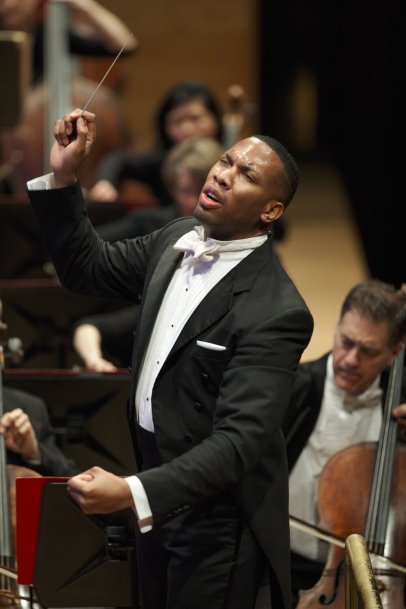 Roderick Cox

