MEMETERIA by Thomas May

Music & the Arts

John Luther Adams and JACK Break New Ground at Tippet Rise

JLA and JACK at Tippet Rise-1

John Luther Adams (center) with the JACk Quartet: John Pickford Richards, Austin Wulliman, Christopher Otto, and Jay Campbell (left to right)
Credit: Zackary Patten 

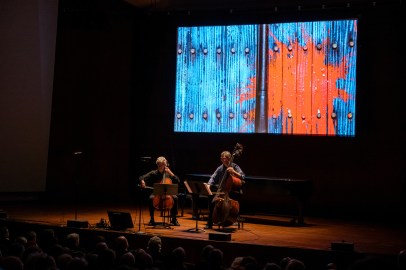
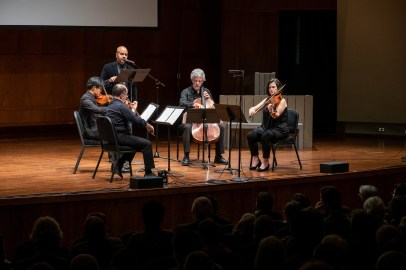
Last weekend, at Tippet Rise Art Center, I got to experience the brilliant JACK Quartet give the world premiere of Lines Made by Walking, the latest string quartet (No. 5) by John Luther Adams (plus a foretaste of his next quartet, whose premiere is already on the horizon in spring 2020).

Thanks to his close working relationship with the JACKs, JLA has become fascinated with the medium, though he waited until age 58 to take it up. He’s now finishing his Sixth and Seventh String Quartets. My review for Musical America:

FISHTAIL, MT — The vast, roiling orchestral soundscape of the Prize-winning Become Ocean has served many listeners as an entrée into the world of John Luther Adams. But he is just as much at home within the intimate dimensions of chamber music…

continue

Filed under: commissions, John Luther Adams, string quartet, Tippet Rise

Xylem: A Place of Refuge

IMG_3466.JPG

Some shots of the new architectural installation and gathering place at Tippet Rise Art Center: Xylem,  by the internationally acclaimed architect Diébédo Francis Kéré.

A delightfully imaginative and welcoming  pavilion designed to invite moments of meditation, pop-up musical performance, and community exchange, Xylem is composed of sustainably harvested pine logs (longe pole and ponderosa).

From the artist’s website:

The logs of the canopy are assembled in circular bundles bore by a modular hexagonal structure in weathering steel, lying on top of seven steel columns. The upper surface of the canopy is carved sinuously in order to create a rounded topography that blends in the surrounding hills. At the same time massive and light, the roof is inspired by the “toguna”, the traditional most sacred space in every Dogon village, a wooden and straw shelter designed in order to protect from the sun but at the same time to allow the ventilation of the shaded space underneath.

IMG_3465.JPG

IMG_3468.JPG


Filed under: architecture, art

Herman Melville at 200

Born Herman Melvill 200 years ago on this day, the writer I have idolized since I first got seriously into literature went largely unrecognized during his own lifetime, apart from his early commercial success.

“There is no knowing Herman Melville,” writes Jill Lepore in her profile in the current issue of The New Yorker. “He needed to write. He wanted to be read. He could not bear to be seen.”

She quotes Melville’s famous metaphor for the creative act:

Taking a book off the brain is akin to the ticklish & dangerous business of taking an old painting off a panel — you have to scrape off the whole brain in order to get at it with due safety — & even then, the painting may not be worth the trouble.

Here’s a motley assortment of reflections on the unknowable, unfathomably fascinating Melville:

–a trove of links and information from the Melville Society

–Melvilliana: Clement C. Moore’s blog on all things Melville

–from Deutsche Welle, a consideration of Melville’s modernity from a European perspective

–on the inspiration of Mount Greylock from his window as Melville wrote Moby-Dick

–And a nod to Melville the poet:

“Art”

In placid hours well-pleased we dream
Of many a brave unbodied scheme.
But form to lend, pulsed life create,
What unlike things must meet and mate:
A flame to melt—a wind to freeze;
Sad patience—joyous energies;
Humility—yet pride and scorn;
Instinct and study; love and hate;
Audacity—reverence. These must mate,
And fuse with Jacob’s mystic heart,
To wrestle with the angel—Art.

Filed under: literature, Melville

Bayreuth’s Free-Willing Tannhäuser

Here are the most perceptive reviews I’ve encountered so far of the controversial new Bayreuth “Venus-goes-to-Burger-King” Tannhäuser that recently opened the 2019 season.

In [Tobias] Kratzer’s rollicking production — intelligent and surprisingly wrenching, though not quite fully formed — the Venusberg is not the libretto’s mythical pleasure realm so much as a lifestyle of young, brash artistry.

Some confusion aside, Mr. Kratzer’s reading of the opera is both novel and clever. … The idea is that our interpretations of Wagner are ever-evolving; that’s why directors are hired for several years, to tweak their productions with each revival.

Joshua Barone in The New York Times

Kratzer and his team simply refused to let themselves by intimidated by tradition, by the overwhelming aura of this historic theater, and by the ever-virulent orthodoxy of the Wagner cult. They instead choose to tell the narrative-romantic saga of the inner human conflict between love and lust, between conformity and rebellion, using sassy, fresh images. And for all their irony, they avoid the trap of playing with it in a way that degrades the work. The opera’s lofty pathos has always provoked parody, but Kratzer does it better: he does it brilliantly.

Christian Wildhagen in Neue Zürcher Zeitung (in German)

The real trick [of Kratzer’s staging] is that the jokes are not all at the expense of the work. Kratzer doesn’t aim to mock Wagner but to humanize his mythically enraptured figures … Most of all, he shows two forms of art clashing with each other. On the one hand, the world of canonical masterpieces … on the other, the sensual, spontaneous world of performance and counterculture. Wagner himself contained both: the anarchic revolutionary who became a classic during his life. Kratzer doesn’t glorify either side in the process. Venus’s subversive gang is shown to be not only violent but also venal and selfish.

Bernhard Neuhoff for BR-Klassik (in German)

A shared observation: despite the excellent cast and stimulating (while problematic) staging (especially in the third act), Valery Gergiev was less than satisfactory in the pit.

And here’s an interview with director Tobias Kratzer from Deutsche Welle:

DW: How do you tell the story of Tannhäuser in 2019?

Tobias Kratzer: For me, the biographical context behind the creation of Wagner’s Tannhäuser is important. If you take that into account, the opera appears more up-to-date and contemporary. Wagner developed his play during a phase in which he didn’t really know where his life was going; whether he’d go down in history as a revolutionary and anarchist, or as a composer. That was a really interesting insight for me.

continue

Filed under: Bayreuth Festival, music news, Wagner

Festival Season, Opera Style

The wonderfully provocative new production of Tannhäuser directed by Tobias Kratzer (responsible for a first-rate Der Zwerg this spring) was streamed live and is currently available from BR-Klassik (configure your VPN as needed); the audio is at the moment available here.

Elsewhere in Bavaria, Barrie Kosky has applied his stage genius to Handel’s Agrippina, with Ivor Bolton conducting. You can watch it on Bayerische Staatsoper TV here (available 29 July-12 August).

There’s lots of information about Salzburg Festival’s new Idomeneo here, including interviews with director Peter Sellars and music director Teodor Currentzis.

Here’s another piece on the season-opening production from ORF’s Kultur Heute program.

At 19:00 EST on 28 July 2019, the concert performance of the complete Die Walküre with the Tanglewood Festival Orchestra, led by Andris Nelsons and taped over two days, will be broadcast via WMNR Radio. Marc Mandel’s program notes here.

For more Mozart, Glyndebourne Festival’s new Barbe & Doucet production of The Magic Flute will be streamed live on Sunday 4 August and remain available for seven days.

Filed under: Bayreuth Festival, Mozart, Salzburg Festival, Wagner

Othello in the Seraglio by Mehmet Ali Sanlıkol

Mehmet Ali Sanlıkol’s Othello in the Seraglio is now streamable on Amazon Prime in the US and the UK.

Mehmet Ali Sanlıkol, a distinguished professor at the New England Conservatory as well as an active musician with the Boston-based ensemble Dünya, has created what he terms a “coffeehouse opera” in which he reimagines Shakespeare’s tragic hero as a former African slave, a powerful but aging Ottoman Eunuch.

He explains: “In addition to a storyteller narrating in English, all characters sing in either Italian or Turkish in the musical idioms of 17th-century Italy and Turkey, accompanied by an on-stage ensemble of early European and Middle Eastern instruments with an unusual combination of percussion instruments.”

Othello in the Seraglio is performed by Dünya (which Sanlıkol also helms) and, since its premiere in Boson in February 2015, has already tallied an impressive record of 20 performances.

The critic Susan Miron compares the result to “opera pasticcio, a Baroque form in which composers like Handel and Vivaldi created substantial theatrical works from both existing and original music.” She explains that the audience is “meant to imagine being in a coffeehouse in Istanbul (then Constantinople) in the 17th century, where an all-male cosmopolitan audience smoked and sipped coffee, ‘a newly fashionable stimulant imported from Yemen.'”

Of his score, Sanlıkol remarks:

There are three distinct layers of music, which may stand alone, interact or merge; borrowed period music (European and Turkish); new music incorporating melodic and harmonic features of the borrowed material; and certain musical instruments and timbres—not period-specific—that highlight dramatic moments. I hoped to achieve a coherent musical statement by balancing these layers within the architecture of the opera. Duets between a Turk and a European even combine music of East and West: the Turkish makam (mode) is used for the Turk, and the European’s music is scored against it following the modal polyphonic practices of early European music.

Here’s an interview with the composer for WBUR Radio from 2015.

More information here.

Filed under: new opera, Shakespeare, Turkish music

Brahms Times 2: Hamelin Displays Mettle And Might

Mard-Andre-Hamelin-performs-Brahms-at-the-Bellingham-Festival-Catherine-Fowler

Marc-André Hamelin performed both Brahms piano concertos at the Bellingham Festival. (Photo: Catherine Fowler)

I spent a lovely day in Bellingham on Sunday. Here’s my review of Marc-André Hamelin’s program of the two Brahms piano concertos at the Bellingham Festival of Music for Classical Voice North America.

BELLINGHAM, Wash. – Rhapsodizing about his summer getaway in the lakeside resort of Pörtschach, Brahms observed that “the melodies fly so thick you must watch out not to step on one.” It’s easy to imagine the composer armed with a melody-catching butterfly net and setting out for a stroll through the idyllic campus in coastal Washington, where the Bellingham Festival of Music takes place over three weeks each July.

continue

Filed under: Brahms, festivals, pianists, review

Intriguing Voyage Out Anchored by 19th-Century Delights in Seattle

sebastian currier

Sebastian Currier

My review of Monday evening’s Summer Chamber Festival concert, which presented the world premiere of Sebastian Currier’s piano quintet Voyage Out, along with music by Fanny Mendelssohn* and Antonín Dvořák:

Under the smart and tastefully reliable artistic direction of the distinguished violinist James Ehnes, the Seattle Chamber Music Society has basically hewed to a longstanding programming formula: an overlooked work by a familiar composer, a piece featuring instrumentation unusual for the chamber format, and a blockbuster or two, typically from the 19th century…

continue

*This observation was cut from my review, but since the event has still left me seething, I want to include it:
As if patriarchal strictures hadn’t suppressed Fanny Mendelssohn’s voice sufficiently during her own lifetime, contemporary technology continued the insult to this wonderfully gifted composer in the form of entitled, inexcusable rudeness: in both the first and second movements, the same audience member had to silence a cell phone’s intrusions (not before the beastly device rang out a full cycle of Westminster chimes as the Adagio was supposed to have ebbed into silence).

Filed under: Antonín Dvořák, commissions, Fanny Mendelssohn, James Ehnes, review, Seattle Chamber Music Society

New Piano Quintet by Sebastian Currier in Seattle

Looking forward to this evening’s world premiere of Voyage Out: Quintet for Piano and Strings by Sebastian Currier — this summer’s Seattle Chamber Music Society commission. Currier will introduce the piece in a talk at 7pm. Also on the 8pm program are Fanny Mendelssohn’s String Quartet in E-flat major and Dvořák’s Op. 87 Piano Quartet.

Above is a fascinating interview with Currier conducted by Frank Oteri in 2012, in which the composer discusses his aesthetic.

Filed under: commissions, Seattle Chamber Music Society

Midpoint of Summer Festival at Seattle Chamber Music Society

The Seattle Chamber Music Society has been on a roll with its SummerFestival lineup this week. I’ve especially enjoyed Emerson String Quartet cellist Paul Watkins in killer Beethoven (Cello Sonata No, 3) and Brahms (C minor Piano Trio, Op. 101, with James Ehnes and Alessio Bax), the piano four-hands version of Ravel’s Ma mère l’Oye with Inon Barnatan and Angela Drăghicescu, and the long-belated U.S. live premiere of George Enescu’s Piano Trio No. 1 from 1897 (thanks to the diligence of Angela Drăghicescu, who was joined by James Ehnes and Ani Aznavoorian to perform it — I have a report on the rediscovery coming out later in Strings magazine). Plus, a delightful account of the “Sunrise” Quartet by Haydn (who’s been all-too-missing from summers past), courtesy of Alexander Kerr, Benjamin Bowman, Beth Gutterman Chu, and Ani Aznavoorian.

Another series of gems has been provided by the tenor Nicholas Phan and colleagues in several chamber song cycles: Fauré’s exquisite La bonne chanson and a cycle Mr. Phan created by interweaving secular love songs by John Blow and Purcell (with Stephen Stubbs and Julie Albers, plus new obbligato violin parts for Alexander Kerr and Benjamin Bowman). The tenor returns this evening for a prelude recital of selections from Schubert’s Schwanengesang (with Inon Barnatan at the keyboard) and, to James Ehnes’s violin, a Vaughan Williams rarity: Along the Field, his cycle of A.E. Housman settings. Also on the program tonight: Hindemith’s Viola Sonata, Op. 11, no. 4, more Enescu — Concert Piece for Viola and Piano — and Beethoven’s Op. 1, no. 1, the Piano Trio No. 1 in E-flat major.

Filed under: chamber music, Seattle Chamber Music Society

Archive

Enter your email address to follow this blog and receive notifications of new posts by email.