MEMETERIA by Thomas May

Music & the Arts

Guest Review: Les Troyens in Paris

Tom Luce contributes the following report on the much-discussed Paris Opera production of Berlioz’s operatic masterpiece as staged by Dmitri Tcherniakov:

The new production at the Opéra Bastille of Berlioz’s great Virgil-inspired account of the Trojan War and Aeneas’s dalliance with Dido the Carthaginian Queen is the fourth the city has seen in the last 30 years. The 1990 production, which was staged by Pierre Luigi Pizi, celebrated the opening of the new Bastille opera house. A fine production by Yannis Kokkos under John Eliot Gardner’s musical direction was given at the Théâtre du Châtelet in 2003. Herbert Warnicke’s Salzburg version was repeated at the Paris Opera in 2006, with Sylvain Cambreling conducting.

The Russian Dmitri Tcherniakov staged this new production, with the company’s music director Philippe Jordan on the podium, which marks the 350th anniversary of the Paris Opera, the 30th of its home at the Bastille, and the 150th of the composer’s death.

The staging has excited controversy and the singing and playing admiration. Tcherniakov gives the work contemporary settings. The first part — the conquest of Troy by the Greeks after the Trojans thought they had won — takes place in a modern, badly war-damaged environment suggesting recent Balkan or Middle Eastern conflicts. This was generally effective and provided a convincing setting for a stunning vocal and dramatic performance by Stéphanie d’Oustrac as the unbelieved prophetess of doom Cassandra (graduating from the part of Ascanius, which she had sung in the John Eliot Gardner performances). Stéphane Degout as her lover Chorebus contributed another outstanding performance amongst a generally fine cast matched by formidable singing and acting from the chorus.

Some features of Tcherniakov’s interpretation were more questionable. King Priam of Troy and his family are shown on a separate corner of the stage in a protected regal environment and introduced one by one in a dumbshow before the real opera begins. A video suggests that Cassandra’s contrarian attitude stems not from a power of prophecy but rebellion against her father the King because he sexually abused her as a child. Aeneas is portrayed as being secretly in league with the attacking Greeks. These notions might be intriguing if found in a fantasising modern playwright’s revisionist interpretation of the Trojan legend, but they have no basis in or consistency with either Virgil’s or Berlioz’s versions. Overall, however, they were not important or obtrusive enough to undermine the power and vividness of Tcherniakov’s presentation of the first two acts of the opera and the conviction with which the performers conveyed it.

Sadly, the same cannot be said of his directorial intrusions into the three Carthage acts. These are not set as Berlioz specified — in Dido’s Royal Park, then a forest, and, finally, the Trojans’ camp near the port from which they leave for Rome — but occur throughout in the communal meeting hall of a “Clinic for the Rehabilitation of Traumatised War Victims.” The cast initially does not take the parts attributed to them by Berlioz but are all either residents or care staff who, in supposedly therapeutic amateur dramatics, act out the roles of Dido, Aeneas, of Carthaginians and Trojans, etc.

All of the scenes are accompanied by normal features of a modern-care clinic — stretching classes and a television set constantly showing up-to-date news programmes which, in the 6 February performance I saw included (fortunately silent) pictures of President Trump delivering the State of the Union address and a headline announcing “Renegotiation du Brexit.” Some of the time there was a ping-pong game.

Of course both Trojans and Carthaginians were refugees from brutal conflicts. Yet so narrowly enclosing Berlioz’s profound and complex vision of their sufferings and heroism could not fail to undermine it. It is hard to see how Iopas’s beautiful song to the fertility of the land or the wonderful quintet “Tout conspire a vaincre mes remords …” — in which Dido shifts from loyalty to the memory of her murdered spouse to love of Aeneas — could possibly be enhanced by such distracting goings-on.

There were also cuts. None of the ballet music in the Carthage acts was performed. We did get the “Combat de Ceste” in the first Troy act but, weirdly for such exuberant music, it accompanied not a celebratory dance by the Trojan wrestling squad but the whole Trojan community in a protracted stance of frozen grief for their dead war heroes.

Leaving out the ballet episodes is not without precedent; to my recollection they were all omitted from the 2006 Wernicke staging. Though superb music, they can admittedly present a staging problem ––for example, the three ballets of sailors, builders, and farmers illustrating Dido’s pride in the achievements of the young Carthaginian state can sometimes rather improbably suggest that she had contracted out the development of its infrastructure to a ballet company. Skillful staging can overcome such risks, as was shown by Patrice Caurier and Moshe Leiser in 1987 for the Lyons Berlioz Festival, which in this and other respects demonstrated how imaginative innovation can refresh and enhance without undermining the composer’s vision.

Still more serious was the omission of the Shakespearian scene in which two Trojan soldiers in the final act moan about being forced to leave their obliging Carthaginian lovers for a tiresome expedition to Italy which they will probably fail to survive. The amateur actors in the care-home would have had fun impersonating them, and, along with the ballet episodes, they illustrate Berlioz’s greater interest in and empathy for the Trojan and Carthaginian communities than can be found in Virgil, who concentrates more on gods and heroes.

Unlike on opening night, when Dmitiri Tcherniakov’s presence during the bows apparently elicited some loud hostility, the performance of 6 February was greeted with great and unadulterated acclaim by its audience. This was deservedly directed at the performers, who collectively gave a very fine account of the opera. In their hugely challenging roles, Ekaterina Semenchuk rose to great heights in Dido’s final scenes and Brandon Jovanovich convincingly delivered the rather brutal vision of Aeneas the staging seemed to demand. There was much excellent quality and scarcely any weakness in the rest of the large cast.

The chorus were rightly greeted with enormous enthusiasm, along with their chorus masters Jose Luis Basso and Alessandro di Stefano. No opera has a more important role for chorus. Their singing was throughout at a level very rarely encountered, as was their acting, for which presumably Tcherniakov and those working with him should be given credit — whatever view is taken of his overall staging concept.

Equal enthusiasm deservedly greeted the splendid orchestra and Philippe Jordan for their thrilling musical rendition of Berlioz’s still-astonishing score.

This is the ninth production of the opera I have been privileged to see. It was a mixed evening, but I am glad not to have missed it.
–Tom Luce

Filed under: Berlioz, reviews

New Concertos by Caroline Shaw and Kinan Azmeh at Seattle Symphony

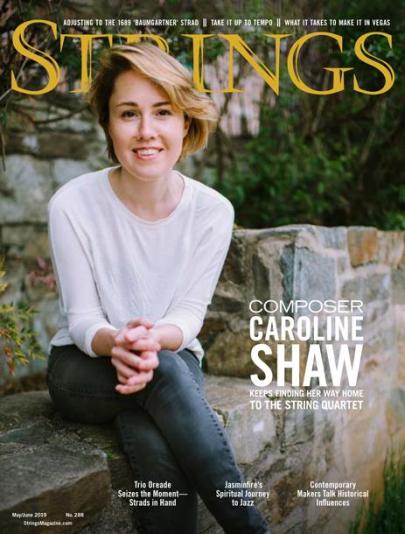
Caroline Shaw

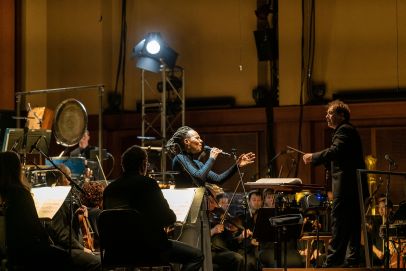
Caroline Shaw, Jonathan Biss, and Ludovic Morlot with Seattle Symphony; photo (c) Brandon Patoc

My coverage of recent world premieres by Caroline Shaw and Kinan Azmeh has now been posted at Musical America.

SEATTLE—As Ludovic Morlot’s final season at the helm of the Seattle Symphony gets closer to the final stretch, his legacy of nurturing new music is coming into sharper relief. The SSO’s last two programs in particular—otherwise so strikingly different in character and mood—each unveiled commissions that took the form of brand-new concertos of genuine distinction: Watermark, Caroline Shaw’s score for pianist Jonathan Biss; and a moving work composed by and for the brilliant clarinetist Kinan Azmeh.

Silk Road Ensemble

Kinan Azmeh with Seattle Symphony and Ludovic Morlot premiering his new Clarinet Concerto; photo (c) Brandon Patoc

continue

Filed under: Caroline Shaw, Kinan Azmeh, Ludovic Morlot, new music, Seattle Symphony, Silk Road Project

Kernis and SSO to the Grammys

This Sunday we’ll find out whether Ludovic Morlot and the Seattle Symphony’s recording of the Violin Concerto by A.J. Kernis with James Ehnes as the soloist wins either (or both) of its two Grammy nominations: for Best Contemporary Classical Composition and Best Classical Instrumental solo. Hard to believe two years have passed since that wonderful premiere. Here’s the review I wrote back then:

In last night’s Seattle Symphony concert led by Ludovic Morlot, James Ehnes introduced a brand-new violin concerto written for him by one of today’s finest composers, Aaron Jay Kernis. This was the U.S. premiere; last week Ehnes gave the world premiere in Toronto (a co-commissioner with SSO).

continue

Filed under: Aaron Jay Kernis, James Ehnes, Ludovic Morlot, Seattle Symphony

Dreamers at Cal Performances

article-header-dreamers

My story on a major upcoming new premiere by Jimmy López in collaboration with Nilo Cruz has been posted here.

Music Makes the Dream Reality:
A New Oratorio Inspired by the Immigrant Experience

It has been a few years since composer Jimmy López and playwright Nilo Cruz first conceived their latest collaboration, the oratorio Dreamers. But the message behind this musical-dramatic reflection on the challenges faced by undocumented immigrants seems to become more pressingly relevant every day. The work, which was commissioned by Cal Performances and receives its highly anticipated world premiere March 17 in Zellerbach Hall, pays homage to the experiences of Berkeley students who were brought to the United States as children and now face uncertain legal status.

continue

Filed under: Cal Performances, Jimmy López, Nilo Cruz

Barbara Hannigan’s New York Conducting Debut

BarbaraHannigan_MusacchioIanniello

Here’s my story for the Julliard Journal on the phenomenal Barbara Hannigan:

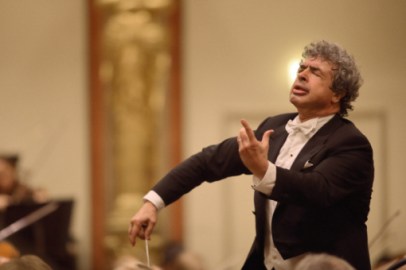
Even as an internationally acclaimed soprano, Barbara Hannigan is unable to resist challenging herself to ever more-formidable accomplishments. In 2011 she made a bold leap to the podium, debuting as a conductor at the Châtelet in Paris with Stravinsky’s Renard.

continue

Filed under: Barbara Hannigan, conductors, Juilliard

Caroline Shaw’s New Piano Concerto Premieres in Seattle

Very excited–especially after getting a foretaste in rehearsal–to hear the world premiere tonight of super-talented Caroline Shaw’s Watermark, her piano concerto for Jonathan Biss.

Check out the video above for the composer in a master class on her own music. And here’s an interview from yesterday with KING-FM’s Dave Beck on Watermark.

Filed under: Caroline Shaw, commissions, pianists, Seattle Symphony

Berkeley Symphony To Premiere Hannah Kendall’s Disillusioned Dreamer

Berkeley Symphony’s upcoming concert on Thursday 31 Jan. includes the world premiere of Hannah Kendall’s Disillusioned Dreamer, inspired by a passage from Ralph Ellison’s Invisible Man. Read my program notes for an introduction to this remarkable young composer’s new work.

Filed under: Berkeley Symphony, commissions, Hannah Kendall

Medusa Muse

img_0813

Filed under: art, photography

Matthias Pintscher Premiere

pintscher

Tomorrow’s program at the Boulez Saal in Berlin brings the world premiere of the new commission Nur by Matthias Pintscher, along with his early work Verzeichnete Spur and Debussy’s Sonata for Flute, Viola, and Harp. Here’s my essay for the program:

The complex phenomena associated with a dialogue—musical, social, intellectual, emotional—inform the core of Matthias Pintscher’s musical thinking, whether in his guise as composer, conductor, or teacher. In an interview with the immunologist Jacques Banchereau on the topic of creative inspiration, Pintscher remarked that “these musical objects start talking and erasing each other or clashing and transforming, and then you start developing the drama, the narrative, the story.”

continue

Filed under: Matthias Pintscher, Pierre Boulez Saal

On the Air! Juilliard’s Focus Festival Salutes Radio Commissions

focusfest_banner

For this year’s Focus Festival at Juilliard, titled On the Air! A Salute to 75 Years of International Radio Commissioning, Joel Sachs has curated six programs sampling this wealth of compositions from an international array of stations.

The opening concert is on 25 January at Juilliard’s Peter Jay Sharp Theater, when Sachs will lead the New Juilliard Ensemble. All six Focus events are free of charge.

Sachs explains what inspired the 2019 Festival:

I unexpectedly realized the role of radio in October 2017, while writing a program note about Argentinean-German composer Mauricio Kagel for a New Juilliard Ensemble concert. Because Kagel settled in Cologne, I began thinking about the extraordinary post-World War II new music scene that flourished there, where he and many other compositional giants, German and foreign, had settled.

Being reasonably acquainted with that Rhineland city and its institutions, I immediately recalled the German letters WDR (Westdeutscher Rundfunk, West German Broadcasting), the radio-TV public broadcast based there. An enormous operation, WDR generally considered the most important broadcaster in German, with five radio transmissions, television, internet broadcasts, and a group of external studios in various cities around Germany’s industrial heartland. Having had a professional relationship with WDR 3, I realized that it has had a vital role as one of the most prominent of European radio stations with its decades-old commissioning program.

Dots began to connect. I had performed or recorded at the BBC, Radio France, Swiss stations in Zurich and Basel, Austrian radio in Salzburg, but what had never struck me was that they all were busily commissioning composers, not just creating background music for radio dramas, but also music intended for live performance in concerts, and not just those composers who produced ‘comfortable’ music. Suddenly I had a topic for Focus 2019: “On the Air! A Salute to 75 Years of International Radio Commissions.”

more on the 2019 Focus Festival at Juilliard: 25 Jan-1 Feb

Filed under: commissions, Juilliard

Archive

Enter your email address to follow this blog and receive notifications of new posts by email.