Ludovic Morlot’s return to Seattle Symphony during the first month of this already profoundly troubled year has been a balm, offering some reassuring proofs of music’s ability to uplift in times of uncertainty and upheaval. Earlier in January, he led members of Seattle Symphony at Seattle Opera in an immersive account of the second part of Les Troyens, the grandest and yet most personal of Berlioz’s masterpieces at Seattle Opera.
Even without full staging, this performance of the “Carthage” part of the epic opera was spellbinding from start to finish. Incredibly, Seattle Symphony’s conductor emeritus insisted on continuing with the engagement despite losing his home and entire musical archive to the recent wildfires in the LA region.
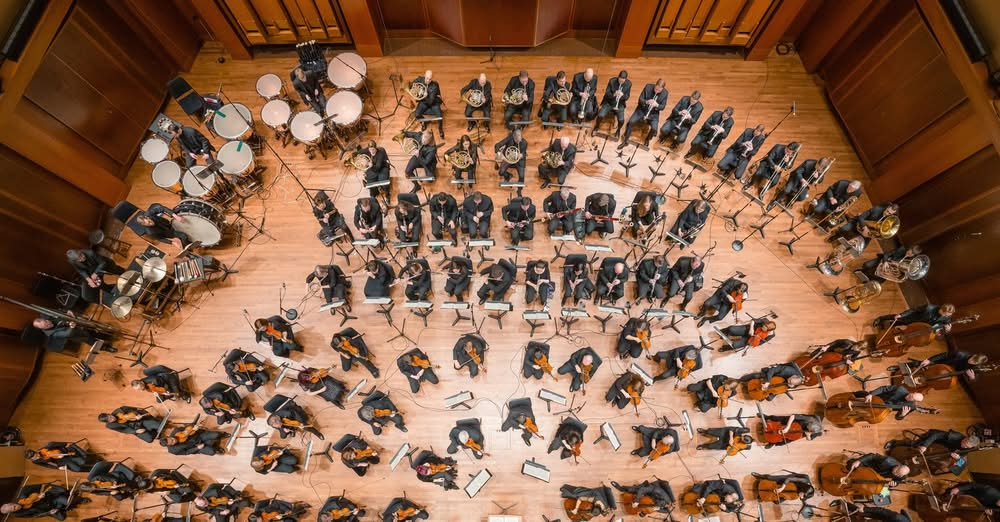
The connection they made with Berlioz’s multi-dimensional score turned out to be the perfect preparation for this weekend’s all-French program back in the concert hall. Fauré’s Suite from Pelléas et Mélisande instantly brought back treasured memories of Morlot’s early years with the orchestra. (They recorded it on their all-Fauré album on Seattle Symphony’s in-house record label in 2014.)
Morlot also reminded us of his commitment to contemporary composers. It’s always a risk-taking venture, but one that during his tenure resulted in some wonderful new music by John Luther Adams, for example. He led pianist Jean-Yves Thibaudet and principal harp Valerie Muzzolini in the world premiere of Hanoï Songs, a duo concerto commissioned from French composer Benjamin Attahir that strives for a Ravelesque combination of fantasy and meticulous clarity.
The best part of the program was the all-Ravel second half. Introduction and Allegro, written as a showpiece for the double-action pedal harp, benefited from Morlot’s gently fluctuating sonic choreography, subtly balancing ensemble and soloist. Muzzolini, now fully in the spotlight, played with luminous charm.
Morlot then led the orchestra in the complete Mother Goose — not just the suite but the expanded ballet score that Ravel fleshed out with connecting material to create a more coherent sense of narrative. It was sheer bliss to experience how deftly Morlot conjured each atmosphere, leaning into exquisite sound colors that were both transparent and intricate while articulating the score’s rhythmic subtleties with grace. The musicians played with rapt attention and obvious enjoyment.
Much more than an endearing string of fairy-tales, Morlot’s MotherGoose conveyed an opera’s worth of emotions, along with a sense of tonal refinement that has deepened and matured. The concluding “Enchanted Garden” at times even radiated an almost “Parsifal”-like serenity that, for some precious minutes, kept the chaos outside at bay.
Seattle Symphony released a bombshell announcement this afternoon:
The Seattle Symphony and Benaroya Hall today announced that Dr. Krishna Thiagarajan, President & CEO, will resign after six and a half years of dedicated service to the organization. His last day will be April 30, 2025.
“It’s been a deeply fulfilling experience to work with all the talented and dedicated people at the Seattle Symphony, Benaroya Hall and its foundation,” stated Dr. Thiagarajan. “Leading the organization through COVID, the rebuilding of audiences and the historic appointment of Xian Zhang as the first female and woman of color Music Director have been some of the highlights of my time here.”
… The Symphony board of directors is forming a search committee to launch an international search for Dr. Thiagarajan’s successor. While the Seattle Symphony begins its search for its next President & CEO, Maria Yang, Chief Development and Project Officer, will serve as Acting CEO to ensure a smooth transition.
Lionel Meunier and his vocal and period instrument ensemble Vox Luminis make their Pacific Northwest debut this weel with a program of sacred music by Claudio Monteverdi. Presented by Cappella Romana, there will be performances in Portland on 6 November and in Seattle on 7 November, both at 7.30pm (St. Mary’s Cathedral in Portland and St. Demetrios Greek Orthodox Church in Seattle); tickets here.
French conductor and baritone Lionel Meunier counts among the most influential figures in today’s historical performance and choral scenes. He founded Vox Luminis (“Voice of light”) in Belgium in 2004, having studied at the Institut Supérieur de Musique et Pédagogie in Namur.
Vox Luminis comprises a core ensemble of vocal soloists specializing in English, Italian, and German repertoire from the 17th and early-18th centuries; depending on the repertoire, they are supplemented with solo instruments, an extensive continuo, or a complete orchestra.
Artist in residence at Concertgebouw Brugge, Vox Luminis has earned international acclaim for its signature sound, with each voice emerging in a solo light while being able to fuse with the others “into one luminous fabric of sound.” The ensemble performs some 70 concerts a year and boasts an award-winning discography.
Meunier has put together a program of sacred music by Monteverdi, mostly from his later collection Selva morale e spirituale (“The Virtuous and Spiritual Forest”), which was published in 1640-41 in Venice. They will also present a couple of motets and the instrumental and vocal versions of the echo motet O bone Jesu o piissime Jesu (“O good Jesus, have mercy on us”).
PROGRAM:
Gloria (SV 258) from Selva morale e spirituale
Dixit Dominus II (SV 264) from Selva morale e spirituale
Beatus vir I (SV 268) from Selva morale e spirituale
O bone Jesu o piissime Jesu (SV 313) (instrumental version)
Adoramus te Christe (SV 289) from Libro primo de motetti, Giulio Bianchi
Cruxifixus (SV 259) from Selva morale e spirituale
Laetaniae della Beata Vergine (SV 204) from Libro secondo de motetti, Giulio Bianchi
O bone Jesu o piissime Jesu (SV 313) (vocal version)
Magnificat I (SV 281) from Selva morale e spirituale
Claudio Monteverdi was born in Cremona, the son of a surgeon and apothecary. Although there is no record of him being a member of the city’s cathedral choir, the young Monteverdi received his first composition lessons from its maestro di cappella Marc’Antonio Ingegneri, whose teachings he acknowledged in his first publications.
Monteverdi was clearly a precocious talent. His first publication, the three-voiced Sacrae cantiunculae (1582), was printed when he was just 15 years old. After attempts to find employment in Verona and Milan, he was eventually appointed as a viol player at the court of Vincenzo I Gonzaga, Duke of Mantua. It was in Mantua that he first began to experiment with the contemporary forms of liturgical music and develop a novel approach that united elements of the musical past and present, while offering glimpses of the future. This balance between tradition and innovation was epitomised in his much-loved Vespro della BeataVergine of 1610. His compositional achievements undoubtedly helped him in 1613, when he advanced to the prestigious post of maestro di cappella at Venice’s Basilica di San Marco, where he would remain until the end of his career.
The majority of the repertoire contained within this programme is drawn from three publications: the Selva morale e spirituale(‘Moral and Spiritual Forest’), published in 1640, and Giulio Bianchi’s two books of motets, both of which were published in 1620. The Selva morale e spirituale was a retrospective anthology that drew together some of his most innovative and successful music from his time in Mantua alongside his more recent Venetian work. It includes a mass, several psalm and Marian hymn settings, as well as two separate Magnificats. Bianchi was a cornettist and composer, who was also born in Cremona and led the wind band at Mantua alongside Monteverdi.
The seven-voiced setting of the Gloria is thought to have originally been part of a large-scale mass written by Monteverdi in 1631 to commemorate the end of the Italian Plague of 1629-31 (also known as the Great Plague of Milan). The plague brought great devastation to northern Italy and is thought to have killed up to 50,000 people in Venice alone. Monteverdi divides the Gloria into five distinct sections, closely following the sense of the text. Over the course of the piece, individual voices and pairs of voices emerge from the main texture with flashes of rapid coloratura, to participate in a compelling musical dialogue with the violins.
Dixit Dominus is the first psalm of the evening office of Vespers on Sundays and feast days. As part of the San Marco liturgy, Vespers services on special occasions saw the uncovering of the Pala d’Oro, the exquisite gold high altar at the far east end of the church. To accompany this, sixteenth-century Venetian composers normally produced lavish eight-voice, double-choir settings of the Dixit Dominus. While this second setting by Monteverdi is scored for eight voices, he does not stick to a rigid division between two ensembles. Instead, he uses the forces in a series of different combinations to depict the psalm’s lucid imagery — for example, using the full ensemble to terrifying effect in the stile concitato (‘agitated style’) section at the words Confregit in die irae suae reges (‘The Lord shall strike through kings in the day of his wrath’), but then suddenly paring back, in complete contrast, to a pair of soprano voices for the beginning of the following verse.
One of Monteverdi’s best-known later sacred works, Beatus vir (his first of two settings of Psalm 111) was actually based on a secular canzonetta Chiome d’oro, which was included in his Seventh Book of Madrigals (1619). In Beatus vir, Monteverdi borrows the charm and naïveté of his earlier work, originally addressed to the beauty of a lover’s physical features, to convey the blissful assurance of the faithful man that fears God and obeys his commandments.
Adoramus te, Christe was included in Bianchi’s first book and is a simple but heartrending setting of a text from the Hours of the Cross in devotional Books of Hours. Its opening statement, ‘We adore you, O Christ’, is tinged with bittersweetness, effected by Monteverdi’s unconventional use of dissonances, but the closing statements of Miserere nobis (‘Have mercy on us’) bring comfort and solace in the ending.
In addition to the simple four-part mass setting published in the Selva morale, Monteverdi also includedsome more modern alternative settings that could be substituted for sections of the mass. This short Crucifixus setting is one such alternative. It is cast in a much more modern style, with its descending chromatic line giving it a distinctly different character to the ordinary of the mass, which remained very consciously within the parameters of the stile antico.
There was a conspicuous increase in expressions of Marian devotion in Venice from 1571, after the city’s victory over the Turkish navy at the Battle of Lepanto, with Pope Pius V attributing the victory to the intervention of the Virgin Mary. As part of this, musical settings of the Litany became popular. Monteverdi’s setting of the Litany of Loreto, the Litaniae della Beata Vergine, was printed in Bianchi’s second book. Between the opening Kyrie eleison and the closing Agnus Dei, the Litany consists of a sequence of invocations addressed to the Trinity and then to Mary, as mother, virgin, saint and queen. The music is relatively simple and it is likely the piece was intended to be sung in procession.
O bone Jesu was actually first printed outside Italy, in a collection entitled Promptuarii musici issued by the German composer Johannes Donfrid in Strasbourg in 1622. A simple setting for two sopranos and continuo of a devotional hymn text, it is an example of the so-called ‘echo motet’, whereby the first voice sings a phrase that is immediately repeated by the second voice, before the pair join together to elaborate and extend the melodic materials. Growing out of a fairly sparse opening, the piece builds cumulatively in intensity, culminating in the final invocation, Salva me (‘save me’).
Following the five psalms at Vespers, the Magnificat featured as the centrepiece of the liturgy, being sung as the altar was censed. This eight-voice setting is the first of two contained within the Selva morale e spirituale.Breaking the text down into a series of standalone sections, Monteverdi explores its vivid imagery in a number of fresh ways. The stile concitato is introduced once again with the words Fecit potentiam in brachio suo (‘He hath showed strength with his arm’). In juxtaposing these modern forms of expression with elements of the musical past, in the shape of short fragments of plainsong and imitative polyphony, Monteverdi demonstrates his unique ability to make the unfamiliar seem somehow familiar. These truly immersive soundworlds must have been utterly entrancing to seventeenth-century ears — but they remain no less captivating to contemporary audiences.
Yulianna Avdeeva‘s Sunday afternoon recital at Benaroya Hall seemed to be timed especially well: The New York Times published a story that day about the unexpected find of a waltz by Chopin. Her refined interpretations of that composer suggested how much remains open to discovery, even in the case of long-familiar pieces.
Avdeeva burst on the scene when, at the age of 25, she took the gold medal in the 2010 Chopin Competition (the first woman since Martha Argerich to have garnered the award). She recently released Chopin: Voyage, an album focused on late works that he composed while surrounded by nature, which the Moscow-born pianist recorded in the idyllic setting of Tippet Rise Art Center in Montana. She performs widely across Europe but still seems to be something of a well-kept secret in the US. On the basis of Sunday’s performance, I certainly hope that changes.
Though for years they lived just a few minutes away from each other by foot in Paris, Chopin and Liszt inhabit such strikingly different worlds that it was fascinating to find them juxtaposed on Avdeeva’s program, with one half devoted to each composer.
She began with Chopin, lingering on the first note as she launched into the Op. 30 Mazurkas, as if preparing to whisk us away from ordinary life. In his 1851 biography of Chopin (likely co-written with his Polish mistress, Princess Carolyne von Sayn-Wittgenstein), Liszt ascribes to Chopin’s mazurkas “the most delicate, tender, and evanescent shades,” evoking impressions that are “purely personal, always individualized and divided.”
Each of the four mazurkas in the Op. 30 set, which Avdeeva played without breaks, indeed seemed to be a separate microcosm rather than another elaboration on a type. Her management of micro-transitions, of the slightest fluctuation of mood, was especially impressive. Even in the more assertive No. 3 in D-flat, an inner melancholy shaded the echoing phrases.
Avdeeva maintained a spirit of improvisation while executing compelling and clearly thought-out ideas about each piece with breathtaking precision.
The Op. 60 Barcarolle in F-sharp major suggested an idealized singer in a state of ecstasy – a melody beyond human reach yet fallible with emotion, as far as could be from mechanical virtuosity.
Avdeeva spun out the sense of mystery and enigmatic wandering that makes the Op. 45 Prelude in C-sharp minor so beguiling, while the Scherzo No. 3 (in the same key) abounded in well-judged contrasts and textural control.
It was above all in the Andante spianato and Grande Polonaise brillante, Op. 22, that Avdeeva revealed new facets. Her Chopin involves such complex, meticulously articulated gradations of weight and light that you realize how much variety lives within a single miniature – not just Schumann’s “cannons buried in flowers” in the case of Op. 22, but an entire epic encompassing heroic adventures and bravely intimate confessions. Rhythmic and dynamic nuances are a special forte with this pianist, who is equally subtle in she staging of rubato and crescendo.
Avdeeva then turned from Chopin’s lyric poetry to the mystical, tormented Romanticism of his far longer-lived peer, Franz Liszt – and showed that she had a great deal to say on that score as well. Her combination of two late-period, avant-garde works from 1885 with the B minor Sonata – all played seamlessly, as if transcribing a single brooding meditation by the robed, solitary Abbé – proved intriguing.
On the one hand, with the Bagatelle sans tonalité and Unstern! – Sinistre, the difference and distance from Chopin could not have been more pronounced. Avdeeva seemed to depict a stark search for threads of meaning amid Liszt’s harmonic vagaries, stalled by abysses of silence. The effect was utterly mesmerizing.
When she arrived at the B minor Sonata, Avdeeva drew on the full arsenal of her stupendous technique to portray an intense psychic drama. The Benaroya Steinway resounded with the most thunderous playing of the afternoon, but Avdeeva also relished Liszt’s celestial harmonies and gossamer ornaments, articulating with a scintillating transparency that recalled Chopin – and what Liszt admired in Chopin’s playing. Her two encores once again confronted the two personalities, offering prismatic accounts of Chopin’s Op. 42 Waltz in A-flat major and the Concert Paraphrase Liszt made from Rigoletto.
Last May, I covered the launch of Fabio Luisi and the Dallas Symphony’s concert presentation of Wagner’s Ring cycle with performances of Das Rheingold and Die Walküre. I returned recently to attend the continuation of their bold adventure with Siegfried and Götterdämmerung. Here’s my report for Classical Voice North America:
DALLAS — Having left Brünnhilde deep in slumber at the end of Die Walküre last May, Fabio Luisi and the Dallas Symphony returned to awaken her this month with their continuation of the Ring in concert at their Meyerson Symphony Center home. They presented Siegfried on Oct. 5 and Götterdämmerung on Oct. 8, thereby scaling an Everest normally considered the domain of opera companies. Between Oct. 13 and 20, the adventure will be repeated — this time with the usual interval of just a few days separating the four operas.
Seattle Symphony violinist Elisa Barston (l) and soprano Ellaina Lewis (r), featured soloists in Philharmonia Northwest’s inaugural concert of the season
Seattle-based Philharmonia Northwest opens its season — and introduces its new music director, Michael Wheatley — on Sunday 13 October with a program titled Origin Story. The concert takes place at 2pm at the Shorecrest Performing Arts Center.
Wheatley has chosen four works central to his musical identity, beginning with Wojciech Kilar’s celebration of the folk traditions of Poland’s Tatra Mountains in Orawa. Seattle Symphony violinist Elisa Barston will be the soloist in Dvořák’s Romance in F minor and Ravel’s dazzling Tzigane.
The second half of the program will present soprano Ellaina Lewis in her Philharmonia Northwest debut as the soloist in Mahler’s Symphony No. 4, the last of the so-called Wunderhorn symphonies. Lewis, who is known locally for her appearances in Seattle Opera’s Blue and Porgy and Bess.
Following the concert, Michael Wheatley will appear in a Q&A talk-back with the audience.




 MEMETERIA by Thomas May