

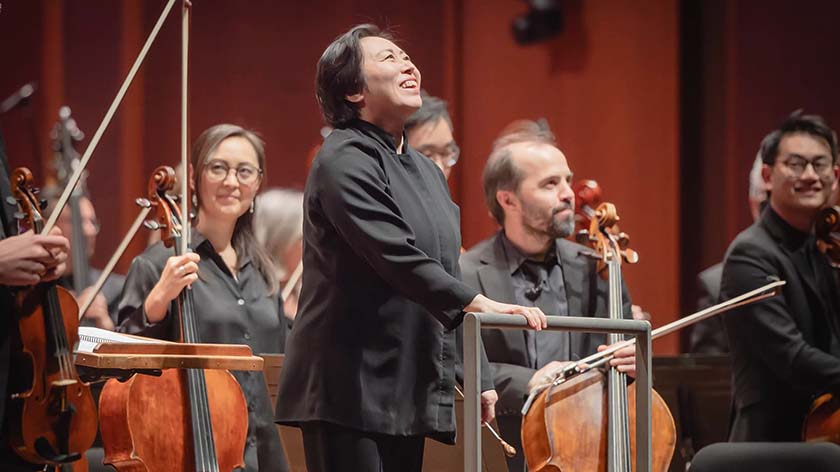
Seattle Symphony has just announced its 2026–27 season, the second under music director Xian Zhang.
She describes the year as shaped by “two sources of inspiration… nature and community,” invoking Seattle as “a city embraced by mountains, water and forests.” The rhetoric frames a three-week spring festival devoted to “monumental works” inspired by landscape.
Beyond that framing, the season’s center of gravity lies in the late-Romantic and early 20th-century canon: Strauss, Tchaikovsky, Rimsky-Korsakov, Brahms, Wagner, Shostakovich and Mahler dominate the symphonic offerings, with Yuja Wang opening the season in Prokofiev’s Third Piano Concerto and appearances by Emanuel Ax, Gil Shaham, and Itzhak Perlman reinforcing a roster built on established appeal.
Zhang herself will lead twelve programs in all – including Tchaikovsky’s less frequently heard Manfred Symphony – and has cited Seattle artist Dale Chihuly as an influence on the season’s visual identity, another signal of her effort to root the orchestra’s presentation in local culture.
As for contemporary composers, the season includes co-commissions from Joe Pereira (a new concerto for timpani) and Steven Mackey – the latter now a recurring presence in the Symphony’s programming – alongside Samuel Adams, whose No Such Spring receives its Seattle premiere under Ludovic Morlot this fall, with soloist Conor Hanick. I’m especially interested to hear it in Benaroya Hall. Having studied the score around its world premiere by the San Francisco Symphony a few years ago, I know it’s a piece of real substance.
Adams’s presence extends into the Octave 9 series, where Conor Hanick joins percussionist Mari Yoshinaga and a quartet of Symphony musicians for Etudes and Devotions, featuring Adams’s Etudes for Piano and the U.S. premiere of his Devotions for String Quartet and Percussion.
The Elwha River project – a collaboration between flutist Claire Chase and composer Annea Lockwood inspired by the restoration of the Olympic Peninsula river – will be featured in April and stands out immediately to me as one of the season’s most compelling offerings. Adam Tendler’s Inheritances, built from commissions by Laurie Anderson, Missy Mazzoli, Nico Muhly, Pamela Z, Sarah Kirkland Snider and Devonté Hynes, also looks promising, and a centenary homage to György Kurtág is most welcome. (Why I’ve listed these in reverse chronological order is anyone’s guess.)
The series ranges further, from Pamela Z’s solo work for voice and electronics to a closing appearance by the Brandee Younger Trio (harp, bass, and drums).
The “community” emphasis also extends beyond the stage. The Symphony is set to reopen Benaroya Hall’s renovated public spaces at the start of the season, marking the completion of its Amplify capital campaign. The upgrades – new gathering areas, expanded concessions, and reconfigured lobby spaces — underscore an effort to position the hall as more than a performance venue at the outset of Zhang’s second year.
Music Director Xian Zhang and the Symphonic Series
- Xian and James Ehnes (September 24, 26 & 27), featuring Bruch’s Violin Concerto No. 1 and Berlioz’s Symphonie fantastique.
- Tchaikovsky’s First Piano Concerto and Zarathustra (November 12, 14 & 15), pairing Tchaikovsky’s Piano Concerto No. 1 with Strauss’ Also sprach Zarathustra.
- Mozart’s Requiem with Xian (November 19, 21 & 22), presenting a Seattle Symphony co-commission and World Premiere of Joe Pereira’s Timpani Concerto, followed by Mozart’s Requiem with the Seattle Symphony Chorale.
- Xian and Emanuel Ax (January 28 & 30), featuring Haydn symphonies and Mozart favorites, including his Piano Concerto No. 25.
- Tchaikovsky’s Manfred with Xian (February 4, 6 & 7), with saxophonist Steven Banks performing a work by Ibert and his own composition, Come As You Are.
- Xian Conducts the Sounds of Spain (February 11 & 13), spotlighting Lalo, Ginastera and Rimsky-Korsakov while featuring Concertmaster Noah Geller.
- Xian Conducts Scheherazade (March 11 & 13), featuring Smetana’s The Moldau, Steven Mackey’s Concerto for Orchestra (a Seattle Symphony Co-commission and World Premiere) and Rimsky-Korsakov’s Scheherazade.
- Grieg’s Peer Gynt with Xian (April 8 & 10), with music by Vaughan Williams, Webern, Scriabin and Grieg, and featuring Associate Concertmaster Helen Kim.
- Beethoven’s Pastoral and Gil Shaham (April 15, 17 & 18), pairing Beethoven’s Symphony No. 6 with Dvořák’s Violin Concerto.
- Pines & Fountains of Rome with Xian (April 22, 24 & 25), featuring Gabriela Montero’s Piano Concerto No. 1, “Latin” and Respighi’s Roman tone poems.
- Xian Conducts Brahms (June 17, 18 & 20), encompassing Brahms’ Symphony No. 3 and his Violin Concerto.
- Wagner’s The Ring Without Words (June 24 & 26), closing the season with Liszt’s Piano Concerto No. 2 and Wagner’s purely symphonic Ring cycle.
Filed under: music news, Seattle Symphony, Xian Zhang, classical-music, composer, music, new music, orchestra


 MEMETERIA by Thomas May