MEMETERIA by Thomas May

Music & the Arts

Bernstein’s Chamber Music

Leonard Bernstein in 1944; photo by Carl van Vechten

Leonard Bernstein in 1944; photo by Carl van Vechten

The “curse” of being Leonard Bernstein — of having to cope with too many talents and corresponding passions within a 24-hour day — is usually talked about as too-muchness on the macro level: Lenny the composer, say, becoming frustrated by the energy he had to siphon off into conducting gigs, ditto for Lenny the pianist, Lenny the teacher, etc.

Sometimes what’s shuffled into the Lenny-the-composer persona is broken down into the rubrics of “classical” versus Broadway undertakings. But it’s remarkable how many subcategories can be teased out here. For instance: chamber music.

While recently working on a piece about some of the early chamber works, I realized these comprise an entire subset of their own of unfulfilled potential, since, for the most part – and for obvious practical reasons – Bernstein pretty much abandoned writing chamber music despite the incredible promise shown by some of his earliest pieces.

His Sonata for Clarinet and Piano from 1941-42, which after all he chose as his first officially published composition, has become a mainstay in that sparse repertory. And with good reason. Here’s the second movement:

There’s a lone Sonata for Violin and Piano, from 1939, the year Bernstein graduated from Harvard – though the Sonata for Clarinet has also been reworked as a violin sonata. Written for a young Raphael Hillyer (future co-founder of the Juilliard Quartet), this piece also demonstrates Bernstein’s flair for abstract chamber writing, but he also made use of some of the ideas here in the ballet score Facsimile and the Age of Anxiety Symphony.

An even earlier treasure is the Piano Trio from 1937, also a product of his undergraduate years at Harvard. Already Bernstein shows his natural gift for absorbing a multitude of influences and turning them into something fresh. Notice the intriguing inclusion of then-fashionable Neoclassicism alongside the blues touch of the middle movement (later recycled as the tune “Gabey’s Comin'” in On the Town).

“I have a suspicion that every work I write, for whatever medium, is really theatre music in some way” — L. Bernstein in his prefatory note to his Symphony No. 2 (The Age of Anxiety).

Filed under: American music, Bernstein

Are American Orchestras Undermining Their Mission?

Orchestras
In a substantial and thought-provoking article in The New Republic, Philip Kennicott grapples with the issue of American distrust of “cultural authority” and how it affects the identity crisis suffered by today’s orchestras.

“The problems are financial and cultural, and the two are intertwined,” he observes. This year’s Pulitzer Prize winner for criticism, Kennicott compares the self-questioning undergone by American orchestras to a “protracted and painful Vatican II,” while the failure of the traditional subscription model has put orchestras in the same sinking boat as newspapers in the Internet era. As a last-ditch survival effort, orchestras have been forced to create a new paradigm based on audience segmentation, performing not just classical concerts but presenting a smorgasbord of watered-down “special events.”

But the most paradoxical and distressing result is the utterly generic quality of what most American orchestras now offer. By parsing audience taste to smaller fractions, the concert schedule in Oklahoma looks more and more like the concert schedule in Maine. At the League conference, the mantra was all “local, local, local”—that orchestras will survive only by catering in nuanced ways to their local constituents (not to audiences or listeners or music lovers, who are all passé). But a tendency toward groupthink across the field has led to the repetition of the same solutions, few of them successful or in any way particularly local.

Read the whole thing here.

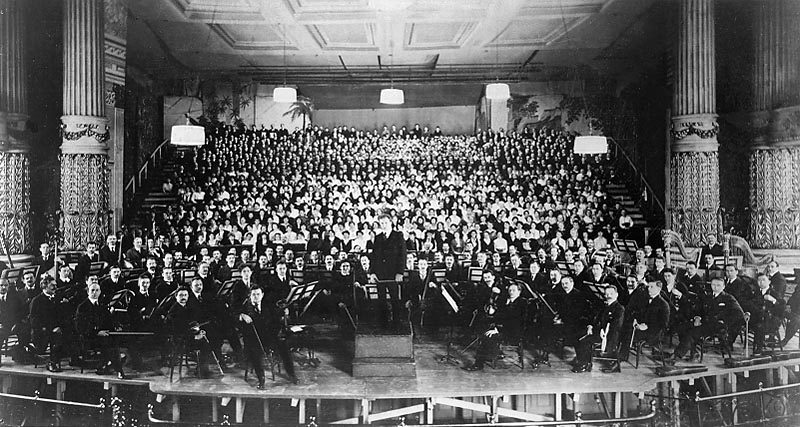
(Above: American premiere of Mahler’s Eighth in 1916, with Leopold Stokowski conducting the Philadelphia Orchestra)

Filed under: American music, orchestras,

Remembering Lenny

Leonard_Bernstein_1971
Lenny in 1971, when he was rehearsing his new work Mass to open the Kennedy Center

So today Leonard Bernstein would have turned 95 [97]. If he were Elliott Carter, he’d still have about nine [seven] years left to share his genius with us — and Lord knows the world could desperately use it. I can still feel a pang when I pass by the Dakota on Central Park West; strangely, that Sunday afternoon in October when he died there doesn’t seem so far off.

I got to meet him just once, near the end of his life, when he was touring with the Vienna Philharmonic, conducting a program of Mahler Five paired with the Mozart Clarinet Concerto. I waited patiently afterward to get him to sign the book I happened to have on me — the first volume of Ernst Bloch’s Das Prinzip Hoffnung, which immediately prompted him to set aside his bottomless glass of Ballantine’s scotch and exclaim incredulously, “That’s my favorite book! Do you realize Bloch is the perfect book to go with Mahler?! Unbelievable!” And then he took another deep drag on his endless chain of L&M cigarettes.

Whenever I used to hear about folks who first fell in love with music thanks to the inspiration they found in Leonard Bernstein’s famous Young People’s Concerts, their accounts simultaneously intrigued me and left me feeling a touch jealous. The heyday of the series was before my time, so I never ended up seeing any of them until years later, when they became available on DVD. I can’t help but imagine how much these would have changed my life, too, if I’d had the opportunity to discover them when I was growing up.

Actually, I do have another gift from Lenny for which I remain eternally grateful. I can vividly recall chancing upon some PBS re-broadcast of his legendary Norton Lectures, first delivered at Harvard in the early 1970s and drawing on Noam Chomsky’s linguistic theory of transformational grammar, just around the time music was starting to become a force in my life.

Instantly I was hooked. To judge by what I can still remember from that first viewing — even taking into account the “creative reconstruction” that’s inherent to the process of memory — this encounter was remarkably formative. It didn’t just serve as my first crash course in music history and theory, in how to listen beyond the surface and look for structures and connections, but it even imparted a whole philosophy about music and its capacity to mean, to be at least as significant as everything else I cherished — maybe even more.

“I also believe, along with Keats, that the poetry of earth is never dead,” I remember Lenny declaring in his credo, “as long as spring succeeds winter, and man is there to perceive it.” The way he imparted these observations, as if they were a confidence shared with his prized students, was a perfect example of yet another gift of this impossibly gifted, complicated, multi-layered man — Bernstein as the great teacher and rabbi. He ended with this summing-up:

I believe that our deepest affective responses to these languages are innate ones that do not preclude additional responses that are conditioned or learned. And that all particular languages bear on one another, and combine into always new idioms perceptible to human beings, and that ultimately these idioms can all merge into a speech universal enough to be accessible to all mankind. And that the expressive distinctions among these idioms depend ultimately on the dignity and passion of the individual creative voice.

And finally, I believe that all these things are true, and that Ives’ “Unanswered Question” has an answer. I’m no longer quite sure what the question is, but I do know the answer, and the answer is, “Yes.”

Lenny the polymath: here he conducts and plays solo in one of the most exquisite scores I know, Ravel’s Piano Concerto in G.

Filed under: American music, Bernstein, composers

America’s Shape-Note Tradition Remade

Image

Will Robin traces the remarkable impact of the rediscovery of shape-note customs by American composers in the 1930s and also points to how today’s young generation of composers — Sam Amidon, Sufjan Stevens, Gabriel Kahane, Matt Marks, and David T. Little — is adding their own perspective to this legacy:

Today’s young musicians don’t seem particularly interested in the Billings strain or the patriotic fervor of the Yankee tunesmiths and the Bicentennial that renewed them. They are, instead, children of the 1970s revivalists… In absorbing the style and sound of Sacred Harp as sung today, [this] generation recasts a vibrant tradition for a new audience, pointing towards a true style for the 21st century.

Filed under: American music

Archive

Enter your email address to follow this blog and receive notifications of new posts by email.