MEMETERIA by Thomas May

Music & the Arts

A New East-West Polyphony

Condcutor Fawzi Haimor

Conductor Fawzi Haimor; photo by Kelly Newport

The Summer 2015 edition of SYMPHONY (the quarterly magazine published by the League of American Orchestras) was timed to be available for the League’s annual conference (which just took place in Cleveland). The contents have now been published online as well.

This issue of SYMPHONY contains my feature on composers who are drawing on their Arabic, Turkish, and Iranian roots to enrich America’s orchestral life.

Along with the much-in-demand Mohammed Fairouz — who has even been featured on MSNB’s Morning Joe (click here: http://www.msnbc.com/morning-joe/watch/composer-and-journalist-team-up-for-opera-447080003746) — I discuss the contributions of such composers and/or performers as Fawzi Haimor, Mariam Adam, Mehmet Ali Sanlıkol, Kinan Azmeh, Kareem Roustom, Karim Al-Zand, Malek Jandali, and Reza Vali.

There are many more: this is only the start of a conversation about an exciting phenomenon. You can read my story here (in pdf format):

A New East-West Polyphony-Summer 2015

The entire Summer 2015 issue of SYMPHONY is available here.

Filed under: American music, essay, League of American Orchestras, Mohammed Fairouz, programming, symphonies

New Music from Bryce Dessner

Getting commissioned to write a percussion piece to be paired with your mentor David Lang’s the so-called laws of nature is a pretty impressive vote of confidence. And the result was Bryce Dessner‘s enchanting Music for Woods and Strings  (2013), commissioned by Carnegie Hall.

This piece has just been released on Sō Percussion’s new album. Dessner, also known as the guitarist for The National, describes the “chord stick” process he devised for the work: “Using sticks or violin bows, the players can sound either of two harmonies, or play individual strings, melodies, and drone tremolos.” This “hybrid dulcimer” sound, which he likens to “chord hockets,” shows the inspiration of American folk song tradition in its warmly layered rhythmic counterpoint.

The Los Angeles Philharmonic will premiere Dessner’s latest piece, Quilting, as part of the Next on Grand Festival of contemporary American composers, which has just gotten under way (with John Adams to lead a program on Tuesday.

A couple years ago, Dessner compiled a list of his own favorite contemporary works for BoingBoing, including both Adams’s Shaker Loops and John Luther Adams’s For Lou Harrison. I approve the man’s taste.

Filed under: American music, Bryce Dessner, David Lang, John Adams, John Luther Adams, Los Angeles Philharmonic, new music

Trimpin the Light Fantastic

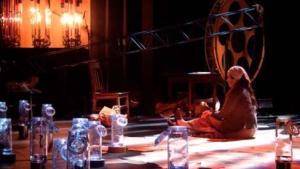
Trimpin's Gurs Zyklus; photo courtesy Nic Dahlquist, Stanford Lively Arts

Trimpin’s Gurs Zyklus; photo courtesy Nic Dahlquist, Stanford Lively Arts

I’m unable to attend this week’s world premiere of Trimpin’s latest project, Above, Below, and In Between, a commission from the Seattle Symphony and Ludovic Morlot.

But to mark the occasion, here’s a feature I wrote a few years ago in conjunction with the Seattle premiere of Trimpin’s Gurs Zyklus at On the Boards:

Contemporary composers are so routinely described as “crossing barriers” and “defying genres” that these tags have become meaningless clichés. But Trimpin genuinely resists categorization.

The familiar labels aren’t much help in trying to define his unusual career. Based in Seattle for over three decades, the German-born Trimpin follows a path that zigzags wildly, unbound by conventional parameters. He’s a kinetic sculptor working with sound, an installation artist, an inventor, an instrument builder who combines the insatiable curiosity of artist and scientist alike with the old-fashioned know-how of a craftsman.

Trimpin’s work can be encountered in museums (the tornado of guitars at EMP), in natural environments, and even in venues like Terminal A in Sea-Tac Airport, where travelers unwittingly activate his 80-foot-long kinetic sculpture of gadgets and instruments as they pass alongside on a rolling walkway. But his latest big project breaks new ground even for Trimpin. Receiving its Seattle premiere this Thursday through Sunday at On the Boards, The Gurs Zyklus is as unclassifiable as the MacArthur “genius” award-winning artist himself.

The Gurs Zyklus places his vision as a composer, inventor, and builder within the context of music theater. Originally commissioned by Stanford University’s Lively Arts program and given its world premiere there last May, the work has been reconfigured as a site-specific work for On the Boards. “It’s being presented as a three-sided staging and will feel very intimate in our main stage theater space,” says artistic director Lane Czaplinski. “You feel you’re inside the work, as in a sculpture, as opposed to on the outside watching.”

The production marks the first time since the early 1990s that On the Boards has hosted the work of Trimpin and of Obie Award-winning director Rinde Eckert, who is collaborating on the theatrical conception of The Gurs Zyklus. It’s an especially good fit, Czaplinski adds, since it represents “that in-between category which is the future of opera and music theater. People don’t yet know quite how to talk about it, but this is what we do at On the Boards.”

The creative process underlying the work, Trimpin explains, was fueled by a desire to transform the inert facts of history and information into “other forms of expression: notation, music, sound sculpture design, and performance.” It also represents the artist’s attempt to come to terms with memories that have haunted him since his childhood in a small town in southwestern Germany, where Gerhard Trimpin was born in 1951. (Long ago he officially lopped off his first name.) He recalls chancing upon an overgrown Jewish cemetery as a youngster and becoming intrigued by the Hebrew inscriptions on the headstones,” which he thought resembled “mysterious hieroglyphs.”

But the fate of the Jewish population was a taboo topic in those early postwar years. Eventually Trimpin learned that in October 1940 the Nazis had rounded up all of the town’s Jews and sent them by train to the internment camp of Gurs. Located to the southwest, in the French Pyrenees close to the Spanish border, Gurs was run by the collaborative Vichy government but had been operating since the 1930s, when the French first used it to control the influx of refugees from Franco’s forces in the Spanish Civil War.

A profile of Trimpin by Jean Strouse called “Perpetual Motion” in the New Yorker in May 2006 caught the attention of Victor Rosenberg. His mother had come from the same hometown (Efringen-Kirchen ) and his uncle was interned at Gurs. Rosenberg contacted Trimpin, offering to let him access to a shoebox full of letters mailed from the camp to his father. This became the trigger for The Gurs Zyklus, which, says Trimpin, “is about the challenge of learning, deciphering, investigating, wanting to know more about what is happening.”

Other remarkable connections from Trimpin’s own experience began to illuminate the past. In the late 1980s he had become friends with fellow maverick composer Conlon Nancarrow, for example, but only later learned that Nancarrow himself had spent time as a prisoner at Gurs in its earlier phase, after fighting with the Abraham Lincoln Brigade against Franco’s Fascists. Trimpin decided to retrace the journey from his hometown to Gurs, recording the sounds of the train and the announcements at each stop. And as he was developing The Gurs Zyklus during a year-long residency at Stanford, by chance he encountered a local resident who had been sent to Gurs as a young boy.

All of these links to Gurs became strands of the work, which blends aspects of opera, oratorio, staged installation, and memory play. Its musical and symbolic elements range widely. Clicking castanets mimic a message being sent in Morse code as Spanish Fascists order the assassination of Federico García Lorca. This reference to the struggle in which Nancarrow took part — the score also incorporates his music — ominously foreshadows the darkness descending over Europe. Trimpin’s script and sequence of visual imagery draws from the Rosenberg letters. Along with their despairing reports of everyday conditions, the letters express a poignant hope for release from the camp.

The raw material gathered from his own trip to Gurs — the sounds of the train trip, the innocuous-sounding roll call of place names — provides the “information” that becomes transformed into a powerfully resonant narrative. Even the patterns on tree bark samples taken from Gurs are translated into musical notation, giving voice at last to these silent “witnesses” of what took place. Trimpin also uses instruments he has invented for other pieces, such as the “Fire Organ” — a contraption of glass tubes and Bunsen burners that emits sounds with a texture uncannily similar to the human voice. While interacting with his students at Stanford, Trimpin designed other mechanical elements specifically for The Gurs Zyklus, constructing the most intricate components in his three-storey studio in Madrona.

All of Trimpin’s projects share this one-of-a-kind aura. Yet while much of his work evokes a sense of delighted whimsy with the sheer bravura of its invention — a “Dr. Seuss,” as Czaplinski puts it —The Gurs Zyklus explores a dark past, pushing beyond the expressive limits of conventional instruments and easily digested narrative chronology. The essence of its dramaturgy lies in the metaphorical combinations of sound and visual images, of isolated memories that turn out to be interconnected. Site-specific acoustical perceptions are also integral to the piece. “These are events that don’t make sense at first,” Trimpin remarks. How to decipher them “is then up to the individual. The audience’s understanding comes from their own interpretation of what they have just experienced.”

(c) 2015 Thomas May. All rights reserved.

Filed under: American music, new music, Seattle Symphony

Zabur

Mohammed Fairouz; photo by Samantha West

Mohammed Fairouz; photo by Samantha West

A notable premiere by composer Mohammed Fairouz is being given tonight by the Indianapolis Symphony: Zabur, to a libretto by Najla Said.

From Scott Shoger’s interview with the composer about this contemporary war requiem:

Fairouz:

Zabur is the most persistently and overwhelmingly dark pieces that I’ve ever written, although it doesn’t end in that darkness. It ends in a wonderful image of children in the sunlight like the end of Mahler’s Kindertotenlieder. Sometimes as an artist, part of the job description is to go into psychological and emotional places that the rest of the world would avoid.

[…]

Zabur begins with a great outcry and destruction that proves to be a flash-forward or premonition of what will happen — that everyone in the shelter will be destroyed. I was debating with myself how to end the piece, but I decided to bring back the children’s choir to sing, “The children of your servants will live on forever.” It’s an absolutely heartbreaking ending, but with the sound of the children, you have this group of 100-some children in Indianapolis connecting artistically, in some way, to their brothers and sisters half a world away in Syria who are suffering. There’s something very moving about that.

Filed under: American music, new music

Where the Weeping Willows Wave

Wonderful program over the weekend from Pacific MusicWorks: “An American Tune,” which was aimed at recapturing the sound of vernacular American music — through songs and instrumental pieces — from the nineteenth century.

The program was beautifully curated and beautifully, at times movingly, executed. For this occasion Stephen Stubbs exchanged his lute for a couple guitars. The recent Grammy Award-winner and artistic director of PMW conceived the program for a chamber-size group of colleagues. Stubbs was joined by Tom Berghan on banjo (Berghan was a lute duet partner from Stubbs’ early days in Seattle), mandolinist John Reischman of the Jaybirds, violinists Tekla Cunningham and Brandon Vance, and soprano Catherine (Cassie) Webster.

As a model, Stubbs decided to apply the ideas and practical skills of the “historically informed performance practice” movement, to which he’s devoted his career, to the wealth of musical traditions that were hybridized and became popular in America of the nineteenth century: the American of the expanding frontier, of the Civil War, of the parlor and the fairground.

Stubbs remarks that the skills of the early music movement evolved “to cope with filling in the blanks where notational records were incomplete and the aural traditions broken or hopelessly confused” — ergo, he realized, these skills “were the very ones that had a chance of penetrating the original spirit and sound of the vast panorama of ‘lost’ American music.”

And vast it is. For this program, instead of looking to European institutional models like the orchestra or other fixed ensembles — which many “classical” American music programs attempt to do — the idea was to focus on the following areas: the popular song model established by Stephen Foster, a gathering of songs associated with the Lincoln years, music of the frontier from the era of westward expansion, and American folk song in the specific form of the murder ballad subgenre. These sets were interspersed with instrumental numbers exemplifying the American folk fiddling tradition characteristic of Appalachia.

Stubbs et al. performed to a capacity audience in the Nordstrom Recital Hall at Benaroya (while the second program of the Sibelius Festival, acoustically secure and sealed off, was at the same time booming under Thomas Dausgaard’s baton in the big hall below). In place of the sentimental tinge of nostalgia that a familiar tune like “My Old Kentucky Home” usually evokes, it was intriguing to hear this in the context of lesser-known vocals and instrumentals. Webster’s soulful phrasing and timbre made it easy to fill out a throughline connecting singing styles of the era and popular idioms today. The quintet of plucked and bowed strings added a wealth of colors and expressive nuances.

Notoriously, Foster also wrote for black-face minstrel shows, represented here by the songs “Nelly Bly” and “Angelina Baker.” “This … unsettling phenomenon,” notes Stubbs “…was too pervasive to ignore. To take only the positive side into account, it was a vehicle for the influence of African music, dance, and instruments (particularly the banjo) to put down widespread and permanent roots in our musical culture.”

Richard Millburn’s “Listen to the Mockingbird,” we learned, was held in high regard by Lincoln. It’s a wistful song of a beloved who has died young: the mockingbird sings over her grave, is “still singing where the weeping willows wave.” The synergy between the ensemble and Webster reached fever pitch in the lengthy cowboy song “The Buffalo Skinners.” They also gave a haunting account of the murder ballad “Two Sisters/The Wind and the Rain” (a tune which left its mark on Bob Dylan’s “Percy’s Song”).

In preparing the four-part setting for violins and guitar of the Mormon hymn “Come, Come, Ye Saints,” “with the banjo taking an ornamental approach to the melody,” Stubbs writes that they experienced an “aha moment”:

The connection to the early seventeenth century sound of the English “broken consort” was immediate and unmistakable. In the earlier context, plucked and bowed strings provide the harmonic framework while the solo lute decorates the melody — this is the earliest form of specifically orchestrated music in the European tradition, and here it is again in a hymn from Utah!

(c)2015 Thomas May. All rights reserved.

Filed under: American music, early music, review, Stephen Stubbs

A Birthday Cheer for John Corigliano

Photo by Enid Bloch

Photo by Enid Bloch

February is the birth month of another of America’s greatest composers: today marks the 77th birthday of John Corigliano. A brilliant creative force, Mr. Corigliano has earned acclaim as a master of emotionally complex chamber and orchestral music as well as artful film scores, while his grand opera The Ghosts of Versailles helped pave the way toward the blossoming of new American opera over the last quarter-century.

Los Angeles Opera’s splendid new production of Ghosts, which is bringing this masterpiece to the West Coast for the first time, led the LA Times to suggest that the opera may have “a shot at immortality.”

As if his marvelous catalogue of compositions weren’t enough, Mr. Corigliano has garnered such accolades as the Pulitzer Prize, Grawemeyer Award, five Grammies, and an Oscar.

And he’s obviously a gifted and influential teacher and mentor, as evidenced by the success of such students as Mason Bates and Wlad Marhulets, whose debut opera The Property is about to be given its premiere in Chicago.

Yo-Yo Ma speaks for many of us who care deeply about the arts in our troubled times when he says: “I feel lucky that John and I are living in the same era.”

Filed under: American music, anniversary, John Corigliano

Another Birthday Salute: John Adams at 68

john-adams

A toast to John Adams, who needs no introduction. Today, as Mr. Adams turns 68, he continues to astonish with his inexhaustible creative drive.

Just last month the St. Lawrence String Quartet unveiled his Second Quartet at Stanford University. At the Grammies the St. Louis Symphony and David Robertson’s recording of City Noir and the Saxophone Concerto nabbed the award for Best Orchestral Performance. And next month brings the world premiere of Scheherazade.2, a “dramatic symphony for violin and orchestra.”

This very weekend, Opera Omaha is presenting a new production of his 2006 opera A Flowering Tree directed by James Darrah and conducted by Christopher Rountree.

Composed by John Adams, “A Flowering Tree” made its debut in 2006 and is still relatively unfamiliar to opera lovers. It has its roots in a 2,000-year-old Tamil Indian folk tale and is decidedly dark…
Although this all might seem narratively challenging to communicate in just a little over two hours, James Darrah delivered a mesmerizing production.

–Kim Carpenter, Omaha.com

The works Mr. Adams has given us since my anthology was published nearly a decade ago show this American master working at a sustained peak of creative power. Here’s to many more years to come!

Filed under: American music, anniversary, John Adams

Going Organic

Hurricane_Mama

The other night it was lovely being reminded of how Hurricane Mama, Disney Concert Hall’s fabulous organ, holds court even when that gorgeous monster’s not being played. So I wanted to share this article on the resurgence of the organ in the concert hall, which included a focus on Paul Jacobs and Cameron Carpenter. I published this piece back in the spring of 2012 in Symphony magazine:

Going Organic: The King of Instruments Makes a Comeback in the Concert Hall

Blame it on Stravinsky. Explaining why he opted against using the organ in his Symphony of Psalms, the composer complained that “the monster never breathes.” His notorious putdown may have only mirrored a larger bias fashionable in the heyday of modernism. Still, as a revered musical icon, Stravinsky condemned the organ in a way that reverberated through much of the latter half of the 20th century. A similar attitude can still be encountered among those who write off the instrument as the concern of a specialist, even fringe constituency. Yet several recent trends indicate that the organ is earning a rediscovered sense of respect—and creating remarkable musical pleasure—in concert halls across North America.

In February, for example, California’s Pacific Symphony and music director Carl St.Clair gave the world premiere in Orange County’s Segerstrom Hall of Michael Daugherty’s organ concerto, The Gospel According to Sister Aimee, which dramatizes the life and career of “the first important religious celebrity of the new mass media era,” as the composer describes it. The piece represents one among an extraordinary range of fresh commissions intended to take advantage of the renaissance of pipe organs that have sprouted up in newly built or renovated concert halls during the past twenty years.

“The organ is like an orchestra in itself, so in effect a concerto is like writing for two orchestras,” says Daugherty, homing in on the special appeal of writing for organ and orchestra. “Yes, this is the king of instruments, but it can produce delicate sounds, too. It’s like the field of percussion, where you have a range from the powerful and loud to the very soft and subtle. You can get hundreds of different timbres from a great organ.” He adds that in the past few years, concerts of original music presented by his students at the University of Michigan have increasingly demonstrated an interest in the organ.

continue reading [Note: please navigate to p. 30 of the linked online magazine]

(c)2015 Thomas May. All rights reserved.

Filed under: American music, essay, organ, programming

Happy Birthday, John Luther Adams!

jla

A birthday salute to the marvelous composer John Luther Adams, who was born on January 23, 1953 — and who was named Musical America’s Composer of the Year for 2015 — on the heels of winning last year’s Pulitzer Prize in Music for Become Ocean.

He also recently garnered Columbia’s William Schuman Award for Lifetime Achievement, it was announced last month.

My feature on JLA and the Seattle Symphony commission of Become Ocean appears in last fall’s issue of Listen magazine — but behind a paywall, so I can’t post the whole thing here.

Explore more of the world of JLA:

— a recent Radiolab feature on the composer

–WQXR’s Meet the Composer spotlight, hosted by Nadia Sirota

–NPR’s Tom Huizenga on JLA’s new CD, The Wind in High Places

–JLA’s essay (he’s also a gifted writer) titled “The Place Where You Go To Listen”

–Kyle Gann’s introduction to JLA [pdf]

–another JLA essay: “Global Warming and Art”

And just listen:

Filed under: American music, John Luther Adams, new music

Protected: How City Arts Tried to Hijack a Seattle Symphony Premiere

This content is password-protected. To view it, please enter the password below.

Filed under: American music, commissions, journalism, new music, Seattle Symphony

Archive

Enter your email address to follow this blog and receive notifications of new posts by email.