
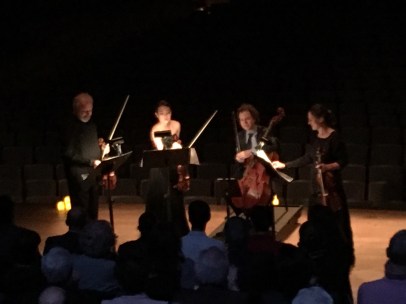
Dmitri Sitkovetsky, Ayana Tsuji (winner of the 2016 first prize), Matt Haimovitz, and Kim Kashkashian at Maison symphonique (Concours musical international de Montréal)
Filed under: Bach, photography

June 3, 2019 • 7:34 pm Comments Off on Bach by Candlelight
Dmitri Sitkovetsky, Ayana Tsuji (winner of the 2016 first prize), Matt Haimovitz, and Kim Kashkashian at Maison symphonique (Concours musical international de Montréal)
Filed under: Bach, photography
April 19, 2019 • 12:00 am Comments Off on St. Matthew Passion: Free Access at Digital Concert Hall
The Berlin Philharmonic is making its 2013 video of J.S. Bach’s St. Matthew Passion in the Peter Sellars staging available for free until Monday.
The St. John Passion is similarly available until Monday.
From the Berlin Philharmonic’s program guide for St. Matthew Passion:
“Not all musicians believe in God, but they all believe in Johann Sebastian Bach,” said Mauricio Kagel, who grappled intensely with the life of the cantor at St. Thomas’s Church, plagued by bureaucratic city fathers and unmotivated Latin pupils, when he composed his own Passion. The term “Passion” is inextricably linked with the name “Bach”, first and foremost due to his St. Matthew Passion, already a work of superlatives in terms of its external dimensions.
That’s because the oratorio of the suffering and death of Christ, which in Bach’s lifetime eclipsed anything conceivable in the field of music, consists of no fewer than 68 individual movements (formerly counted as 78), which include, among others, the monumental opening chorus, the chorale setting “O Mensch, bewein dein Sünden groß” and the epic final chorus.
Already in the first version of the work from 1727 an extensive double choir setting of choir and orchestra is also required: the impressive stereophonic effects have lost none of their fascinating impact. (Bach himself demonstrably dared at a 1736 performance to separate the ensembles completely, enabling the real-spatial differentiation of the dialogue between the two vocal-instrumental ensembles.)
Starting off a week of festivities to celebrate the 50th anniversary of the opening of Hans Scharoun’s Philharmonie, Sir Simon Rattle conducts Bach’s greatest passion music, together with the Rundfunkchor Berlin, boys from the Berlin Staats- und Domchor and a top-class ensemble of soloists. It is a work you can become addicted to, a work in which you can always discover something new even if you have listened to it repeatedly. This concert is also a feast for the eyes: as in April 2010, the St. Matthew Passion is performed in Peter Sellars’ unforgettable staging.
Filed under: Bach, Berlin Philharmonic, Peter Sellars
March 20, 2019 • 6:01 am Comments Off on John Harbison Comes to Seattle

If you’re in Seattle over the next few days, don’t miss the chance to experience John Harbison in person, who will perform at the keyboard with his wife, violinist Mary Harbison at Octave 9 tonight. AND Ludovic Morlot and the Seattle Symphony give the West Coast premiere on Thursday and Saturday of Harbison’s new work for organ and orchestra What Do We Make of Bach?. The program also includes a Stokowski Bach transcription and the last of Shostakovich’s 15 symphonies.
For more background on John Harbison, here’s my profile for a recent edition of Strings magazine:
Filed under: American music, Bach, John Harbison, Seattle Symphony
March 4, 2019 • 7:21 am Comments Off on Poetry and Politics: Sir András Schiff Does Double Duty with Seattle Symphony
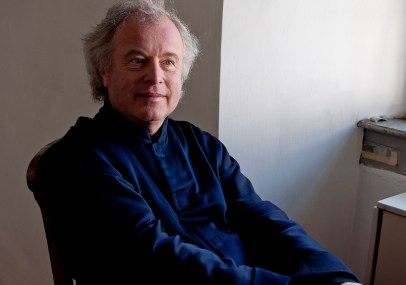
Sir András Schiff © Nadia F. Romanini
Sir András Schiff began a remarkable weekend of music with his appearance as guest conductor of the Seattle Symphony. My review:
For a long time, Seattle audiences have made clear their admiration for the artistry of Sir András Schiff whenever he comes into town for solo recitals – including one occasion 17 years ago, when his Bösendorfer had an unfortunate encounter with black ice while being transported across the continent and a replacement had to be found at the last minute.
Filed under: András Schiff, Bach, Bartók, Beethoven, review, Seattle Symphony
January 1, 2019 • 12:00 am Comments Off on Turning the Page: Happy New Year 2019
Here’s one way to start the New Year: with this remarkable interpretation of Book I of The Well-Tempered Clavier by Samuil Feinberg. The opening Prelude and Fugue in C major in particular sounds like a fresh start, yet already shadowed by experience.
Filed under: Bach, miscellaneous
July 31, 2018 • 11:06 am Comments Off on A Weekend at Tippet Rise
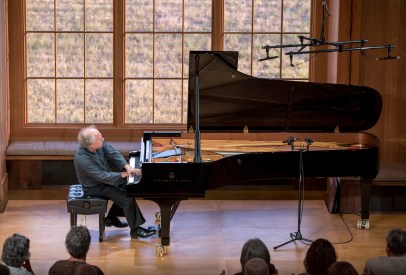
Jeffrey Kahane playing the “Goldberg” Variations. Credit: photo is by Emily Rund, courtesy of Tippet Rise Art Center
My report for Musical America on my recent trip to the Tippet Rise Art Center for a weekend of chamber music, sculpture, and nature has now been posted. PDF version here: Tippet Rise-pdf-07.30.18_MusicalAmerica
FISHTAIL, Montana–Lots of music festivals beckon with the prospect of a temporary retreat from the mundane. Tippet Rise Art Center takes this to a remarkable extreme, thanks to its geography. Located on a 10,260-acre working ranch in rural south-central Montana, Tippet Rise requires nothing less than a pilgrimage just to take in one of the musical weekends of this year’s summer festival season, spread over eight weeks between July and September.
Filed under: Bach, John Luther Adams, Musical America, pianists, review, travel
July 28, 2018 • 6:27 pm Comments Off on Strange Loops and Golden Braids
Last night’s performance of The Musical Offering is a contender for the highlight of the four performances I attended during this summer’s festival presented by the Seattle Chamber Music Society.
Today, by coincidence, as the thema regium occupies my mind, marks the 278th anniversary of the death of J.S. Bach. The performers — violinists James Ehnes and Amy Schwartz Moretti, violist Richard O’Neill, and cellist Edward Arron (the newly reformulated James Ehnes Quartet); violinists Yura Lee and Erin Keefe; violist Che-Yen Chen; cellists Julie Albers and Ronald Thomas; flutist Christie Reside; and harpsichordist Byron Schenkman — sustained a very special atmosphere throughout.
It differed in fascinating ways from the usual SCMS mood, Bach’s intellectual virtuosity holding the capacity audience spellbound, but with the tragic undertone that is also part of this music ever-present. Such a rare pleasure.
A few observations from Douglas Hofstadter’s 1970s classic, Gödel, Escher, Bach:
“The Musical Offering” is a fugue of fugues, a Tangled Hierarchy like those of Escher and Gödel, an intellectual construction which reminds me, in ways I cannot express, of the beautiful many-voiced fugue of the human mind. And that is why in my book the three strands of Gödel, Escher, and Bach are woven into an Eternal Golden Braid.
In [the Canon per Tonos], Bach has given us our first example of the notion of Strange Loops. The “Strange Loop” phenomenon occurs whenever, by moving upwards (or downwards) through the levels of some hierarchical system, we unexpectedly find ourselves right back where we started. (Here, the system is that of musical keys.) … Implicit in the concept of Strange Loops is the concept of infinity, since what else is a loop but a way of representing an endless process in a finite way?
To give an idea of how extraordinary a six-part fugue is, in the entire Well-Tempered Clavier by Bach, containing forty-eight Preludes and Fugues, only two have as many as five parts, and nowhere is there a six-part fugue! One could probably liken the task of improvising a six-part fugue to the playing of sixty simultaneous blindfold games of chess, and winning them all. To improvise an eight-part fugue is really beyond human capability.
“Quaerendo invenietis” is my advice to the reader.
Meanwhile, the Boston Public Library has digitized and put online dozens of Escher’s prints here.
Filed under: Bach, Seattle Chamber Music Society
July 28, 2017 • 6:33 am Comments Off on Vancouver Bach Festival 2017

Last summer, Early Music Vancouver inaugurated an annual Bach Festival, and this year’s edition focuses on the 500th anniversary of Martin Luther’s Protestant Reformation.
A number of prominent Seattle-based artists are heading north to perform: Stephen Stubbs, Byron Schenkman, and Tekla Cunningham. The festival’s 14 concerts run August 1-11, 2017 (most of them at Christ Church Cathedral downtown).
Along with music by J.S. Bach, the program spans the historical spectrum from Renaissance polyphony, Latin American Baroque, 18th century opera to Romantic composers, along with contemporaries like Philip Glass featured on cellist Matt Haimovitz’s “Overtures to Bach” concert.
The complete lineup:
Overtures to Bach
August 1 at 6pm and 9pm
Renowned as a musical pioneer, Canadian cellist Matt Haimovitz performs four of Bach’s beloved Cello Suites preceded by new commissions written by composers including Philip Glass and David Sanford that anticipate, reflect, and transform the originals.
Schumann Dichterliebe and Brahms Four Serious Songs
August 2 at 1pm
Internationally acclaimed Canadian baritone Tyler Duncan and pianist Erika Switzer, playing an original 19th century fortepiano.
Songs of Religious Upheaval: Byrd, Tallis, Tye – Music from Reformation England
August 2 at 7:30pm (Pre-concert talk 6:45pm)
Cinquecento sings music of William Byrd, Thomas Tallis, and Christoper Tye
Lutheran Vespers: Songs for Troubled Times
August 3 at 1pm
Eleven Vancouver-based performers offer a complete Lutheran vespers written to provide comfort and consolation following the Thirty Years’ War and its aftermath
Bach’s Italian Concerto
August 3 at 7:30pm (Pre-concert talk 6:45pm)
The French Overture and the Italian Concerto performed by harpsichordist Alexander Weimann. Swiss baritone and founding musical director of Gli Angeli Genève Stephan MacLeod joins Weimann for cantatas by Handel and Bach
Conversions: Mendelssohn, Moscheles, and Bach
August 4 at 1pm
Fortepianist Byron Schenkman & cellist Michael Unterman perform works by Mendelssohn and Moscheles, two Jewish artists who converted to Christianity to conform to social norms.
Handel in Italy: Virtuosic Cantatas
August 4 at 7:30pm (Pre-concert talk 6:45pm)
Terry Wey and Jenny Högström perform cantatas and love duets by Handel from his early Italian period, along with a duet by Agostino Steffani (one of Handel’s mentors)
Playing with B-a-c-H: Sonatas for Violin by Telemann, Pisendel and J.S. Bach
August 8 at 1pm
Baroque violinist Tekla Cunningham performs a solo Bach partita, a Pisendel
solo sonata, and two solo Telemann fantasias
Before Bach: “The Fountains of Israel” by Johann Schein (1623)
August 8 at 7:30 pm (Pre-concert talk 6:45pm)
European vocal ensemble Gli Angeli Genève sing Johann Schein’s Israelis Brünnlein
Bach for Two Flutes
August 9 at 1pm
Janet See and Soile Stratkauskas play Baroque flutes, with Christopher Bagan on harpsichord
Heavenly Love: Sacred Arias for Counter-Tenor
August 9, at 7:30pm (Pre-concert talk 6:45pm)
Alex Potter sings music by Buxtehude, Schütz, Purcell, and Strozzi
Bach Transcriptions – Victoria Baroque Players
August 10 at 1pm
Bach’s trio sonatas for organ transcribed for chamber ensemble
Music of Missions and Mystery: Latin American Baroque
August 10, at 7:30pm (Pre-concert talk 6:45pm)
Pacific MusicWorks and director Stephen Stubbs
J.S. Bach St. John Passion at the Chan Centre
August 11, at 7:30 pm (Pre-concert talk 6:45pm)
The Pacific Baroque Orchestra, the Vancouver Cantata Singers, and a cast of seven soloists led by Alexander Weimann
To complement the artist lineup, EMV will offer an array of thought-provoking film screenings and expert talks
Filed under: Bach, festivals, music news
March 7, 2017 • 3:12 pm Comments Off on Ignacio Prego’s Revelatory Goldbergs
A new review for Vanguard Seattle:
An opportunity to hear the Goldberg Variations in live performance on harpsichord is rare enough. But the latest offering from Byron Schenkman & Friends was special in several ways. For one thing, it marked the first time that Byron Schenkman has presented a program in his chamber music series without himself being one of the performers. The Spanish harpsichordist Ignacio Prego had the show to himself for about 80 uninterrupted minutes.
Filed under: Bach, review, Vanguard Seattle
December 30, 2016 • 12:08 am Comments Off on The Healing Bach
 A link to my feature story, in this month’s Strings magazine, on the inexhaustible appeal of the Sonatas and Partitas for solo violin:
Bach’s works for solo violin and cello are the Shakespearean monologues of the string world: The indefinable balance of technical mastery and interpretive insight they require is the touchstone of a great artist.
Filed under: Bach, violinists
 Arts & Culture Stories from NPR

