Along with its mix of well-known and unusual repertoire, the Seattle Chamber Music Society annually commissions a brand-new work for its Summer Festival. Monday evening’s programme unveiled the selection for 2015: Cantus by the Pulitzer Prize-winning composer Steven Stucky, who has gained prominence primarily as an instrumental and choral composer. (His first opera – a brilliantly witty yet at the same time touching one-act buffa to Jeremy Denk’s libretto improbably “dramatising” Charles Rosen’s The Classical Style – will receive its full stage première next week at the Aspen Festival.)
One of my favorite string quartets is celebrating its 25th anniversary with a typical overdrive of crative activity. Here’s my recent portrait of the St. Lawrence for Stanford Arts:
“It’s a great time both to be playing in a string quartet and to be writing string quartets,” remarks Geoff Nuttall, first violinist and cofounder of the St. Lawrence String Quartet (SLSQ). He’s thrilled about how both pursuits—those of the recreative performing artist and of the composer who creates from scratch—will be fused in three distinctive ways during the course of the SLSQ’s upcoming season at Bing Concert Hall.
One of my favorite string quartets is celebrating its 25th anniversary with a typical overdrive of crative activity. Here’s my recent portrait of the St. Lawrence for Stanford Arts:
“It’s a great time both to be playing in a string quartet and to be writing string quartets,” remarks Geoff Nuttall, first violinist and cofounder of the St. Lawrence String Quartet (SLSQ). He’s thrilled about how both pursuits—those of the recreative performing artist and of the composer who creates from scratch—will be fused in three distinctive ways during the course of the SLSQ’s upcoming season at Bing Concert Hall.
The composer John Luther Adams has been very much on my mind since I conducted a lengthy interview with him shortly after Seattle Symphony brought his Pulitzer Prize-winning Become Ocean to Carnegie Hall in May.
(Stay tuned for my feature devoted to that commission and the world of JLA in the upcoming fall issue of Listen magazine.)
I couldn’t make it to the recent world premiere of JLA’s site-determined piece Sila: The Breath of the World co-presented by Lincoln Center Out of Doors as part of the Mostly Mozart Festival, but I’m eager to encounter it next spring when it will be performed in my old hometown by co-commissioner Washington Performing Arts.
Here’s a vicarious take on Sila from a roundup of reviews I’ve seen:
In “Sila,” as in many such happenings, music is less a finished product than an activity; it both interacts with and creates a space. In the limpid air of a New York summer, it was a sound garden, embracing a multiplicity of narratives as people variously sat in the dappled shade of a stand of trees, or sipped drinks under cafe umbrellas, or talked quietly, or played with their kids, or paced the plaza looking for new viewpoints and that elusive orchestral balance.
The composer translates the Inuit title of the piece this way: “Sila is the wind and the weather, the forces of nature. But it’s also something more. Sila is intelligence. It’s consciousness. It’s our awareness of the world around us, and the world’s awareness of us.” Even with the buzz of Manhattan so close, Adams and his musicians created a work of music, and of theater, that encouraged listeners to look both deeply inward and out into an imaginary expanse far beyond Hearst Plaza.
[A]s the music evolved, it gained in body and density, though not exactly volume. Choirs of reedy woodwinds and delicate, sometimes scratchy string sounds permeated the space. At times “Sila” was like music depicting continental drift. Halfway through, melodic fragments seemed to emerge, though these were often just instruments rising up the harmonic series.
In endeavoring to have the music become part of nature, and vice versa, Mr Adams encourages an open-minded and thoughtful kind of listening. The listeners sat on the ground between and in front of the musicians and, farther back, underneath a grove of trees. A garbage truck growled in the distance; birds chirruped nearby. These unscheduled sounds mingled with Mr Adams’ clouds of sound as they gradually merged and evaporated and grew, letting some motifs imprint themselves and fossilize in our minds.
JLA’s focus on the note B-flat and its overtones is a fascinating choice. Apparently B-flat has the honor of representing “the lowest note in the universe”, according to the astronomer Andrew Fabian at the Institute for Astronomy at Cambridge University in England in this 2003 report from Dennis Overbye:
Astronomers say they have heard the sound of a black hole singing. And what it is singing, and perhaps has been singing for more than two billion years, they say, is B-flat — a B-flat 57 octaves lower than middle C.
The National Youth Orchestra of the United States of America has just launched its second season. Tomorrow brings the NYO to Carnegie Hall for its official debut there, with a program of music by Bernstein, Britten (Gil Shaham soloing in the Violin Concerto). Mussorgsky, and a newly commissioned orchestral piece by Samuel Adams. David Robertson is serving as the NYO’s conductor this year.
It’s a ploy that always generates controversy: announce the death of “classical music” (however you define it), furnish your obituary with a sauce of ominous statistics and watch your site traffic explode. Another death knell hit the blogosphere and Twitterverse this January, courtesy of a Slate article titled “Requiem: Classical Music in America Is Dead,” which came illustrated with a gray-haired conductor stationed in front of a tombstone. Predictably, the piece triggered a raft ofindignant but thoughtful counterarguments in response.
The composer Derek Bermel gives an introduction to his new Piano Trio, titled Death with Interruptions after José Saramago’s novel. Commissioned by the Seattle Chamber Music Society, it receives its world premiere on tonight’s program, part of the 2014 Summer Festival.
My recent preview of the Summer Festival includes more on Death with Interruptions from my interview with Bermel.
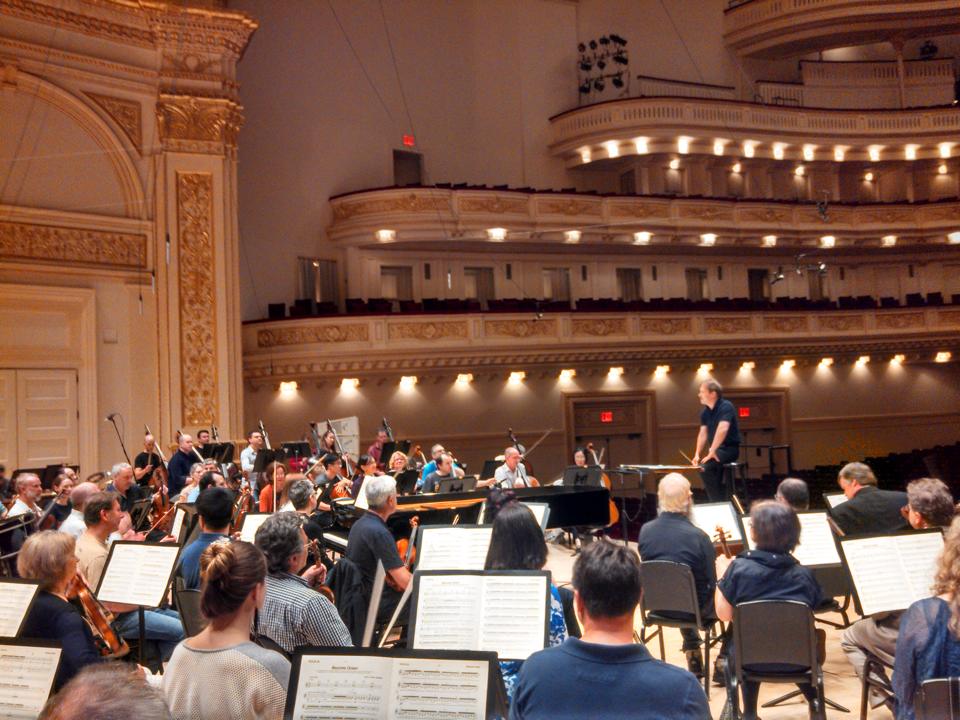
Ludovic Morlot and the Seattle Symphony in rehearsal at Carnegie Hall
I’m still processing the experience of the Seattle Symphony’s concert Tuesday evening at Carnegie Hall — part of this week’s Spring for Music series, which will sadly constitute the final chapter of that worthy festival’s history.
By now the program itself is as familiar as a friend. I heard the second half twice in Seattle, some rehearsal sessions, and the entire program last Friday during the SSO’s epic “preview” evening of the Carnegie adventure for Seattle audiences. But Tuesday included an extra dimension of excitement: the New York premiere of Become Ocean, the reactions of major critics in a world music center, and the unmistakeable ambience of Carnegie Hall itself. Even disregarding my obvious bias, this was received as a triumph for the amazing talent of the Seattle Symphony and its music director Ludovic Morlot.
Of course there’s always a substantial amount of guesswork and gut instinct to rely on when it comes to a new composition. Most premieres tend to be somewhere in the vast “middle” range of quality and potential durability, but it’s certainly all too easy to get it wrong, to err in the direction of fatuous dismissal or foolhardy hyperbole. I know I’ve been guilty of both.
So it’s all the more thrilling when instinct kicks in early on in a first encounter with a piece — as it did for me and the John Luther Adams — and you sense that this might be an even greater achievement than you could have reasonably expected. On both occasions I was able to share the experience with trained musician friends who reaffirmed this “instinctual” response to Become Ocean. This time I found myself tuning in even more to an underlying sense of elegy in the music.
Certainly JLA’s big orchestral piece is at the furthest possible remove from any New Agey connotations or glib “environmental” message that some descriptions I’ve seen imply. (That’s not to deny or diminish the composer’s environmental commitment, which is not reducible to a bland gesture of political art.) Instead, this is challenging music, requiring a major effort from the listener while at the same time profoundly engaging the emotions. The days of either/or cliches like “tough” modernism versus “easy-listening” neo-Romanticism should be behind us.
There’s so much to say about this music and its effect, so much about its implications as a commission, that I’m working on a profile of John Luther Adams and Become Ocean. More on that when the time comes.
Meanwhile, the thoughtful dramaturgy of the program — combining JL Adams with Varèse and Debussy — was justly admired for its contrasts and cross-connections. Here’s a quick round-up of the critical coverage I’ve seen so far:
–Alex Ross, as usual, really gets it. He wrote the first substantial critique of Become Ocean after the world premiere last year in Seattle (which I had to miss). On Tuesday Alex found that “Carnegie’s mellow, resonance-rich space brought out the Wagnerian aspect of Become Ocean, favoring sonorities of strings and brass,” adding that from his position in the orchestral seats, “much of the score’s glittering detail was lost … “and the most delicate percussion effects disappeared as well.”
—New York magazine’s Justin Davidson neatly summarized the piece’s overall effect: “Serenity comes tightly wrapped up with terror.” He points out that, while Become Ocean is “about boundless nature,”it’s an indoor piece, ravishingly traditional in the way it relies on walls and floor and ceiling to convert raw sound into the illusion of shimmering surfaces and the violent deep.”
–Tony Tommasini writes in The New York Times of how Adams extends the familiar idea of an “organic” composition that evolves “in a swirling mass of sound,” pushing it in “an uncompromising, courageous way.”
–On that score, I was puzzled as to why Martin Bernheimer, in his positive review, insists on labeling Become Ocean “an extended tone-poem.” Even the loose or distant mimesis traditionally associated with the Romantic notion of that genre is merely one level to which JLA alludes.
–At New York Classical Review, George Grella found the programming concept to be mere “window dressing for abstract music about form, structure, and time.” Fair enough, but I disagree with Grella’s assessment of the orchestra’s playing in the Debussy as “surprisingly thin and light.” It was, in my opinion, anything but — in fact, unusually, and unconventionally, muscular and finely articulated, very far from “idées reçues” of French “Impressionist” music.
–On Bachtrack, David Allen offers an interesting and lengthy reflection in which he quotes Gurnemanz’s famous, enigmatic aphorism “Here space becomes time” anent Become Ocean. (I’ve been thinking of another Parsifal reference that comes to mind when I listen to this music, from the Prelude.)
Incidentally, I notice all these critics are male and would love to see a female critic’s reaction to this music. I know my pianist friend Judith was impressed on her first hearing, aptly likening the experience to an extended encounter with a Rothko painting.
Update: this isn’t a review of the concert, but Corinna da Fonseca-Wollheim published a preview for The New York Times. There she writes that Become Ocean “submerges the listener in a swirling, churning wash of sound.”
Update No. 2: Just discovered that the world premiere of Become Ocean was covered for the local Seattle media by Melinda Bargreen. She didn’t much care for it:
But after the first 20 minutes or so, the musical ideas had pretty much run their course, and there were no further developments to justify sustaining the piece. (Some listeners in the balcony areas made a discreet but early retreat.) At least the music fell gratefully on the ear, delivering consonance rather than dissonance, and in its very length, “Become Ocean” evoked a sense of vast oceanic scale.
Interesting, too, to see some of the reader comments from back then:
“spiritdancer47,” mistaking the piece for a symphony, didn’t find much there there:
Having been a dancer for PNB, I am familiar with the extended time it takes for the orchestra in the pit to warm up. Listening to Adams’ symphony took me back to that time…and left me there. I would be one of the “early leavers.”
“proud2Bliberal” gave it more thought by trying to locate precedents:
“Become Ocean” was wonderful. It is the perfect piece for just putting your head back, closing your eyes and letting the sounds happen around you. It conveyed what it must feel like to be in Alaska near the ocean and the forests. The piece had a refreshing and genuine feeling, and somewhat of the personality of American experimentalists Charles Ives and Henry Cowell. Morlot was the perfect conductor for this work. Clearly the piece has its roots in Debussy’s “La Mer” and the ocean passages of “Pelleas.” As a French conductor, Morlot was able to conduct all of those “Debussyiste” sea rumblings (bruits, in French). It would be a great piece to have on a CD at home.
And I hope “vf” didn’t place a bet on this prediction:
“It would be unfortunate if the SSO took the Luther Adams piece to NYC, it would be a disaster, hope they reconsider. In comparison to the works of composers like Arvo Part or Phillip Glass Become Ocean is minor league at best.”
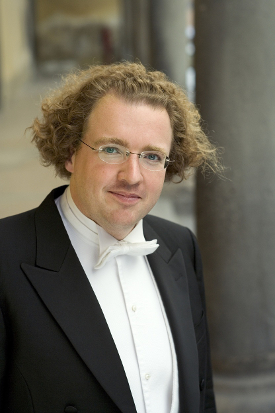
My review of this week’s Seattle Symphony program, with guest conductor Stéphane Denève and pianist Paul Lewis, is now live on Bachtrack:
This week’s Seattle Symphony programme brings the third and last of the current season’s co-commissions — all of which are United States premières — with The Death of Oscar by James MacMillan. Music director Ludovic Morlot led the SSO in the previous two (Pascal Dusapin’s violin concerto Aufgang and Alexander Raskatov’s piano concerto Night Butterflies); for the MacMillan, Stéphane Denève, a champion of the composer since his tenure with the Royal Scottish National Orchestra, was on hand as guest conductor. Denève had also premièred The Death of Oscar in November in Stuttgart, where he currently helms the Stuttgart Radio Symphony Orchestra.
UPDATE on Saturday 22 March, 9:42: I just learned that Richard Taruskin will not be at the Conference to give the keynote speech; he’s prevented from traveling on account of illness. The lineup given here appears to have just been updated.
Living in exile, crossing borders, starting over—are there any experiences more definitive of the modern era? Along with their concrete political and social consequences, these experiences have shaped cultural expression. What, for example, does it mean to be a “Russian” composer today? Does it even make sense to keep referring to national musical styles in this century of instant global connectivity?






 MEMETERIA by Thomas May