MEMETERIA by Thomas May

Music & the Arts

“What Kind of a God Lets Others Fight for Him?”

I’m still processing my reactions to the Deutsches Theater’s production of Nathan the Wise, the Enlightenment masterpiece from 1779 by Gotthold Ephraim Lessing.

“Provocative” would be an understatement — though provocation (or at least the semblance thereof) is mother’s milk in this theater scene by comparison with the usual fare in the English-speaking world.

At least it can’t be denied that director Andreas Kriegenburg, along with his designers Harald Thor (sets) and Andrea Schraad (costumes), has created a visually arresting production: inspired by the enigmatic monolith at the opening of Stanley Kubrick’s 2001: A Space Odyssey, it’s dominated by a large wooden cube — here, a ramshackle, hut-like structure that comically, unpredictably, moves back and forth on the stage.

The Kubrickian impetus is also apparent in a lengthy pantomime-prelude that has nothing to do with Lessing. Kreigenburg shows two “clay figures,” man and woman after the moment of their creation in the process of discovering each other, but then enters in original sin…by way of a primeval “us against them” pattern the cast enacts. And then a childish voice reminds everyone: “But what about the Lessing?” — and the “play” begins.

The comedy is the thing here: Kriegenburg has dared to radically rethink this sacred text of Enlightenment tolerance as an “archaic comic strip” in which the characters — still decked out in their primordial clay but adorned with cliched bits of dress and props to signify their religious affiliations — waddle about in the comic style of silent films, recalling Charlie Chaplin and Harold Lloyd in their gestures. (Some of their stage movement also called The Walking Dead zombie dramaturgy to mind, though I couldn’t tell whether that was intentional.)

Jörg Pose (Nathan), Bern Moss (Saladin), and Elias Arens as the arrogant young Templar play out their roles, but their gestures and even declamation of Lessing’s poetic text are riddled with an eccentric, frequently strained, range of comic moves. The shtick at times gives way to the crudest potty humor, as when the Patriarch — (Natali Seelig, outfitted in a grotesque fat suit) — holds his conference with the naive Templar while on the can. And all of this is accompanied by an almost ceaselessly piped-in soundtrack of clownish music, as if these were routines they had performed over and over.

The dramaturgical notes for the production speak loftily of the relation between comedic form and the “supremely serious” content of Lessing’s text. But is Kriegenburg merely underscoring a profoundly cynical understanding of Lessing’s vision as not only a marvelous “fairy-tale” with a “utopian conclusion” but, literally, a farce in the face of historical — and present-day — reality?

Does this explain his avoidance of allusions to gravely serious issues in the news today, to which an “earnest” director would clearly want to relate Lessing’s play — from the refugee crisis to the atrocities of Daesh? Such topical allusions as do appear are treated as jokes.

And yet, in the scene Nathan’s recitation of the famous Ring Parable, the tone changed, perhaps even in spite of the context. Much of the critical reaction I’ve seen has been pretty vehemently negative, but I can’t say my own experience was. At times I was reminded of the eccentric, apocalyptic humor of Ligeti’s Le Grand Macabre, at others of the craziness of Charles Ludlam and the Ridiculous Theater, where iconoclastic absurdity can suddenly trigger a shocking reversal into something profound.

Perhaps it was just the chance to encounter Lessing’s magnificent text again (in English here), however distorted.

(c)2015 Thomas May — All rights reserved.

Filed under: directors, Enlightenment, Lessing, theater
Seattle Opera’s Nabucco Falls Flat

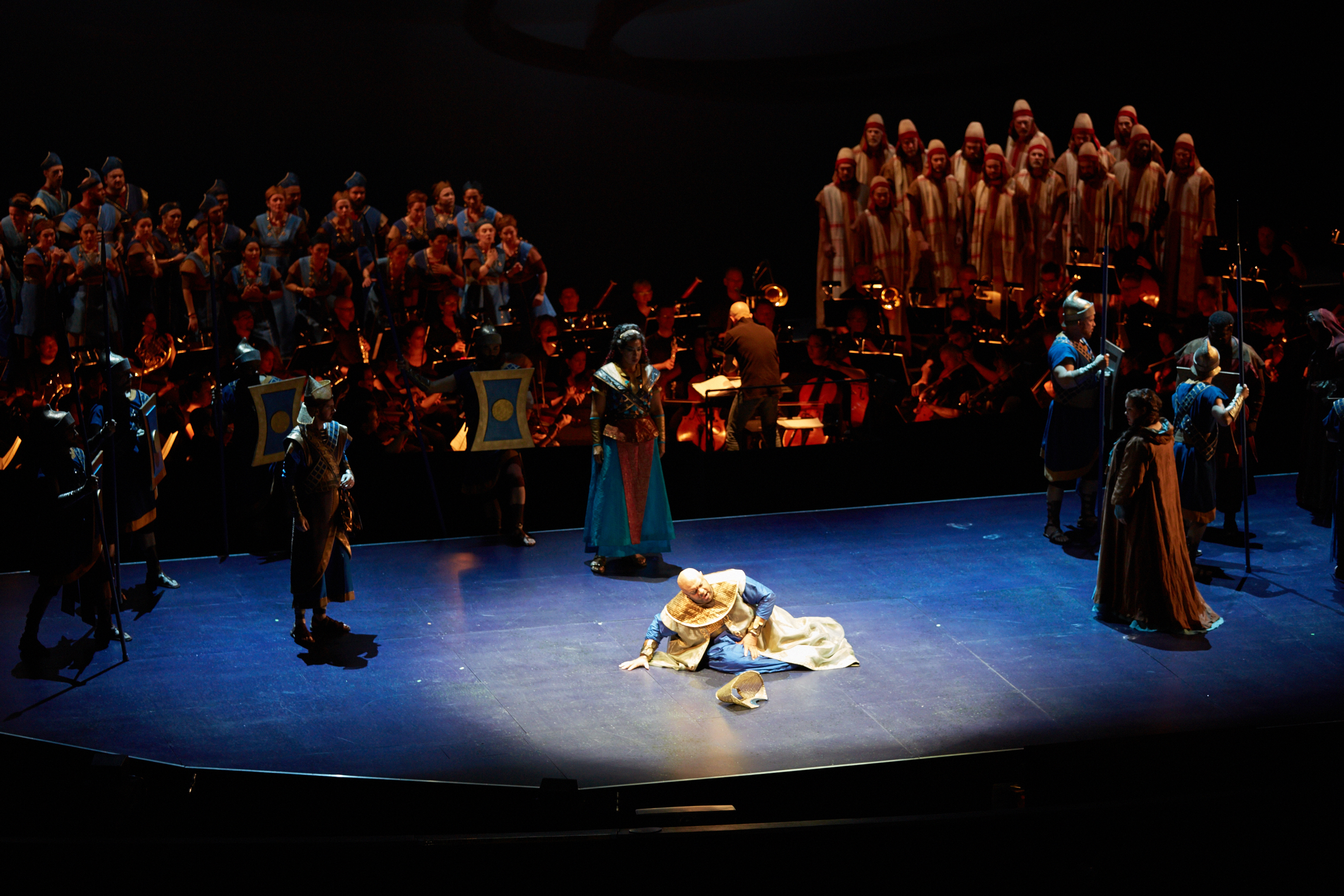
The cast and orchestra of Seattle Opera's Nabucco. © Philip Newton

The cast and orchestra of Seattle Opera’s Nabucco. © Philip Newton

My Bachtrack review is now live.
(I think I managed to catch all the autocorrects that
were turning “Nabucco” into “Nabisco.”)

On paper, Seattle Opera’s new production of Nabucco sounded enticing. General Director Aidan Lang generated buzz about the ‘innovative staging concept’ we should anticipate for the company’s first-ever presentation of Verdi’s third opera. Seattle Opera had meanwhile undertaken a rebranding effort that included a design facelift of its website to emphasise large, bold visuals — with billboard-style tags announcing Nabucco: ‘BETRAYED’ ‘TWISTED’ “EPIC’.

continue reading

Filed under: directors, review, Seattle Opera, Verdi

The Standard Rep at Santa Fe Opera: Summer 2015

Alex Penda as Salome; photo © Ken Howard for Santa Fe Opera, 2015

Alex Penda as Salome; photo © Ken Howard for Santa Fe Opera, 2015

Along with my Cold Mountain coverage, here’s the round-up review of three opera productions I wrote for Musical America, in the order in which they impressed me: Salome, Rigoletto, and The Daughter of the Regiment). (Sorry for the paywall, which prevents me from presenting the whole text here.)

SANTA FE — With the world premiere of Cold Mountain and the announcement of a newly commissioned opera about Steve Jobs by Mason Bates, Santa Fe Opera has been in the media spotlight over the past week. The company is also emphasizing its versatility in this summer’s three productions of familiar fare.

continue reading

Filed under: directors, Donizetti, review, Richard Strauss, Santa Fe Opera, Verdi

“May It Return to the Heart!”

MISSA+1

This week brings the San Francisco Symphony’s performances with Michael Tilson Thomas of the Missa Solemnis of Beethoven — a work that certainly belongs to my top-ten list of all time.

Following a trial run in Los Angeles in January, it’s being given as a “multimedia staged event”, complete with scenic, lighting, and video design; James Darrah is the director.

Of the earlier run in January, Mark Swed had this to say about MTT’s relationship with the Beethoven score:

In the grandest sense, this “Missa Solemnis,” with all its attendant baggage, is a kind of mission statement for MTT. He sets out to unpack a complicated artistic and musical construct, to reveal its workings and to treat it as a large-scale act of discovery.

The Missa Solemnis held intense personal significance for its composer as well: “Von Herzen — Möge es wieder — Zu Herzen gehn!” (“From the heart –- may it return to the heart!” wrote Beethoven on the copy of the score he presented to its dedicatee, his pupil and friend Archduke Rudolf.

For its public “premiere” in Vienna, three of the Missa‘s movements were given as part of the grand concert of 7 May 1824 that also unveiled the Ninth Symphony. (The secular context brought objections to performing the entire Missa.)

Next week MTT and the SFS continue their Beethoven Festival with a recreation of an earlier “marathon concert”: the one on a cold December night in 1808, when Beethoven premiered his Fifth and Sixth Symphonies, and Fourth Piano Concerto in a program that also included a concert aria, three movements from his other Mass setting (the Mass in C major), a piano fantasy, and the Choral Fantasy, that fascinating precursor to the Ninth.

Filed under: Beethoven, choral music, directors, San Francisco Symphony

Seattle Opera: Buffing the Buffa in Ariadne

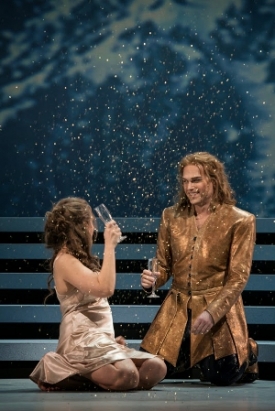
Kate Lindsey (The Composer) and Sarah Coburn (Zerbinetta); photo (c) Elise Bakketun

Kate Lindsey (The Composer) and Sarah Coburn (Zerbinetta); photo (c) Elise Bakketun

My review of Ariadne auf Naxos has now been posted on Bachtrack:

At the end of Seattle Opera’s previous production – a refreshing new staging of Handel’s Semele – the ill-fated heroine is burned by Jupiter’s glorious fire, but the god Bacchus emerges from her destruction: “born as my mother expired in the flames”, as Hugo von Hofmannsthal has the wine god explain in his libretto for Ariadne auf Naxos.

continue reading

Filed under: directors, review, Seattle Opera, Strauss

Pacific MusicWorks Retunes The Magic Flute

Cyndia Sieden and Mary Feminear

Cyndia Sieden and Mary Feminear

My review of Pacifc MusicWorks’ Magic Flute production has now been posted on the Musical America site. (The complete review is behind MA’s paywall.) This was a delightfully fresh take on the Mozart classic, matching historically informed performance values with a provocatively revisionist staging (including a newly commissioned translation/adaptaton of Schikaneder’s libretto):

SEATTLE — A couple years after the conductor, lutenist, and recent Grammy laureate Stephen Stubbs resettled in his native Seattle in 2006 — following three decades based in Europe (mostly in Germany) — he established Pacific MusicWorks, a production company focused primarily on presenting Baroque opera and oratorio in innovative collaborations. PMW’s latest project, which closed on Sunday, offered a fresh perspective on The Magic Flute by combining period instruments with a provocatively anti-traditional staging directed by Dan Wallace Miller and a newly commissioned translation and adaptation of the libretto by the playwright Karen Hartman.

continue reading

Filed under: directors, early music, Mozart, opera, review, Stephen Stubbs

A Ravishingly Entertaining Semele Alights in Seattle

Brenda Rae (Semele) and Alek Shrader (Jupiter); (c) Elise Bakketun

Brenda Rae (Semele) and Alek Shrader (Jupiter); (c) Elise Bakketun

My review of Seattle Opera’s latest production is now live on Bachtrack.com (Happy 330th, George Frideric!)

It’s amusing to imagine the pitch Handel must have used to convince the presenters of Covent Garden’s oratorio concert series for the 1744 Lenten season to back his latest creation. Why not schedule his theatrical treatment of a myth that portrays the head of the pagan gods setting his human mistress up in a pleasure palace? After all, the moral is clearly stated at the end: “Nature to each allots his proper sphere”. Still, you can’t send your audience home on a such a grim choral note, so all the more reason to end things with a cheerful ode to the powers of Bacchus!

continue reading

Filed under: directors, Handel, review, Seattle Opera

Ghosting in LA

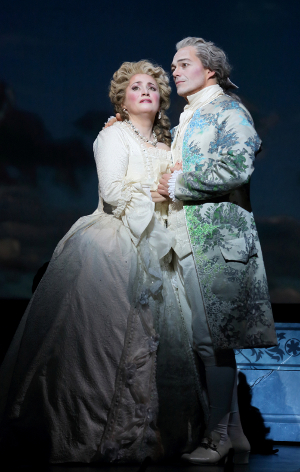
Patricia Racette (Marie Antoinette) and Christopher Maltman (Beaumarchais): © Craig Mathew | LA Opera

Patricia Racette (Marie Antoinette) and Christopher Maltman (Beaumarchais): © Craig Mathew | LA Opera

One of the most thrilling evenings I’ve experienced in years at the opera house — at the theater in general — was last weekend’s opening night of Los Angeles Opera’s new production of The Ghosts of Versailles.

Here’s a quick overview of the critical reaction so far:

It’s comic and serious, entertaining and erudite, silly and thoughtful, emotional and mysterious, harrowing and uplifting, intimate and over-the-top — and the more times you see it, the more you’ll find in it and the more you’ll get out of it. It helps to be an opera or history buff to get all of the references, reminiscences and send-ups, but it’s not necessary.

–Richard S, Ginell, Los Angeles Times

James Conlon in the pit showed an absolute mastery of the score and LA Opera Orchestra played like angels for him. Through an evening of very challenging harmonies and swift changes of tempo they alighted on each new melody with precision and a transparency that I hadn’t enjoyed in this work before…

A better performance of this large and complex work couldn’t possibly be hoped for and I can’t express strongly enough what a tremendous experience it was to see live. We were “in the presence of the composer’ last night as they say.

–Patrick Mack, parterre.com

In an achingly beautiful LA Opera production, the ghosts of monarchies and revolutions past materialize before our eyes at the Dorothy Chandler Pavilion. We are enveloped in an exquisite postmodern version of Marie Antoinette’s little theatre at Versailles, awash in dusty blues and pearlescent greens. It is the world of John Corigliano’s opera, The Ghosts of Versailles.

–Jane Rosenberg, The International Review of Music

It’s all interesting and entertaining if not invariably arresting. Written for the Metropolitan Opera, which gave the premiere in 1991, “Ghosts,” lasting nearly three hours on Saturday, seems rather loosely-knit and bloated. The jokes, pretty good though sometimes fairly broad, don’t always sit right with the ostensibly serious subject matter. When all is said and done, the whole is about as deep as an episode of “The Twilight Zone.”

–Timothy Mangan, Orange County Register

With an expensive stage set that rivals the royal opera house in Versailles and a large cast that includes a headless Marie Antoinette and a rabid army of French Revolutionaries — as well as an exotic temptress portrayed by a certain Broadway star who enters astride a hot-pink elephant — L.A. Opera’s production of The Ghosts of Versailles at the Chandler Pavilion is a visually stunning affair.

–Falling James, LA Weekly

Patricia Racette gives a commanding performance as Marie Antoinette, combining wistfully naïve nostalgia with nightmarish horror.

–Jim Farber, San Francisco Classical Voice

In the end, there wasn’t even enough room on stage! At the curtain call the cast stretched the entire width of it with several getting squeezed out of the final bow. Corigliano’s opera really is larger than life, and, appropriately, the last person brought out was the composer himself. The Ghosts of Versailles, over 20 years after its première, (which was 11 years after it was commissioned) was worth the wait. While the opera isn’t perfect, it is a colossal achievement. William M. Hoffman’s poetic libretto with Corigliano’s evocative fusion of styles makes not only an impressive spectacle of theater, but an opera of intense feeling and LA Opera’s production captures that magic exquisitely. It was a triumph.

–Matthew Richard Martinez, bachtrack.com

Filed under: American opera, directors, John Corigliano, Los Angeles Opera

To Moscow, Moscow, Moscow!

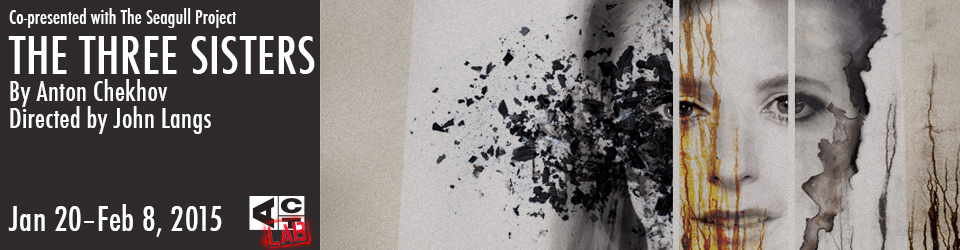
ThreeSisters

About 10-15 years ago, it seemed one of the big trends around Chekhov productions was to ratchet up the comedy. All that tristesse and Russian pathos had become so clichéd that directors tried to outdo one another in getting audiences to laugh — too often by hard-hitting with effects that were more vulgar sit-com-y than Chekhovian non-sequitur (Kulygin’s “nonsense”).

So it intrigued me to notice some of the audience bafflement during intermission at last night’s preview of The Three Sisters in a new production by the Seagull Project soon to open at ACT Theatre. “It sounds like theater of the absurd,” insisted the woman next to me. “You can’t keep it straight what they want!”

Not humor and laughs, but frustration over the confusion of tone — which is exactly what makes Chekhov, and in particular The Three Sisters, such a formidable challenge to direct. Not the relaxed “plotlessness,” but the matter of tone For all the self-congratulation we hear about how our we “break down barriers” nowadays, so many are still glued to obvious genre distinctions: is it supposed to be a comedy? a tragedy? avant-garde? (I sensed similar reactions recently to Seattle Shakespeare’s Measure for Measure, that notorious “problem play.”)

For me, the two characters who most successfully establish real Chekhovian ambiguity in John Langs’s thoughtful production (using Carol Rocamora’s translation) — though the director relies a bit too much on leitmotivic tics that turn characters into caricatures — are CT Doescher’s poignantly resigned but cheerful Tusenbach and the intelligent, suave, but gently bitter Vershinin of David Quicksall.

Julie Briskman comes closest to getting the Chekhov chiaroscuro as the oldest sister, Olga. Her mood swings feel more integrated and organic, whereas they come across as merely “quirky” in several other characters’ portrayals. Alexandra Tavares’ Masha is especially compelling in her “stolen moment” of brief happiness with Vershinin. Sydney Andrews conveys the woozy longing of Irina as a young woman on the cusp of adulthood in the first act; her later development still seems to be a work in progress. John Abramson’s captures the proto-Uncle Vanyan angst of their brother Andrey Sergeevich as he tries to put up a bold front in the face of his crushing disappointments.

Hannah Victoria Franklin plays up Natalya’s bossy boorishness and her independent streak, but the class resentment that fuels her seems lost in translation. Recently seen doing good work in New City Theater’s Hamlet, Brandon J. Simmons takes a more straightforwardly comic approach as Kulyigin but gives his pomposity an awkward edge that pays off well in his final scene with Masha.

Langs is particularly good at organizing this talented cast in the larger ensemble scenes; he’s not able to solve the complex issues of Chekhov’s tempo and pacing from these to intimate encounters — but this will probably improve as the production matures. He neatly frames the play with marching scenes featuring the army arriving at and then departing from the provincial garrison town where the Prozorov family languishes. They stomp in to the beating of a big bass drum, automatons ready for the call of duty; but at they end we see them marching in silent slow motion far upstage — and can imagine them heading straight for the trenches of the First World War.

Among the delights of this production are the design elements: Jennifer Zeyl’s birch-framed set with tricky Chekhovian seasonal changes beautifully established by Robert J. Aguilar’s lighting. Robertson Witmer’s soundscape brings out the full range of Chekhov’s “score” — in this play whose subtexts include a major role for sounds: the forest echoes, a flock of birds passing, the wind, the magic of the spinning top given as a gift to Irina by the aging army doctor Chebutykin (such a powerful symbol of frenzied but futile action).

There’s another Chekhovian music in Péter Eötvös’ gorgeous opera distilled from the play:

Filed under: Chekhov, directors, opera, review, theater

Sigmund Shakespeare

Measure
Steven Pinker has published a thought-provoking essay titled “Shakespeare: One of the First and Greatest Psychologists”.

Pinker focuses specifically on the scene in which Isabella pleads to the puritanical interim authority Angelo to spare her brother Claudio’s life in Measure for Measure (which is currently playing in a Seattle Shakespeare production directed by Desdemona Chiang):

Isabella compares the administration of an idealized divine justice with the all-too-fallible human justice. She reminds us that humans are capable of meting out patently cruel and pointless punishment judgments with complete confidence they are doing the right thing.

Aside from Shakespeare’s ceaselessly relevant “universality,” Pinker points to how uncannily spot-on he is with regard to the findings of contemporary psychologists:

Worse still, we humans are the last to notice our own limited nature. In seven words, Shakespeare sums up a good portion of the findings of modern psychology: “most ignorant of what he’s most assured.”

A recurring discovery of social and cognitive psychology is that human beings are absurdly overconfident in their own knowledge, wisdom, and rectitude. Everyone thinks that he or she is in the right, and that the people they disagree with are stupid, stubborn, and ignorant.

People reliably overestimate their own knowledge, and misjudge their own accuracy at making predictions. A common theme of both Shakespeare and modern social psychology is the human species’ overconfidence.

On the Bard’s use of his psychological insight to intensify the drama:

These two perspectives — that of the perpetrator or scientist, and that of the victim or moralist — color every analysis of human behavior. And here, we see Shakespeare suddenly flipping from one to the other for dramatic effect.

Filed under: directors, Shakespeare

Archive

Enter your email address to follow this blog and receive notifications of new posts by email.