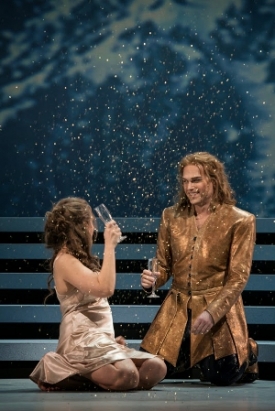
Brenda Rae (Semele) and Alek Shrader (Jupiter); (c) Elise Bakketun
My review of Seattle Opera’s latest production is now live on Bachtrack.com (Happy 330th, George Frideric!)
It’s amusing to imagine the pitch Handel must have used to convince the presenters of Covent Garden’s oratorio concert series for the 1744 Lenten season to back his latest creation. Why not schedule his theatrical treatment of a myth that portrays the head of the pagan gods setting his human mistress up in a pleasure palace? After all, the moral is clearly stated at the end: “Nature to each allots his proper sphere”. Still, you can’t send your audience home on a such a grim choral note, so all the more reason to end things with a cheerful ode to the powers of Bacchus!
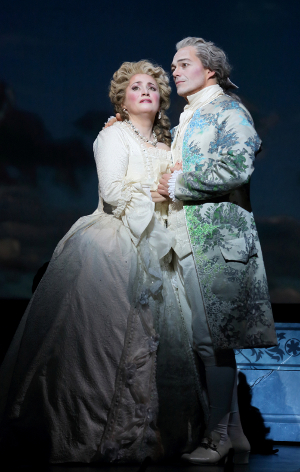
One of the most thrilling evenings I’ve experienced in years at the opera house — at the theater in general — was last weekend’s opening night of Los Angeles Opera’s new production of The Ghosts of Versailles.
Here’s a quick overview of the critical reaction so far:
It’s comic and serious, entertaining and erudite, silly and thoughtful, emotional and mysterious, harrowing and uplifting, intimate and over-the-top — and the more times you see it, the more you’ll find in it and the more you’ll get out of it. It helps to be an opera or history buff to get all of the references, reminiscences and send-ups, but it’s not necessary.
James Conlon in the pit showed an absolute mastery of the score and LA Opera Orchestra played like angels for him. Through an evening of very challenging harmonies and swift changes of tempo they alighted on each new melody with precision and a transparency that I hadn’t enjoyed in this work before…
A better performance of this large and complex work couldn’t possibly be hoped for and I can’t express strongly enough what a tremendous experience it was to see live. We were “in the presence of the composer’ last night as they say.
In an achingly beautiful LA Opera production, the ghosts of monarchies and revolutions past materialize before our eyes at the Dorothy Chandler Pavilion. We are enveloped in an exquisite postmodern version of Marie Antoinette’s little theatre at Versailles, awash in dusty blues and pearlescent greens. It is the world of John Corigliano’s opera, The Ghosts of Versailles.
It’s all interesting and entertaining if not invariably arresting. Written for the Metropolitan Opera, which gave the premiere in 1991, “Ghosts,” lasting nearly three hours on Saturday, seems rather loosely-knit and bloated. The jokes, pretty good though sometimes fairly broad, don’t always sit right with the ostensibly serious subject matter. When all is said and done, the whole is about as deep as an episode of “The Twilight Zone.”
With an expensive stage set that rivals the royal opera house in Versailles and a large cast that includes a headless Marie Antoinette and a rabid army of French Revolutionaries — as well as an exotic temptress portrayed by a certain Broadway star who enters astride a hot-pink elephant — L.A. Opera’s production of The Ghosts of Versailles at the Chandler Pavilion is a visually stunning affair.
In the end, there wasn’t even enough room on stage! At the curtain call the cast stretched the entire width of it with several getting squeezed out of the final bow. Corigliano’s opera really is larger than life, and, appropriately, the last person brought out was the composer himself. The Ghosts of Versailles, over 20 years after its première, (which was 11 years after it was commissioned) was worth the wait. While the opera isn’t perfect, it is a colossal achievement. William M. Hoffman’s poetic libretto with Corigliano’s evocative fusion of styles makes not only an impressive spectacle of theater, but an opera of intense feeling and LA Opera’s production captures that magic exquisitely. It was a triumph.
About 10-15 years ago, it seemed one of the big trends around Chekhov productions was to ratchet up the comedy. All that tristesse and Russian pathos had become so clichéd that directors tried to outdo one another in getting audiences to laugh — too often by hard-hitting with effects that were more vulgar sit-com-y than Chekhovian non-sequitur (Kulygin’s “nonsense”).
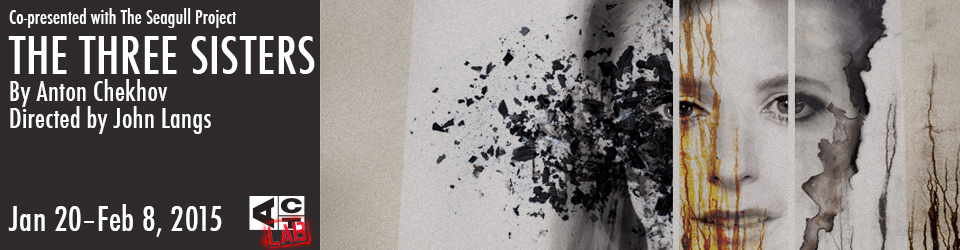
So it intrigued me to notice some of the audience bafflement during intermission at last night’s preview of The Three Sisters in a new production by the Seagull Project soon to open at ACT Theatre. “It sounds like theater of the absurd,” insisted the woman next to me. “You can’t keep it straight what they want!”
Not humor and laughs, but frustration over the confusion of tone — which is exactly what makes Chekhov, and in particular The Three Sisters, such a formidable challenge to direct. Not the relaxed “plotlessness,” but the matter of tone For all the self-congratulation we hear about how our we “break down barriers” nowadays, so many are still glued to obvious genre distinctions: is it supposed to be a comedy? a tragedy? avant-garde? (I sensed similar reactions recently to Seattle Shakespeare’s Measure for Measure, that notorious “problem play.”)
For me, the two characters who most successfully establish real Chekhovian ambiguity in John Langs’s thoughtful production (using Carol Rocamora’s translation) — though the director relies a bit too much on leitmotivic tics that turn characters into caricatures — are CT Doescher’s poignantly resigned but cheerful Tusenbach and the intelligent, suave, but gently bitter Vershinin of David Quicksall.
Julie Briskman comes closest to getting the Chekhov chiaroscuro as the oldest sister, Olga. Her mood swings feel more integrated and organic, whereas they come across as merely “quirky” in several other characters’ portrayals. Alexandra Tavares’ Masha is especially compelling in her “stolen moment” of brief happiness with Vershinin. Sydney Andrews conveys the woozy longing of Irina as a young woman on the cusp of adulthood in the first act; her later development still seems to be a work in progress. John Abramson’s captures the proto-Uncle Vanyan angst of their brother Andrey Sergeevich as he tries to put up a bold front in the face of his crushing disappointments.
Hannah Victoria Franklin plays up Natalya’s bossy boorishness and her independent streak, but the class resentment that fuels her seems lost in translation. Recently seen doing good work in New City Theater’s Hamlet, Brandon J. Simmons takes a more straightforwardly comic approach as Kulyigin but gives his pomposity an awkward edge that pays off well in his final scene with Masha.
Langs is particularly good at organizing this talented cast in the larger ensemble scenes; he’s not able to solve the complex issues of Chekhov’s tempo and pacing from these to intimate encounters — but this will probably improve as the production matures. He neatly frames the play with marching scenes featuring the army arriving at and then departing from the provincial garrison town where the Prozorov family languishes. They stomp in to the beating of a big bass drum, automatons ready for the call of duty; but at they end we see them marching in silent slow motion far upstage — and can imagine them heading straight for the trenches of the First World War.
Among the delights of this production are the design elements: Jennifer Zeyl’s birch-framed set with tricky Chekhovian seasonal changes beautifully established by Robert J. Aguilar’s lighting. Robertson Witmer’s soundscape brings out the full range of Chekhov’s “score” — in this play whose subtexts include a major role for sounds: the forest echoes, a flock of birds passing, the wind, the magic of the spinning top given as a gift to Irina by the aging army doctor Chebutykin (such a powerful symbol of frenzied but futile action).
There’s another Chekhovian music in Péter Eötvös’ gorgeous opera distilled from the play:
Pinker focuses specifically on the scene in which Isabella pleads to the puritanical interim authority Angelo to spare her brother Claudio’s life in Measure for Measure (which is currently playing in a Seattle Shakespeare production directed by Desdemona Chiang):
Isabella compares the administration of an idealized divine justice with the all-too-fallible human justice. She reminds us that humans are capable of meting out patently cruel and pointless punishment judgments with complete confidence they are doing the right thing.
Aside from Shakespeare’s ceaselessly relevant “universality,” Pinker points to how uncannily spot-on he is with regard to the findings of contemporary psychologists:
Worse still, we humans are the last to notice our own limited nature. In seven words, Shakespeare sums up a good portion of the findings of modern psychology: “most ignorant of what he’s most assured.”
A recurring discovery of social and cognitive psychology is that human beings are absurdly overconfident in their own knowledge, wisdom, and rectitude. Everyone thinks that he or she is in the right, and that the people they disagree with are stupid, stubborn, and ignorant.
People reliably overestimate their own knowledge, and misjudge their own accuracy at making predictions. A common theme of both Shakespeare and modern social psychology is the human species’ overconfidence.
On the Bard’s use of his psychological insight to intensify the drama:
These two perspectives — that of the perpetrator or scientist, and that of the victim or moralist — color every analysis of human behavior. And here, we see Shakespeare suddenly flipping from one to the other for dramatic effect.
Bart Sher’s Tales of Hoffmann production is returning to the Met this week.
Here’s my essay on Offenbach’s fascinating, problematic masterpiece for the Met Playbill (starts on p. 35 [pdf format]):
Les Contes d’Hoffmann is a most unusual swan song. In its formal ambition
and psychological scope, the opera represents a striking makeover.
Jacques Offenbach hoped to reinvent himself as an artist, proving that he
was capable of more than the wickedly satirical but lightweight brand of lyrical
theater on which his reputation had been built. And Hoffmann did secure his
place in the operatic pantheon, although the truncated version through which it first became known made a jumble of Offenbach’s original vision.
Enjoy your Nutcracker this season, but me, I’d much rather have the other part of the double-bill with which the ballet was first paired in 1892: the one-act fairy-tale opera Iolanta.
I’m currently admiring Peter Sellars’s enlightening interpretation, paired on DVD with Stravinsky’s Perséphone from a production at the Teatro Real.
“It is a very radical opera, it is the start of symbolism in Russia, of modern art, of the search for light,” says Peter Sellars in an interview for El País.
Iolanta was Tchaikovsky’s very last opera and suffered from terrible bowdlerization under Soviet authorities. A new production starring Anna Netrebko — in a double-bill with Bartók’s Bluebeard’s Castle and directed by Mariusz Trelinski — comes to the Met early in 2015.
I’m deeply grateful to Tom Luce to be able to publish his insightful review of the world premiere of the opera staging of John Adams’s The Gospel According to the Other Mary. Directed by Peter Sellars, the production just opened this past weekend at English National Opera.
Review by Tom Luce: The Gospel According to the Other Mary
World Premiere Staging of John Adams’s and Peter Sellars’s Masterpiece
On Friday 21 November, English National Opera unveiled its new production of the Adams/Sellars “alternative” version of the crucifixion of Christ. The two-act work, described by its creators as a “Passion Oratorio”, was premiered in a concert performance at Disney Concert Hall by the Los Angeles Philharmonic in May 2012 under Gustavo Dudamel’s baton. The following year came the first semi-staged concert performance, also featuring the LA Philharmonic under Dudamel. That version later toured to New York and Europe (including a stop at London’s Barbican). Dudamel’s interpretation was released on a recording by Deutsche Grammophon earlier this year, so the music has been accessible to the public at large since then.
Directed by Sellars himself, ENO’s production was the work’s first full staging. Along with its two creators, it deservedly received a prolonged ovation from a rapt and obviously much moved audience.
The performance was uniformly excellent, with cast and chorus admirably meeting the challenging mixture of singing, movement, and acting Sellars demands of and inspires from his performers. All the principal singers — Patricia Bardon as Mary Magdalene, Meredith Arwady as Martha, and Russell Thomas the Lazarus — were committed and effective, as were dancers Banks, Stephanie Berge, Ingrid Mackinnon, and Parinay Mehra, who variously shadowed them and contributed other parts to the narrative.
The musical side at ENO was in the hands of Joana Carneiro. Of Portuguese origin, she is better known in the U.S. than in Britain, having for some years been music director of the Berkeley Symphony. Her technical mastery and impassioned commitment to this highly complex score were remarkable. The ENO orchestra played magnificently.
Those familiar with Sellars’ “ritualisations” of the two Bach Passions with the Berlin Philharmonic Orchestra would find nothing to surprise them in his staging. One hallmark is his use of dance, mime, and body movement to externalise and heighten emotion. “Put your body where your belief is”, he says in the ENO’s introductory video. Another is the subtle intermingling of narrative and representation. The main thrust is narrative, but to heighten impact at critical points in the drama, the narrators act out the events — just as the Evangelist in the Berlin Bach Passions both expounds the story and at times impersonates characters — e.g., Peter in denial, or Christ at his death. This subtle shifting of roles keeps crude dramatisation at bay but facilitates a wide variety of dramatic tone and effects. I have not seen anything comparable in other directors’ work; it is one of Sellars’s most skilful and original attributes.
The stage design by George Tsypin, subtly lit by James Ingalls, is spare but eloquent: sand and barbed wire represent a Middle East riven by conflict and oppression, simultaneously biblical and contemporary.
The work juxtaposes and fuses ancient and modern in presenting Mary and Martha as running a hostel for homeless, impoverished, and marginalised people, with Jesus as a mixture of family friend, honoured guest, and spiritual patron. He is also a miracle worker in the raising of their dead brother Lazarus, sacrificial victim of the elites whose power he challenges, and a source of hope for the future of the world.
The literary sources are the Bible — especially St John’s Gospel — supplemented and re-interpreted through modern American cultural figures: poet and author Louise Erdrich, who is partially of native American descent; Dorothy Day of the radical Catholic Worker movement; Rosario Castellanos, the Mexican writer, activist, and diplomat; and the black poet June Jordan (who wrote the libretto for an earlier Adams/Sellars collaboration, I Was Looking at the Ceiling and Then I Saw the Sky).
In the ENO video Sellars also says: “The moment you feminize Christianity and you go into feminine spirituality, you go into a very different space and it operates very differently”. It is of the essence in Sellars’s dramatic work that he sees the cultural myths we have inherited through women’s eyes. This is as much an emotional and dramatic as a political standpoint.
The main originality of his St Matthew Passion ritualisation lies in its inspiration and liberation in the listener and viewer of wider and wilder feelings going well beyond the conventional liturgical responses or the “authentic” musical response to a deeper human involvement in the passion of Christ and its human and political significance. In doing so he responds to the injunction in the very first line of the work: “Come, ye daughters, help me lament”. (The discreet presence in the audience of Mark Padmore, the Evangelist in the Berlin Passions, at Friday’s Gospel premiere served to underline the connection between the Bach and Adams ventures.)
John Adams’s music reaches new levels of emotional profundity, dramatic responsiveness, and absence of mannerism, going even beyond his achievement in The Death of Klinghoffer. There is an extraordinary richness and flexibility of harmony and melody and a fascinating orchestral sound, to which a cimbalom gives an exotic edge without ever sounding kitschy. Amongst many fine moments, the most deeply moving for me is the aria with which the first act ends, sung by Lazarus after the Passover evening: “Tell me, how is this night different? … This is the night we eat the bread of affliction so that evil may turn into good”. Within an orchestral palette evoking a kind of Nachtmusik, Adams here creates a deep and movingly optimistic reflection on the events of the opera. Over many years I have heard nothing finer from a contemporary composer.
With this production English National Opera cements its standing as the world’s most committed John Adams house, having previously mounted Nixon in China and Doctor Atomic and having originated the Klinghofferproduction admired recently at the Met.
The work itself will surely take a high place in the canon of works from the last century or so in which great composers address themes of human injustice and inequality. It will be alongside Tippett’s A Child Of Our Time (1944) and his The Knot Garden (1970), an opera featuring a female revolutionary fighter and a mixed-race/same-gender couple, which sadly seems to have slipped out of the repertoire in recent years); Hans Werner Henze’s dramatic cantata The Raft of Medusa; and above all Alban Berg’s Wozzeck. Its full unveiling at last week’s premiere was an event of real significance.
Tom Luce lives in London and Seattle. He has followed musical events for over 50 years. He wrote music reviews for Seattle’s Crosscut.com.
Jay Myers as Orsino and Allie Pratt as Viola. Photo by John Ulman.
“Why, this is very midsummer madness!” exclaims Countess Olivia in the middle of Twelfth Night — just as the whirligigs of the plot against Malvolio start cranking away. Olivia’s normally uptight steward has been set up to believe his boss is suddenly overcome with uncontrollable passion for him and is putting on a display that makes for one of the most outrageously funny scenes in all Shakespeare.
But Malvolio’s (David Quicksall) crazed behavior is easily matched by the antics indulged in by Olivia herself (Elinor Gunn) in Seattle Shakespeare Company’s deliriously unconventional new production, which opened this past weekend and which plays through Nov. 16 at the Center Theatre at Seattle Center. Visiting director Jon Kretzu approaches Twelfth Night as if it were a vastly elaborated version of the nocturnal spell cast in the Bard’s decade-earlier A Midsummer Night’s Dream. Just about everyone seems to wander about in a woozy haze of confused, mismatched desire.
Tonight brings the opening of Los Angeles Opera’s curious pairing of Purcell’s Dido and Aeneas with Bluebeard’s Castle by Bartók.
The Australian-born, Berlin-based director Barrie Kosky (intendant at the Komische Oper Berlin) has brought his staging of the double bill for Oper Frankfurt to LA.
In a recent Opera News profile, Kosky explained the connections he’s come to see between these two one-act operas:
“Both pieces are about arrival and departure in different ways. Both operas have a couple and the complexities of love in different ways as the central element of the pieces. And the third thing is, both pieces have a degree of sadness and melancholia running through them.”
Here’s a very brief introduction to the evening by LA Opera’s CEO Christopher Koelsch:
Just to whet your appetite: a snippet from this deliciously sophisticated Handel comedy.
I’ll post my new essay on Handel’s Partenope as soon as San Francisco Opera publishes it. The production, which took the Olivier Award for Best Opera when it premiered at English National Opera, is directed by Christopher Alden, and I had a chance to spend time with him as he was rehearsing the SFO cast (a dream cast, I might add).