MEMETERIA

Icon

Arts writing by Thomas May

Speak What We Feel: King Lear at Seattle Shakes

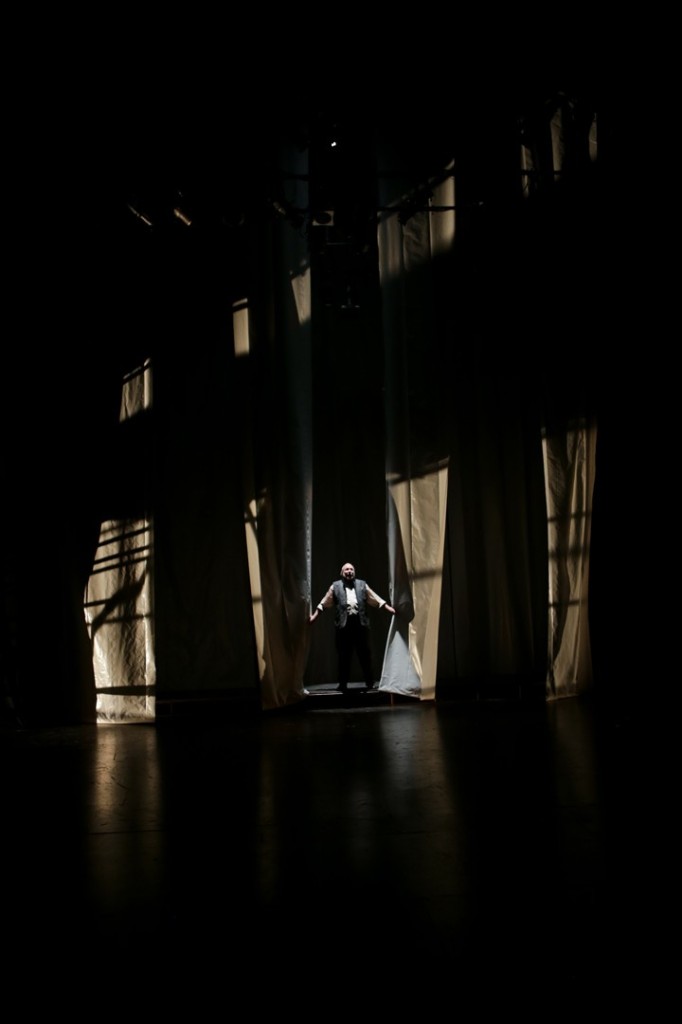
Blow, winds, and crack your cheeks!

“Blow, winds, and crack your cheeks!” Dan Kremer as King Lear; photo by John Ulman

To grapple with the challenge of staging King Lear has to be the Shakespearean equivalent of trying to produce an entire Ring cycle. The play is so vast, so all-encompassing, its web of theatrical and emotional motifs so intricately woven, that it’s no wonder old-fashioned — well, OK, ancient — critical opinion deemed the play simply “too huge for the stage” (A.C. Bradley).

But visionary productions over the past century have dispelled that misgiving. Or maybe it’s just that the course the world itself has undergone makes us more receptive to Lear‘s devastating dramatic truths. Sometimes it almost seems as if Shakespeare had written the script for our times — and we’re just bumbling along, trying to act it out. Things don’t just fall apart; they coil toward entropy.

In Seattle Shakespeare’s new production, the play’s apocalyptic dimensions are essentially eclipsed by the familial — and all-too-familiar — realism of dysfunctional relationships and personal psychology.

Linda K. Morris, Patrick Allcorn, and Dan Kremer; photo  by John Ulman

Linda K. Morris, Patrick Allcorn, and Dan Kremer; photo by John Ulman

Director Sheila Daniels conceives the tragedy as an intimate echo chamber of unstable characters who are progressively losing it. What they undergo entails a series of variations on the theme of Lear’s crack-up. Scene by scene (with the whole divided here into three acts), their attempts to impose order on events, to get closer to their desires, become increasingly desperate. The overriding impression isn’t so much of the grim inevitability of consequences — Shakespeare’s merciless updating of classical “fate” — as of psychological meltdown.

As the ex-monarch, Dan Kremer underscores this approach through the unpredictable variability of his temper. It works very well for the first sections of the play — particularly in how it clarifies the relationship between Lear and his daughters that has already charted the course of the tragedy long before it begins.

We see how Goneril (Linda K. Morris) and Regan (Debra Pralle), given neatly differentiated portrayals here, aren’t just self-serving but have been brought up to fear daddy’s mercurial outbursts. Elinor Gunn’s Cordelia shows a steely stubbornness she must have learned first-hand. That’s what keeps her from seeing the danger she puts herself in — not a martyr complex to speak truth to power.

As for their husbands, while the Duke of Cornwall compresses into a sadistic psychopath (Gordon Carpenter), Shakespeare gives amplitude to the Duke of Albany (Patrick Allcorn) to grow in self-awareness and influence.

What lacks the needed emotional force are the actual climaxes marking each way-station in Lear’s descent. Kremer’s scene on the heath becomes just another fit, his verbal torrent more a fest of self-pity. By the same token, the Lear Kremer depicts in the final scenes fails to stir any deeper pity than he already has at the beginning of his long humiliation.

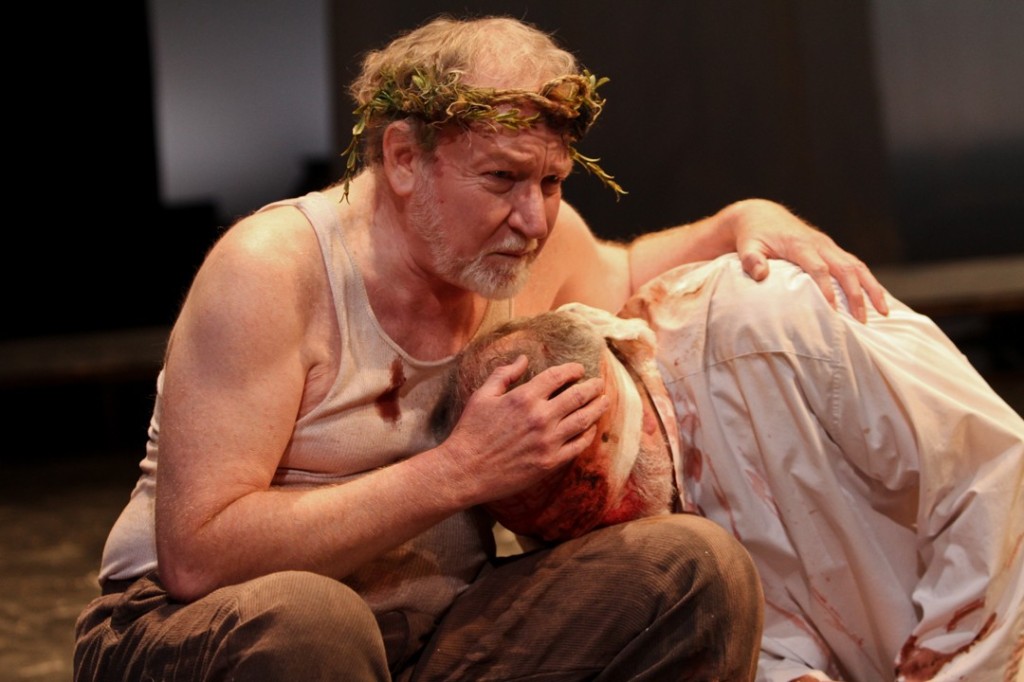
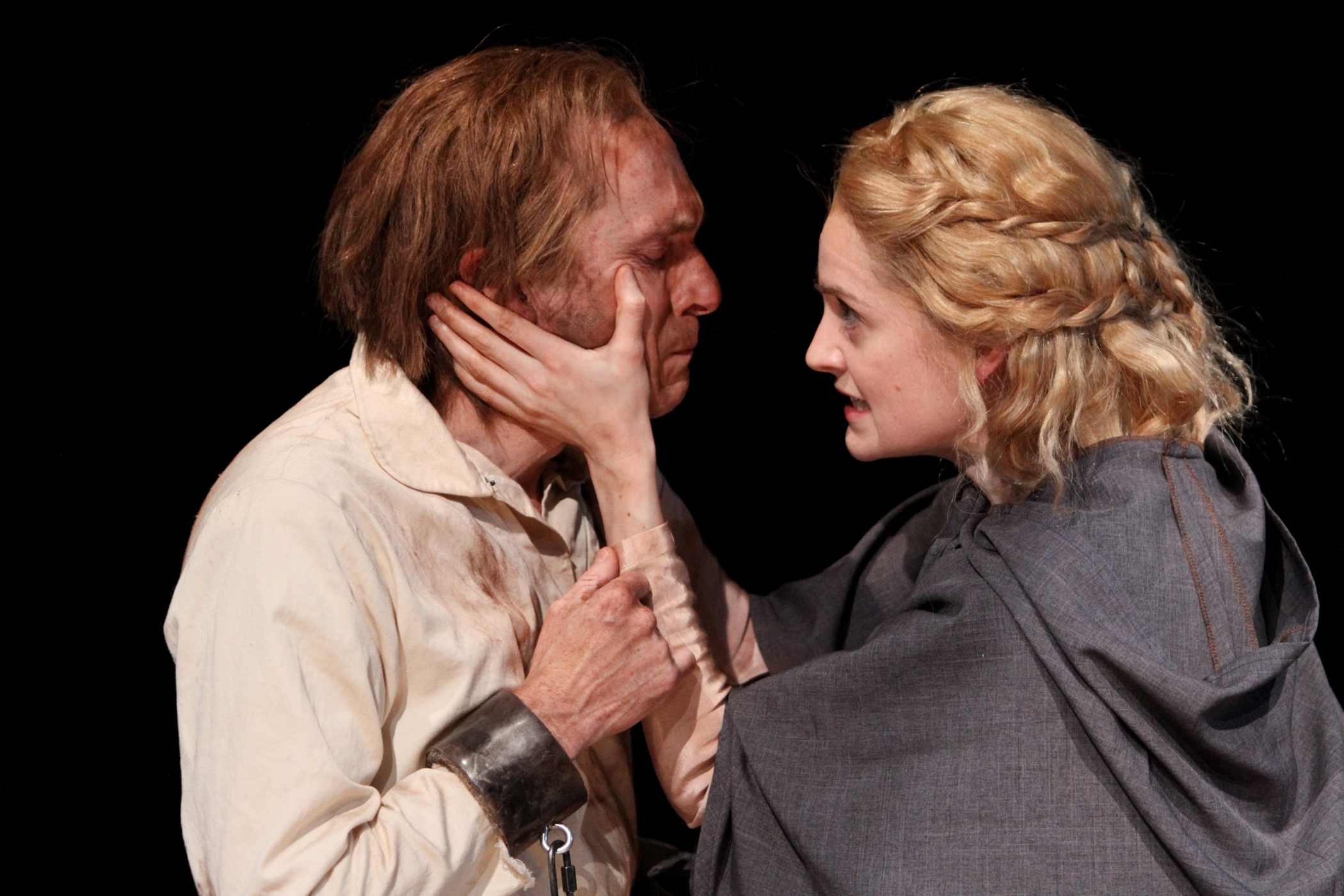
Kremer is more compelling in his interactions with “the other half” — with the fellow victims of ruin who never seem to faze him as they cross his path and all head toward the final confrontations at Dover. His reunion scene with the blinded Gloucester (Michael Winters) is especially resonant in its unsettling blend of horror and comic absurdity.

Dan Kremer and Michael Winters in Seattle Shakespeare Company’s production of “King Lear.” Photo by John Ulman

Dan Kremer and Michael Winters; photo by John Ulman

Some stand-out performances by others in the cast tilt the focus of the play in interestingly unexpected directions. Eric Riedmann’s chillingly embittered Edmund — possibly the most accomplished single interpretation — conveys the malign intelligence of a Iago yet always feels human. It’s one of Daniels’ strengths to clarify each character’s motivations in a way that makes them psychologically persuasive, further emphasizing the intimacy of family connections in this production.

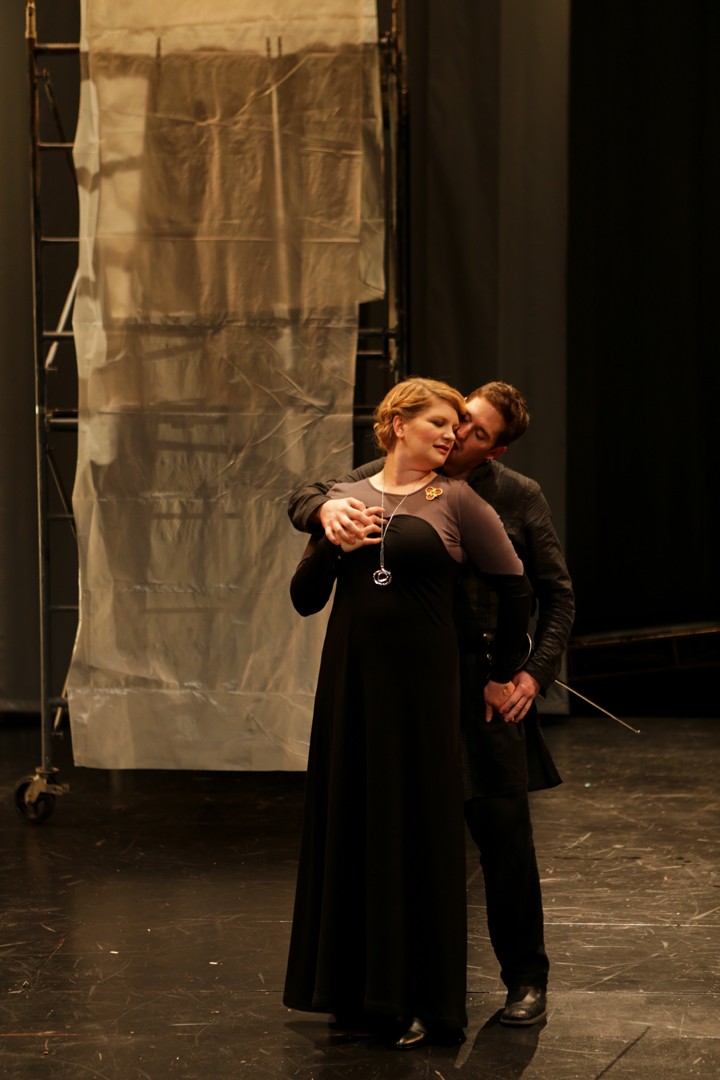
Riedmann moreover revels in Shakespeare’s poetry, articulating its sonorities and rhythms with a relish and variety I wish were not otherwise the exception in this cast. The only misstep is the close-to-campy exaggeration of the sexual dalliance between him and Regan.

Linda K. Morris and Eric Riedmann in Seattle Shakespeare Company’s production of “King Lear.” Photo by John Ulman

Linda K. Morris and Eric Riedmann; photo by John Ulman

Winters makes Gloucester’s wishful gullibility work, and the scenes with his two sons are among the most vividly realized. In his guise as Poor Tom, Jorge Chacon draws on physical hints he’s shown us as the nervous if good-natured Edgar.

King Lear is notable for the overdetermination of the fool archetype. Along with the official fool (Todd Jefferson Moore), the disguised Kent (played as a “Duchess” by the splendid Amy Thone) and Poor Tom on the heath reinforce the fool’s function of bearing witness to the truth as they retreat most deeply into their roles. Thone and Jefferson have a winning dynamic together and help re-introduce some of the play’s larger perspectives — particularly, its obsession with the power of language to shape reality, both positively and negatively. This is what gives the humor they interject its edge.

After all, they continue to subject Lear to the treatment that outraged him when it came from Cordelia. But even to “speak what we feel” is a kind of rhetoric, if the mirror side of Lear’s fulminations and curses. Language is the one thing the dispossessed king is left with — the very language he obviously abused throughout his reign.

Dan Kremer, Craig Peterson, Sophie Paterson, Amy Thone, and Jonathan Crimeni in Seattle Shakespeare Company’s production of “King Lear.” Photo by John Ulman.

Dan Kremer, Craig Peterson, Sophie Paterson, Amy Thone, and Jonathan Crimeni; photo by John Ulman

The scenic conception is notably weak and lags far behind the many fine nuances of the ensemble’s acting. Daniels, who collaborated with set designer Craig Wollam, opts for a colorless, ultra-minimalist playing space with a backdrop of hanging plastic and linen sheets and a scaffold that rolls to and fro. It is a way of making the stage the world, but the process of stripping away so essential to the play’s arc has already happened by the start.

Melanie Burgess’s abstract-pattern, cheerless costumes seem out of sync with the high contrasts of Jessica Trundy’s lighting. I do like the effect of cruel illumination upon the arrival at Dover, but the veer toward a horizontal Rothko glow at the end puzzles. Robertson Witmer picks up on the script’s references to drums to create a sternly percussive sound design.

Seattle Shakespeare Company’s production of King Lear plays through May 17 at the Cornish Playhouse (formerly Intiman) at Seattle Center, Wed. – Sun. Tickets here or call 206 733-8222.

(c)2014 Thomas May. All rights reserved.

Filed under: directors, review, Shakespeare, theater

John Adams’s Gospel

Gospel

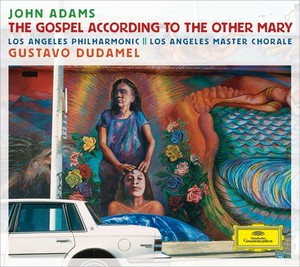
Since my essay is included in this recording, I have to recuse myself from offering a review, but I can say that I consider The Gospel According to the Other Mary among John Adams’s most profound accomplishments. It certainly probes new ground for this ever-evolving, brilliant musical mind.

As for the critical reactions I have seen, nothing yet has come to my attention that seriously grapples with the full complexity of this score.

A curious note: Gospel was among this year’s Pulitzer finalists. I think it’s a safe bet that this year marks the first time two composers sharing the same last name were up for the same prize, which in this case was taken by John Luther Adams for Become Ocean.

If you haven’t had a chance to explore this Adams/Peter Sellars collaboration, do yourself a favor.

Filed under: American music, directors, John Adams, new music, spirituality

Minimalist Jukebox in LA: Philip Glass

Philip Glass

Philip Glass

The Los Angeles Philharmonic is now presenting its 2014 edition of the Minimalist Jukebox Festival, curated by Creative Chair John Adams. I’m especially excited about the offering for Thursday, 17 April: the Rome section from the CIVIL warS, a Robert Wilson-Philip Glass collaboration. Here’s the essay I wrote for the LA Phil’s program:

Is it too far-fetched to compare Einstein on the Beach’s seismic effect with that of The Rite of Spring? At least in terms of the prospects for contemporary opera in America — in a moribund condition at the time — Einstein’s U.S. premiere in 1976 was a game-changer. And in the context of Minimalism itself, this groundbreaking collaboration between Philip Glass and Robert Wilson opened up a new world of possibilities for a composer who, as Glass has often repeated, up to that point had never dreamed of writing opera.

By the time of his second collaboration with Wilson on the CIVIL warS project, Glass had taken up the “conventional” rhetoric of opera — which is to say operatically trained voices, chorus, and full orchestra — and translated this into his unique style and idiom.

Glass himself considers Einstein to be both his first opera and an end point — the culmination of a long period of experimentation in abstract, instrumental forms with what is now generally regarded as “hard-core” Minimalist processes. This inaugural collaboration with Wilson was followed by Satyagraha, his first work written for an actual opera company (Netherlands Opera). Glass then undertook Akhnaten, completing his trilogy of “portrait operas” based on iconic figures in the period when he was working on the CIVIL warS.

The work we hear on tonight’s program therefore represents another important early step in cultivating a medium on which Glass has concentrated, with incredible productivity, up until the present. It is in opera that “Glass found a medium in which he could put his newly developed language to expressive use,” as the critic Allan Kozinn observed as far back as 1986. His turn “from abstract composition to representational music” has not kept Glass from continuing to write such abstract instrumental works as symphonies, concertos, and quartets, but the collaboration with Wilson in particular left a decisive mark on Glass’s conception of Minimalist language.

This language itself, it should be noted, was in its Glassian dialect initially rooted in “representational” projects from the composer’s early Paris years, when he made pivotal encounters with Indian music and the theater of Samuel Beckett. Through these projects Glass became fascinated by theatrical and musical sensibilities that posited an alternative to Western conventions of narrative linear time and space. Glass apparently first happened upon the work of Robert Wilson via the 12-hour-long The Life and Times of Joseph Stalin, which the Brooklyn Academy of Music presented in 1973.

That encounter had the effect of an epiphany. “I understood then, as I feel I have ever since, [Wilson’s] sense of theatrical time, space, and movement,” Glass has remarked. The composer once characterized the sense of time in his own music as existing outside “colloquial time,” with the result that audiences tend to perceive this music “as extended time, or loss of time, or no sense of time whatsoever.”

In Einstein Glass had his first opportunity to match his musical constructions to the vision of the maverick director from Texas. Wilson abandoned the business career intended by his father to instead take up a life in the performing arts, evolving his enormously influential brand of theater in New York City’s avant-garde downtown scene of the 1960s.

Through his idiosyncratic collages of surreal, dreamlike elements, stylized stage movement and gesture, and associative rather than plot-driven content, Wilson created a modernist counterpart to the Wagnerian Gesamtkunstwerk — only this is a “total work of art” that, unlike Wagner’s, reflects the intersecting visions of its collaborators rather than the vision of a single artist.

And, as Glass has emphasized over the years, its meaning is outside the control of the creators. Figuring out the relation of his own music to the words and images of the entire theatrical experience (or film, in the case of his collaborations with the director Godfrey Reggio) thus requires the active participation of the audience to be completed. “Early on in my work in the theater, I was encouraged to leave what I call a ‘space’ between the image and the music. In fact, it is precisely that space which is required so that members of the audience have the necessary perspective or distance to create their own individual meanings.”

Even in a cantata-like concert performance lacking the hallucinatory visuals that originally accompanied the full staged version, the Rome section (a Prologue and three scenes), affords the audience fascinating examples of this “intertextual” space, which might be contrasted to a more straightforwardly expressive “translation” of text and feelings into musical content.

The libretto prepared by Wilson and his collaborator Maita di Niscemi, for example, wasn’t intended merely to be “set” to music. Wilson had already constructed a multilayered verbal and visual text lacking only the musical layer. Glass’s contribution thus represented the final creative stage. He carpentered his score to align precisely with the timings from a pre-recorded read-through of the text as a stage play (though with the words delivered at an abnormally but operatically “true” slow pace).

All of this was meanwhile intended as the part of a still larger whole titled the CIVIL warS: a tree is best measured when it is down, to be performed in Los Angeles to celebrate the international spirit of the Olympics held here in 1984. Wilson began with a characteristically elliptical take on the American Civil War — in particular, Matthew Brady’s haunting contemporary photographs — and imagined a world historical juxtaposition of images and associations from antiquity to the Space Age. These riff on themes of war and peace, nation and family, civil and internalized struggle and enlightenment.

The peculiar typography of the title draws attention to a “struggle” between upper and lowercase letters as well as to the plurality of this phenomenon. “Civil Wars” also happens to be the customary translation of one of Julius Caesar’s writings. The subtitle quotes from Carl Sandburg’s canonical biography of Abraham Lincoln, for whom Wilson devised an unforgettable visual of a figure who is eventuality “struck down” (a singer suspended in a 16-foot-high harness, draped with a long black coat and sporting a stovepipe hat).

Never lacking for ambition, Wilson intended to stage a day-long ceremonial opera featuring composers, writers, and performers from around the world. Glass was one of several composers invited to contribute music for a different section of the vast five-act opus. The sections which were completed took their names from the locations of their separate premieres: hence the Rome section, envisioned as the final, fifth act of the CIVIL warS, was independently commissioned and staged (in March 1984) by the Opera di Roma. Glass also wrote the music for the Cologne section (scenes from Acts 1, 3, and 4), while David Byrne created connective pieces to link the scenes, known as The Knee Plays or the Minneapolis section.

At the last minute, the LA Olympic Arts Festival pulled the plug and canceled its plans to fund the complete staging. One of the commentators in Katharina Otto-Bernstein’s 2006 documentary Absolute Wilson observes that the director has since regarded this decision as the single greatest disappointment of his career. The Rome section, like the others, was thus left as a torso that has been occasionally performed on its own.

There is no story to synopsize. Wilson and di Nascemi’s libretto is largely a collage, an assemblage of texts from letters of the American Civil War period, ancient tragedies by Seneca for the Roman connection (in the original Latin and translated into Italian), and stream-of-consciousness word poems by Wilson himself, recited by a male and a female narrator. (On the Nonesuch recording, these parts are taken by Wilson and Laurie Anderson.)

It is for you, gentle listener, to generate what you will from the text’s recombination of historical, iconic, symbolic, and seemingly “automatic” elements. Figures we expect to see from the American Civil War — Abraham and Mary Lincoln and Robert F. Lee (who reappear in Glass’s more recent 2007 work for San Francisco Opera, Appomattox) share this dreamscape with the (French-born) leader of the Italian Risorgimento, Giuseppe Garibaldi, Hercules and Alcmene (the hero’s mother), and mythic Hopi characters, the “Earth Mother” and “Snow Owl.”

Glass’s very first notes, an ominously descending bass, happen to echo a similar gesture at the beginning of Einstein. But the original commission by Rome Opera — in the land where opera was born — led Glass to reflect on the power of the human voice itself and its central role in this medium. Whereas Einstein had featured relatively little singing, the Rome score is cast for huge, dramatically projected voices, with especially demanding high parts for the soprano and tenor soloists.

At the same time, Glass resorts to a Wagnerian sweep of orchestral sonorousness over which these voices float, as well as recurrent motivic ideas such as the brief trumpet call pervading the Prologue. Oscillation between major and minor provides the fulcrum for Glass’s idiosyncratic slant on tonality. The orchestral writing features primary-color effects, with fresh twists on conventional instrumental “imagery” such as military brass and drums or the floating arpeggios of bel canto accompaniment.

Indigenously American congregational hymn singing also informs some of the choral writing (Scene B), and elsewhere references to nineteenth-century Romanticism (Verdi and Tchaikovsky) color the choral and solo parts as well as the orchestral interludes. Creating a panorama of alternately turbulent and elegiac soundscapes, Glass recontextualizes familiar imagery in a way that’s reminiscent of Wilson’s process. Musically, the result is akin to the opera’s mingling of history and myth, of artifact and dream.

(c) 2014 Thomas May – All rights reserved.

Filed under: American music, directors, essay, opera, Philip Glass

“The Delicate Alchemy of Collaboration”: Peter Sellars on Gerard Mortier

Gerard Mortier in 2007

Gerard Mortier in 2007

Alex Ross has provided this translation of Peter Sellars’s tribute to the visionary director Gerard Mortier, who died on 8 March in Brussels:

Gerard Mortier was a mercurial operatic visionary who transformed the art form—not with a particular production or body of work, but with an attitude. Wherever Gerard was and whatever he was doing, you knew it would be exciting. His imprimatur guaranteed challenge, engagement, pleasure, and the kind of adventure informed and made possible by profound conviction and deep connoisseurship.

None of us who knew and worked with Gerard will ever be the same. His visionary, always practical, and constantly generous presence enlivened each conversation, each rehearsal, each project. Perhaps more amazingly, many of Gerard’s rivals, critics, and adversaries will never be the same either. They also did what they did and are doing what they are doing in response to Gerard’s vision, leadership, and permanent challenge. Gerard’s particular brilliance is to be equally vital and ultimately influential to his friends and to his enemies.

Gerard’s rare gift was his sense of the delicate alchemy of collaboration. Most of us have met some of the most important artistic partners of our lives courtesy of Gerard’s inspired insight and at Gerard’s elegant invitation. The results could be seen and heard on stage, but many of Gerard’s commitments and innovations remained backstage.

Read the whole thing at The Rest Is Noise blog

Filed under: directors, opera

The Cruelty of Strangers

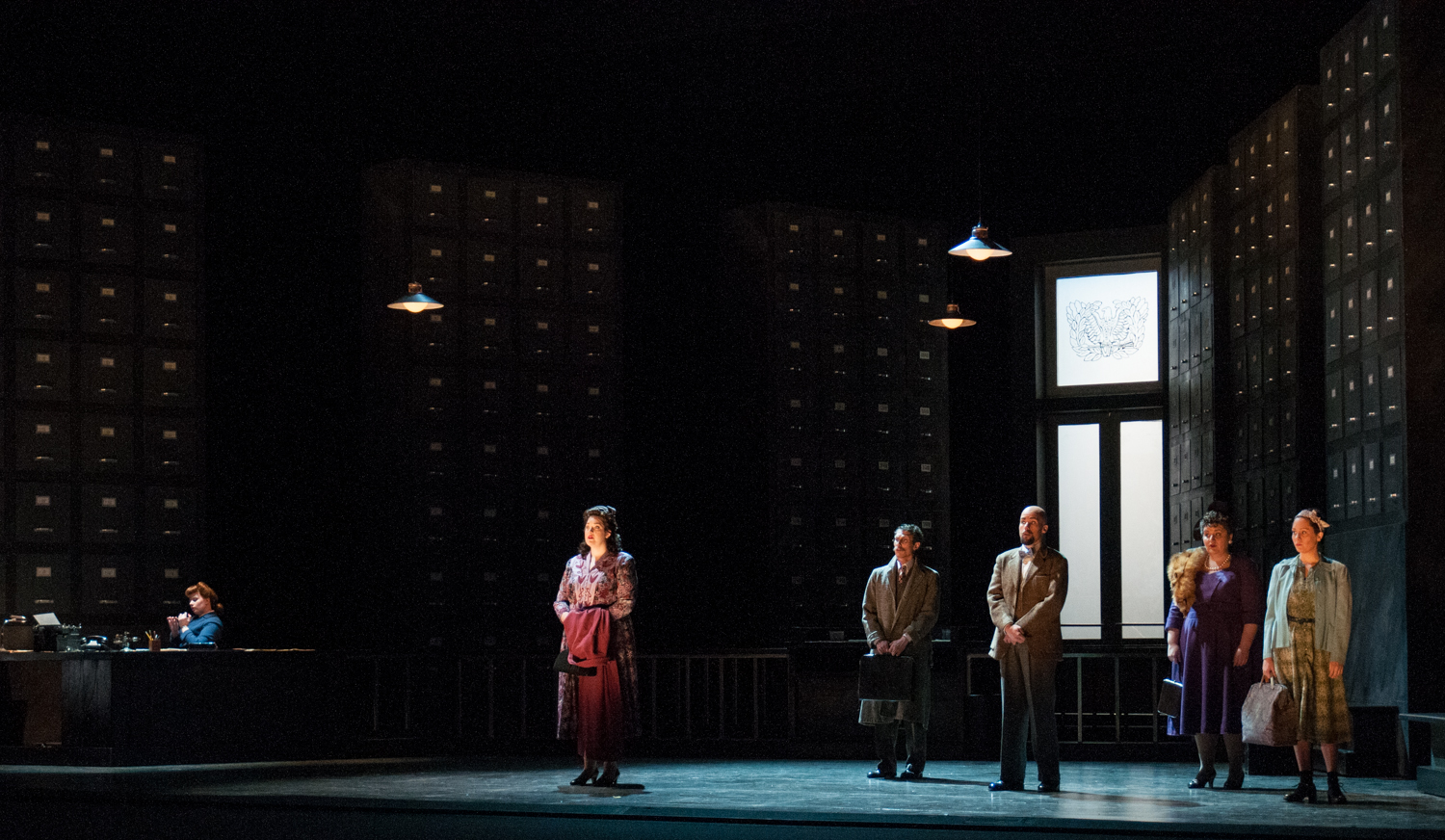
Menotti's The Consul at Seattle Opera; photo by Elise Bakketun

Menotti’s The Consul at Seattle Opera; photo by Elise Bakketun

Here’s my City Arts preview of the production of Gin Carlo Menotti’s The Consul, opening this weekend at Seattle Opera:

It may seem odd for an opera company to be cagey about revealing the ending of a work written more than a half-century ago. But Seattle Opera is holding the cards very tight to its chest when it comes to The Consul by Gian Carlo Menotti. Seattle Opera’s production, which opens this weekend, marks the company’s first staging of the work and will certainly be the first live experience of it for many in the audience. Premiered in March 1950, The Consul enjoyed a flash of glory when it transferred to a Broadway theatre that year, playing for some 286 performances.

Set in a grey, unidentified totalitarian state in the middle of the 20th century, The Consul revolves around the plight of Magda Sorel and her husband John, a dissident who is forced, shortly after the opera begins, to go into hiding as an enemy of the state. Magda desperately attempts to negotiate the dehumanizing bureaucracy of the state Consulate to arrange for legal emigration.

There are obvious tinges of Kafka and other poets of modern alienation as Magda repeatedly tries to satisfy the baffling documentation requirements demanded by the Consul’s office. The secret police stalk her, closing in on her husband’s whereabouts. In the final scene, after they arrest John at the Consul’s office, “it comes down to whether the secretary will break the rules and do the right thing…” Or at least that’s how the cliffhanger synopsis on Seattle Opera’s website describes the ending.

continue reading

Filed under: directors, opera, Seattle Opera

Mad for Shakespeare

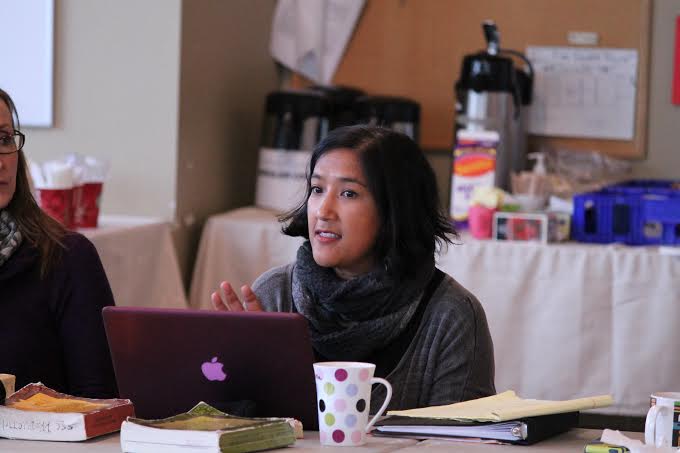
Rosa Joshi

Rosa Joshi

This is a fuller version of my profile of the Seattle-based director Rosa Joshi for Crosscut.com. Joshi and her team at Seattle Shakespeare Company have staged Richard II, a play that’s been in the spotlight thanks to the BBC’s Hollow Crown series but that — at least in the U.S. — remains a relative rarity.

“I don’t choose easy plays!” admits Rosa Joshi. She’s explaining her selection of Richard II as the vehicle for her directorial debut with Seattle Shakespeare Company.

The match between Joshi and Seattle Shakes is long overdue, given what she has brought to the Bard’s twist on “sad stories of the death of kings.” For my money, her Richard II ranks among the finest of the company’s recent productions, achieving a delicate balance of clarity and forceful poetic imagination.

“Shakespeare is my greatest love to direct,” says Joshi, who has been on the fine arts faculty at Seattle University since 2000.

“There are no small choices in Shakespeare. He makes you go to the extremities of emotion and experience, from the heights of joy to the depths of despair. That to me is infinitely challenging.”

Extreme situations frame Richard II, which traces the downfall of its titular king. Ill-suited to the throne, the impolitic Richard is forced to hand the crown over to his cousin-made-rival, Henry Bolingbroke, before being imprisoned and assassinated. His dramatic reversal of fortune has its counterpart in Henry’s equally dramatic ascent.

Richard (George Mount) surrenders his crown to Henry Bolingbroke (David Foubert); photo by John Ulman

Richard (George Mount) surrenders his crown to Henry Bolingbroke (David Foubert); photo by John Ulman

Over the past decade, Joshi has made a splash in Seattle with her all-women versions of Shakespeare. In 2006 she co-founded upstart crow, a local collective devoted to producing classic theater with exclusively female casts. Their inaugural production took on the Bard’s King John; their second effort followed in 2012 with the ultra-violent Titus Andronicus.

A central aim of upstart crow has been “to create opportunities for women to participate in the Western classical canon for which they share a passion – in a way they don’t get to do in more conventional arenas.”

“Any time you have one gender onstage it makes you look at gender differently,” Joshi says. “I’m not so much prescriptive about what it means, but think of it as an experiment in how the audience relates to the work. For some people, the gender simply goes away, and some people really notice it. There isn’t just one experience I’m trying to make the audience have.”

Joshi is well-aware of the seeming paradox that with the conventionally cast Richard II at Seattle Shakes, she’s chosen a play featuring a predominantly male cast (with just two actresses). In fact, she points out, upstart crow has also gravitated toward heavily male plays.

“With Richard, there is a way of looking at him as a character who has a certain female energy in a male world,” Joshi explains. As he loses the confidence of his subjects, Richard becomes increasingly marginalized. The actual women in the play, meanwhile, “are the only ones who hold on to family while the others are torn by loyalty to the state.”
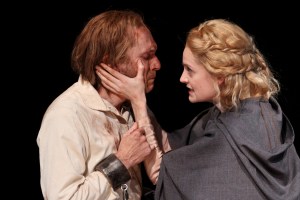
Richard (Geroge Mount) and his Queen (Brenda Joyner); photo by John Ulman

Richard (George Mount) and his Queen (Brenda Joyner); photo by John Ulman

In a similar vein, Joshi expresses puzzlement over another question she says is inevitably posed: “Why do you, as a woman of color, insist on doing this work by Dead White Males? Whenever I’m asked that, I point out that these plays are just as much my heritage, too.”

Joshi, who grew up in England and Kuwait, initially thought she was destined to become a doctor like her father. Still, she decided to keep her options open by studying in the United States and pursuing her love of theater on the side as a double major.

The turning point that made her decide to choose theater over medicine came when she was given the chance to direct during a semester abroad in London. Naturally, it was a thorny piece: Harold Pinter’s one-act “The Lover.”

After internships at the Williamstown Theatre Festival and Juilliard in New York, Joshi headed to Yale Drama School (during the Stanley Wojewodski era). Her classmates included Paul Giamatti, Liev Schreiber and the indie director Tom McCarthy. “I learned so much just from being around my peers,” she recalls.

Joshi relocated to Seattle during the 1990s, when the fringe theater scene was exploding. Legendary local director John Kazanjian of New City Theater, she says, became a key mentor. Kazanjian gave her the opportunity to produce her own shows — including her Seattle debut, a “Twelfth Night” staged on the steps of Capitol Hill’s Richard Hugo House.

“I think Seattle is a great place where emerging artists can sink their teeth into work. But it’s harder to sustain mid- and late-career artists.” Still, Joshi sees a positive development in the resurgence of adventurous theater in recent years from groups like New Century Theatre, azeotrope, Washington Ensemble Theatre, and Strawberry Workshop.

“A lot of these are companies started by artists who realize they need to self-produce: artists who have a shared mission and the expertise to produce their work, which is empowering. One of the things we try to promote here at SU to my students is the idea that they need to be nimble and able to do more than one thing.”

Joshi herself had taken that advice to heart during her early years in Seattle by self-producing. A stint as artistic director at the Northwest Asian American Theater got her involved in collaborations between Asian-American and Asian artists.

Since taking up her position at Seattle University, Joshi has guest directed at several Seattle theaters. She seems especially at home with Seattle Shakespeare, where she coaxes a poetically nuanced performance of the doomed Richard from George Mount, the company’s artistic director.
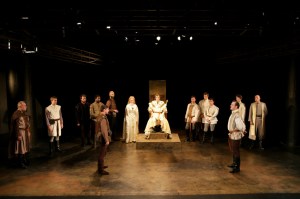
Cast of Richard II; photo by John Ullman

Cast of Richard II; photo by John Ulman

The complexity of Richard II, along with its confusing back story, poses daunting challenges for any director and cast. But Joshi and her actors bring a red-hot focus to what’s at stake for the two sides, and the story plays out with riveting dramatic rhythm.

It is Shakespeare’s ability to convey all of this through elaborately poetic language that particularly enthralls Joshi. Richard II is his only play written entirely in verse (even a gardener and his assistant carry on in lofty iambic pentameter).

“He’s able to use language to convey the inner workings of character and to externalize the souls and emotions of these characters,” Joshi explains. “At time we might feel the language is excessive: and that’s exactly the language we need in order to understand what’s going on with Richard.”

“I know lots of directors work from a very visual world, but I consider myself very text-driven.” Which hardly means Joshi’s work can’t be strongly visual — her production’s most indelible image reverses the moveable throne that dominates the minimalist set so that, in the prison scene, it becomes a looming gravestone — but she emphasizes that she wants such visual ideas to “emerge from the text. And what richer playground is there than Shakespeare, where the text delivers and encapsulates so much.”

Joshi is also intrigued by the ways in which Shakespeare blends the genres of history and tragedy in Richard II. And though it’s one of his less frequently staged plays, Richard II strikes a relevant chord because of the very modern crisis Richard faces, even within the play’s medieval setting.

Joshi points to Richard’s most self-reflective moments in the pivotal Pomfret Castle prison scene. “Take his lines: ‘but whate’er I be,/Nor I nor any man that but man is/With nothing shall be pleased, till he be eased/With being nothing.’ The density of meaning in that has always struck me as something that could be out of Samuel Beckett.”

“The existential journey that Richard goes through is something I think contemporary audiences can relate to in terms of how we define ourselves in the world. Richard has to grapple with who he is when he’s no longer king.”

“How does he cope with the absence of that identity? How does Henry edit his identity in order to become a leader? And how much are both shaped by who they are versus the people they have around them? Do we get the leaders we deserve?”

Richard in Pomfret prison; photo by John Ulman

Richard in Pomfret prison; photo by John Ulman

In fact, Richard II appears to have become a hot theatrical topic of late. Recent broadcasts by the BBC of The Hollow Crown series (the cycle of four history plays that begins with Richard II) has brought the melancholy Richard into the spotlight – as has a much-touted Royal Shakespeare Company production starring David Tennant as the deposed king, which was widely disseminated via HD cinemacast.

For Joshi, it’s no surprise that Richard II is suddenly brimming with contemporary relevance. “The history plays seem to come up more and more in part because we live in a politically cynical age. These are plays that focus on what people do for power and ambition. The first week of rehearsals, one of the news stories was of how Kim Jong-un had his uncle executed to consolidate his power.”

Yet in this case, Joshi has seen no need to “modernize” the setting in order to emphasize its relevance. “I’m always interested in the artificiality of theater. What does theater do that film doesn’t do?”

“We don’t compete with the kind of verisimilitude that you get in film because theater demands that the audience’s imagination be engaged to complete the experience. It is this pact we go into – audience and actors and designers – to create this world together through this act of imagination.”

(c) 2014 Thomas May. All rights reserved.

Filed under: directors, Shakespeare

Archive

Enter your email address to follow this blog and receive notifications of new posts by email.