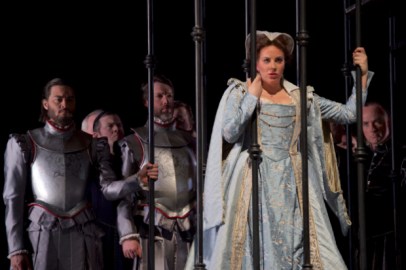
Joyce El-Khoury in the title role of Maria Stuarda; image credit: Jacob Lucas
My review of Maria Stuarda at Seattle Opera — where soprano Joyce El-Khoury has made a spectacular company debut — is now posted on Bachtrack:
Tudormania continues its invasion of America. Later this month at the Met, Sondra Radvanovsky will have added the third and final jewel to her Donizetti crown when she sings Elizabeth in Roberto Devereux. And across the continent, Seattle Opera has been presenting its company debut of Maria Stuarda (1835).
Finding a suitable label to encompass James Darrah’s artistic practice is not easy. He has directed operas in more or less conventional spaces, yet this represents only one sliver of his work. You’re also likely to experience Darrah’s art in the concert hall. Indeed, seeing the multimedia staging of Beethoven’s Missa Solemnis this past June by the San Francisco Symphony and Michael Tilson Thomas brought me one of the year’s most lasting revelations.
Although I didn’t have a chance in Los Angeles to experience the Hopscotch opera phenomenon firsthand, I’m trying to catch up vicariously. My colleague Alex Ross has written extensively and enthusiastically about this mobile opera, even calling it “a high-tech work of Wagnerian scale.”
Ross explains that the title “was taken from Julio Cortázar’s 1963 magical-realist novel, which invites the reader to navigate the text in nonlinear fashion.” As for its impact, he declares that Hopscotch “triumphantly escapes the genteel, fenced-off zone where opera is supposed to reside.”
At The Wall Street Journal, Heidi Waleson writes that “the experience is atmospheric rather than narrative, with each chapter a surprise and a plunge into the emotional character of the moment.”
Hopscotch‘s director Yuval Sharon, founder of the experimental opera group The Industry, “has broken the fourth wall with a vengeance, not merely freeing opera from the opera house, but making its heightened expression the sound of real, everyday and inner life,” Waleson concludes.
Mark Swed’s Los Angeles Times review, on the other hand, is more hesitant about what he views as a “hyped” production: “‘Mobile opera’ and ‘city pieces’ have been around for a while,” he reminds us. “…Operas with multiple composers and librettists, like Hopscotch, go back to the Baroque.”
“The actual experience of the opera is to be lost,” notes Swed. And indeed the complexity of the jigsaw puzzle fragments that are part of the whole story as well as “the engineering feat of making it all work are all part of the cool factor that has given the opera international attention. I, however, found nothing cool about riding around in a limousine through economically disadvantaged parts of L.A. These appallingly tacky vehicles are designed to keep you far removed from your environment.”
Swed’s proposed solution for the “self-involved, isn’t-this-cool response” Hopscotch has been eliciting?
I never thought I’d say this, but the first epic L.A. opera requires not artificial immersive reality but virtual reality. Let the Industry assemble all the episodes as transmitted to the Hub, all the animations and all the expendable material together online (or on an app or disc), and Hopscotch will surely and with irresistible suitability become the first exceptional hyperopera.
I’m still processing my reactions to the Deutsches Theater’s production of Nathan the Wise, the Enlightenment masterpiece from 1779 by Gotthold Ephraim Lessing.
“Provocative” would be an understatement — though provocation (or at least the semblance thereof) is mother’s milk in this theater scene by comparison with the usual fare in the English-speaking world.
At least it can’t be denied that director Andreas Kriegenburg, along with his designers Harald Thor (sets) and Andrea Schraad (costumes), has created a visually arresting production: inspired by the enigmatic monolith at the opening of Stanley Kubrick’s 2001: A Space Odyssey, it’s dominated by a large wooden cube — here, a ramshackle, hut-like structure that comically, unpredictably, moves back and forth on the stage.
The Kubrickian impetus is also apparent in a lengthy pantomime-prelude that has nothing to do with Lessing. Kreigenburg shows two “clay figures,” man and woman after the moment of their creation in the process of discovering each other, but then enters in original sin…by way of a primeval “us against them” pattern the cast enacts. And then a childish voice reminds everyone: “But what about the Lessing?” — and the “play” begins.
The comedy is the thing here: Kriegenburg has dared to radically rethink this sacred text of Enlightenment tolerance as an “archaic comic strip” in which the characters — still decked out in their primordial clay but adorned with cliched bits of dress and props to signify their religious affiliations — waddle about in the comic style of silent films, recalling Charlie Chaplin and Harold Lloyd in their gestures. (Some of their stage movement also called The Walking Dead zombie dramaturgy to mind, though I couldn’t tell whether that was intentional.)
Jörg Pose (Nathan), Bern Moss (Saladin), and Elias Arens as the arrogant young Templar play out their roles, but their gestures and even declamation of Lessing’s poetic text are riddled with an eccentric, frequently strained, range of comic moves. The shtick at times gives way to the crudest potty humor, as when the Patriarch — (Natali Seelig, outfitted in a grotesque fat suit) — holds his conference with the naive Templar while on the can. And all of this is accompanied by an almost ceaselessly piped-in soundtrack of clownish music, as if these were routines they had performed over and over.
The dramaturgical notes for the production speak loftily of the relation between comedic form and the “supremely serious” content of Lessing’s text. But is Kriegenburg merely underscoring a profoundly cynical understanding of Lessing’s vision as not only a marvelous “fairy-tale” with a “utopian conclusion” but, literally, a farce in the face of historical — and present-day — reality?
Does this explain his avoidance of allusions to gravely serious issues in the news today, to which an “earnest” director would clearly want to relate Lessing’s play — from the refugee crisis to the atrocities of Daesh? Such topical allusions as do appear are treated as jokes.
And yet, in the scene Nathan’s recitation of the famous Ring Parable, the tone changed, perhaps even in spite of the context. Much of the critical reaction I’ve seen has been pretty vehemently negative, but I can’t say my own experience was. At times I was reminded of the eccentric, apocalyptic humor of Ligeti’s Le Grand Macabre, at others of the craziness of Charles Ludlam and the Ridiculous Theater, where iconoclastic absurdity can suddenly trigger a shocking reversal into something profound.
Perhaps it was just the chance to encounter Lessing’s magnificent text again (in English here), however distorted.
My Bachtrack review is now live.
(I think I managed to catch all the autocorrects that
were turning “Nabucco” into “Nabisco.”)
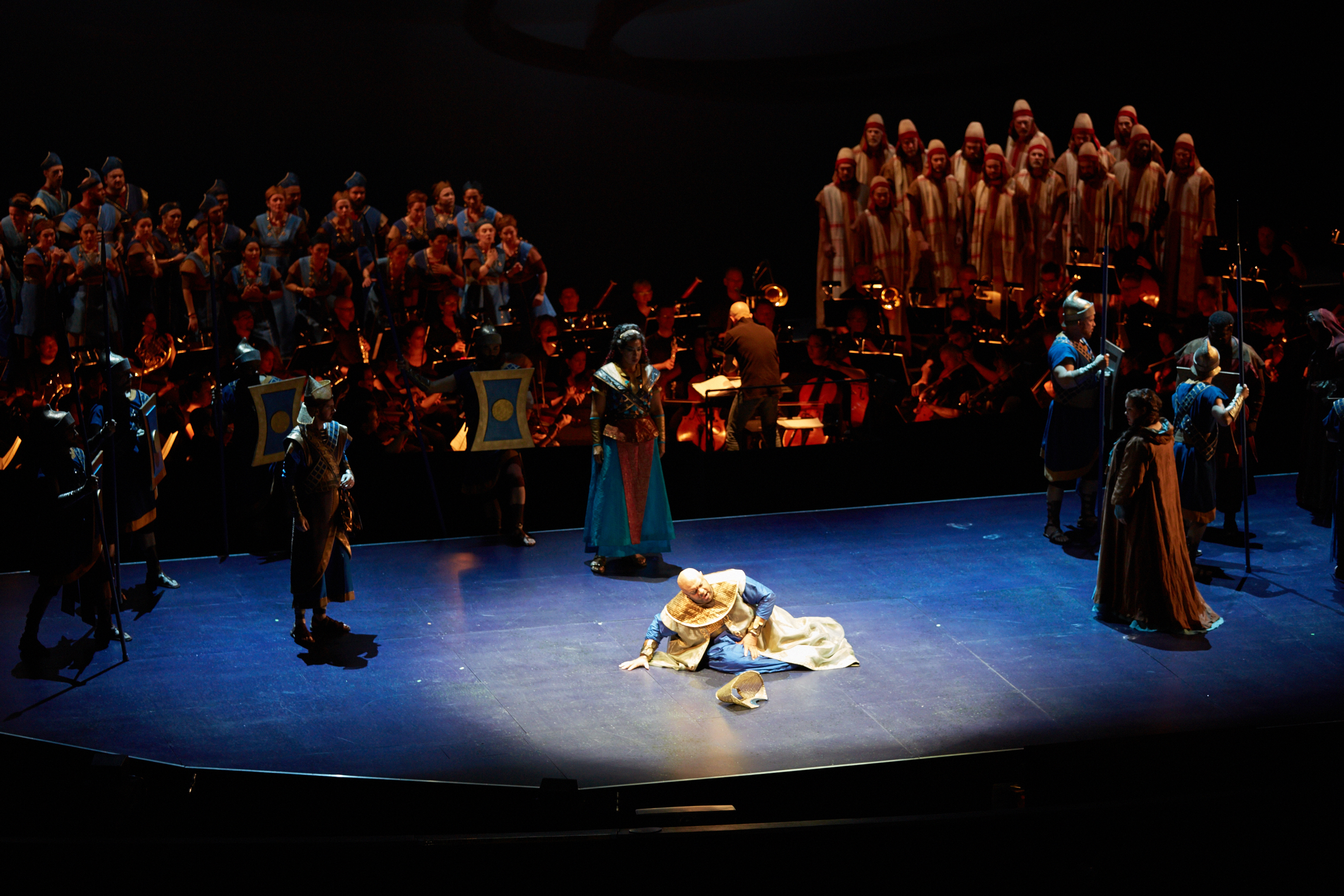
On paper, Seattle Opera’s new production of Nabucco sounded enticing. General Director Aidan Lang generated buzz about the ‘innovative staging concept’ we should anticipate for the company’s first-ever presentation of Verdi’s third opera. Seattle Opera had meanwhile undertaken a rebranding effort that included a design facelift of its website to emphasise large, bold visuals — with billboard-style tags announcing Nabucco: ‘BETRAYED’ ‘TWISTED’ “EPIC’.
Along with my Cold Mountain coverage, here’s the round-up review of three opera productions I wrote for Musical America, in the order in which they impressed me: Salome, Rigoletto, and The Daughter of the Regiment). (Sorry for the paywall, which prevents me from presenting the whole text here.)
SANTA FE — With the world premiere of Cold Mountain and the announcement of a newly commissioned opera about Steve Jobs by Mason Bates, Santa Fe Opera has been in the media spotlight over the past week. The company is also emphasizing its versatility in this summer’s three productions of familiar fare.
This week brings the San Francisco Symphony’s performances with Michael Tilson Thomas of the Missa Solemnis of Beethoven — a work that certainly belongs to my top-ten list of all time.
Following a trial run in Los Angeles in January, it’s being given as a “multimedia staged event”, complete with scenic, lighting, and video design; James Darrah is the director.
Of the earlier run in January, Mark Swed had this to say about MTT’s relationship with the Beethoven score:
In the grandest sense, this “Missa Solemnis,” with all its attendant baggage, is a kind of mission statement for MTT. He sets out to unpack a complicated artistic and musical construct, to reveal its workings and to treat it as a large-scale act of discovery.
The Missa Solemnis held intense personal significance for its composer as well: “Von Herzen — Möge es wieder — Zu Herzen gehn!” (“From the heart –- may it return to the heart!” wrote Beethoven on the copy of the score he presented to its dedicatee, his pupil and friend Archduke Rudolf.
For its public “premiere” in Vienna, three of the Missa‘s movements were given as part of the grand concert of 7 May 1824 that also unveiled the Ninth Symphony. (The secular context brought objections to performing the entire Missa.)
Next week MTT and the SFS continue their Beethoven Festival with a recreation of an earlier “marathon concert”: the one on a cold December night in 1808, when Beethoven premiered his Fifth and Sixth Symphonies, and Fourth Piano Concerto in a program that also included a concert aria, three movements from his other Mass setting (the Mass in C major), a piano fantasy, and the Choral Fantasy, that fascinating precursor to the Ninth.
Kate Lindsey (The Composer) and Sarah Coburn (Zerbinetta); photo (c) Elise Bakketun
My review of Ariadne auf Naxos has now been posted on Bachtrack:
At the end of Seattle Opera’s previous production – a refreshing new staging of Handel’s Semele – the ill-fated heroine is burned by Jupiter’s glorious fire, but the god Bacchus emerges from her destruction: “born as my mother expired in the flames”, as Hugo von Hofmannsthal has the wine god explain in his libretto for Ariadne auf Naxos.
My review of Pacifc MusicWorks’ Magic Flute production has now been posted on the Musical America site. (The complete review is behind MA’s paywall.) This was a delightfully fresh take on the Mozart classic, matching historically informed performance values with a provocatively revisionist staging (including a newly commissioned translation/adaptaton of Schikaneder’s libretto):
SEATTLE — A couple years after the conductor, lutenist, and recent Grammy laureate Stephen Stubbs resettled in his native Seattle in 2006 — following three decades based in Europe (mostly in Germany) — he established Pacific MusicWorks, a production company focused primarily on presenting Baroque opera and oratorio in innovative collaborations. PMW’s latest project, which closed on Sunday, offered a fresh perspective on The Magic Flute by combining period instruments with a provocatively anti-traditional staging directed by Dan Wallace Miller and a newly commissioned translation and adaptation of the libretto by the playwright Karen Hartman.