My latest piece for the Seattle Times (in the Sunday edition) has now been posted online:
What drives a composer to write music — especially for a group as complex as a symphony orchestra?
The Romantic era has conditioned us to look for the answer in lofty concepts like “self-expression” and “genius.” But that represents only one variable in an intricate equation.
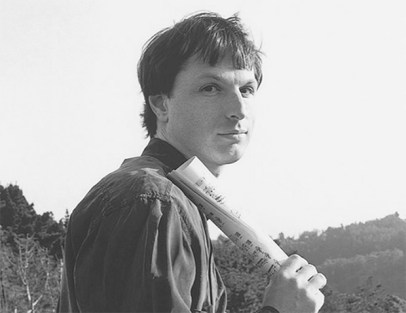
Huck Hodge, portrait by Mark Rabinowitz for the American Academy in Rome
Pairing Beethoven with a world premiere: that’s my kind of program, and it’s what the Daedalus Quartet unpacked for their recital Friday night at Meany Hall under the auspices of the University of Washington’s World Series (soon to be rebranded as “Meany Center for the Performing Arts”).
The Daedalus Quartet consists of Min-Young Kim and Matilda Kaul, violins; Jessica Thompson, viola; and Thomas Kraines, cello. This adventurous young ensemble, which has been quartet-in-residence at the University of Pennsylvania since 2006 while also maintaining a busy touring schedule, is a proud champion of an impressive range of contemporary music: George Perle, Ligeti, Carter, Kurtág, Joan Tower, and Fred Lerdahl are all part of the group’s rep.
On Friday Daedalus gave the world premiere of The Topography of Desire by Huck Hodge. Currently an associate professor on UW’s School of Music Faculty, the 39-year-old Hodge studied with Lerdahl and Tristan Murail and spent time in Stuttgart and as a fellow of the American Academy in Rome — all the while evidently developing a heady mix of philosophical, psychological and poetic interests that are embedded in his bold musical investigations.
His output includes compositions that draw on such material for inspiration as the pre-Socratic philosophers, the Gestalt theory of perceptual illusions, stellar parallax, seascapes at night, the poetry of Jorge Luis Borges.
The program note for his new piece observes that Hodge is also inspired by “uniquely northwestern American light patterns … ‘the way that a piercing slant of light, breaking through a dreary cloudscape, casts an intense, otherworldly chiaroscuro on the landscape,’ the ethereal yellowness of the light in bas-relief against the yawning darkness of the sky.”
Hodge himself took to the stage to introduce The Topography of Desire — a substantial work for string quartet cast in a single movement, which shared the program with two Beethoven quartets. The central question he sets out to explore in this music is nothing less than the insatiability of desire itself: the unbridgeable “gap between our needs and the way we come to represent them in the mind.”
While the composer’s printed note frames the issue of desire and non-fulfillment in terms familiar from French post-structuralist theory, Hodge’s comments onstage yielded a more-straightforward description of the two basic musical techniques he used to construct the piece. First is “detuning” of the inner voices (second violin and viola) vis-a-vis the “normal” tuning of the other instruments by a fractional tone, so as to build in harmonic friction. Such dissonance becomes an audible symbol of the “gap” and the itch for unison harmony.
The second technique involves Hodge’s use of a “phantom theme” — the ever-present melodic source content that derives from the overtone series, appearing in spread-out or super-speeded-up incarnations such that we never hear it clearly spelt out. That strategy reminded me, conceptually, a bit of the “enigma theme” in Elgar’s famous Variations.
The result of these techniques of “deferring unity” is to generate what Hodge aptly calls a “poetics of the near miss.” Presented in this context, Topography initially brought to mind the way we often encounter a contemporary art installation, via explanatory placards that help guide the view and point the way toward interesting things to look for — and I mean that in a good way, because the concert music scene has much to learn, in my view, from the presentation of new visual art.
Of course the ineluctable difference is that, once the music starts, you can’t scurry back and forth between the wall text and “the piece.” (If you do dip back into the program notes, you’re already losing the music however long your distraction lasts.) Hodge’s Topography was genuinely immersive, continually revealing surprises and new, unexpected corners as it unfolded.
The Daedalus Quartet played with the conviction and focus necessary to thread listeners through this musical labyrinth. The key idea of desire, for example, is emphatically not something to be “gotten” as soon as your ears have acclimated to the weird tuning. That’s simply a given, part of the foundation Hodge uses to then design an astonishingly varied edifice. Sometimes the fractional pitch differences (at times played with a sort of vibrato effect by the same instrument) sounded more conventionally “dissonant,” yet Hodge creates pockets — through shifting tempo, register, and counterpoint — in which the effect suddenly turns curiously peaceful and serene.
The composer referred to his experiences in Indonesia last summer studying Balinese gamelan music and the shimmering, vibrant quality of multiple tunings. Hodge manages to replicate this sensation with his scoring for four Western string instruments: Goethe’s famous metaphor of the Classical quartet as “a conversation among four reasonable people” is supplanted by a music alternately evoking confusion and prayer. At times it touches on the otherworldly spaces that Ligeti weaves with his micropolyphony.
Hodge’s intrepid ambition doesn’t stop at sharing a program with two Beethoven quartets (including what is arguably among the top five ultimate masterpieces in the genre, Op. 132). He also invites comparison with Richard Wagner, whom he mentioned in his remarks as the “grand master of the poetics of the near miss,” referring to the chromatic frustrations and delayed resolutions in Tristan und Isolde.
If you invoke Wagner/Tristan, you raise the issue of “the art of transition” — of mediating between strongly contrasting material through musically sensible and sensitive connections. Here I found myself less convinced by the structure of Topography — which is comparable in length to Schoenberg’s Verklärte Nacht (if not longer — I was unintentionally without watch). But the score is too richly layered to possibly grasp in one hearing, and I hope to have the opportunity for future encounters.
Heading outside at intermission after Topography, I was struck by how fitting the last glints of setting sun appeared as a commentary on the music — to the point of speculating how Hodge’s new work might sound as a site-specific, environment-based experience in the manner of John Luther Adams….
The Daedalus Quartet opened the program with the Quartet in D major from Beethoven’s inaugural Op. 18 set (replacing the originally announced Quartet in F major). Though no. 3 in the Op. 18 sequence, the D major is actually the first Beethoven completed.
Some indecisive intonation and tentative phrasing gave the impression that they hadn’t quite settled on an interpretation. Thematically, in any case, the yearning two notes of the opening phrase suggested an interesting Classical starting point for the music of desire that would follow in Topography.
They brought a more identifiable point of view to the ineffable Quartet in A minor, Op. 132, which filled out the program’s second half. Overall, the Daedalus steer clear of obvious dramatics. Their style is ultra-refined, elegant, even understated. There’s no playing to the gallery. This approach enhanced the mysterious melancholy of the first movement, which almost hinted at a dark undercurrent of repression.
Daedalus underscored the “normalcy”of the movements framing Beethoven’s “holy song of thanksgiving.” Even the theatrics of the recitative were restrained — too demure for my taste — and they kept the anxious passion of the finale from rising to a proper boil. Here, their subtlety of approach felt excessive, just when the reins should be loosened.
The centerpiece of Op. 132, the beyond-the-battle Heiliger Dankgesang, got an intriguing approach that was not without risk. They exaggerated the vibrato-less purity of the “Lydian” theme, which enhanced not only its archaic quality but the contrast with the “modern,” vibrato-colored Andante theme in this loose set of double variations.
Upon each variation of the opening section, they introduced more and more vibrato, converging on a richly resonant sonority in the final section. Initially the movement sounded too weightless, but the strategy proved to offer emotional satisfactions I wasn’t expecting.
A day in the life of Mason Bates: after this morning’s Santa Fe Opera season announcement, with a foretaste of The (R)Evolution of Steve Jobs, the San Francisco Symphony tonight unveils his latest orchestral piece, Auditorium. Here’s my introduction:
The relationship between Mason Bates and the San Francisco Symphony has played a pivotal role in the emergence of one of the most frequently performed American composers at work today. It began in 2009 with the first SFS commission of an orchestral work by Bates, The B-Sides: Five Pieces for Orchestra and Electronica (dedicated to Michael Tilson Thomas), and has continued through this most recent collaboration, which receives its world premiere on this program.
Here’s my program note on the Violin Concerto Mason Bates wrote for Anne Akiko Meyers, on this weekend’s program with the National Symphony Orchestra:
With the Violin Concerto of Mason Bates, this all-American program extends to music being written in the 21st century. At the same time, Bates’s adventurous outlook and interest in expanding the possibilities of the orchestral sound world link him to the American maverick tradition represented by such composers as Charles Ives, whose music concludes the program.
This week’s Seattle Symphony concerts bring the U.S. premiere of Valentin Silvestrov’s Symphony No. 8, a work in six movements. The world premiere took place last year, on 25 May 2015, in the composer’s native Kiev. Mikhail Tatarnikov (Music Director and Principal Conductor of the Mikhailovsky Theater in St Petersburg) will guest conduct.
Under Christoph Eschenbach, the National Symphony recently premiered Tobias Picker’s Opera Without Words — his first major orchestral composition in years. The perceptive critic Hilary Stroh gave a sensitive review for Bachtrack.
Here’s the program essay I wrote for the NSO world premiere:
Tobias Picker, described as “displaying a distinctively soulful style that is one of the glories of the current musical scene” by BBC Music Magazine and “a genuine creator with a fertile unforced vein of invention” by The New Yorker, has drawn performances and commissions by the world’s leading musicians, orchestras, and opera houses.
Jaffe is a San Francisco-based composer and performer with a special interest in computer music innovation (Silicon Valley Breakdown); he’s also a software developer and writer.
The Space Between Us, commissioned by the San Francisco Other Minds Festival and dedicated to Jaffe’s mentor, the legendary Henry Brant, receives its Seattle premiere. The work mixes acoustic instruments with “robotic percussion instruments” created by sound sculptor and maverick composer Trimpin.
Jaffe offers this background:
“It combines the remarkable ‘radiodrum’ 3D controller, which Seattle percussionist Andrew Schloss has pioneered, with Trimpin’s transformations of funky pre-war instruments I inherited from spatial music pioneer (and Pulitzer Prize-winner) Henry Brant, as well as eight string players distributed throughout the hall.”
Jaffe explains that Brant died before he could realize a collaboration he had been planning with Trimpin: “I was in Santa Barbara packing up for shipment the instruments that he left me in his will, and I got the idea of approaching Trimpin to see if he would be interested in doing a piece with these instruments in honor of Brant. He was enthusiastic so, at the very last minute, while standing at the UPS counter, I changed the destination address and sent the instruments directly to Trimpin….”
More info on the work, including reviews, can be found here.
The program will also include Jaffe’s virtuoso fiddle showpiece Cluck Old Hen Variations, “which sounds like what Paganini might have written if he were from Kentucky,” and Impossible Animals for computer voices, “in which the brain of a bird is transplanted into a wildly-gifted computer-generated soprano.”
The all-woman Lafayette String Quartet — for whom Jaffe has written several quartets — will additionally perform Shostakovich’s String Quartet No. 9 and English composer Rebecca Clarke’s Poem.
My latest piece on this wonderful composer has now been posted on Rhapsody:
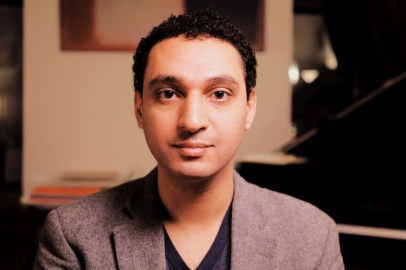
It’s not every day you expect a major talk show to spotlight a composer from the world of contemporary classical music. But Mohammed Fairouz has a way of defying expectations: Last May, MSNBC’s Morning Joe presented a segment on the young Arab-American composer — just one indication that Fairouz, only 30 years old, has rapidly become one of the most visible figures in the new-music scene.
My preview of two upcoming events at Stanford Live has now been psoted:
The coming weeks feature two unusual programs in Stanford Live’s ongoing performance season—each featuring a uniquely unclassifiable collaboration with chamber musicians. Singer-songwriter and composer Gabriel Kahane joins with the innovative string quartet Brooklyn Rider to bridge the gap between folk-pop songs and instrumental music. And in Nufonia Must Fall, DJ extraordinaire Kid Koala transforms his graphic novel into a one-of-a-kind music theater/film hybrid with the help of the Afiara Quartet, director-designer K. K. Barrett, a team of puppeteers—and a timeless tale of robots in love.


 My latest piece for the Seattle Times (in the Sunday edition) has now been posted online: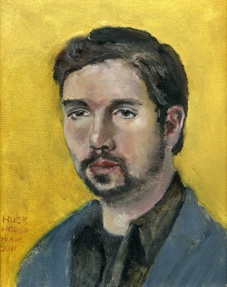

 David Aaron Jaffe
 My latest piece on this wonderful composer has now been


