MEMETERIA by Thomas May

Music & the Arts

A Radically New Cello Concerto

Here’s the more-complete version of my Los Angeles Philharmonic essay on Michel van der Aa’s remarkable cello concerto, Up-close, which gets its West Coast premiere in the Green Umbrella series next week:

Regular followers of the Los Angeles Philharmonic will have encountered the work of Michel van der Aa before, but Up-close has intensified his profile, particularly in North America, thanks to the acclaim it earned last year, when it received the mega-prestigious Grawemeyer Award for Music Composition. Written in 2010 on a commission from the European Concert Hall Association and the Dutch Performing Arts Fund for the Amsterdam Sinfonietta and the Argentine cellist Sol Gabetta – who premiered it in Stockholm in March 2011 – Up-close represents nothing less than a thorough reimagining of the concerto genre to mirror the way our high-tech, wired era shapes and compartmentalizes perceptions of reality.

Like Louis Andriessen, an important mentor with whom he has collaborated on such works as the multimedia opera Writing to Vermeer (1999), van der Aa has evolved a music theater aesthetic that resists classification in its intriguing combination of live performers and film visuals. The younger composer (born in 1970) studied recording engineering as well as composition in his native Holland and later enrolled in classes at the New York Film Academy. Many a composer combines multiple talents within the realm of music, but van der Aa brings a synthesis of composer, stage director, and filmmaker to several of his endeavors, including Up-close.

Van der Aa has also created works showcasing each of those talents separately. He emphasizes that his use of film visuals and extra-musical components has to be “a necessity,” not an adornment “which is there merely to be hip or entertaining. I try to be strict with myself, to use film in a way that extends and enhances my musical vocabulary. The film contributes something I can’t communicate with the music alone.” In Up-close, Van der Aa points out, he conceived the music “in parallel with my work on the script for the film and the small staging. These feed into each other. I like that flexibility. Sometimes the music gives me visual ideas, and sometimes it’s the other way around.” He considers Up-close to be a work of music theater, the cello concerto embedded within as a part interdependent on the whole.
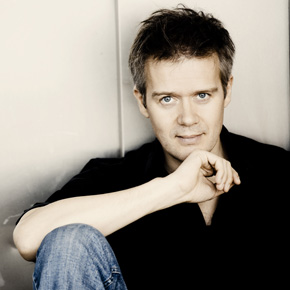
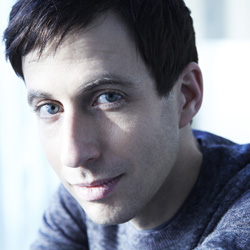
Michel van der Aa (photo: Marco Borggreve)

Michel van der Aa (photo: Marco Borggreve)

Along with the familiar three-movement concerto format which he uses as a formal design for Up-close, van der Aa explains that the relative significance of its constituent layers likewise structures our sense of unfolding events. Their interrelations also pose unique challenges of synchronization. There are three such layers: the conventional one of the solo cellist and the all-string ensemble, the “mirror reality” of the film that is projected simultaneously, and the prerecorded sounds (encompassing electronic samples and the film’s soundtrack).

There is a fourth layer, which is less extensive, pertaining to the instructions for the soloist to take part in the mise-en-scène (as at the end of the first movement, when the cellist gets up and moves a lamp on the stage). “It provides a way of exaggerating the inherent theatricality of instrumentalists,” according to the composer. The soloist is required not only to perform with traditional musical virtuosity but also to act. The gulf separating the illusionistic reality of the film and that of the live performance becomes one of a cascading series of metaphors for what van der Aa has described as “a dream about communicating” which in the end fails.

But all of these layers don’t function with equal intensity throughout. The process of creating Up-close involved determining at each point “which of these layers are in the foreground, and which are in the background.” In the opening minutes of the work, the soloist remains in the spotlight, introducing crucial thematic material that will appear in new lights in conjunction with the other layers. The connections between the three movements make the shifting perspectives of van der Aa’s concept especially evident. For example, a lengthy segment of about five minutes bridging the first two movements brings the film to the center of attention as the main bearer of the “narrative,” with a thinned-out sonic background from the prerecorded music and the live ensemble remaining silent until metal chimes link up their world to the enigmatic “code machine” in the film. (Van der Aa collaborated with a friend who works as props master at the opera to build this visual, imagining “a cross between a music box and a Morse machine.”)

For the frenetic final movement, the code machine “ignites the ensemble” back into action, as the strings pulsate with a nervous energy at times reminiscent of Bernard Herman. Van der Aa likens the musical patterns of their “timbral counterpoint” to “little wood fires spreading through the ensemble,” while the woman in the film becomes increasingly anxious.

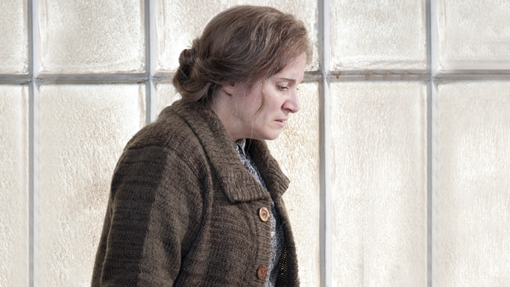
Writing the piece originally for Sol Gabetta, the composer imagined the elderly protagonist in the film as a kind of “alter ego.” The Dutch actress Vakil Eelman was chosen, he explains, because he wanted “an archetypal elderly figure: someone who carries youth in herself as well as wisdom and experience. I really like that ambiguity in her.” Johannes Moser is the first male cellist to perform as Up-close’s soloist, which, says van der Aa, “will generate different questions, but not necessarily less interesting ones, about the relationship between these two people – the actress in the film and the soloist on the stage. I think it’s important to let the audience take the last steps itself to decide what the piece is about.”

And my commentary on the other works on the program is here:

Pierre Boulez, Éclat
Elliott Carter, Triple Duo

(c) 2014 Thomas May — All rights reserved.

Filed under: composers, new music, orchestras, program notes

Rising Up with Meredith Monk

Meredith Monk; photo by Masimo Agus

Meredith Monk; photo by Masimo Agus

Songs of Ascension is one of Meredith Monk’s creations of the past few years. If you don’t know her incomparable music yet, this is a wonderful place to start exploring it.

Monk’s unclassifiable art is grounded in a unique understanding of the flexibility of the human voice. She loves to create new contexts in which to fathom its expressive depths. The result is music that sometimes sounds as if it had been quarried from an archeological dig or beamed in from a distant future. Both impressions emanate from Songs of Ascension, the tenth project Monk has recorded for ECM since her path-breaking Dolmen Music was released three decades ago. That discography charts her intrepid forays “between the cracks,” as Monk likes to put it, where different ways of perceiving the world through art converge.

On one level, Songs of Ascension encapsulates Monk’s aesthetic outlook over a long career, one in which the voice serves as a guiding thread for her interdisciplinary performance pieces. But it also reveals the undiminished curiosity of her artistic quest by incorporating the expanded musical language Monk has evolved over the past decade. With Possible Sky (2003), her first work for orchestra, Monk began to apply her intuitive sense of the voice as a complicated instrument to larger ensembles, teasing out the feedback between singers and instrumentalists in ways that rethink the very bases of composition.

Songs of Ascension represents an ambitious example of this development in her work. One stimulus for the work was Monk’s encounter with poet Norman Fischer’s translation of the Psalms into a Zen-infused language. His imagery led to further reflections on the trope of worshipers ascending a mountain and pausing periodically to sing a psalm of praise. A simultaneous invitation to collaborate with visual artist Ann Hamilton further clarified her evolving musical images, adding a site-specific dimension. Hamilton’s project involved performing while ascending a new tower the artist had designed in Sonoma County, California, inside which a pair of staircases that resemble a double helix spiral upward. In this form Songs premiered in October 2008.

To explore her fascination with the connection between worship, transcendence, and images of ascension, Monk interweaves a fabric drawn from her recent experience writing for string quartet and the signature extended technique of her own vocal ensemble (with the added contributions of The M6 and the Montclair State University Singers). Other threads she includes are woodwinds, an array of percussion, and a blend of Western and Eastern sonorities (with a prominent role for the harmonium-like shruti box, which is associated with Indian music).

In place of a libretto the “text” consists of unpredictable patterns of abstracted phonemes, fluid vocalise, and shaman-like incantations. Yet even as non-sense replaces the logic of language, the vocalizations by Monk and her collaborators seem to imply the origin of speech rather than the disintegration of Babel.

The effect is especially enchanting at the beginning of the piece, which the string quartet inaugurates with sustained whispers of just a few pitches: a gentle fog which rises to reveal the echo of human voices. These “clusters” (in Monk’s terminology) set the stage for the sprouting of song, the blossoming of harmony. The interlinked sections are the first two of 21 that comprise Songs. Monk’s titles cue us in to recurrent patterns—and are also provocatively enigmatic (why are the seasons out of order, and why are winter and autumn instrumental-only while summer and spring include voices?).

Monk’s continual intercutting of highly varied textures builds a sense of larger-scale momentum. The section “mapping,” for example, suddenly introduces a new tone of festive tintinnabulation, while the gliding swoops of strings and voices in “falling” convey the curious sense of whimsical archaism that tempers the more meditative sections crisscrossing through the work. The range of Monk’s vocal idiom is literally breathtaking: a strangely beguiling repertoire of aviary microtones, robust yodels, insectoid whispers, and (in the penultimate “fathom,” a lengthy solo for Monk as she accompanies herself with a shruti box), dusky, low-range chanting. The final number, “ascent,” makes for an inspiring conclusion to the adventure, its layered sonic tapestry suggesting an endless procession/quest as solo lines leap in ecstatic figures from the drone-like foundation.

Though the original Songs of Ascension was conceived as an “immersive experience” with video and site-specific movement, Monk’s music is thoroughly evocative on its own terms. ECM’s engineering gives the music rich, warm resonance and even manages to convey something of Monk’s spatial acoustic. The recording was made in 2009 at the Academy of Arts and Letters in New York. The booklet includes a smart essay by composer Kyle Gann and a color-photo essay from the premiere in Hamilton’s tower. Songs is further confirmation of the musical treasure we have in Monk, who shows no signs of slowing down.

(c)2014 Thomas May. All rights reserved.

Filed under: American music, CD review, new music

CD Review: Hochman/Homage to Schubert

Benjamin Hochman

Benjamin Hochman; photo by Jürgen Frank

I haven’t yet had the pleasure of encountering Benjamin Hochman in live performance, but I come away from his new release, Homage to Schubert, with a remarkably vivid sense of what he brings to the competitive scene of today’s young pianists. This is his second solo album and debut recording for the AVIE label, and it amply reveals Hochman’s qualities as an interpreter as well as the creative and original programming style that appears to be a signature.

A native of Jerusalem now based in New York, Hochman counts Claude Frank and Richard Goode among his mentors. He made his New York debut in 2006 with a Met Museum recital juxtaposing Bach, Berg, Schubert, and a newly commissioned piece. A similar imaginative leap ties together his program here: two lesser-known Schubert sonatas and a pair of contemporary pieces “commenting” on the Austrian’s legacy — by György Kurtág (Hommage à Schubert) and Jörg Widmann (Idyll und Abgrund), respectively. Hochman performs on a Steinway and benefits from the tasteful production and engineering (Eric Wen and Dennis Patterson).

Of course there’s lots of powerful competition even when it comes to these less-familiar Schubert sonatas. Paul Lewis, the spiritual scion of Alfred Brendel, has recently staked an irresistible claim to this territory, and Mitsuko Uchida is another eloquent advocate. (She also began linking Schubert’s piano music with Schoenberg back in the ’90s.) A fundamental attraction of Hochman is that he allies a natural sympathy for Schubert’s brand of musical thinking with superbly balanced technique, all the while effacing any temptation to showboat or force a newfangled reading onto these scores.

In other words, Hochman’s overall stance toward Schubert himself is pretty traditional, while smartly allowing the “moderns” sharing his program to provide a contemporary angle. It’s a daring and subtle strategy, and one that rewards the listener. Which is by no means to imply that there’s anything even remotely stodgy or routine here: Hochman initiates the proceedings with the gorgeously spun lyrical flow of the Sonata in A major D664 (from 1819), his control of the pulse so mesmerizing that it seems as if this music has always been going on — a stream we’ve been graced to chance upon.

Hochman is fully alert to the potential of Schubert’s wild contrasts. That’s the premise, after all, of pairing the gentle, smaller-scale A major with the hugely ambitious and even aggressive Sonata in D major D850 (the so-called “Gasteiner,” after the spa town where it was written in 1825, the year Schubert sketched most of the “Great” C major Symphony). Yet Hochman doesn’t overload these contrasts with melodrama, but lets the few outbursts in D664 take us by surprise within the larger context.

At several points I could almost imagine D664 versus the “Gasteiner” as a precursor for Schumann’s Eusebius (especially in the melancholy appoggiaturas of D664’s Andante) and Florestan dichotomy. But what excites me the most about Hochman’s deeply satisfying approach to D850 is his implicit understanding of the Schubert-Beethoven connection. By this point, Schubert’s acquired admiration of the German composer had begun inspiring a new level of ambition (he was a Beethovenian convert).

Hochman seems to hint at the uncanny echoes of late Beethoven, as in the “Gasteiner”‘s widely wandering second movement, where one passage of reiterated chords suddenly approaches the radiance of the Arietta in Beethoven’s Op. 111. But he avoids any impression of Schubert as an imitator or epigone: these moments occur as genuine Schubertian epiphanies within a remarkably different musical landscape.

Between Schubert and Beethoven, there is an almost diametrically opposed sense of drama, as Hochman points out in his excellent booklet essay, alluding to Brendel’s famous image of Schubert “the sleepwalker” in contrast to Beethoven “the architect.” That groping around unforeseen corners to alight on a new vista that is so characteristic of Schubert is especially apparent in the weirdly mercurial variants of the finale’s rondo theme as Hochman performs it.

As for the contemporary homages, Hochman has chosen two utterly distinct ways of thinking about Schubert. Kurtág’s lapidary piece (lasting about a minute) distills the contradictory ingredients that make up Schubert into an intense poetic reverie — a musical life that flashes before our ears.

The German composer Widmann — who is just 7 years older than Hochman — has meanwhile written a miniature suite of “six Schubert reminiscences” in Idyll and Abyss (originally conceived as a companion work to the great final B-flat Sonata D960). Teasing direct references to cadences and phrases slip a reflective scrim over the distance between Schubert and us. Alternately playful and disturbing, Widmann’s suite rudely juxtaposes the many sides of Schubert’s personality, purposely emphasizing the paradoxical nature of a genius that encompassed sweet melody, leisured reflection, and savagely violent outbursts. Widmann and Hochman leave it up to the listener to put the pieces together.

(c)2013 Thomas May. All rights reserved.

Filed under: CD review, new music, review, Schubert

Protected: Stairway to Heaven: A Major Seattle Symphony Premiere

This content is password-protected. To view it, please enter the password below.

Filed under: Beethoven, composers, new music, review, Seattle Symphony

Silver Apples and Cloudless Sulphur Skies

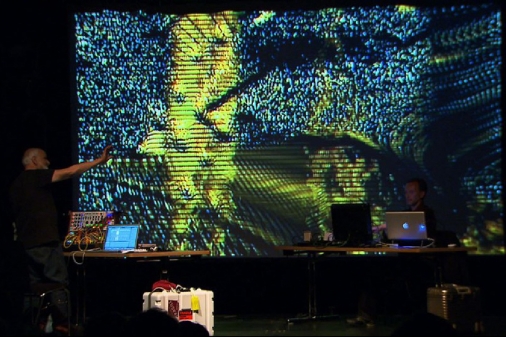
Morton Subotnick, who at 80 looks as eager as ever to experiment with his Buchla and laptop, rolled into town recently to perform a decades-spanning program at Seattle’s Town Hall. Joining him onstage was Berlin-based video artist Lillevan. The two have been collaborating on several projects in recent years, and both are obviously so well attuned to each other’s aesthetic that they can improvise with pre-existing material. It all added up to a blissed-out gesamtkunstwerk for synth geeks and video art aficionados.

The concert’s official title – “From Silver Apples of the Moon to A Sky of Cloudless Sulphur IV: LUCY” – refers to the main sources for the prerecorded music Subotnick used to build the performance in tandem with Lillevan’s abstract imagery of fluid and fractal-like shapes in restless transformation. Subotnick describes his current process:

For each season of performances I create a new hybrid Ableton-Buchla “instrument” loaded with prepared samples from all my previous works and performances and new patches that will allow me to modify the samples while performing brand new sound gestures created especially for the new season. The work always has the same title, “From Silver Apples of the Moon to a Sky of Cloudless Sulphur IV: LUCY.” The “IV: LUCY” refers to the season number and the name given to the newest materials.

Subotnick in action

Subotnick and Lillevan in action

Subotnick’s gently processed whisperings and vocalizations – sent whirling about the surround-sound arrangement of speakers – launched this voyage of about an hour or so. Of course the act of musical performance itself tends to override ordinary clock time, to make it seem simultaneously speeded-up and in slow motion. But in this case, time seemed to become unmoored as if we were in a gravity-less environment.

The early atonalists used to worry about how to structure a piece without the old familiar signposts. Subotnick’s large-scale excursions can echo the craggy, mountainous landscapes of a Romantic tone poem, no matter how “alien” the sounds. Inevitably I found myself turning to metaphors, both from the natural world – that ubiquitous “watery” sound of electronics – and from acoustic instruments, imagining a troop of pizzing strings here, bleating woodwinds there.

Lillevan

Lillevan

Berlioz’s opium dreams, the psychedelic trips of the ’60s: why is it this intensely focused sense of isolation, of utter aloneness, much more than any Dionysian, “orgiastic” frenzy, that they so strikingly share? Above all I’m fascinated by Subotnick’s “art of transition” and his ability to steer toward heaving climaxes, only to dial the mood down within a short span, like a turntablist working the dance crowd – even though we were all passive listeners.

Just before the performance, Subotnick recollected how exciting it was to be a young composer in the late ’50s, when the introduction of the commercial transistor seemed to point the way toward a new utopian paradigm: music that could be made and performed by everyone, not limited to “the 1%” who had the training for classical music-making. Yet for all its influence on popular culture, and for all the revolutionary changes in daily life this technology has enabled, the type of electronic composition Subotnick pioneered still inhabits a rarefied world of its own.

Filed under: electronic music, new music, video art

george WASHINGTON

Roger Reynolds, 2005

Roger Reynolds, 2005

Despite the recent government shutdown, this month’s world premiere of george WASHINGTON by the National Symphony went ahead as scheduled. Here’s the essay I wrote for the program:

“I believe all things will come out right at last, but…the people must feel before they will see.” These words of George Washington (1732-1799), observes Roger Reynolds, might serve as the epigraph for his new composition. They occur in the final section of the libretto for george WASHINGTON, which Reynolds carefully selected and assembled from the diaries and letters of the iconic figure. In comparison with Washington’s relatively “wooden” speeches, which represent a “publicly constructed persona” intended to shield his imposing image, these more intimate sources proved to be a wellspring: “I was staggered by his wisdom, his sensitivity, even his ability to be poetic and to make emotively potent statements.”

The priority of experience as the gateway toward true understanding, Reynolds adds, is an idea that recurs in Washington’s writings, but it also expresses the composer’s own goal for the work. He envisioned george WASHINGTON as a multimedia amalgam of orchestral music, narration, visual projections, and computer-processed “surround” sound. All of this elaborate technical apparatus, in the end, is meant to provide an immersive experience that can “provoke the imagination and arouse in the audience some sense of their own relationship to Washington as a human being. It’s not about giving a history lesson but about trying to enter into Washington’s world.”

continue reading

Filed under: commissions, music news, new music, orchestras

Remembering Toby Saks

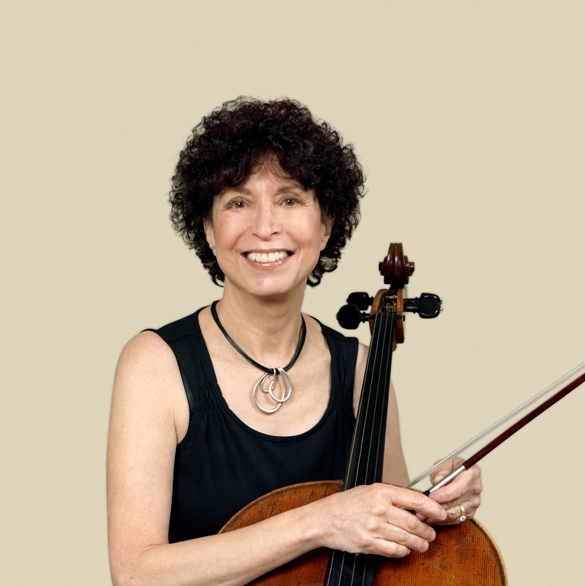
Toby Saks

Toby Saks

Yesterday evening Seattle’s Benaroya Hall was the gathering place for a large crowd of musicians, music lovers, friends, and members of a very extended family who were there to commemorate Toby Saks. She died two and a half months ago, just after a particularly successful edition of the annual summer Seattle Chamber Music Society Festival, her baby, had come to an end.

Toby Saks’s legacy as a cellist, educator, festival organizer, champion of new talent, and overall remarkable human being was recalled last night from many different angles. There were moving personal anecdotes from her circle of friends and peers. Most significantly, the event centered around performances featuring a combination of local musicians and others traveling from around the country — over 60 musicians, all told. They made it clear that it is through living music most of all that Toby would want to be remembered.

Quite a few were wearing buttons custom-made with a photo of the cellist smiling and the inscription “I’m Here for Toby.” The official program was framed by excerpts from Toby’s extensive archives — performances restored from reel-to-reel tapes and converted to digital format by her brother, Jay David Saks, a musical producer for the Metropolitan Opera.

Toby Saks - (c)Seattle Chamber Music Society

Toby Saks – (c)Seattle Chamber Music Society

One of the restored pieces listed in the program was of the Dvořák Cello Concerto as recorded by Toby at 19 with the Kol Yisrael Symphony Orchestra (in Jerusalem, 1961). Gerard Schwarz, the Seattle Symphony’s conductor laureate, spoke eloquently of the first time he had heard her playing, which happened to be this very work. It took place at the High School of Performing Arts in New York – her alma mater, where Schwarz was then studying – as Toby as en route to participating in and winning the Pablo Casals Competition in Israel.

Schwarz reminded us that Toby was among the very first women cellists of the New York Philharmonic and noted the many ways in which her musicality continued to astonish and inspire him throughout their decades together in Seattle. Schwarz himself led a string orchestra (some Seattle Symphony players with mostly SCMS associates) in a rich-voiced account of the “Elegia” movement from Tchaikovsky’s Serenade for Strings to open the celebration. For all the sense of loss and the meditative, even solemn character of most of the musical selections, that’s exactly what the event was: “This is a celebration of life,” her husband, Dr. Martin Greene, reminded everyone. “It’s not about mourning.”

Greene introduced a video tribute looking back over Toby’s 30 years heading the Chamber Music Festival she had founded in 1982. Her fellow musicians competed to outdo each other with their praise and gratitude for how much she had influenced their lives, their careers, converging on a shared theme of “Mama Tobs” as an insatiably generous and passionate advocate for music. Violinist James Ehnes, who took over as artistic director of SCMS two years ago, described what a vital force she had been, operating a complicated network and interacting with hundreds of musicians through the years. Robin McCabe, director of University of Washington’s School of Music, recalled Toby’s “feisty” vitality and fierce love of her students.

Of the many remarkable musicians who were on hand to perform in Toby’s honor, cellist Robert deMaine’s performance of the Largo from Chopin’s Cello Sonata (with pianist Jon Kimura Parker) struck me as especially heart-felt, to the point that his warmth of phrasing seemed to be speaking directly to Toby – cello to cello, as it were.

Toby Saks

A particularly notable moment was the premiere of a new piece, spontaneously composed in memory of Toby Saks by Lawrence Dillon as soon as he learned of her passing. Dillon had gotten to know her only recently in connection with the chamber work he was commissioned to write for this past summer’s festival. His Passing Tones, for three cellos and violin (Ehnes and deMaine, Jeremy Turner, and Andrés Díaz). This compact, elegiac essay carried a poignant reminder of the principles of ensemble and the individual voice, the creative tension between them, that’s at the heart of chamber music making – and about which Toby was so passionate.

Martin Greene introduced the closing number, remarking there could be no better way to end than with a composer his wife especially loved, rendered by an orchestra of her favorite instrument, the cello. And so 19 cellists took the stage, with Schwarz again conducting, to play the arrangement by Heitor Villa-Lobos of Bach’s Prelude No. 8 in E-flat minor from Book One of the Well-Tempered Clavier. A prelude, not a postlude, speaking worlds about the enduring ways in which Toby touched the lives of those around her.

Filed under: chamber music, new music

Peter Lieberson’s Final Word: Shing Kham

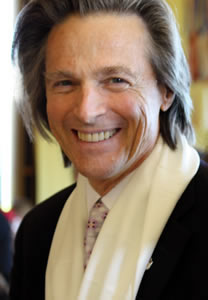
Peter Lieberson

Peter Lieberson

I can’t believe it’s been over two years since the passing of Peter Lieberson, a truly wonderful human being and a highly gifted artist. He had so much still to say when he left us.

For the posthumous Los Angeles Philhamonic premiere of Peter’s percussion concerto, Shing Kham, I had the unique privilege of being able to write about his final — but unfinished — word as a composer. I’m so grateful to Peter’s widow Rinchen Lhamo and the marvelous percussionist Pedro Carneiro for sharing their memories and insights regarding what Peter was thinking about when he worked on the score up until his untimely death in Tel Aviv on 23 April 2011.

Here’s the note I wrote for the LA Phil’s concerts:

For Peter Lieberson, working on what would be his final composition “was a life-sustaining and joyful activity,” according to the writer Rinchen Lhamo. She adds that it’s likely Pedro Carneiro’s “unique capacities as a percussionist had something to do with this: something brand new for Peter to wrap his mind around.” Lhamo was Lieberson’s wife when he died from complications of lymphoma in April 2011. Although he had been in treatment for some years, she recalls that her husband anticipated being able to complete Shing Kham up until his last bout of illness, which arrived suddenly and unexpectedly. Several other projects on the horizon – including an orchestral song cycle he planned to compose to poems by Lhamo – additionally indicate the resurgence of creative energy that accompanied work on the percussion concerto.

continue reading

Filed under: music news, new music, spirituality

Tales of King

Claiborne_med_racette
Patricia Racette as Dolores Claiborne; photo by Scott Wall

Dolores Claiborne the new opera by composer Tobias Picker and librettist-poet J.D. McClatchy, opens in just a week at San Francisco Opera. I recently interviewed Picker and McClatchy about their collaboration for my latest SF Opera feature:

The story really matters. That premise may seem self-evident, but there’s a long-standing cliché, at least as far as opera is concerned, that the story is what you have to put up with to get to the music—never mind that Verdi and Puccini obsessed over their choice of subject matter and tormented their librettists whenever it was time to consider a new project for the stage. One of the happy side effects triggered by the American Renaissance in opera that’s been unfolding for the past two to three decades has been to puncture the silly notion that the story is, at best, incidental to the experience.

“For me,” asserts Tobias Picker, “opera is about telling stories in music.”

Read the whole thing here

Filed under: composers, literature, new music, opera

Archive

Enter your email address to follow this blog and receive notifications of new posts by email.