And so Sir Harry turns 80! Harrison Birtwistle has created some of the most strangely arresting soundscapes among the composers of our time. It’s extremely difficult music to write about, as I’ve discovered with various assignments over the years. Music that defies even more than most the feeble attempt to circumscribe it with mere words — it makes mincemeat of those who try — but that can strike you as uncannily direct and visceral. (See what a knot he just got me caught up in?)
Among my favorites of his “satellite” works are Earth Dances, The Shadow of Night, and Night’s Black Bird — disturbing and thrilling works Birtwistle conceives as orchestral “processions” and “imaginary landscapes.”
All of these seem to be parts of a vaster, labyrinthine work-in-progress, with a number of threads interwoven among them. Chief among these is a tension between linear and circular patterns, between an “ordinary” sense of chronological time and a heightened awareness of other kinds of times.
Tom Service offers this lovely, user-friendly intro to the utterly distinctive world of Sir Harrison Birtwistle, including Panic, The Cry of Anubis, Secret Theatre, Earth Dances, and the Violin Concerto.
In his excellent series of guides to contemporary composers, Service writes:
So where was the crucible of Birtwistle’s creative imagination? Manchester in the 1950s. Born in Accrington in 1934, and growing up as a clarinetist playing in local theatre bands, Birtwistle studied in the north west with what would become an (in)famous group of composers and musicians: Alexander Goehr, Peter Maxwell Davies, pianist John Ogdon, and trumpeter, conductor, and composer Elgar Howarth.
The usual story about what this “Manchester school” achieved was that they ripped up the rule book, and made British music confront contemporary continental modernisms that previous generations and the establishment had been frightened of. That’s true, to the extent that Harry, Max, and Sandy did engage with and devour everything they could get their hands on by Schoenberg or Webern or Stravinsky, and one of the pieces that changed Birtwistle’s life was Boulez’s “Le marteau sans maître.”
But just as there was a move to the modern, there was an equivalent excavation of the musical and mythical past, as Max and Harry delved into medieval music, into plainchant and polyphony, to find new-yet-old ways of structuring and thinking about what music could be.
The composer Derek Bermel gives an introduction to his new Piano Trio, titled Death with Interruptions after José Saramago’s novel. Commissioned by the Seattle Chamber Music Society, it receives its world premiere on tonight’s program, part of the 2014 Summer Festival.
My recent preview of the Summer Festival includes more on Death with Interruptions from my interview with Bermel.
So the Seattle Symphony gave a special one-off concert last weekend, part of its Sonic Evolution series. The series — just one of the many ideas music director Ludovic Morlot inaugurated in his first season three years ago — is basically about connecting the orchestra with other musical genres spawned in the Seattle region.
For this latest edition of the series, a trio of young (or youngish) composers was commissioned to write original orchestral pieces responding in some way, with no strings, so to speak, to musical figures linked culturally or biographically with Seattle. There was the Portuguese Luís Tinoco; Du Yun, a Chinese-born composer based in New York; and Gabriel Prokofiev, who is, yes, the grandson of Sergey, who is based in London. (He’s the only one of seven Prokofiev grandchildren with a career in music.)
Composer Du Yun
Their new compositions drew loosely on source inspirations, respectively, from Bill Frisell (who lives in the region), Ray Charles (who made his first recording in Seattle, the town “where I got my start,” as Charles once said), and the hip-hop legend Sir Mix-A-Lot. The latter’s onstage performance, backed by the Seattle Symphony, is of course what grabbed the headlines.
A final segment of the program was given over to a local band called Pickwick; they performed three of their soul-infused songs to the accompaniment of the SSO, in arrangements by David Campbell (a Seattle native who’s done lots of work for film soundtracks).
Sure, the loaded concept of “crossover” has been responsible for many a dubious or at best misguided project. The standard critique runs something like this: if you present an orchestra playing versions of “pop music,” it dilutes the original into a sappy, watered-down product while making a mockery of the players’ musicianship. Neither constituency (the classical or pop audience) is likely to find the result appealing, so what you get is music that exists in a kitschy limbo, a no-man’s-land of pointless vulgarity.
All too often that actually is the case, as we all know from any number of dreadful PBS pledge promos. But — a big but — that kind of simplistic, pandering crossover doesn’t fairly describe what the Sonic Evolution project is after. And certainly not what actually happened on Friday night’s concert.
It’s been amusing to see how many commentators who weren’t actually there consider themselves entitled to pontificate. (And yes, there really is an “aura” aspect to these concerts that you can’t absorb via youtube osmosis.)
I’m referring mostly to the naysayers who conclude that such efforts spell the doom of civilization, but just as much to the hipster pundits who think everything else the Symphony does is irrelevant or that the pairing of Sir Mix-A-Lot and Morlot represents a rare moment of cultural credibility that you don’t get with business as usual.
Many seem to assume that the whole concert was about having the SSO play Sir Mix-A-Lot “covers” in a madcap attempt to fill the house and stir up media attention. Do they really think an entire season has been planned around busily orchestrated versions of pop music icons? That there’s going to be no more Brahms or Bach or Beethoven — or Dutilleux and Ravel, to mention the splendid program that also took place last week, one which happens to serve as a perfect example of the level of artistic excellence at which the SSO is playing these days?
In fact, Prokofiev crafted two orchestrations of hits by Sir Mix-A-Lot (“Posse on Broadway” and “Baby Got Back”), but his main event was a completely new composition titled Dial 1-900 Mix-A-Lot. In my opinion this was the most interesting music of the program, brimming with invention and a one-of-a-kind orchestral imagination. Among the challenges Prokofiev set himself was to deploy the full orchestra on its own terms, without resorting to boring cookie-cutter gestures and predictable sectional blocks. (Prokofiev discusses the process of working on this piece on his blog.)
Gabriel Prokofiev
Besides, you’ve got to admire a piece that prompts this in the program note (written by my friend Aaron Grad, also a composer): “A recurring four-note motive, for instance, traces the rhythm of the opening phrase from ‘Baby Got Back’: ‘I like big butts.'”
I also very much enjoyed Tinoco’s kaleidoscopically orchestrated ruminations in FrisLand, which he describes as “an imaginary voyage through an (also imaginary) sound-world inspired by Frisell’s music.” It was interesting to learn about the juxtaposition of Ray Charles with a bit of Buddhist folklore in Du Yun’s Hundred Heads, though I admit that the musical argument of her piece left me puzzled; here the fusion didn’t persuade me.
Luís Tinoco
What I did find cringeworthy about the concert, though I haven’t seen anyone else mention it, was the final set spotlighting Pickwick. I’m sure they’re eminently enjoyable on their own terms, in their usual setting. But this was the part that for me reeked of cheesy crossover. Why? The three songs were two much of a kind, but most of all because of the dreary paint-by-numbers arrangements that wasted the resource of the SSO, making it into a predictable jukebox of fizzing tremolo strings, etc. etc. No imagination.
So why have some people gotten so riled up over the orchestra sharing the stage with Sir Mix-A-Lot and a bevvy of eagerly dancing women? This was one part of the program, and the spirit overall seemed genuinely joyful; certainly the musicians appeared to be having fun with the playfulness of it.
No one can seriously believe this is the Trojan horse that will suddenly yield a concert hall full of converts to Bruckner. That’s not the intention anyway, and Bruckner will still be waiting there for those fortunate enough to discover what he has to offer. But it was exciting to realize that a significant portion of the audience had never once been inside the Benaroya Hall auditorium before. And they stayed and heard some “serious” concert music by worthwhile composers at work today; they also had a blast encountering very familiar music in an unusual context.
I admire the Seattle Symphony and Morlot’s willingness to take these kinds of risks. It’s not just about trying out gimmicks. They honestly are walking the talk, putting into action the themes that had just been discussed at this year’s League of American Orchestras Conference, which had wrapped up earlier that day in Seattle: the need to rethink how our orchestras can connect with their local audiences and how the concert experience itself can be innovated, can become an event that leaves a mark. That means being willing to stumble, to get parts wrong, even to have people question your sanity.
Seattle really is the place to be when it comes to envisioning the future of the American orchestra. The future, as in: not another whine-fest of grumpy old men (or ill-informed hipster “observers”) bewailing “the death of classical music,” but the future as a challenge to rethink the “binaries” that shackle the art, that limit how we conceive the culture of performance.
That’s the message enticingly floated by flutist extraordinaire, new music advocate, innovative entrepreneur, and MacArthur genius Claire Chase, who gave the keynote speech for this year’s edition of the League of American Orchestras Conference: “Critical Questions, Countless Solutions.”
The 2014 Conference has just gotten under way, and the choice of Seattle is especially fortuitous. The Seattle Symphony under Ludovic Morlot is gaining wider recognition as an engine for smart orchestral innovation. Their major commission of music by John Luther Adams won this year’s Pulitzer Prize in Music. And the Symphony did something more than hit a home run with its Carnegie Hall performance last month, which inspired Alex Ross to write (and League President and CEO Jesse Rosen to quote during his presentation yesterday at Benaroya Hall): “When conductor, players, and administrators are of one mind, an orchestra can become a singularly vital beast.”
The opening session got a nice launch with a brief concert by the Seattle Youth Symphony Orchestra under Stephen Rodgers Radcliffe: Joshua Roman contributed the solo cello part to Aaron Jay Kernis’s Dreamsongs for Cello and Orchestra, which was followed by a Wagnerian excerpt (Dawn and Siegfried’s Rhine Journey). Deborah Rutter, incoming new President of the Kennedy Center (and a major force in making this concert hall a reality back in the 1990s), gave a heartfelt and quite moving tribute speech to Wayne S. Brown. Brown then appeared onstage to accept the League’s prestigious Golden Baton Award.
Ending the afternoon was a duo session by Joshua Roman and Gabriel Prokofiev (performing the latter’s Cello Multitracks, which mixes live acoustic playing with “electronica” to effect a cello nonet). Claire Chase introduced herself with a superb performance of a piece she says changed her life: Edgard Varèse’s Density 21.5.
Note the prominence of non-orchestral music here. It might seem odd for the opening session of an orchestral conference, but the point seemed to be that the standard model of full-scale orchestral performances can benefit from a flexible context of solo and chamber playing, a dialogue with other forms of music-making.
Chase waxed on about her hero Varèse’s pronouncement that “music, which should pulsate with life, needs new means of expression.” There were a lot of heady suggestions drawing on her experiences spearheading the contemporary music ensemble ICE, but this was primarily a mood setter. Some will say it’s just another variant of the standard pep talk self-congratulation. One friend and colleague points out that you can’t just leap-frog past ingrained traditions of performance, not to mention the nitty-gritty of musicians’ contracts that are in place, to will new models into being.
At the other extreme, the promise of “countless solutions” can, after all, lead nowhere: if there are too many options, how is any to have a lasting, meaningful impact? But what I heard in Chase’s remarks was a provocative invitation to do more than daydream about a promising future. Let’s see what concrete suggestions emerge from the next few days of sessions, brainstorming, and conversation.
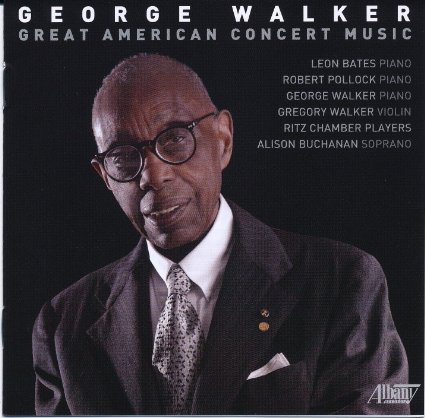
An update: Here’s another (unnumbered) volume in the Albany Records series featuring George Walker‘s music. (The label also has a series focusing on Mr. Walker as pianist.
Highlights are Music for 3 (1971) and his Piano Sonatas No. 3 (1976) and No. 5 (2003), along with several songs to the poetry of Emily Dickinson, Paul Lawrence Dunbar, Robert Burns, and others.
Albany Records has added a fourth volume to its laudable series of recordings of music by George Theophilus Walker. At 92 (going on 93), Mr. Walker remains an active composer and was recently nominated for New Jersey’s Hall of fame — he resides in Montclair — and if he wins, it would make a lovely addition to his accolades. They just happen to include a slew of honorary doctorates, AASCAP’s Aaron Copland Award, induction into the American Classical Music Hall of Fame … oh, and a Pulitzer, which he received in 1996 for his Whitman-inspired Lilacs.
These are sensitive but rigorous performances and give a wonderful spread of Mr. Walker’s career, from Antifonys for String Orchestra (love the title), originally composed in 1967 for double string quartet, and the Pulitzer-winning Lilacs for Voice and Orchestra to several compositions that prove Mr. Walker’s creative energy has not dimmed.
I’m especially attracted to the 2012 work Sinfonia No. 4 (“Strands”), which I recently heard as part of the National Symphony’s innovative New Moves series. (My notes on the piece are here.) To be honest, the account on this CD is a good deal richer and more compellingly shaped than what I heard in the live performance. Conductor Ian Hobson, leading Poland’s Sinfonia Varsovia, not only gets the solemnity and idea-dense intricacy of this music but knows how to articulate its drama, its transitional energy.
Mr. Walker explains that the guiding idea behind the title “Strands” involves an “interplay” of thematic material that’s both severely compact and, with the subtle introduction of two quotations from spirituals, visionary and affirming. Given the task of writing a short “concert opener” with this commission, he chose a complex, densely argued soundscape over an easy crowd-pleasing rouser. It’s powerful stuff.
I hadn’t realized Mr. Walker originally wrote Lilacs with Vinson Cole in mind. Mr. Cole has had an illustrious career at Seattle Opera — I’ve heard his exquisite tenor on several occasions — but he was “unable to sing the part” at the world premiere in 1996 by the Boston Symphony under Seiji Ozawa. They had commissioned Lilacs as a brief work for a concert to commemorate the legendary tenor Roland Hayes. Mr. Walker therefore was asked to reconfigure the piece for a soprano, Faye Robinson, who sang the solo part in the premiere. (Geoff Gehman has the whole story here.)
On this recording Albert Rudolph Lee provides the originally intended tenor solo, singing this demanding, high-lying part with emotional fervor and conviction. As for the “eight minutes” originally stipulated by the commission, we’re fortunate that Mr. Walker followed his muse and composed a characteristically eloquent piece of 14 minutes (divided into four sections), the whole packed with gripping ideas and fragrant sound colors.
Further evidence of Mr. Walker’s phenomenal creative drive at an advanced age is found in Movements for Cello and Orchestra, another product of his 90th year (2012). Dmitry Kousov is the splendid protagonist in this inventive rethinking of the cello concerto format.
For more information on this American treasure, Ethan Iverson has conducted an interview at dothemath.
This weekend brings the next installment in the National Symphony Orchestra’s current NEW MOVES: symphony + dance festival. I enjoyed researching this material to write the program essays for all three programs, which are being conducted by the Omaha Symphony’s Thomas Wilkins. Each program pairs classic American rep with music by living composers.
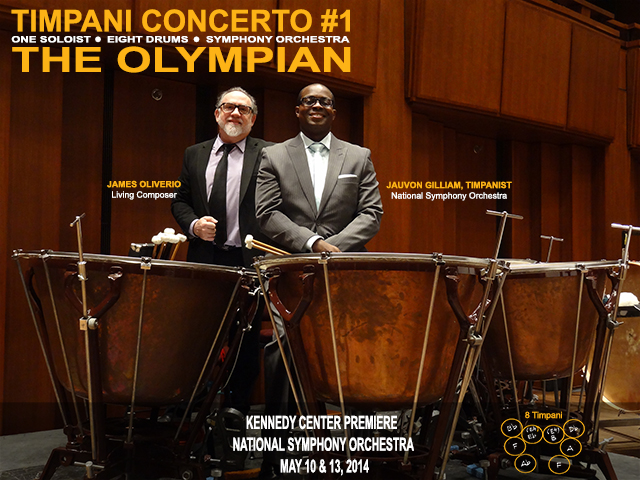
This second of the three programs features the Timpani Concerto No. 1 (“The Olympian”) by James Oliverio. Here’s a bit of my intro to his work:
The composer, educator, and new media producer James Oliverio (now based in Florida) has been redefining what it means to be a creative artist in the 21st century. “As composer there are two main ‘instruments’ that I work with: the symphony orchestra and the digital media studio,” he says, envisioning a music of the future that bridges the gap between traditional acoustic instruments and our rapidly evolving digital world. “Ultimately I want to unite them — to remove the distinction between my digital and orchestral endeavors,” adds Oliverio, an acclaimed pioneer of globally synchronized performing arts collaborations. (The rest can be found here.)
More on the amazing Jauvon Gilliam, principal timpanist of the NSO, from Andrew Lindemann Malone’s blog post. Writes Malone:
Not everyone who attends orchestral concerts knows that the timpani is not a fixed-pitch instrument; drummers tune them through the use of a foot pedal. So to play the right notes, you have to have both your hands and your feet in the right spot. With the typical orchestral complement of four timpani, this is challenging enough; as Gilliam says, “it’s like a choreographed dance. You can overshoot it, you can undershoot it, it’s just like if you do a pirouette.” To really master the instrument, “you almost have to have four different brains or have your brain in four different compartments.”
[…]
It’s an unusual role for an instrument that normally sits in the back and makes everything sound fuller and more forceful, but Gilliam doesn’t mind the change. “My job is to support people. I really enjoy that, that’s what I love about my job,” he says, but performing a solo is a “different way of doing things, and it allows me to expand my talent. It allows me to be a better musician.”
The concerto is also, he says, “the hardest thing I’ve ever played” — a challenge worthy of the title “The Olympian,” and a summit only scalable for a man who’s sure on his feet.
Here’s Jauvon Gilliam’s own blog post on “The Olympian.”
And here’s a radio interview WETA’s Nicole LaCroix conducted with Wilkins (beginning), Gilliam (6:15), and Oliverio (at 9:15).
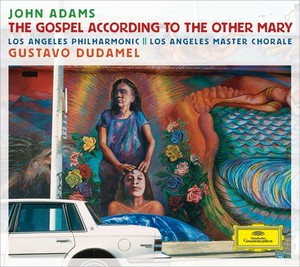
Since my essay is included in this recording, I have to recuse myself from offering a review, but I can say that I consider The Gospel According to the Other Mary among John Adams’s most profound accomplishments. It certainly probes new ground for this ever-evolving, brilliant musical mind.
As for the critical reactions I have seen, nothing yet has come to my attention that seriously grapples with the full complexity of this score.
A curious note: Gospel was among this year’s Pulitzer finalists. I think it’s a safe bet that this year marks the first time two composers sharing the same last name were up for the same prize, which in this case was taken by John Luther Adams for Become Ocean.
If you haven’t had a chance to explore this Adams/Peter Sellars collaboration, do yourself a favor.
And the winner is … John Luther Adams. This is especially exciting news, since Ludovic Morlot and the Seattle Symphony will be taking Become Ocean, the large-scale work they recently commissioned from Mr. Adams, to Carnegie Hall next month as the centerpiece of their Spring for Music program.
The Pulitzer Prize citation states:
Awarded to “Become Ocean,” by John Luther Adams, premiered on June 20, 2013 by the Seattle Symphony, a haunting orchestral work that suggests a relentless tidal surge, evoking thoughts of melting polar ice and rising sea levels (Taiga Press/Theodore Front Musical Literature).
In his review of the world premiere last June for The New Yorker, Alex Ross memorably wrote:
Anyone who has gone down a stretch of road and then reversed course knows that a landscape does not look the same when viewed from opposite directions. One mystery of “Become Ocean” is how different the material often sounds during the second half of the [overall] palindrome [structure]. The section after the first climax is thick with minor chords, particularly in the brass. Somehow, as these chords loom again in the buildup to the final climax, they take on a heavier, more sorrowful air. There is a sense of unwinding, of subsiding, of dissolution… That a piece constructed with such fanatical rigor can convey such potent emotion is the greatest mystery of all.
In an interview from 2011 with Molly Sheridan of NewMusicBox, Mr. Adams explains that his music is “never about representation or reproduction” but about “authentic personal experience, about the primary experience of being there and paying attention.”
Music is not what I do; music is how I understand the world. I hope that if I find myself in a singular place: wilderness, urban, indoors, outdoors, real, imaginary—doesn’t matter—if I find myself in a real place, a true place, and I am paying attention, then maybe I hear something that becomes music. If that happens, then I hope the music floats away, takes on a life of its own, and becomes something else to you when you hear it. What I may have experienced, what I may have been reading, or looking at, or listening to, or thinking about when I was in that place working on the music really doesn’t matter. What matters is the music and how it touches you.
My preview of Wayfinders, Holcombe Waller’s biggest show to date and coming to On the Boards this week, is now live on CityArts:
“Pushing boundaries” and “defying genres” are among the most tired clichés in arts writing these days. But along comes a visionary like Holcombe Waller, who manages to push the boundaries of the genre defiers, and genuinely eye-opening things happen. Seattle audiences have a chance to experience Waller’s most ambitious—and decidedly boundary-ripping—project to date when Wafinders comes to On the Boards for its fully staged premiere on April 10-12.
There’s no real point trying to caption Wayfinders with a label—song cycle, music theater, video space opera?—since Waller’s new work maps out a region of its own, synthesizing these elements into a deliriously hypnotic performance experience.
“Ultimately it’s about the evolution of consciousness that we see happening in connection with our technology,” Waller explains. “Wayfinders imagines a distant future where our conscious and technology merge and become interdependent.” In that headspace, how do we navigate a sense of identity? How do we connect with others while our own reality changes as we become increasingly entangled in and dependent on our technology?
My latest concert review is now live on Bachtrack:
The music of Alexander Raskatov remains relatively little known in the United States. Smart concert programmers, though, should take note of the effectiveness of his new Concerto for Piano and Orchestra, “Night Butterflies”, as demonstrated in this performance by Tomoko Mukaiyama and the Seattle Symphony. With these concerts, Ludovic Morlot gave the work a persuasive American premiere, fully alert to the score’s psychological fascination. The SSO co-commissioned Night Butterflies with Het Residentie Orkest Den Haag, which presented the world première in the Netherlands last May.