UPDATE on Saturday 22 March, 9:42: I just learned that Richard Taruskin will not be at the Conference to give the keynote speech; he’s prevented from traveling on account of illness. The lineup given here appears to have just been updated.
Living in exile, crossing borders, starting over—are there any experiences more definitive of the modern era? Along with their concrete political and social consequences, these experiences have shaped cultural expression. What, for example, does it mean to be a “Russian” composer today? Does it even make sense to keep referring to national musical styles in this century of instant global connectivity?
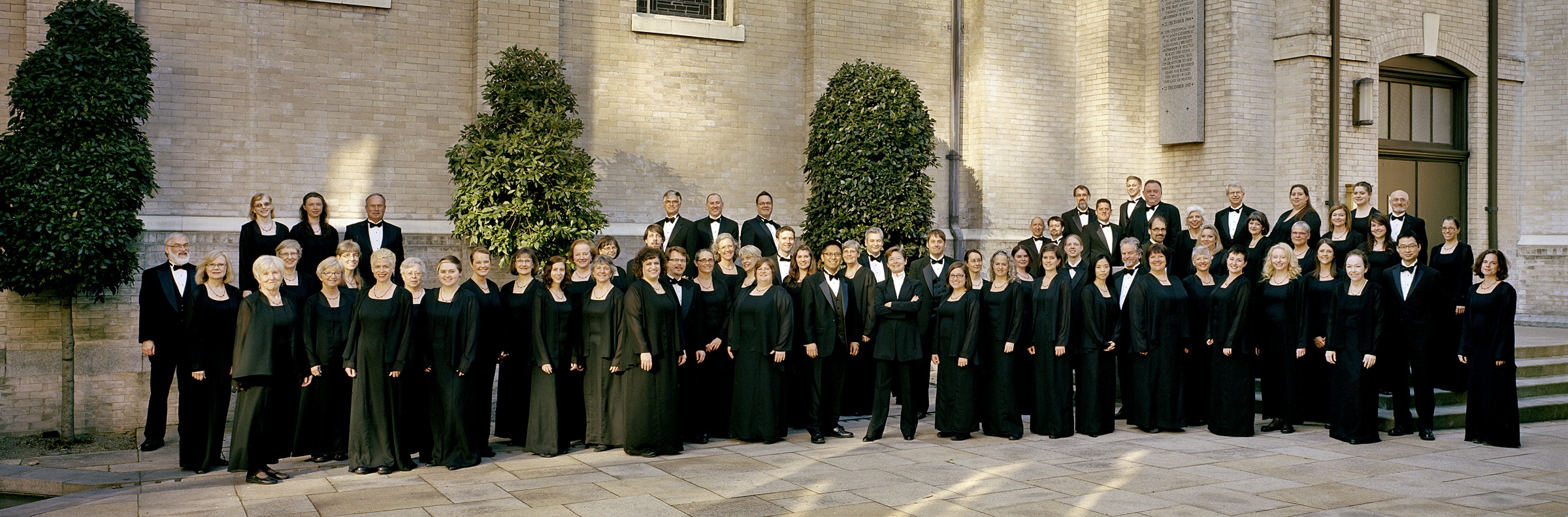
I’ve always admired the quality and imagination of Karen Thomas’s programming for Seattle Pro Musica, but their upcoming program, titled Passio: Light in Darkness, has me champing at the bit, to put it frankly.
“The concept for Passio is music related to Lent and the deep human emotions this season has inspired composers to explore,” says Thomas, who not only directs Pro Musica but is herself a composer. And that can also take the form of completely secular works like the little match girl passion by David Lang, which draws on models from Medieval mystery plays and J.S. Bach’s Passions to retell a children’s story of searing, tragic simplicity.
The fact that Pro Musica will be presenting match girl (in the area premiere of the choral version) is by itself enough of a sell: this just happens to be one of the most haunting and inspired choral compositions by an American composer in recent years. But the program also includes a “re-discovered” rarity from the Russian choral rep: Passion Week by Rachmaninoff contemporary Alexander Gretchaninoff (1864-1956). Plus, there will be sprinklings of music by Benjamin Britten, Thomas Weelkes, and living composers like Paul Mealor and Kay Rhie. All of these selections, in different ways, highlight the special strengths of Seattle Pro Musica — and of the smaller ensembles comprising the company.
Seattle Pro Musica
Lang, an LA native now based in New York (and known as one of the co-founders of the innovative Bang on a Can new-music outfit), has fast forwarded the American maverick lineage into the 21st century. Lang is also an adventurous collaborator who has worked with the likes of photographer William Wegman and the film director Jonathan Parker (scoring the 2009 indie comedy (Untitled). But for the little match girl passion, which won the Pulitzer Prize in Music in 2008, Lang engages in a remarkably original “collaboration” with sources you don’t normally associate with each other. He uses the tradition of musical settings of the Christian Passion narrative as a model for his retelling of an incredibly poignant children’s story by fairy-tale master Hans Christian Andersen.
The root of the word “passion” is from the Latin term for suffering. Lang strips away the traditional religious associations of the Passion story but uses the narrative techniques that were pioneered and perfected by Bach — “commentary” passages interpolated into the ongoing story — to recount the suffering and death of the little girl in Andersen’s story who tries to sell matches on a street corner on a brutally cold New Year’s Eve. Or, another way to put it, as Lang himself does: “There is no Bach in my piece and there is no Jesus — rather, the suffering of the little match girl has been substituted for Jesus’, elevating (I hope) her sorrow to a higher plane.”
There have been many musical adaptations of Andersen’s tale — TV musicals, operas, a synthpop video by Erasure, a concept album by The Tiger Lillies. But nothing I know comes close to the gut-wrenching impact of Lang’s treatment. His post-Minimalist score is deceptively simple, in keeping with the story. Spare harmonies and other archaisms evoke the starkness of early Medieval chant (think Perotin — that far back); tiny gestures generate maximal emotional response.
“There’s an extremely intimate quality to it,” Thomas explains. “Lang’s music has an immediacy and at the same time a kind of emotional reserve about it, because of the way he writes for the voices to evoke the Evangelist in a Bach Passion or a Greek chorus. So there’s a certain coldness and detachment as well that makes the tragic story that much more poignant as a result.”
Over the past two weeks, in concerts featuring the same vocal soloists, I’ve taken advantage of the rare opportunity to experience and compare the two great Passions by J.S. Bach that survive. (Pro Musica also performed the St. John Passion two seasons ago.) So it should be especially fascinating to encounter Lang’s piece, which I’ve long treasured since on recordings, with this context fresh in mind. Yet on its own terms, match girl is an immediately gripping and effective work, a mix of modern morality play and music theater — but with none of the preachiness that can sometimes creep into, say, a performance of Brecht.
Alexander Gretchaninoff in 1910
As for Gretchaninoff’s Passion Week, Karen Thomas points out that it will beautifully complement the pared-down sound of Lang’s little match girl passion by taking us to another extreme of lushness and blooming choral texture. Premiered in Russia in 1912, Passion Week sets texts from the Russian Orthodox liturgy that are used as prayers during the week that culminates in Easter. Gretchaninoff, a student of Rimsky-Korsakov, was part of the Renaissance of Russian choral music in the early 20th century that’s also represented by Rachmaninoff’s beloved Vespers (1915).
“In Gretchaninoff’s setting you can hear the influence of early Russian music and chant even more clearly,” says Thomas. “And he writes even more extensively for the low range of the basses than Rachmaninoff. This will sound especially compelling when heard in the acoustic space of St. James.”
Thomas adds that the prayers Gretchaninoff sets combine mystical and liturgical texts. They tend to be “more of a personal reflection” on the events of Good Friday, for example, than the librettos Bach set for his Passions. But this music fell into oblivion in the wake of the Soviet Union’s official crackdown on the Russian choral movement that had begun to take flight. Gretchaninoff himself stayed for a time but finally emigrated to the U.S. in 1939. His Passion Week wasn’t revived until the 1990s. Thomas believes these may be the first Seattle area performances.
An additional note: Yet another composer involved in the Russian choral movement — and another Rimsky student — will be in the spotlight next month when Cappella Romana presents the recently rediscovered Passion Week of Maximilian Steinberg, “the last major sacred work composed in Russia before Stalin’s 1932 crackdown (April 11 and 12).
Seattle Pro Musica’s Passio – Light in Darkness concerts take place on Saturday and Sunday, March 8 and 9, both evenings at 8 pm at St. James Cathedral. Tickets here.
On the road: after being in the spotlight in Madrid for the Orquesta Nacional de España’s Carta Bianca Festival, John Adams is being celebrated this week by the Toronto Symphony with the New Creations Festival. The festival culminates on Friday with one of Adams’s most fascinating recent works, Absolute Jest. Here’s the essay I wrote for the original version of Absolute Jest on the occasion of its world premiere by the San Francisco Symphony and the Saint Lawrence String Quartet in 2012:
More than three decades have passed since the San Francisco Symphony gave its first world premiere of music by John Adams (the choral-orchestral Harmonium in 1981). The event marked the beginning of a longstanding relationship between composer and orchestra that has resulted in the commissioning of several landmark works: Adams’s breakthrough orchestral composition, Harmonielehre (a new recording of which the SFS has just been released), El Dorado, the millennial “nativity oratorio” El Niño, the opera A Flowering Tree, and My Father Knew Charles Ives.
Seattle Chamber Players (SCP) just concluded Icebreaker, its biennial two-day festival of new music. This year’s edition, the seventh in their history, was titled open source, with a focus on high-tech music-making.
Artistic director Elena Dubinets — a key figure responsible for the Seattle Symphony’s smart programming — organized a stimulating and provocative program of five compositions spread over two evenings at Seattle’s terrific On the Boards space. SCP’s core members consist of Laura DeLuca (clarinet), David Sabee (cello), Mikhail Shmidt (violin) — all members of the Seattle Symphony — and Paul Taub (flute).
Their ranks were supplemented by a chamber orchestra of fine colleagues, with Alastair Willis conducting for the majority of the two concerts. (The requirements for some of these pieces should count as training for a certification in air traffic control — that’s how nerve-wrackingly intricate they are.)
open source ranged far and wide in terms of ambition, scope, and attitude. There was room for pieces featuring cheeky allusions and playful “rewiring” of musical codes as well as epic-scale updatings of the Gesamtkunstwerk meme and its goal of a total-immersion experience.
Pieces like Spam! by the Portuguese composer Luís Tinoco (on hand as this year’s guest composer) offered a sardonically comic take on the flotsam and jetsam of spam email in our procrastination-information culture. Another type of saturation provided the impetus for a music-and-video piece by the German composer Michael Beil, the title of which did double duty as the name for the festival itself.
The ideal of “open source” culture touches on utopian attitudes of sharing and pooled creativity. In Beil’s retooling of the hypnotic barcarolle from Jacques Offenbach’s Tales of Hoffmann, it also suggested a new angle on Walter Benjamin’s notion of the “aura” for this era of hyper-reproducible artifacts. In practice, though, open source turned out to be rather less fascinating than in the abstract, on paper.
The Greek composer Yannis Kyriakides also started with a promising concept in his recent Karaoke Etudes, to which this observation by Douglas Coupland serves as an epigraph: “21st-century life is karaoke — a never-ending attempt to maintain dignity while a jumble of data uncontrollably blips across a screen.” And this time, in practice, the interplay of pop-culture artifact, memory, improvisation, and oblique visual cues — with its mix of beguiling innocence and bemusement — cast a charming spell.
The two highlights of open source — a concerto-with-film by Michel van der Aa and a psychedelically tinged “video-opera” by Fausto Romitell — were substantial, visionary pieces featuring extremely complex and sophisticated media synchronizations. (The once-ubiquitous “multi-media” really has started to sound like a quaintly old-fashioned term — something like “mimeograph” or “xerox.”)
And both of these therefore represent one-of-a-kind works. It was a real coup for Elena Dubinets and SCP to score the Northwest premiere of the Dutch composer Michel van der Aa’s Up-close, which had its West Coast premiere in the Los Angeles Philharmonic’s Green Umbrella series just last month. I’ve recently written aboutUp-close — scored for solo cello, string ensemble, and electronic soundtrack — and its radical reimagining of the concerto format as a hybrid of film and live theater.
Simply put, it was thrilling to experience this significant new composition in live performance. As the solo cellist, Julie Albers also had to perform a scripted part in tandem with the images from van der Aa’s filmic counterpoint — a mysteriously never-explained narrative involving an older woman and her traumatic memories (having to do with coded messages, communication, and an implicit backdrop of the Dutch Resistance in the Second World War).
I found Albers’s stern, grainy, edgy sound extremely effective and dramatically compelling. Her phrasing captured the desperation of her “character” with a deeply felt immediacy. I also admired how alert she was to the amazing spectrum of nuances van der Aa has written into the part.
To be able to present a contemporary composition as significant, as cutting edge, and as emotionally engaging as van der Aa’s Up-close underscores the value of SCP’s Icebreaker festivals. Seattle audiences would benefit from more of this kind of boldly planned and executed new work — an undeniable peak of this edition of the festival.
So, too, was the big work on the first night: An Index of Metals by the Italian composer Fausto Romitelli, who died a decade ago (only in his early 40s). Romitelli’s video-opera for soprano and ensemble turned out to be case in which what’s “on paper” pales by comparison to the live experience in real time.
Fausto Romitelli in 2001
Dubinets neatly summarizes Romitelli’s part-sculptural, part-industrial preoccupation with sound, which he thought of as “material to be forged”:
Anything but a formalist composer, Romitelli did not shy away from hybridization, breaking down the barrier between art music and popular music. Distortion, saturation, psychedelic rock-inspired compositions and “dirty” harmonies were part of his musical universe…”
Romitelli’s final work, An Index of Metals, has been characterized as an artistic final testament that synthesizes everything he had developed in his process of treating sound as malleable matter. Remarking on the starting point for his compositions in general, Romitelli wrote: “The grain, thickness, porosity, density, brilliance, and elasticity are the main aspects of these sound sculptures resulting from amplification and electroacoustic treatment as well as simple instrumental writing.” He explained the guiding idea behind An Index of Metals as follows:
The aim … is to turn the secular form of opera into an experience of total perception, plunging the spectator into an incandescent matter that is both luminous and sonorous, a magma of flowing sounds, shapes, and colors, with no narrative but that of hypnosis, possession, and trance. It is a lay ritual, rather like the light shows of the the 1960s or today’s [i.e., at the millennium] rave parties in which space, having assumed a solid form through the volume of sound and visual saturation, appears to twist into a thousand anamorphoses. Rather than calling on our analytical ability, like most contemporary music, “An Index of Metals” aims to take possession of the body with its over-exposition of senses and pleasure.
Granted, that could merely amount to a lot of gobbledegook signifying nothing. But the incredibly meticulous planning that went into this realization paid off: the SCP and their collaborators succeeded in conveying the re-enchanted performance dynamic that has to be there for Romitelli’s magic to work.
In one sense, you could say Romitelli’s rejection of the “analytical” in favor of Dionysian immersion and sensory overload — what the composer calls “the fusion of perception” and “the henceforth limitless body in the furnace of a ritual mass of sound” –makes for a contemporary reincarnation of Romanticism.
Certainly Index recalls the psychedelic Romanticism of groups like Pink Floyd (whose “Welcome to the Machine” from their 1975 album Wish You Were Here gets sampled at the start), but aspects of early-20th-century modernist fusions enter the mix as well. On top of all that, Romitelli uses high tech to fuse sound, image, and spatial perception into a delirious feedback loop of continual “translation.”
The video elements comprise three separate films (created by Paolo Pacchini and Leonardo Romoli), while a solo soprano, accompanied by 11 amplified instruments, sings a text by the Solvenian writer Kenka Lekovich (translated into English).
As the soloist, the Polish soprano Agata Zubel was mesmerizing and indeed “elemental.” (Zubel and SCP have recorded an album together — Cascando — which took a prize in the Polish equivalent of the Grammies in 2011.)
And what an assignment the soprano is given — to project musical-emotional sense from the foggy, twilit timbres of Romitelli’s soundscape. To the fluid stream of video images she sings Lekovich’s texts of “Hellucination.” It all induced a state of awe — an awe both majestically terrifying and ecstatic.
As Romitelli writes, he wanted Index to present “a violent, abstract narrative, denuded of all operatic artifice, providing an intiaiton rite of immersion and a trance of light and sound.”
Quite happy to see Tom Adès take the Best Opera Grammy for The Tempest. I had the opportunity to write this essay for the Met when the production staged by Robert Lepage first appeared there:
When The Tempest opened at London’s Royal Opera House in February 2004, the anticipation couldn’t have been more intense. Composer Thomas Adès—only 32 at the time—had already been thrust into the international spotlight in the previous decade and found himself having to live up to recurrent comparisons with his similarly precocious compatriot and predecessor Benjamin Britten. Despite all this pressure, the overwhelming, almost unanimous response to Adès’s second opera seemed to confirm the parallels. “Only time will tell whether the first night of The Tempest in 2004 was a moment to set alongside the first night of Peter Grimes in 1945 in the history of British music,” wrote The Guardian the day after the occasion. “But it felt that way in the theatre.”
Time has proved that the initial verdicts weren’t idle hyperbole. The Tempest belongs to that rare group of contemporary operas whose critical acclaim is matched by the ultimate practical test of stage-worthiness. In fact, The Tempest—still less than a decade old—can already boast an astonishing track record of five different productions: the original Covent Garden staging (which was revived in 2007 and recorded for EMI’s award-winning CD), the American premiere at Santa Fe Opera in 2006, two separate productions in Germany, and now the opera’s premiere at the Met, which promises to be among the highlights of the new season.
Robert Lepage’s staging is a co-production of the Met, Opéra de Québec, and the Vienna Staatsoper and will also feature Adès (pronounced AH-diss) making his company debut as conductor. Reprising his performance as Prospero is baritone Simon Keenlyside, whose combined vocal and physical presence were widely admired as ideally suited to the role he created at the Royal Opera House.
The once-obligatory references to Britten became a kind of shorthand for English critics eager to spell out the high expectations pinned on Adès. In fact, he is an artist whose voice is unmistakably and audaciously original. Many gifted young composers demonstrate an eclectic, anxiety-free facility when it comes to claiming elements from the musical past for their own creative tool kit, but what was especially striking about Adès, while he was still just in his twenties, was the uncanny confidence with which he forged a rich, complex, allusive language with a coherence all its own.
Even more, before the millennium Adès had already found exciting ways to develop his flair for formal, abstract structures, vivid orchestration, and spirited detail while also demonstrating a compelling theatrical instinct. His range was apparent, whether in writing for a large Mahlerian orchestra (the symphonic Asyla, commissioned for the Berlin Philharmonic, for example) or in his first work for the stage, the chamber opera Powder Her Face (1995).
The latter, which used the scandalous story of an aristocrat’s fall from grace to ironically turn the mirror back on a tabloid-saturated culture, also revealed Adès’s extraordinary feel for portraying characters in music. With the far vaster canvas of The Tempest, he progressed to a mature mastery of his art, taming the often volatile energy found in his youthful scores into a sustained, emotionally gripping arc.
Shakespeare’s beloved final romance, remarks Adès, “is famously full of references to music, while the intangibility of some of its characters has always inspired music.” Purcell, Tchaikovsky, Sibelius, and Berio are just a few of the many composers who have fallen sway to its spell; even Mozart, near the end of his life, may have contemplated turning The Tempest into an opera. Yet instead of finding himself daunted by the weight of associations bound up with the source material—above all by the sheer power and poetry of Shakespeare’s language—Adès discovered a fresh approach to “translating” the Bard’s vision into opera.
The composer collaborated closely with librettist Meredith Oakes, an Australian-born playwright and poet whose talent for evoking traditional poetic patterns through “a very specific, archaistic style” felt particularly appropriate. Oakes distilled the original verse into pithy, condensed couplets that echo the play’s most famous passages in eminently singable phrases—instead of competing with them. Many of the couplets take the form of half-rhymes or slant-rhymes that acquire an extra charge by being ever so slightly off. The result, Adès says, “is a translation of Shakespeare into modern English, to be all the more faithful and concentrate the drama.”
Yet the three-act opera remains remarkably true to the arc of Shakespeare’s story and the spirit of his characters, while at the same time opening up the creative space necessary for Adès to add the unique perspective of his musical imagination. “I want it to be The Tempest. I want it to be Shakespeare and to bring that vision into the opera house as faithfully as possible,” the composer points out. “We actually started further away from the play than we ended up but found ourselves going back to Shakespeare’s structure much more.” But to achieve such fidelity—as opposed to a pale imitation—Adès and Oakes determined early on that they needed to swerve away from dogged, literal re-creation.
The most striking shift involves the opera’s conception of Prospero, the former Duke of Milan who, in the back story, has been usurped by his brother Antonio and shipwrecked on an island with his young daughter, Miranda. Prospero’s desire for vengeance is more pointed in the opera, as is his related assertion of control over the island’s indigenous creatures—Ariel and Caliban—and over Miranda’s emerging emotional autonomy as she falls in love with Ferdinand, his enemy’s son.
The libretto provided Adès with clearer “musical emotions” that motivate the dynamics of enslavement and liberation in the story as well as the transforming power of love and compassion. The real turning point, observes the composer, comes when Ariel tells Prospero that the suffering he has caused his enemies to endure would soften Ariel’s own heart if he were human. “And it’s the moment when Prospero realizes he’s gone too far and has to stop.”
Lepage, familiar to Met audiences for his stagings of Berlioz’s The Damnation of Faust and Wagner’s Ring cycle, praises the opera for capturing the “magic” of what is often considered the playwright’s final artistic testament. Not surprisingly for this wizard of theatrical illusion, the figure of Prospero has long fascinated Lepage, who has directed numerous productions of Shakespeare’s play. Each time he returns to it, he uncovers new insights. For his own concept of the opera, Lepage has expanded its aura of magic into a metaphor for artistic performance itself, envisioning Prospero as an 18th-century impresario of La Scala, the opera house in Milan, which he has recreated on the island of his banishment as a reminder of home.
“In those days, La Scala was a very magical place to set operas because it had all of the new state-of-the-art machinery,” Lepage explains. “The beach where everybody is marooned is actually a stage that’s been planted there and constructed by Prospero.” Lepage adds that each of the three acts presents a different perspective—from the stage itself, from the auditorium, and what goes on behind and off stage—to encompass this “opera-within-an-opera house.”
Members of his creative team will be making their Met debuts: Jasmine Catudal designed the sets, and the costumes are by Kym Barrett (known for her collaborations with Baz Luhrmann and her work on The Matrix films). The overall look will marry a sense of the island’s “native, aboriginal culture” with the Italian Baroque sensibility imported by the European interlopers.
Lepage’s mastery of both traditional stagecraft and its most up-to-date technological forms provides an ideal complement to the composer’s unique fusion of a classic play with a contemporary vision of opera. In his musical characterizations of the five leads, for example, Adès developed wonderfully effective alternatives to the vocal type casting that might have tempted a less-imaginative composer. While Ariel, a male character played by a soprano, sings in a stratospheric tessitura (frequently perching on Ds, Es, and Fs above high C, even reaching to G), “this isn’t a way of expressing high emotion and shouldn’t feel like the top of the singer’s range. That’s where she lives.”
Ariel is an elemental force of nature who—in another alteration of the original source—sings the final airborne phrase and becomes the wind again. Her island counterpart, the “monster” Caliban, is depicted not as a “lumpen, earthy brute” with a bass voice but is a lyrical tenor. “He’s often described in the play as being like an eel or a fish, and I suddenly thought he could be more like one of those exotic, wonderful voices from the East, with a weird elegance. And of course he is an aristocrat, not only in his own mind,” says Adès, who gives Caliban one of the most radiantly beautiful passages in the score: his aria reassuring the shipwrecked newcomers not to fear the island’s “noises.”
As for Prospero, the composer created a fully dimensional baritone role (with shades of Verdi’s and Wagner’s authoritarian father figures) who nevertheless defies the stereotype of the wise old sage. Adès was especially inspired by crafting the role for Keenlyside. “Simon’s a terrifically physical performer who projects youth. In a way, it’s that characterization, as much as the extraordinary voice, that was on my mind. I don’t think of Prospero as an old man. This is the only play of Shakespeare which observes the classical unities of happening in one place, in one day. When Prospero meditates on the evanescence of life, my feeling is actually it’s not that he does that every day and has been doing it for years and he’s an old bore. It’s that he’s just realizing it at that exact moment. That’s the first time he’s thought this.”
While Adès writes for the voice with great character, his score is also distinguished by its symphonic intricacy and architecture. This quality provides the opera with a richly satisfying cohesion and unity. Adès achieves this not through conventional leitmotif technique but by expertly manipulating his uniquely evocative harmonic language. He explains: “The music has its own internal logic of relationships; it doesn’t just do what it wants to do because the characters suddenly decide to go somewhere. It’s a tissue that’s woven in, so that everything is related in the music, and all the elements create a view of the world that’s whole, a sphere.”
Here’s the more-complete version of my Los Angeles Philharmonic essay on Michel van der Aa’s remarkable cello concerto, Up-close, which gets its West Coast premiere in the Green Umbrella series next week:
Regular followers of the Los Angeles Philharmonic will have encountered the work of Michel van der Aa before, but Up-close has intensified his profile, particularly in North America, thanks to the acclaim it earned last year, when it received the mega-prestigious Grawemeyer Award for Music Composition. Written in 2010 on a commission from the European Concert Hall Association and the Dutch Performing Arts Fund for the Amsterdam Sinfonietta and the Argentine cellist Sol Gabetta – who premiered it in Stockholm in March 2011 – Up-close represents nothing less than a thorough reimagining of the concerto genre to mirror the way our high-tech, wired era shapes and compartmentalizes perceptions of reality.
Like Louis Andriessen, an important mentor with whom he has collaborated on such works as the multimedia opera Writing to Vermeer (1999), van der Aa has evolved a music theater aesthetic that resists classification in its intriguing combination of live performers and film visuals. The younger composer (born in 1970) studied recording engineering as well as composition in his native Holland and later enrolled in classes at the New York Film Academy. Many a composer combines multiple talents within the realm of music, but van der Aa brings a synthesis of composer, stage director, and filmmaker to several of his endeavors, including Up-close.
Van der Aa has also created works showcasing each of those talents separately. He emphasizes that his use of film visuals and extra-musical components has to be “a necessity,” not an adornment “which is there merely to be hip or entertaining. I try to be strict with myself, to use film in a way that extends and enhances my musical vocabulary. The film contributes something I can’t communicate with the music alone.” In Up-close, Van der Aa points out, he conceived the music “in parallel with my work on the script for the film and the small staging. These feed into each other. I like that flexibility. Sometimes the music gives me visual ideas, and sometimes it’s the other way around.” He considers Up-close to be a work of music theater, the cello concerto embedded within as a part interdependent on the whole.
Michel van der Aa (photo: Marco Borggreve)
Along with the familiar three-movement concerto format which he uses as a formal design for Up-close, van der Aa explains that the relative significance of its constituent layers likewise structures our sense of unfolding events. Their interrelations also pose unique challenges of synchronization. There are three such layers: the conventional one of the solo cellist and the all-string ensemble, the “mirror reality” of the film that is projected simultaneously, and the prerecorded sounds (encompassing electronic samples and the film’s soundtrack).
There is a fourth layer, which is less extensive, pertaining to the instructions for the soloist to take part in the mise-en-scène (as at the end of the first movement, when the cellist gets up and moves a lamp on the stage). “It provides a way of exaggerating the inherent theatricality of instrumentalists,” according to the composer. The soloist is required not only to perform with traditional musical virtuosity but also to act. The gulf separating the illusionistic reality of the film and that of the live performance becomes one of a cascading series of metaphors for what van der Aa has described as “a dream about communicating” which in the end fails.
But all of these layers don’t function with equal intensity throughout. The process of creating Up-close involved determining at each point “which of these layers are in the foreground, and which are in the background.” In the opening minutes of the work, the soloist remains in the spotlight, introducing crucial thematic material that will appear in new lights in conjunction with the other layers. The connections between the three movements make the shifting perspectives of van der Aa’s concept especially evident. For example, a lengthy segment of about five minutes bridging the first two movements brings the film to the center of attention as the main bearer of the “narrative,” with a thinned-out sonic background from the prerecorded music and the live ensemble remaining silent until metal chimes link up their world to the enigmatic “code machine” in the film. (Van der Aa collaborated with a friend who works as props master at the opera to build this visual, imagining “a cross between a music box and a Morse machine.”)
For the frenetic final movement, the code machine “ignites the ensemble” back into action, as the strings pulsate with a nervous energy at times reminiscent of Bernard Herman. Van der Aa likens the musical patterns of their “timbral counterpoint” to “little wood fires spreading through the ensemble,” while the woman in the film becomes increasingly anxious.
Writing the piece originally for Sol Gabetta, the composer imagined the elderly protagonist in the film as a kind of “alter ego.” The Dutch actress Vakil Eelman was chosen, he explains, because he wanted “an archetypal elderly figure: someone who carries youth in herself as well as wisdom and experience. I really like that ambiguity in her.” Johannes Moser is the first male cellist to perform as Up-close’s soloist, which, says van der Aa, “will generate different questions, but not necessarily less interesting ones, about the relationship between these two people – the actress in the film and the soloist on the stage. I think it’s important to let the audience take the last steps itself to decide what the piece is about.”
And my commentary on the other works on the program is here:
Songs of Ascension is one of Meredith Monk’s creations of the past few years. If you don’t know her incomparable music yet, this is a wonderful place to start exploring it.
Monk’s unclassifiable art is grounded in a unique understanding of the flexibility of the human voice. She loves to create new contexts in which to fathom its expressive depths. The result is music that sometimes sounds as if it had been quarried from an archeological dig or beamed in from a distant future. Both impressions emanate from Songs of Ascension, the tenth project Monk has recorded for ECM since her path-breaking Dolmen Music was released three decades ago. That discography charts her intrepid forays “between the cracks,” as Monk likes to put it, where different ways of perceiving the world through art converge.
On one level, Songs of Ascension encapsulates Monk’s aesthetic outlook over a long career, one in which the voice serves as a guiding thread for her interdisciplinary performance pieces. But it also reveals the undiminished curiosity of her artistic quest by incorporating the expanded musical language Monk has evolved over the past decade. With Possible Sky (2003), her first work for orchestra, Monk began to apply her intuitive sense of the voice as a complicated instrument to larger ensembles, teasing out the feedback between singers and instrumentalists in ways that rethink the very bases of composition.
Songs of Ascension represents an ambitious example of this development in her work. One stimulus for the work was Monk’s encounter with poet Norman Fischer’s translation of the Psalms into a Zen-infused language. His imagery led to further reflections on the trope of worshipers ascending a mountain and pausing periodically to sing a psalm of praise. A simultaneous invitation to collaborate with visual artist Ann Hamilton further clarified her evolving musical images, adding a site-specific dimension. Hamilton’s project involved performing while ascending a new tower the artist had designed in Sonoma County, California, inside which a pair of staircases that resemble a double helix spiral upward. In this form Songs premiered in October 2008.
To explore her fascination with the connection between worship, transcendence, and images of ascension, Monk interweaves a fabric drawn from her recent experience writing for string quartet and the signature extended technique of her own vocal ensemble (with the added contributions of The M6 and the Montclair State University Singers). Other threads she includes are woodwinds, an array of percussion, and a blend of Western and Eastern sonorities (with a prominent role for the harmonium-like shruti box, which is associated with Indian music).
In place of a libretto the “text” consists of unpredictable patterns of abstracted phonemes, fluid vocalise, and shaman-like incantations. Yet even as non-sense replaces the logic of language, the vocalizations by Monk and her collaborators seem to imply the origin of speech rather than the disintegration of Babel.
The effect is especially enchanting at the beginning of the piece, which the string quartet inaugurates with sustained whispers of just a few pitches: a gentle fog which rises to reveal the echo of human voices. These “clusters” (in Monk’s terminology) set the stage for the sprouting of song, the blossoming of harmony. The interlinked sections are the first two of 21 that comprise Songs. Monk’s titles cue us in to recurrent patterns—and are also provocatively enigmatic (why are the seasons out of order, and why are winter and autumn instrumental-only while summer and spring include voices?).
Monk’s continual intercutting of highly varied textures builds a sense of larger-scale momentum. The section “mapping,” for example, suddenly introduces a new tone of festive tintinnabulation, while the gliding swoops of strings and voices in “falling” convey the curious sense of whimsical archaism that tempers the more meditative sections crisscrossing through the work. The range of Monk’s vocal idiom is literally breathtaking: a strangely beguiling repertoire of aviary microtones, robust yodels, insectoid whispers, and (in the penultimate “fathom,” a lengthy solo for Monk as she accompanies herself with a shruti box), dusky, low-range chanting. The final number, “ascent,” makes for an inspiring conclusion to the adventure, its layered sonic tapestry suggesting an endless procession/quest as solo lines leap in ecstatic figures from the drone-like foundation.
Though the original Songs of Ascension was conceived as an “immersive experience” with video and site-specific movement, Monk’s music is thoroughly evocative on its own terms. ECM’s engineering gives the music rich, warm resonance and even manages to convey something of Monk’s spatial acoustic. The recording was made in 2009 at the Academy of Arts and Letters in New York. The booklet includes a smart essay by composer Kyle Gann and a color-photo essay from the premiere in Hamilton’s tower. Songs is further confirmation of the musical treasure we have in Monk, who shows no signs of slowing down.
I haven’t yet had the pleasure of encountering Benjamin Hochman in live performance, but I come away from his new release, Homage to Schubert, with a remarkably vivid sense of what he brings to the competitive scene of today’s young pianists. This is his second solo album and debut recording for the AVIE label, and it amply reveals Hochman’s qualities as an interpreter as well as the creative and original programming style that appears to be a signature.
A native of Jerusalem now based in New York, Hochman counts Claude Frank and Richard Goode among his mentors. He made his New York debut in 2006 with a Met Museum recital juxtaposing Bach, Berg, Schubert, and a newly commissioned piece. A similar imaginative leap ties together his program here: two lesser-known Schubert sonatas and a pair of contemporary pieces “commenting” on the Austrian’s legacy — by György Kurtág (Hommage à Schubert) and Jörg Widmann (Idyll und Abgrund), respectively. Hochman performs on a Steinway and benefits from the tasteful production and engineering (Eric Wen and Dennis Patterson).
Of course there’s lots of powerful competition even when it comes to these less-familiar Schubert sonatas. Paul Lewis, the spiritual scion of Alfred Brendel, has recently staked an irresistible claim to this territory, and Mitsuko Uchida is another eloquent advocate. (She also began linking Schubert’s piano music with Schoenberg back in the ’90s.) A fundamental attraction of Hochman is that he allies a natural sympathy for Schubert’s brand of musical thinking with superbly balanced technique, all the while effacing any temptation to showboat or force a newfangled reading onto these scores.
In other words, Hochman’s overall stance toward Schubert himself is pretty traditional, while smartly allowing the “moderns” sharing his program to provide a contemporary angle. It’s a daring and subtle strategy, and one that rewards the listener. Which is by no means to imply that there’s anything even remotely stodgy or routine here: Hochman initiates the proceedings with the gorgeously spun lyrical flow of the Sonata in A major D664 (from 1819), his control of the pulse so mesmerizing that it seems as if this music has always been going on — a stream we’ve been graced to chance upon.
Hochman is fully alert to the potential of Schubert’s wild contrasts. That’s the premise, after all, of pairing the gentle, smaller-scale A major with the hugely ambitious and even aggressive Sonata in D major D850 (the so-called “Gasteiner,” after the spa town where it was written in 1825, the year Schubert sketched most of the “Great” C major Symphony). Yet Hochman doesn’t overload these contrasts with melodrama, but lets the few outbursts in D664 take us by surprise within the larger context.
At several points I could almost imagine D664 versus the “Gasteiner” as a precursor for Schumann’s Eusebius (especially in the melancholy appoggiaturas of D664’s Andante) and Florestan dichotomy. But what excites me the most about Hochman’s deeply satisfying approach to D850 is his implicit understanding of the Schubert-Beethoven connection. By this point, Schubert’s acquired admiration of the German composer had begun inspiring a new level of ambition (he was a Beethovenian convert).
Hochman seems to hint at the uncanny echoes of late Beethoven, as in the “Gasteiner”‘s widely wandering second movement, where one passage of reiterated chords suddenly approaches the radiance of the Arietta in Beethoven’s Op. 111. But he avoids any impression of Schubert as an imitator or epigone: these moments occur as genuine Schubertian epiphanies within a remarkably different musical landscape.
Between Schubert and Beethoven, there is an almost diametrically opposed sense of drama, as Hochman points out in his excellent booklet essay, alluding to Brendel’s famous image of Schubert “the sleepwalker” in contrast to Beethoven “the architect.” That groping around unforeseen corners to alight on a new vista that is so characteristic of Schubert is especially apparent in the weirdly mercurial variants of the finale’s rondo theme as Hochman performs it.
As for the contemporary homages, Hochman has chosen two utterly distinct ways of thinking about Schubert. Kurtág’s lapidary piece (lasting about a minute) distills the contradictory ingredients that make up Schubert into an intense poetic reverie — a musical life that flashes before our ears.
The German composer Widmann — who is just 7 years older than Hochman — has meanwhile written a miniature suite of “six Schubert reminiscences” in Idyll and Abyss (originally conceived as a companion work to the great final B-flat Sonata D960). Teasing direct references to cadences and phrases slip a reflective scrim over the distance between Schubert and us. Alternately playful and disturbing, Widmann’s suite rudely juxtaposes the many sides of Schubert’s personality, purposely emphasizing the paradoxical nature of a genius that encompassed sweet melody, leisured reflection, and savagely violent outbursts. Widmann and Hochman leave it up to the listener to put the pieces together.
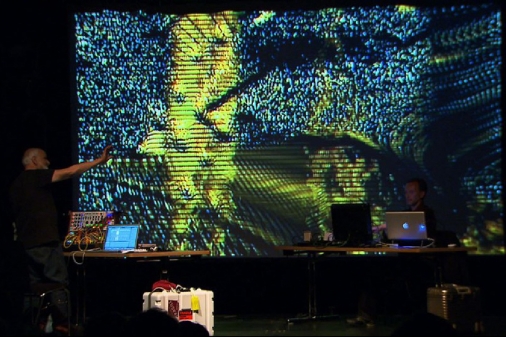
Morton Subotnick, who at 80 looks as eager as ever to experiment with his Buchla and laptop, rolled into town recently to perform a decades-spanning program at Seattle’s Town Hall. Joining him onstage was Berlin-based video artist Lillevan. The two have been collaborating on several projects in recent years, and both are obviously so well attuned to each other’s aesthetic that they can improvise with pre-existing material. It all added up to a blissed-out gesamtkunstwerk for synth geeks and video art aficionados.
The concert’s official title – “From Silver Apples of the Moon to A Sky of Cloudless Sulphur IV: LUCY” – refers to the main sources for the prerecorded music Subotnick used to build the performance in tandem with Lillevan’s abstract imagery of fluid and fractal-like shapes in restless transformation. Subotnick describes his current process:
For each season of performances I create a new hybrid Ableton-Buchla “instrument” loaded with prepared samples from all my previous works and performances and new patches that will allow me to modify the samples while performing brand new sound gestures created especially for the new season. The work always has the same title, “From Silver Apples of the Moon to a Sky of Cloudless Sulphur IV: LUCY.” The “IV: LUCY” refers to the season number and the name given to the newest materials.
Subotnick and Lillevan in action
Subotnick’s gently processed whisperings and vocalizations – sent whirling about the surround-sound arrangement of speakers – launched this voyage of about an hour or so. Of course the act of musical performance itself tends to override ordinary clock time, to make it seem simultaneously speeded-up and in slow motion. But in this case, time seemed to become unmoored as if we were in a gravity-less environment.
The early atonalists used to worry about how to structure a piece without the old familiar signposts. Subotnick’s large-scale excursions can echo the craggy, mountainous landscapes of a Romantic tone poem, no matter how “alien” the sounds. Inevitably I found myself turning to metaphors, both from the natural world – that ubiquitous “watery” sound of electronics – and from acoustic instruments, imagining a troop of pizzing strings here, bleating woodwinds there.
Lillevan
Berlioz’s opium dreams, the psychedelic trips of the ’60s: why is it this intensely focused sense of isolation, of utter aloneness, much more than any Dionysian, “orgiastic” frenzy, that they so strikingly share? Above all I’m fascinated by Subotnick’s “art of transition” and his ability to steer toward heaving climaxes, only to dial the mood down within a short span, like a turntablist working the dance crowd – even though we were all passive listeners.
Just before the performance, Subotnick recollected how exciting it was to be a young composer in the late ’50s, when the introduction of the commercial transistor seemed to point the way toward a new utopian paradigm: music that could be made and performed by everyone, not limited to “the 1%” who had the training for classical music-making. Yet for all its influence on popular culture, and for all the revolutionary changes in daily life this technology has enabled, the type of electronic composition Subotnick pioneered still inhabits a rarefied world of its own.