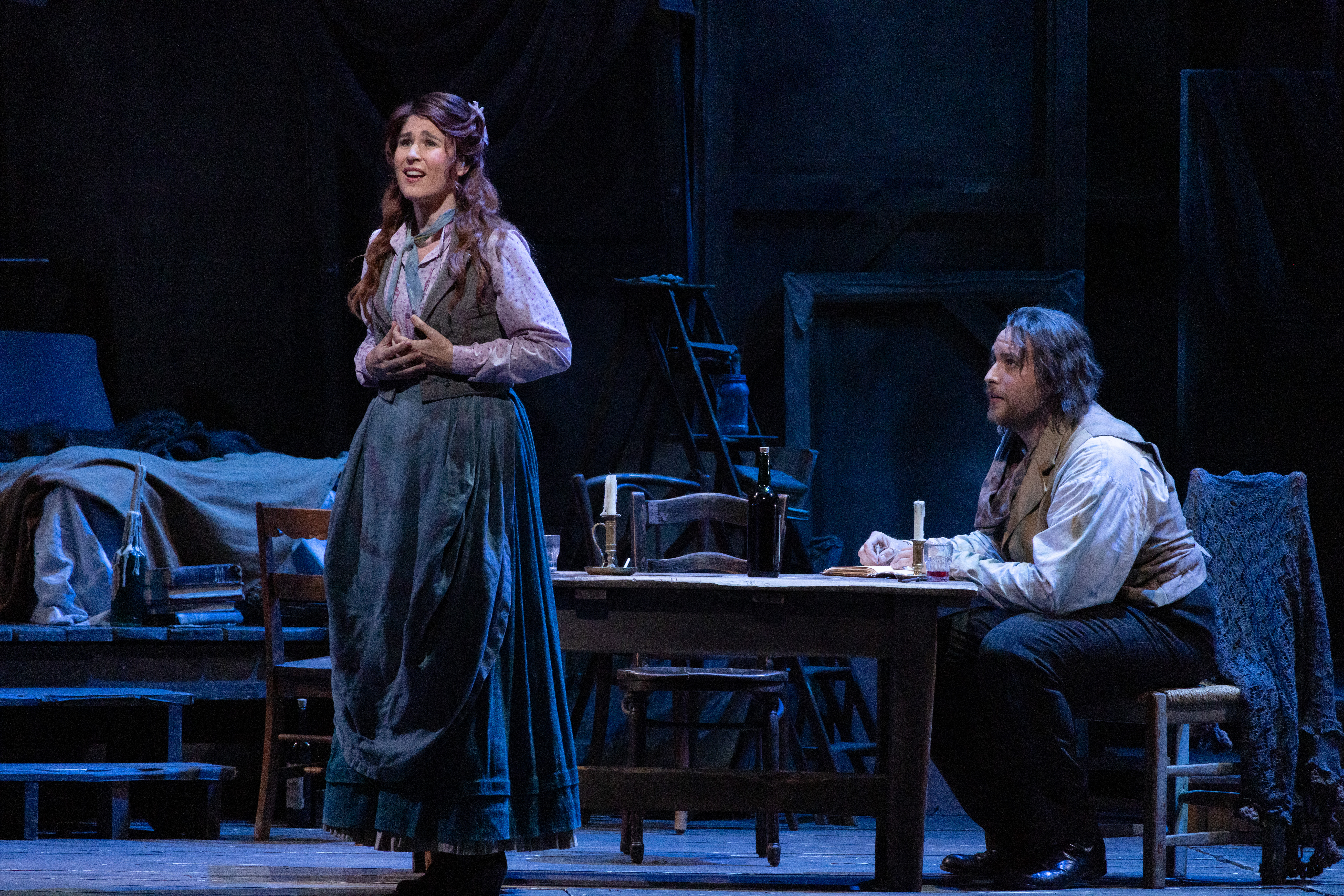
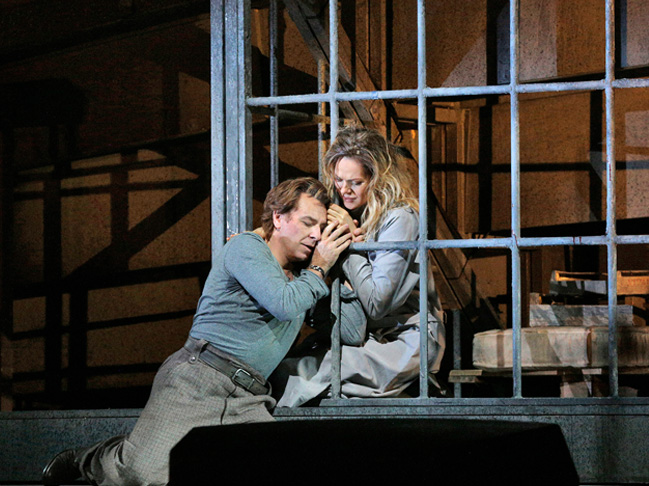
L – R: Long Long (Rodolfo), Szymon Mechliński (Marcello), Emma Marhefka (Musetta), Sylvia D’Eramo (Mimì), photo by Curtis Brown for the Santa Fe Opera
You think you’ve gotten over La bohème. Then a performance comes along and shatters your defenses, breaking your heart again…
My review of James Robinson’s new production spans the length of the 2025 Santa Fe Opera season is online here:
James Robinson’s new production of Puccini’s ubiquitous classic opened Santa Fe Opera’s 2025 season in June and will close it later this month. With its finely observed details and an emotional realism that doesn’t coast on sentimentality, it makes a fitting bookend to a summer that has balanced tradition with reinvention …
Since its founding in 1923, San Francisco Opera has maintained a love story of its own with La Bohème. The company actually opened with a performance of the beloved classic, cementing its identity with Puccini’s story of young love and youthful illusions. One thing this summer’s revival makes clear: when done persuasively, La Bohème seems immune to aging, undiminished in its emotional pull.
John Caird’s production, which originated in 2012 and first arrived at the War Memorial Opera House in 2014, with a revival in 2017, was presented as part of this summer’s shorter-than-usual season alongside a gripping interpretation of another great opera by a youthful artist in the process of making pivotal discoveries about what opera can do: Idomeneo, by the 20-something Mozart. In this revival of Caird’s original staging by Katherine M. Carter, the chemistry between the two main couples and among their circle of close friends gained a dramatic clarity that was believable.
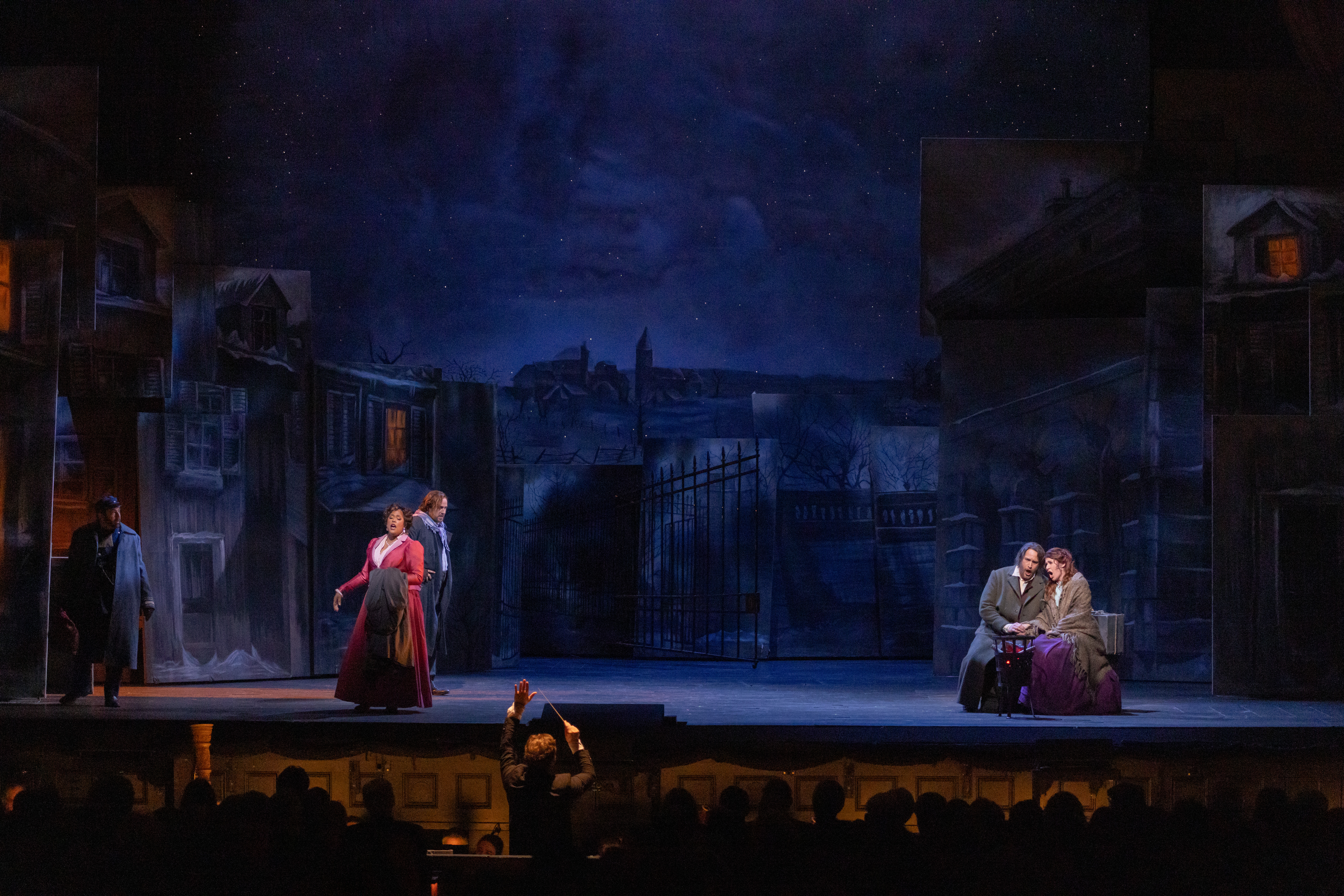
A visual metaphor for the intensity of their dreams and idealism emerges in designer David Farley’s sets, which seem filtered through the imagination of the painter Marcello – as if memory itself were the canvas. Instead of a cosy view of the Parisian skyline, the distinctly crowded and cluttered garret is framed by panels that seem to be his own creation, works in progress. In the crowd scene at Momus, the wintry city is populated by still more painted façades that verge on abstraction, Cubistally tilted as if to hint at the transformation of experiences recollected from a distance, as they become stylized, mythologized. While also nodding to the aesthetic of Toulouse-Lautrec and the Belle Époque, the visual world inhabited by this Bohème wasat times almost dreamlike, even surreal.
Puccini’s achievement in this opera, bolstered by his collaboration with librettists Luigi Illica and Giuseppe Giacosa, gains traction from the varying manifestations of community among these young people: the cramped garret coming alive with roughhousing banter and energy and the glittering Café Momus brimming with a chaotic joy and sense of possibility against all the odds.
Much has been written about La Bohème as an opera of Romantic nostalgia, but this production underscores its deeper structure as a work of memory. Puccini’s savvy recapitulation of musical material – most movingly in the final act’s return to the music of Mimì and Rodolfo’s first meeting – carried incalculable expressive weight in Ramón Tebar’s sensitively detailed conducting, a highlight of the production. With his fine ear for balance and unwavering attention to the colors and harmonic richness of Puccini’s score, he had the orchestra paint in layered brushstrokes of timbre, shaping phrases with warmth and elasticity.
I heard the “alternate” cast on June 18. As Rodolfo, tenor Evan LeRoy Johnson made a welcome impression with his hefty, burnished tone and grounded stage presence. His rapport with Australian soprano Nicole Car as Mimì allowed him to trace an arc from self-conscious artist to grief-stricken lover. Car, in turn, conveyed Mimì’s innocence and vulnerability without reducing her to frailty. Even in the character’s earliest moments, there was a quiet self-awareness beneath the surface. Car uncovered more psychological nuance than is often seen in the third-act encounter with Rodolfo, singing with radiant control across the range. Her resonant low notes lent unexpected weight to a role sometimes misconstrued as a passive victim.
Filling in for the originally announced Will Liverman, baritone Lucas Meachem sang Marcello for the full run, bringing the painter to life with vocal vitality and a sharply etched dramatic immediacy through telling details, like his hint of jaded disdain when he first interacts with Mimì at Momus. He emerged as the opera’s emotional linchpin, bridging the bohemians’ slapstick and the lovers’ tragedy. His scenes with Rodolfo had the ease of real camaraderie – and rivalry.
As Musetta, soprano Brittany Renee lit up the stage with a performance abounding in vocal charisma and larger-than-life presence that also amplified the somewhat underworked Toulouse-Lautrec angle. Her “Quando me’n vo’” was anything but coquettish posturing but a declaration of unapologetic vitality. At the same time, she allowed a genuine compassion for Mimì to emerge with affecting sincerity in the deathbed watch.
There was much to enjoy in the detailed work of the companions as well. Bogdan Talos made a dignified and ultimately touching Colline, keeping a mostly detached air until the death scene released a surge of directness. His “Vecchia zimarra” felt like an intimate farewell to youth itself. Another highlight of the production was Samuel Kidd’s vividly observed portrayal of Schaunard (the one actual musician among these Bohemians), especially in his gleefully morbid story of how a dead parrot brought a windfall – a comic moment that, like so much in Bohème, holds a tragic echo in hindsight. Dale Travis brought seasoned comedic timing to his dual character roles as the landlord Benoit and sugar daddy Alcindoro. The SF Girls and Boys Choruses added charm to the Café Momus scene.
But what gave this performance its distinctive character was the sensitive, detailed conducting of Ramón Tebar. The Spanish conductor proved a superb collaborator – very much a singers’ conductor – with an ear for balance and a painter’s attention to color. He brought out the harp’s glitter, the dark undertow of strings beneath bright melodies, and the often-overlooked harmonic richness of Puccini’s score.
As Larry Rothe insightfully writes in his beautiful program essay, Rodolfo, in retrospect, is not a novice in love but an artist transformed by a singular experience: “He hears himself pleading his case to Mimì in a new voice, honest and unguarded … Mimì, as Rodolfo recalls her, will always illuminate the memory of those rough days … those days that, for all their hardship, will always bear the tender ache suggested in that pivotal rising and falling fourth [of Rodolfo’s motif].”
That “tender ache” lingered well after Rodolfo’s cries of despair in this wonderful revival, reminding us not just of the pain of loss, but of how art redeems it – by turning memory into music.
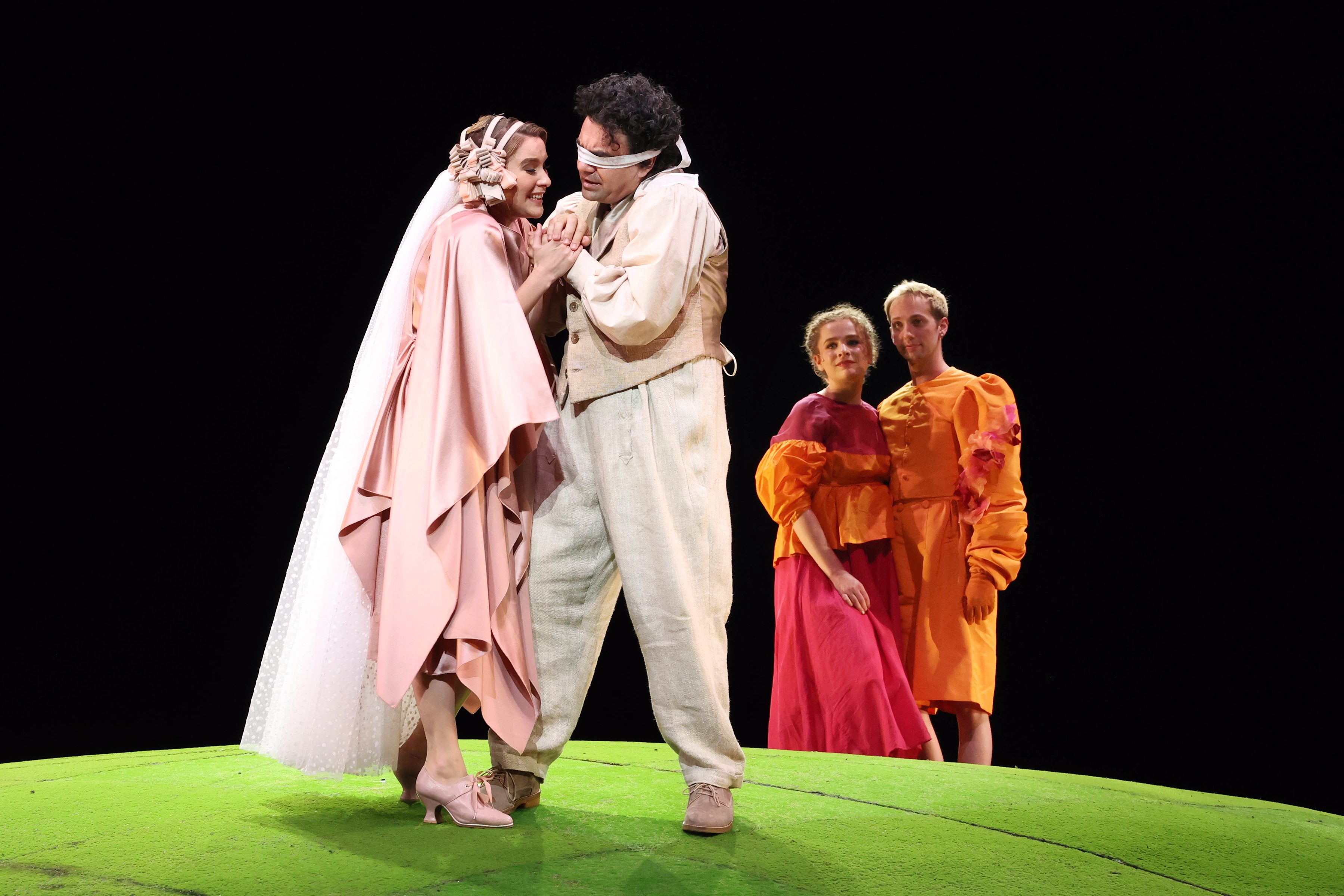
Amber Norelai (Euridice), Rolando Villazón (Orfeo), Lucy Evans (La Ninfa), Luke Elmer (3rd Pastore); photo by Curtis Brown for Santa Fe Opera
The first of my reviews from Santa Fe Opera’s 2023 season is open through the weekend (no paywall) here. I discuss Yuval Sharon’s extraordinary new production of L’Orfeo (or Orfeo, as they’re calling it), which features new orchestrations commissioned from Nico Muhly.
My review of Tosca is here (but behind the paywall). More reviews upcoming in Opera Now.
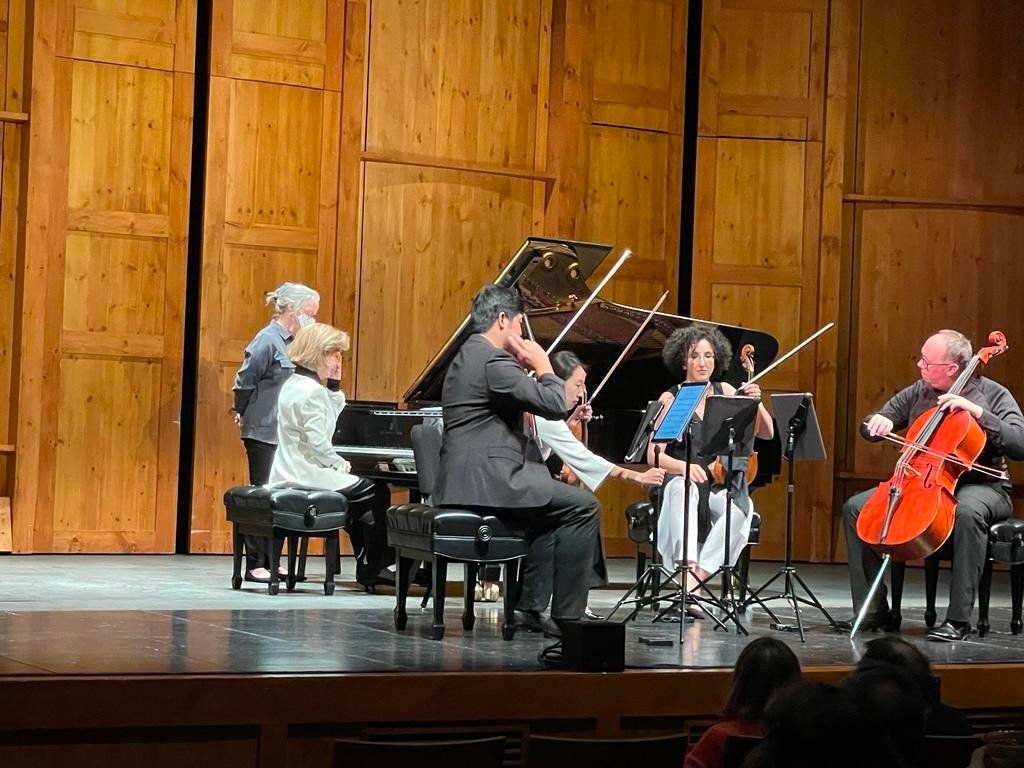
Verona Quartet with Anne-Marie McDermott, photo (c) Jorge Gustavo Elias
Last night I got my first sample of the chamber side of Bravo! Vail Music Festival with a smart program featuring the Verona Quartet and Artistic Director Anne-Marie McDermott at the keyboard. Puccini’s early “Crisantemi” and the first of Beethoven’s Op. 18 string quartets revealed a flair for finely calibrated ensemble balance and color, with a cross-connection of moods traced between Beethoven’s Adagio and the elegiac Puccini miniature.
For me the highlight was an impassioned performance of Samuel Coleridge-Taylor’s Piano Quintet in G minor, Op. 1 — also a youthful work, in fact written when he was only 18 — for which McDermott joined the Veronese to play the taxing, ever-present piano part with power and poise. Together they made a brilliant case for this shamefully long ignored gem, obviously enjoying the fecundity of Coleridge-Taylor’s imagination. Captivating from start to finish, this is the kind of performance that thankfully is reclaiming his work the repertoire.
Act III of Humperdinck’s “Hansel and Gretel” with Heidi Stober as Gretel and Sasha Cooke as Hansel, production by Antony McDonald; photo: Cory Weaver/San Francisco Opera
The last few weeks have been so busy I forgot to post my coverage of a trip last month to the Bay Area. Here are links to my reviews for Musical America of two productions at San Francisco Opera (Hansel and Gretel and Manon Lescaut) and of a concert performance of the first act of Die Walküre by San Francisco Symphony.
ANA MARÍA MARTÍNEZ (MADAME BUTTERFLY) AND JOSHUA GUERRERO (F.B. PINKERTON). PHOTO CREDIT: KEN HOWARD FOR SANTA FE OPERA, 2018
Here’s my report on the rest of the 2018 summer season at Santa Fe Opera* for Musical America. I write about Ariadne auf Naxos, L’italiana in Algeri, and Madama Butterfly. My review of the company’s new production of Doctor Atomic is here.
Santa Fe, NM—-During the long reign of founder John Crosby, Santa Fe Opera cultivated its reputation as a “Strauss house.” Yet only three of the composer’s operas had been presented under the company’s third general director, Charles MacKay, before he decided to include a brand-new production of Ariadne auf Naxos as a key attraction of his farewell season.
continue
[PDF here: Santa Fe 2018 MA reviews]
*Apart from Candide, the one production I had to miss.
Aurelia Florian as Violetta Valéry in Verdi’s “La Traviata.” Photo: Cory Weaver/San Francisco Opera
Part two of my reviews of San Francisco Opera’s fall season is now posted on Musical America:
SAN FRANCISCO—Along with a sensational production of Elektra , San Francisco Opera’s lineup so far this season is spotlighting some of the art form’s most gripping female …
Alexey Dolgov (Pinkerton) and Lianna Haroutounian (Cio-Cio-San); photo by Jacob Lucas
My review for Bachtrack of the new Madame Butterfly production opening Seattle Opera’s season:
How well do we really know Madame Butterfly? So iconic that, for some, it’s the archetype of the art form itself, Puccini’s mega-popular opera has recently been coming in for renewed scrutiny.
Here’s my Playbill essay for the Met’s new production of Manon Lescaut:
Following the world premiere of Manon Lescaut on February 1, 1893, thechorus of critical praise included the observation that, with his new opera,“Puccini stands revealed for what he is: one of the strongest, if not the strongest, of the young Italian opera composers.”
On the TB angle in Puccini (for San Francisco Opera’s La bohème:
“But if she’s dying of that dreadful disease, how could she still sing such gorgeous music?” It’s a question opera-goers often get asked when trying to describe what happens at the climax of one of the most beloved works in the repertoire. In the famous scene from the film Moonstruck, the character played by Cher —who is seeing La Bohème for the first time — notices the paradox and declares, “I didn’t know she was going to die!”
But Mimì’s tragic demise isn’t a medical documentary: it’s depicted in the context of a cultural and artistic tradition in which a wide range of diseases — whether of the body or of the mind — carried powerful symbolic meanings. Influenced by the legacy of Italian opera as well as by Wagner, Puccini was intimately familiar with the sudden madness of Donizetti’s Lucia of Lammermoor, the innocent sleepwalking of Amina in Bellini’s La Sonnambula, and the mysteriously festering “wound” that torments Amfortas in Parsifal. Susan Sontag, in her landmark deconstruction of the use of “illness as metaphor,” observed that “sickness has a way of making people ‘interesting’ — which is how ‘romantic’ was originally defined.”






 Here’s my Playbill essay for the Met’s new production of Manon Lescaut:

 MEMETERIA by Thomas May