MEMETERIA by Thomas May

Music & the Arts

Heiner Goebbels Brings His Surrogate Cities to Seattle

nTHAOYvo

Seattle Symphony in Heiner Goebbels’s Surrogate Cities; photo by James Holt

Last night’s program was a landmark not just of this season but of the Ludovic Morlot era. By the end of the concert, which was devoted exclusively to Surrogate Cities by Heiner Goebbels, the thrilling sense of having just shared a one-time experience had palpably swept through the audience.

It was clear that this full-throttle performance by an expanded Seattle Symphony and guest artists Jocelyn B. Smith and David Moss had been an unprecedented evening at Benaroya — opening up new vistas about what a symphony concert can be and how much territory remains unexplored in the context of this revered medium.

The German composer Heiner Goebbels, an especially compelling personality among the postmodern avant-garde (and now 66), emerged in the 1970s as a socially engaged leftist with a radical understanding of the composer’s identity — and responsibility. His interest in the stage and film and in popular musical idioms is anchored in a fascination with the theatricality of musical performance — hence his close and fruitful association with such figures as the East German playwright Heiner Müller.

Goebbels’s efforts to blur stereotypical distinctions (between composing/performing, for example, or music and other arts, let alone between genres) became a signature well before defying such boundaries was a more widely adopted stance.

Surrogate Cities is a massive, immersive project that began in the 1990s as “an attempt to approach the phenomenon of the city from various sides, to tell stories of cities, expose oneself to them, observe them,” in the composer’s own words. Seattle Symphony’s presentation last night included the world premiere of a brand-new section the orchestra had commissioned: Under Construction, which occurs as the sixth of seven sections, the whole work now lasting close to an hour and a half.

Goebbels points out that Surrogate Cities “was inspired partly by texts, but also by drawings, structures, and sounds, the juxtaposition of orchestra and sampler playing a considerable role because of the latter’s ability to store sounds and noises ordinarily alien to orchestral sonorities.”
The work’s title comes from the novel Surrogate City published in 1990 by his contemporary, the Irish writer Hugo Hamilton, which provides the text used in the seventh, final section, “Surrogate.”

The pluralization here is characteristic: Goebbels’s manner is omnivorous (though in a sense different to Luciano Berio, whose musical rivers drifting with postmodern flotsam evoke another category of aesthetic response) — as with John Cage, everything is up for consideration as part of the total art work.

KQKp0YFo

Jocelyn B. Smith, vocalist, and Ludovic Morlot with Seattle Symphony; photo by James Holt

At the same time — and Morlot brought this out brilliantly — Goebbels shows a connection to some surprisingly traditional ideas about working out musical motifs and cells and establishing coherent architectures. It is in its arresting juxtapositions — of rigorous, “serious” orchestration with all-out aural assault from aggressively amplified samples, instrumentals and radically different kinds of vocals, symphonic logic and surreal sound images — that Surrogate Cities casts its spell, provoking unexpected thoughts about the repertoire and suggesting the overlooked musicality of daily life.

Goebbels also created the lighting design that in some ways functions like a second conductor. Over 150 cues call for lots of different moods: from luminous gold to mystical, intimate blue or the shadows of a dodgy nightclub, later followed by a kind of rock arena flamboyance. The composer has here discovered a new “art of transition,” the lighting assisting the transformations in character of his urban soundscapes.

The vast orchestra meanwhile became a veritable spectacle, swelling to fill the Benaroya stage, with five percussionists perched atop a raised platform upstage. Their “extra” instruments (balls swirling in a glass bowl, shaken sheets of foil) enhanced the character of Goebbels’s orchestration as inherently theatrical.

fIALTBWI

Heiner Goebbels, David Moss, and Jocelyn B. Smith (l-r); photo by James Holt

Prominent roles for two vocalists are integral to this symphonic spectacle. Jocelyn B. Smith was a highlight during a movement of three songs (“The Horatian”) recounting a story from ancient Roman history, her mezzo in the tragic refrain about inevitable violence plummeting deep into the soul of each syllable.

David Moss, an unclassifiable vocalist and improvisational genius for whom Goebbels tailored parts of the work, was a trippingly tongued, one-man vocal orchestra, commanding an improbable spectrum of pitches and complex rythms (imagine Elliott Carter penning patter song).

A lengthy section that blends sampled sounds with the orchestra (including an especially moving use of Jewish chant preserved on “scratchy recordings from the 1920s and ’30s”) brought to mind more recent efforts, such as the electronica brand with which Mason Bates initially made his name — to the detriment of the latter, which seem distinctly pedestrian by comparison.

Goebbels can summon the energy of a rock band from his forces, but without “dumbing down” the orchestra: he makes room for subtle dynamic differentiation and fascinating timbral combinations of the live instruments and his palette of sampled industrial sounds. An especially exciting moment was the carefully built, superheated crescendo Morlot elicited in the final section, leading to Moss’s vocal outburst, “She’s been running…”

“The associations I have are with a realistic, certainly contradictory, but ultimately positive image of the modern city,” according to Goebbels. “My intention was not to produce a close-up but to try and read the city as a text and then to translate something of its mechanics and architecture into music…”

Filed under: Ludovic Morlot, review, Seattle Symphony

Demarre McGill Dazzles in Dalbavie Flute Concerto

IMG_2035

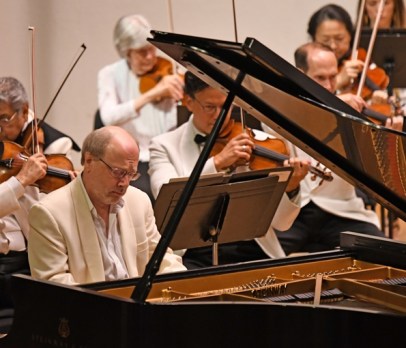
Demarre McGill, Ludovic Morlot, and Marc-André Dalbavie with Seattle Symphony

Seattle Symphony audiences are familiar with Demarre McGill’s magical flute artistry from countless solo moments he’s performed as the ensemble’s principal flute. But this week’s program puts him center stage for the Flute Concerto by Marc-André Dalbavie — and it was an unforgettable highlight of Thursday’s performance.

The French composer wrote his Flute Concerto in 2006 for the Berlin Philharmonic’s principal flutist, the Franco-Swiss Emmanuel Pahud, so you can readily imagine the caliber of playing required. Even at 17 minutes, relatively brief for a concerto, the piece keeps the soloist frenetically active for long stretches.

McGill negotiated its challenges with pure grace and eloquence, engaging in Dalbavie’s unusual dialectic with the orchestra. Rather than a sweet-tuned concerto of airy charms, the flute seems to be simultaneously urging on and trying to tame the orchestra’s ebullient spirits. McGill projected a complex protagonist, Orphic in the central slower section, sprightly as Puck girdling the earth in the rapidfire passages.

Ludovic Morlot led a vivid, gorgeously textured performance that was the theme of the entire generous program, mostly a French affair. He began with another of his specialities, Maurice Ravel’s Suite from Ma mère l’Oye. This time, I detected a radiant, but never forced, tone of elegiac wonder in Sleeping Beauty’s Pavane and the concluding scene of the Enchanted Garden. There was ebullience in the latter as well, underscoring a kinship with the parallel concluding moment in The Firebird. The SSO’s playing was at its most refined, full of silken caresses and subtly articulated rhythms.

The first half ended with the world premiere of Tropes de : Bussy, an ambitious symphonic work the SSO commissioned from Joël-François Durand, Associate Director of the UW School of Music. The title alone requires considerable unpacking and points to the layered associations and post-modern play of Durand’s score. Explains the French-born composer, who developed his concept of the piece while orchestrating some of the piano Préludes of Debussy: “As I kept re-working my arrangements, I gradually started to modify the original music, as if adding more and more interpretive filters with each attempt… Tropes de : Bussy is at first glance a pun on the French composer’s last name, but it also reflects the distance I took from the original texts, revealing and at the same time hiding most of the actual music.”

Durand chose five of the Book I Préludes (Les sons et les parfums, La danse de Puck, Le vent dans la plaine, Des pas sur la neige, and Minstrels. There was much to admire in the imaginative soundscapes he conjured from a large orchestra. If the piece seemed to overstay its welcome, stretching the game of hide-and-seek with the familiar Debussyan harmonies and ideas on at great length, it offered numerous enchanting moments (particularly the “slow” movement after Des pas sur la neige. With its deconstruction of rhythmic structures, the finale after Minstrels recalled something of Ravel’s strategy (though not his sound world) in La valse.

To conclude, Morlot led the one non-French work on this wonderful program. His account of Mozart’s later G minor Symphony, K. 550, glistened with the textural alertness that had been his focus in the French pieces. Taking the Andante at a brisk “walking” tempo worked especially well, and Morlot set off sparks by leaning into the cross-rhythms of the Minuet. The relentless drive of the outer movements gained freshness from being juxtaposed with the Dalbavie.

Review (c) 2019 Thomas May

Filed under: commissions, Ludovic Morlot, Maurice Ravel, Mozart, new music, review, Seattle Symphony

Deutsche Oper Offers Two Back-to-Back Rarities: Der Zwerg and Rienzi

Mick Morris Mehnert and David Butt Philip-Monika Ritterhaus

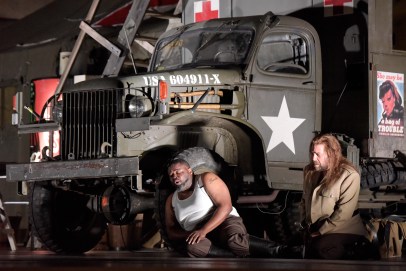
Mick Morris Mehnert and David Butt Philip as the title character in Alexander Zemlinsky’s Der Zwerg (c)Monika Ritterhaus

For Musical America, I reviewed two productions of rarities appearing this month at Deutsche Oper: Alexander Zemlinsky’s moving and powerful Der Zwerg and Rienzi, Richard Wagner’s early appropriation of French grand opera.

BERLIN — Deutsche Oper presented a pair of rarely seen operas in rotation over the past few weeks: Alexander Zemlinsky’s unfairly neglected Der Zwerg (“The Dwarf”) and Richard Wagner’s grandiose early breakthrough, Rienzi — a work understandably overshadowed by what came after it.

Zemlinsky tends to show up as little more than a footnote in discussions of Schoenberg (his student) and Mahler (his sexual rival) — both of whose work he championed. But this compelling production of his one-act opera (which premiered in 1922) left no doubt that Zemlinsky is long overdue for a proper and sustained revival…

continue

Filed under: Alexander Zemlinksy, Deutsche Oper, Donald Runnicles, Musical America, review, Wagner

Yuval Sharon’s Berlin Flute Seeks to Put the Magic Back in Mozart

Papageno (Florian Teichtmeister) and Tamino (Julian Prégardien) in The Magic Flute credit: Monika Rittershaus : Staatsoper Berlin

Papageno (Florian Teichtmeister) and Tamino (Julian Prégardien), with dead serpent, in The Magic Flute (credit: Monika Rittershaus / Staatsoper Berlin)

BERLIN — In his program note for the new production of The Magic Flute that he directed for Berlin Staatsoper, Yuval Sharon recalls the image of a young girl in Ingmar Bergman’s 1975 film version who is repeatedly shown to be deeply absorbed watching a performance of Mozart’s opera unfold. She represents the ideal audience member for this work, according to Sharon, because she retains the childlike capacity for wonder.

continue


Filed under: directors, Musical America, review, Yuval Sharon

Poetry and Politics: Sir András Schiff Does Double Duty with Seattle Symphony

100534-2270-schiff-pf2-c-nadia-f-romanini

Sir András Schiff © Nadia F. Romanini

Sir András Schiff began a remarkable weekend of music with his appearance as guest conductor of the Seattle Symphony. My review:

For a long time, Seattle audiences have made clear their admiration for the artistry of Sir András Schiff whenever he comes into town for solo recitals – including one occasion 17 years ago, when his Bösendorfer had an unfortunate encounter with black ice while being transported across the continent and a replacement had to be found at the last minute.

continue

Filed under: András Schiff, Bach, Bartók, Beethoven, review, Seattle Symphony

Schubert and Britten et al. from Byron Schenkman & Friends

IMG_0958

Byron Schenkman, Jeff Fair, and Zach Finkelstein

Still basking in the emotions from Sunday evening’s program courtesy of Byron Schenkman & Friends – said friends on this occasion being tenor Zach Finkelstein (in his Nordstrom Recital Hall debut), Seattle Symphony principal horn player Jeff Fair, and cellist Nathan Whittaker.

Schenkman’s programming is always an art in itself, but this one really stood out for its combination of poetry and music, focusing on a pair of composers who rank among the most sensitive writers for the voice. Schubert lieder framed the evening, with a set of four songs to begin — “Der Musensohn,” “An die Laute,” “Ganymed,” and “Du bist die Ruh” — and “Auf dem Strom,” one of the miraculous products of his final year, at the close.

Finkelstein’s refined, expressive phrasing and gorgeous tone hit the mark. The tenor was alert to every nuance Schubert uses to paint the emotions evoked by the poet, adding just enough pressure and urgency to make an apparently simple melodic turn suddenly light up with hidden colors. (See the video below for more on this wonderful singer, including some of his insights on Britten.)

“Auf dem Strom” — thought to be possible a tribute to the late Beethoven, who had died the year before — came off as a thoroughly involving miniature drama. I also admired Schenkman’s affinity for this repertoire, which shows off a very different side of his artistry from the early music fare I more frequently hear him perform. Jeff Fair emphasized the touching mellifluousness of the horn part, with hints of nostalgic heroism as well.

Schenkman, Finkelstein, and Fair all have collaborated on a to-die-for recording of all five of Benjamin Britten’s Canticles, which came in 2017. Before performing the two Canticles featured on this program, Schenkman and Finkelstein read the long, intricate poems which Britten set to music: Canticle I, Op. 40 (“My Beloved Is Mine”) by Francis Quarles, composed in 1947 for his life partner, tenor Peter Pears; and 54 the 19Canticle III, Op. 55 (“Still falls the rain: The raids 1940. Night and dawn”), to a poem by Edith Sitwell, which calls for a solo horn part in addition to the piano accompaniment.

These two highly contrasting pieces — the one a mystical ode to love, the other an unsparing reflection on human nature’s darkest side, while still reaching for hope — made for a powerful juxtaposition. Canticle III is of Turn of the Screw vintage and felt both cathartic and emotionally exhausting.

When introducing the first Canticle, Schenkman pointed out the composer’s bravery in living with a same-sex partner during a period when Alan Turing was subjected to such injustice, recalling, too, how Queen Elizabeth sent a personal letter of condolence to Pears following his companion’s death in 1976. Schenkman also referred to Britten’s role in reaffirming the stature of Mendelssohn following the Nazis’ attempt to erase him from history, noting how Mendelssohn himself played a pivotal role in rescuing nearly lost Schubert masterpieces from oblivion.

Schenkman and Nathan Whittaker gave a glowing account of Mendelssohn’s Variations concertantes for cello and piano, Op. 17, after the first Canticle. The cellist also treated listeners to the solo piece The Fall of the Leaf by Imogen Holst (daughter of Gustav Holst and a close friend of Britten and Pears). Written in 1963 for Pamela Hind o’Malley, it comprises “short studies … on a 16th-century tune” from the Fitzwilliam Virginal Book (by Martin Peerson). More eloquent, even grief-stricken, than restrained, Whittaker brought out the thoughtful melancholy of the descending, fatalistic theme, while playfully suggesting the ghost of a lute in Holst’s pizzicato chords.

Filed under: Britten, Byron Schenkman, review, Schubert

Protected: Tan Dun’s Moving Buddha Passion Gets Its U.S. Premiere by LA Philharmonic

This content is password-protected. To view it, please enter the password below.

Filed under: Gustavo Dudamel, Los Angeles Philharmonic, Musical America, review, Tan Dun

A Fuller Monty: Christmas Vespers by Monteverdi

Monteverdi-1

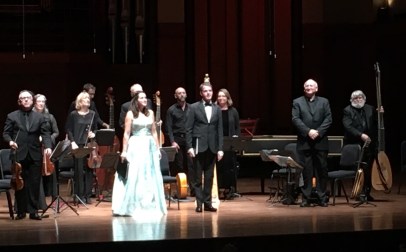
David Fallis and colleagues

Early Music Seattle presented this remarkable concert over the weekend: and it was just what the doctor ordered in these jaded times.

Even if he hadn’t composed a single opera, Claudio Monteverdi would still belong to the greatest of the great for his achievements as a master of sacred music. His Vespro della Beata Vergine, published in 1610, is hailed as a landmark of the literature – and is the work instantly conjured whenever you hear the phrase “the Monteverdi Vespers.” But it was an altogether different setting of the Vespers service that Early Music Seattle presented at this concert, the most recent installment in the ongoing Northwest Baroque Masterworks Project.

continue

Filed under: Monteverdi, review

At BAM: An Early Turnage Opera Still Packs a Punch

GREEK626

Photo: Richard Termine


My Musical America review of Mark-Anthony Turnage’s debut opera Greek, given its belated New York premiere at BAM in a visiting production directed by Joe Hill-Gibbins:

NEW YORK–Raw rage and political engagement were the driving forces behind Mark-Anthony Turnage’s debut opera Greek. Familiar enough for a young artist just setting out, such motivations can make a powerful initial impact but tend to give the art they inspire a rapidly expiring shelf-life. And yet Greek has not staled in the three decades since its premiere.

continue [paywall]

Filed under: Mark-Anthony Turnage, Musical America, review

Akropolis Performance Lab Serves Up Genet’s Subversive The Maids

Emily Testa as Solange in Jean Genet’s The Maids Mark Jared Zufelt/Aether Images
“Did I put on this dress to hear you sing about my beauty? Shroud me with hatred! Insults! Sputum!”

Even the process of booking an evening with Akropolis Performance Lab (APL) differs from the routine. There’s an aura of mystery to requesting an invitation to its current production of The Maids/The Vexations, which is under way until 24 November. The venue remains undisclosed until you’ve committed to actually attending.

Once arrived, you enter a room that’s been artfully converted into an almost uncomfortably intimate performance space — big enough to accommodate the three cast members required for Jean Genet’s play, an audience of 10-12 people tops, a piano, and a little bar. The aura is a blend of speakeasy and adventurous cabaret. A wall of mirrors serves as part of the set design, multiplying the spectators and actresses.

It all reinforces the hyper-self-consciously surreal atmosphere of APL’s remarkable interpretation. Jean Genet’s bold, one-act drama from 1947 (Les Bonnes en français) — his first play to be staged in Paris — was inspired by a real-life crime story that became the equivalent of clickbait news in 1933, when two sisters who were live-in French maids murdered their employer’s wife and daughter. But the very premise of a solid connection to “reality” at the most essential level — the sense of a real, authentic self — is subverted throughout the play, turning Hamlet’s sarcastic/melancholy “‘Seems,'” madam? Nay, it is; I know not ‘seems'” on its head.

Directed and designed by Joseph Lavy, APL’s production brings the point home by appending a preludial pantomime in which the three cast members, dressed in lingerie, strike varying exaggerated poses, interacting but interchangeable, prepared to shift roles on a dime.

And, on top of this, there’s a musical layer: the show actually begins with Zhenya Lavy — with Joseph, cofounding artistic director of APL — taking her place at the aforementioned piano and playing the enigmatic, sphinx-like harmonies of Erik Satie’s The Vexations: once, again, thrice, and over and over, through the pantomime, through the duration of the play.

Satie’s undated, single-page score (which has been variously described as an anti-Ring cycle and a kind of spell to get past a love gone sour) comes with the instruction “In order to play the theme 840 times in succession, it would be advisable to prepare oneself beforehand, and in the deepest silence, by serious immobilities.” That total number of repetitions lasted over 18 hours when John Cage famously staged a presentation, but even at a fraction of that, Zhenya Lavy established a mood of archaic yet ironic ritual that perfectly suited the ritualistic anti-realism of Genet’s theater.

The play itself unfolds amid the accoutrements of the unnamed Madame’s wealth (or, at least, comfortably bourgeois lifestyle), as the maids Claire and Solange take turns rewriting the script of servitude, of mistress and servant. In the process, they enact rituals of domination and humiliation in all its connotations: sexual, political, social, religious.

Their shared, mutual fantasies of mutiny and sadomasochistic reversal climax in a plan to murder Madame with sleeping pill-laced tea, which will also solve the problem of her lover’s suddenly impending appearance, out on bail — after he had been denounced by Claire to the police and jailed.

Joseph Lavy also translated Genet’s text into an English that conveys the curious mixture of poetic filtering and religious ritual central to Claire’s and Solange’s game-playing (or is it even a game?) — aspects that get lost in more pointedly political renditions of the work on the English stage. Madame is also referred to as a kind of medieval “my lady” and, with her flowers and beautiful attire — briefly offered as gifts — creating a Madonna-like aura of reverence.

As Claire, Annie Paladino is spellbinding and dangerous, her ability to enter fully into each role as convincing as the speed with which she sheds one skin for the next. Her older sister, Solange, is given a complex, layered, deeply resonant performance by Emily Testa. One surprise of the casting is the youth of Madame (the excellent Catherine Lavy), which erases the generational distance between the characters and underscores the riddling interchangeability of identities.

All three are coached in APL’s characteristic focus style of ensemble-focused training, a refreshing, much-needed antidote to the default, watered-down “method” that dominates commercial theater and media. This company offers a wonderful, praiseworthy alternative to such predictable and formulaic theater-making.

Review (c) 2018 Thomas May. All rights reserved.

Filed under: Akropolis Performance Lab, review, theater, Uncategorized

Archive

Enter your email address to follow this blog and receive notifications of new posts by email.