Almost a year ago, the New York-based composer Michael Vincent Waller told me about a new album he had in the works. The topic came up when I interviewed him for Musical America, which featured Waller as January’s new artist of the month.
The album, titled Moments, came out just last month on the Unseen Worlds label and offers a wonderful entrée into Waller’s musical world. His third album to date, it comprises 18 miniatures, 13 of them for solo piano, the other 5 for vibraphone.
Waller continues his collaboration with R. Andrew Lee, whose sensitive performances at the keyboard were featured on his preceding album, Trajectories (along with the phenomenal cellist Seth Parker Woods). The percussionist William Winant, a well-known personality in avant-garde circles, plays the pieces for vibraphone.
“One thing I’m trying to explore as an artist is the organic, intuitive sense we have about experiences — the human subtext to what is happening in the music, in its colors, harmonies, and melodies,” the composer explained during our talk last year. In Moments, he has distilled a range of experiences with an open-hearted, intimate honesty that resonates long after the ebb and flow of his compositions’ physical sounds.
It’s not necessary to know any of the autobiographical stories or family relationships and loved ones Waller memorializes here to be moved by the emotions they elicit. On another level, Moments pays gentle tribute to musical figures who are part of a generally known cultural repertoire. “For Pauline,” for example, referring to the late Pauline Oliveros, was prompted by her death in November 2016. Its bell-like chords in alternating registers concentrate the attention on the taken-for-granted miracle that is harmony, effecting an experience of “new sound.”
Similarly, the sounds of the piano itself begin to reassemble into something not-quite-familiar. This lays the ground for the wonderful effect of the vibraphone’s first entrance well into the album (in a kind of mini-suite comprising four of the miniatures and titled “Love”).
In the spirit of Oliveros and the philosophy of what she called “deep listening,” Waller composes with a deceptive simplicity. His aesthetic relies on — and expands from — a generous patience familiar from practices of meditation and mindfulness. These “moments” radiate a fullness that belies their duration — most of the pieces are between just two and three minutes long.
La Monte Young was a formative influence who opened Waller up to new ways of perceiving the materials of a composition — indeed, the phenomenon of sonority itself. Erik Satie and Morton Feldman are some of the other musical spirits evoked by various Moments. The final piece, “Bounding,” even alludes to a mainstay of Western music history, the descending “lamento” chord progression that has taken countless forms, from flamenco to the opening of Philip Glass’s Satyagraha).
But none of these are derivative or reduced to cliches. Waller’s use of the most elemental materials and gestures combines reflective process with an unironic, unconditional sharing of self and soul that I find deeply moving.
Waller again turns to the photographer Phill Niblock — as he does on his previous two albums — for the striking cover image of Moments. An LP edition is also available, and the record includes insightful commentary by Tim Rutherford-Johnson and liner notes by “Blue” Gene Tyranny.
Currently touring the West Coast, the Danish String Quartet paid a visit recently. I now get what the fuss is about. Here’s my review for Strings:
The Danish String Quartet‘s contribution to the Beethoven 250 celebrations this season includes a tripartite North American tour. As part of the fall segment of this tour, which is currently underway, the Scandinavian foursome made a recent stop in Seattle. On offer was the first of the Beethoven-themed programs they are presenting under the project name PRISM. The performance launched this season’s International Chamber Music series at the Meany Center for the Performing Arts of the University of Washington.
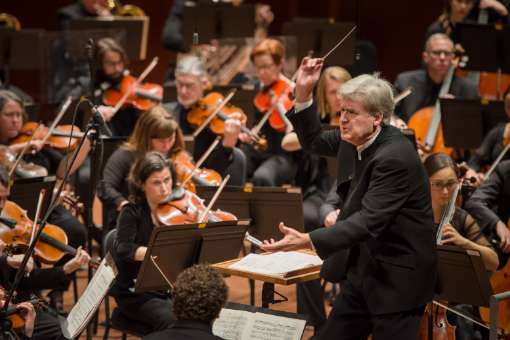
Last night’s concert was the first chance I’ve had to experience Thomas Dausgaard in action with the Seattle Symphony since his inaugural season as music director began. Even with just a fraction of the players onstage for the entire first half (and a modest-sized orchestra for the second), this was music-making on a very high level. There was no fall-back on routine — which might easily have been the case, in view of the presence of two ultra-familiar works anchoring the program: the fourth of J.S. Bach’s Brandenburg Concertos and Mozart’s final Symphony, the so-called (though not by the composer) “Jupiter.”
What gave the programming an edge was the inclusion, side-by-side with the Bach, of a new work by the Austrian composer Olga Neuwirth titled Aello – ballet mécanomorphe. Dausgaard led its world premiere in Stockholm last year, with flutist Claire Chase as the soloist and the Swedish Chamber Orchestra (which he helmed until starting his SSO tenure this fall). Neuwirth was one of six contemporary composers commissioned by Dausgaard and the SCO to write new response works that somehow react to the Brandenburg Concertos. (For the record, the others include Uri Caine, Brett Dean, Anders Hillborg, Steven Mackey, and Mark Anthony Turnage — the whole project was presented at the 2018 BBC Proms [see video above].)
The Seattle Symphony had the honor of giving Aello‘s U.S. premiere — and, it is to be hoped, will continue pursuing the music of this boldly imaginative, singular, uncompromising composer. Neuwirth is at last gaining long-overdue recognition. She was a key presence at the recent Musikfest Berlin
(where I had a chance to hear Susanne Mälkki conduct the young Karajan Akademie musicians in Aello, with Berlin Philharmonic principal Emmanuel Pahud as the soloist).
Neuwirth’s commission was to write a companion piece to be paired with the Brandenburg Concerto No. 4 in G major (BWV 1049), using essentially the same chamber ensemble. Except she replaces Bach’s soloist trio of violin and two flutes (or flute-like instruments) with a solo flute as protagonist. Her counterparts are a pair of trumpets (one piccolo) that play with various mutes — taking on the role of the Bach flutes. (The doubleness of the latter come back as well in the flute soloist’s alternation between her “normal” instrument and a bass flute for the final movement.)
As “continuo,” Neuwirth substitutes a multiple-personality “harpsichord” comprising a synthesizer and a percussionist (Michael Werner) who plays a mechanical typewriter (the score specifies an “Oilivetti Lettera 22” model, which is amplified), a triangle made to resound with an automatic milk foamer, and a water-filled glass pitched to a high E. And even the string ensemble is “de-natured” by the complex multiple tuning system Neuwirth establishes for the whole ensemble (including the solists), with four layers of different pitchings.
Claire Chase, the score’s dedicatee, is a widely acclaimed musical adventurer who has built her solo career around expanding the potential for her instrument. Neuwirth avails herself not only of Chase’s extraordinary musicianship but of her stage charisma as well. The flutist’s performance last night cast a spell with her commanding gusts and mysterious whisperings, egging on the motley trumpet sounds and breaking free from the ensemble’s attempts at hegemony.
As she nimbly — indeed, balletically — turned and twisted, Chase’s compelling stage presence seemed to conjure an oracle, at times blissful, at others demonic in its aura. Aello actually refers to an ancient Greek harpy, but Neuwirth subverts the sexist image by making her mythical being into “someone sent by the gods to restore peace, if necessary with force, and to exact punishment for crimes.”
Similarly, the “macho” personae of Baroque trumpets is tamed and, as it were, Dada-fied through the mutes and the resultant kaleidoscope of colors (Neuwirth herself studied trumpet). The legacy of Dada — its absurdist play with machines and “stuff,” with the mechanical aspects of modernity — is another important influence on Neuwirth’s aesthetic.
There were some muffled gasps and giggles from the audience, reacting to the absurdist humor of the piece — yet Aello is by no means a simple “parody” of the Bach companion (neither in the usual sense of the word nor even the Baroque sense).
Neuwirth follows Bach’s three-movement design and quotes snippets of his motifs and melodies, but these appear more as vanishing recollections of a musical world that no longer makes sense. Along with the playfulness, there are moments of mesmerizing mystery — above all in the slow middle movement, which approaches the ethereal — and even of terror. Neuwirth’s sense of pacing is superb — no wonder she has a flair for the stage and for film scoring. She dramatizes a remarkable attempted coup by the ensemble in the final moments that is thwarted, once again, by the flute-goddess’s knowing breath.
Dausgaard led a (mostly) standing ensemble in the Fourth Brandenburg itself to start the program and set the stage for Aello. Claire Chase joined principal flutist Demarre McGill and concertmaster Noah Geller to form the solo group. All of them listened intently to their fellow musicians and responded with in-the-moment honesty. Dazzlingly stylish and refined, Geller gave the insanely difficult violin cadenzas the elan of breakout jazz solos. I especially relished the mingled “mega-flute” colorations McGill and Chase created as their lines bobbed and wove together.
The Mozart sounded … BIG in comparison to the chamber delicacy of the first half (Baroque and Dadaish alike). I would have preferred a slightly less beefed-up string section. Dausgaard mostly succeeded in keeping balances beautifully weighted, but Mozart’s wind writing was at moments a tad lacking in presence because of the wall of string sound.
Still, the Danish maestro enjoys an inspiring rapport with the SSO, and everyone was on high alert to deliver. He even pulled a few Arthur Nikisch moments, in which he conducted using nothing but his eyebrows. Dausgaard approached the “Jupiter” as a proto-Beethovenian epic, exploiting explosive accents (with dynamic contributions from James Benoit on timpani) and delineating a sense of musical travel, above all in the outer movements.
He obviously possesses a fantastic ear, and the ability to coax microsecond readjustments, so that rich, unexpected colors emerged — most wondrously, in the veiled murkiness he elicited from the slow movement’s harmonic clouds. Mozart’s pauses became a powerful theatrical device through which he drew intriguing connections between the first two movements, the one Apollonian in majesty, its cantabile counterpart an Orphic reverie.
Mozart famously performs his own retoolings of Bach (and Handel) in many of his late period works: the “Jupiter” finale is glorious exemplary. Dausgaard kept the architecture cleanly in view without dampening the visceral excitement.
The program will be repeated on Saturday 12 October at 8pm. And Claire Chase performs in recital tonight at 7.30pm at Octave 9.
Tenor Russell Thomas (Don Alvaro) and baritone Markus Brück (Don Carlo) in Frank Castorf’s staging of La forza del destino at Deutsche Oper Credit: Thomas Aurin
Frank Castorf has long been an avant-garde institution in Berlin, but he just made his debut at Deutsche Oper with a staging of Verdi’s La forza del destino that sparked audience mutiny. Here’s my review for Musical America.
BERLIN — Booing can be a badge of honor in Germany’s theaters, particularly when it comes to canonical works. That’s at least one way of regarding the vehement reactions that have greeted Frank Castorf’s new staging of La forza del destino at Deutsche Oper…
Madison Leonard (Gilda) and Lester Lynch (Rigoletto); (c) Sunny Martini
Seattle Opera has just launched its new season under incoming General Director Christina Scheppelmann with a new Rigoletto production. Here’s my review:
Recounting one of the bleakest, cruelest narratives in the core repertoire, Rigoletto depicts a noirish world of sexual predation, misogyny, despotism, revenge, murder, and… horrifically bad luck. Should all this be approached as timeless tragedy, timely social commentary – or merely as a guilty pleasure akin to consuming a thriller?
Marc-André Hamelin performed both Brahms piano concertos at the Bellingham Festival. (Photo: Catherine Fowler)
I spent a lovely day in Bellingham on Sunday. Here’s my review of Marc-André Hamelin’s program of the two Brahms piano concertos at the Bellingham Festival of Music for Classical Voice North America.
BELLINGHAM, Wash. – Rhapsodizing about his summer getaway in the lakeside resort of Pörtschach, Brahms observed that “the melodies fly so thick you must watch out not to step on one.” It’s easy to imagine the composer armed with a melody-catching butterfly net and setting out for a stroll through the idyllic campus in coastal Washington, where the Bellingham Festival of Music takes place over three weeks each July.
My review of Monday evening’s Summer Chamber Festival concert, which presented the world premiere of Sebastian Currier’s piano quintet Voyage Out, along with music by Fanny Mendelssohn* and Antonín Dvořák:
Under the smart and tastefully reliable artistic direction of the distinguished violinist James Ehnes, the Seattle Chamber Music Society has basically hewed to a longstanding programming formula: an overlooked work by a familiar composer, a piece featuring instrumentation unusual for the chamber format, and a blockbuster or two, typically from the 19th century…
*This observation was cut from my review, but since the event has still left me seething, I want to include it:
As if patriarchal strictures hadn’t suppressed Fanny Mendelssohn’s voice sufficiently during her own lifetime, contemporary technology continued the insult to this wonderfully gifted composer in the form of entitled, inexcusable rudeness: in both the first and second movements, the same audience member had to silence a cell phone’s intrusions (not before the beastly device rang out a full cycle of Westminster chimes as the Adagio was supposed to have ebbed into silence).
Rachel Willis-Sørensen (Rusalka) and Kristinn Sigmundsson (Vodník the Water Goblin); photo (c) Cory Weaver/San Francisco Opera
David McVicar and San Francisco Opera have been a winning combination in recent seasons. Here’s another to add to the list along with Meistersinger and Les Troyens: the company’s staging of Rusalka in June. My review for Musical America (with another on Carmen and Orlando to follow):
SAN FRANCISCO — After he returned from his sojourn in the New World, Dvořák ceased writing symphonies and turned for inspiration to Czech legend and folklore: first, in a brilliant quartet of symphonic poems — still too infrequently programmed — and then in a pair of operas.
It’s not surprising that Rusalka, the second of these, has found its place in the international repertoire as the most popular of Dvořák’s ten stage works. Along with offering a poetic variant on a universally resonant archetype (the folktale of the mermaid), Rusalka fuses Dvořák’s disparate musical influences into a versatile musical language ideally primed for narrative effectiveness.
That said, Rusalka, which premiered in 1901, suffers from some basic dramaturgical weaknesses as well as stretches of second-rate musical inspiration. But the production presented by San Francisco Opera — only the second time Rusalka has been staged by the company — swept these shortcomings aside to reveal a richly layered and fully engaging work…
Ludovic Morlot at his farewell Seattle Symphony concert; photo (c) Brandon Patoc
A look at Ludovic Morlot’s Seattle Symphony legacy:
SEATTLE — With the elegiac strains of the Mondscheinmusik interlude from Richard Strauss’s Capriccio as an encore, Ludovic Morlot brought his final program as music director of the Seattle Symphony Orchestra to an end over the weekend. Stepping back to let the spotlight fall on principal horn Jeffrey Fair during his incandescent solo was a characteristically generous touch. It reminded me of the moment at the end of his opening night concert in 2011, when Morlot descended the podium to join the violin section during Boléro — music making as a shared undertaking among equals.