Sergey Khachatryan. Image courtesy of Seattle Symphony.
My review of this weekend’s Seattle Symphony program with Ludovic Morlot and violinist Sergey Khachatryan is now live onVanguard Seattle:
The Seattle Symphony Orchestra (SSO)’s sixth season with Music Director Ludovic Morlot has so far included a pair of electrifying programs that paired world premiere commissions by composers of today with Beethoven classics—the latter part of an ongoing two-year cycle of the composer’s complete symphonies and piano concertos.
Along with unveiling a world premiere by composer Agata Zubel, the Seattle Symphony continued its ongoing Beethoven cycle with a rhapsodic contribution by soloist Inon Barnatan at the keyboard.
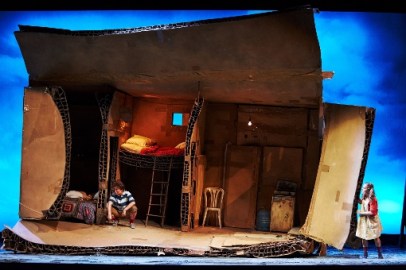
Sasha Cooke (Hansel) and Ashley Emerson (Gretel); photo by Philip Newton
Absurd as it sounds, there was a time in the early 20th century when Hansel and Gretel was regularly performed at the Metropolitan Opera on a double bill with Pagliacci. And its longstanding association with Christmas – Richard Strauss, after all, conducted the world première in Weimar on 23 December 1893 – has reinforced a general impression of Engelbert Humperdinck’s opera as a light entertainment, a candied appetiser in need of more substantial fare to balance it out if presented as part of a regular opera season intended for adults.
Last night’s concert with Pablo Rus Broseta and soloist Yo-Yo Ma was a delightful confirmation that experiencing an orchestra in live performance can provide a high like no other. It doesn’t need to be a Mahlerian epic or a program of revolutionary breakthroughs — those offer up unique experiences of their own — but it does require the unwavering commitment of the musicians.
This was a modest-sized Seattle Symphony, as some of the players are now on duty in the pit for Seattle Opera’s about-to-open production of Hansel and Gretel. And the program of Bartók, early Mozart, and Haydn offered a straightforward menu. But nothing sounded rote, and the evident pleasure taken by the musicians proved to be infectious for the sold-out hall.
Drawing the large crowd, of course, was Yo-Yo Ma’s presence on the evening’s second half, but SSO Associate Conductor Pablo Rus Broseta led achieved some captivating results of his own from the podium. In the rapid succession of Romanian Folk Dances, — featuring excellent clarinet and flute solos — he elicited a touch of melancholy to spice Bartók’s vivid rhythms.
A pair of youthful Mozart symphonies followed: K. 201 in A major and a true rarity, K. 196 in D major (both from the end of the composer’s teenage years, in the mid-1770s). Rus Broseta approached these scores as if Mozart had just turned them in to fulfill an SSO commission. And it was possible to hear evidence of the young conductor’s experience with new music in the mindful focus on texture and balance.
If the opening movement of the A major symphony could have benefited from more-incisive attacks, Rus Broseta showed his sensitivity to Mozart’s spellbinding way of phrasing melody as well as to his expert comic timing. In his hands the spirited finale of K. 201 was made to sound exhilaratingly fresh, almost proto-Beethovenian. The strings played with superb ensemble.
And then Yo-Yo Ma emerged onstage with his glistening cello to give his first Seattle performance (as far as I’m aware) since last year’s memorable accounts of three of Bach’s Cello Suites and other fare at the University of Washington.
Haydn’s long-hidden-away C major Cello Concerto dates from when Mozart was still a young child (though already embarking on his first tour of Europe). Ma’s performance was a study in how to make a phrase and its subsequent repetitions rivet the attention.
While it’s hard not to thrill at the cellist’s technical mastery of intonation, articulation, rapid-fire scales — you name it — Ma’s musical imagination is what really calls the shots, making whatever he plays so compelling. The finale in particular, with its sudden shifts in mood, became downright suspenseful. From the podium Rus Broseta’s confident partnership ensured a lucid orchestral balance.
Ma offered a pair of encores: an elastic Prelude from the G major Cello Suite and Mark O’Connor’s poignant Appalachia Waltz (both in response to vociferous requests shouted from the audience). But with every bow he made his admiration of the orchestra and conductor clear, insisting that they share in the acclaim.
In addition to Bright Sheng’s Dream of the Red Chamber, I reviewed September’s other two productions at San Francisco Opera: a winning Don Pasquale (in which Larry Brownlee made his company debut) and a weak Andrea Chénier. The review is online at Musical America (subscription required):
SAN FRANCISCO—Was it merely coincidence or a cleverly tucked-away reference by way of programming? Regardless, San Francisco Opera opened its new season with a trio of operas in rotation … »Read
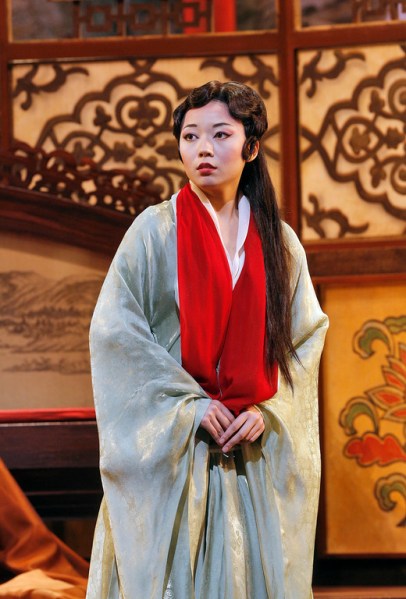
Pureum Jo as Dai Yu (c)Cory Weaver/San Francisco Opera
My review of the world premiere production of Bright Sheng’s Dream of the Red Chamber at San Francisco Opera has now been posted on Musical America (behind paywall):
SAN FRANCISCO—By its very nature, opera is a medium well-suited to synthesizing widely varied traditions into fascinating new hybrids. Dream of the Red Chamber, which received its world premiere production by San Francisco Opera in September, seeks to adapt one of the most beloved works of Chinese literature to the musical and theatrical dimensions of Western opera.
I was fortunate to be able to catch the season-opening program of Byron Schenkman & Friends — already in their 4th season! — at the end of an unusually packed weekend.
What a pleasurable way to regain focus: here was an intelligently programmed and charmingly presented concert that mixed masterworks with some fascinating novelties.
Most of all, it was filled with terrific music-making by colleagues whose enjoyment and passion drew the audience in. There’s always a feeling at a Byron Schenkman & Friends performance that it’s not merely about “presenting” a pre-packaged menu: it’s about sharing that experience as intimately as possible, drawing on the energy and involvement of the listeners — basically, in other words, the chamber music ideal.
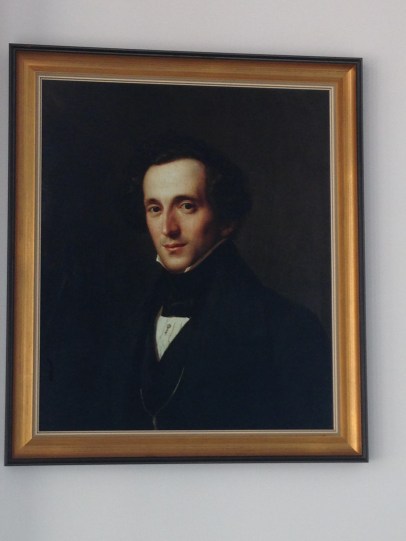
Schenkman built his program around the ties that bind J.S. Bach and the Mendelssohn family — not only Felix, whose advocacy of the Thomas Cantor through his landmark revival of the St. Matthew Passion in 1829 is a famous landmark of Bach reception, but older sister Fanny as well.
Schenkman pointed out that Fanny helped to prepare that performance of the St. Matthew Passion, and her reverence for Bach informed her own musical composition. While still in her cradle, he remarked, Fanny was lovingly described in a letter as wiggling what her prescient mother sensed were destined to be “Bach-fugue-playing fingers.”
The first half of the program was framed with tasteful accounts of Bach works as they may have been revived at a salon gathering chez Mendelssohn (say, while the siblings were growing up, or later, at Felix’s beautiful home in Leipzig).
With Schenkman at the keyboard (the Steinway typically used by Seattle Chamber Music Society for programs in Nordstrom Recital Hall, where the concert was held), Seattle Symphony principal violist Susan Gulkis Assadi played an arrangement for her instrument of the G major Sonata BWV 1027 that was redolent with color and expressivity.
Later came a version of the Concerto in F minor (BWV 1056) for piano and string quartet (with Gulkis Assadi joined by violinists Ingrid Matthews and Liza Zurlinden and cellist Geoffrey Dean), its haunting middle-movement melody — familiar from recycling elsewhere in Bach’s work — an especially effective foil to the restless turbulence surrounding it.
Schenkman eloquently introduced the work of Fanny Mendelssohn, describing her social position as a woman in an assimilated Jewish family in Biedermeier-era Germany — and the constraints to pursuing a composing career this entailed.
And the sense of palpable loss came through most unmistakably in the two selections of her work that were programmed: a Fantasy in G minor for cello and piano, with its genuinely memorable melodic pathos (Schenkman here joined by Dean), and one of her wordless Songs for the Piano, “Il Saltarello romano” (Op. 6, no. 4), one of the few pieces she managed to publish in her name.
But several pieces, according to Schenkman, she was able to publish only under her brother’s name. He referred to Felix’s well-known friendship with Queen Victoria, who once asked him to play her favorite number from his Songs without Words — whereupon he reportedly confessed that it was actually not his, but the work of his sister.
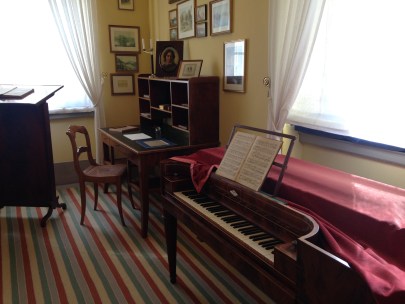
Mendelssohn’s study in Leipzig
The second half of the program offered a particularly rousing account of a late-period masterpiece by Felix Mendelssohn — and one of the highlights of the 19th-century literature — the C minor Piano Trio, Op. 66. It’s the last chamber piece the composer managed to have published with his approval (in 1846) before his untimely death in 1847– less than a half-year after the devastating loss of his beloved Fanny.
Zurlinden, Dean, and Schenkman together homed in on the Romantic passions and extremes of this marvelous score — the opening shared something of the atmospheric suspense of the much earlier Hebrides Overture — allowing the consoling second theme to expand and blossom at leisure.
I also admired the refinement of tonal balances between the strings and Schenkman’s piano textures. The Bach connection came through with noble effect in the finale, with the emergence of the quasi-chorale — beautifully shaped by the players — against an agitated backdrop (an idea Brahms would later take up in his Third Piano Quartet).
Next up — Music for the Sun King — is a program devoted to one of Schenkman’s special loves: the French Baroque.
With their first subscription concert of the new season, the Seattle Symphony and Ludovic Morlot have already scored a home run.
If you’re a fan of new music, you’ll regret missing this; ditto if you’re fan of the core classical repertoire. That in itself gives a good indication of just how remarkable this program is.
Last weekend I previewed Gabriel Prokofiev’s new work, an SSO commission.Having now heard the first full rehearsal as well as the live world premiere of this music, I’m genuinely thrilled by what Prokofiev has accomplished.
Titled When the City Rules, his new composition is a substantial, vividly imagined, and expertly constructed half-hour-long symphonic fantasia inspired by the phenomenon of the mega-city in contemporary life. It’s not program music in the old-fashioned sense of trying to “translate” a narrative into musical terms.
When I spoke to the composer recently, he said he relished the “magical” way in which music can generate images or feelings “without being super-exact”: how it can negotiate a space between pure abstraction and a medium like film, triggering multiple subjective “plots” according to each listener, since the musical images are so “open to interpretation.”
What he does in When the City Rules is to offer a broad suggestive framework for each of the four movements: an overview of the great, looming city and the life of its citizens (think London of today, where Gabriel Prokofiev resides). His “dramaturgy” juxtaposes the big picture with suggested “close-up” moments of characters or particular feelings.
So the first movement, opening with a beautifully sustained atmosphere of layered strings, evokes “the memories that cities hold” but also the modern city’s power; an “Andante Nostalgico” touches on the melancholy associated with cities and the desire to escape to something more pristine; considerable energy and excitement come to the fore in the third movement, which taps into the nervous, ceaselessly busy energy that not only keeps the city going but is a defining trait; and a “Rondo Brilliante” finale replete with echo effects to bring the work to a bracing climax and conclusion.
But it’s no simple affirmation: by then we’ve encountered a matrix of brooding, even oppressive sounds along with Prokofiev’s most animated writing. It’s tempting to work in a sci-fi level of interpretation, of a city becoming conscious of itself and its rulership over mere mortals.
Of course the four-movement pattern just outlined can suggest a more or less classically oriented symphony as well. The point is, there’s no doubt that When the City Rules is a milestone for Gabriel Prokofiev, whether you want to use that generic touchstone or prefer to approach it as a composition sui generis.
This is no mere patchwork of “impressions” or clever soundscape-vignettes, but an ambitiously conceived large-scale piece that works in real time (though I think it could perhaps benefit from a tad more tightening in a passage here or there).
Even though Gabriel Prokofiev first caught the music industry’s attention thanks to his talent for bridging the worlds of classical music and the electronica of the popular dance club scene — his Concerto for Turntables & Orchestra was featured at the 2011 Proms — When the City Rules is, notably, written entirely for acoustic orchestra, with no electronic “bells and whistles.”
And written with marvelous flair and fluency, using its rich palette in a way that makes the orchestra itself embody a vision of the city, both as ensemble and with its prominent roles for particular protagonists (flute, cello, and trumpet, most notably, and, to wonderful effect in the “nostalgic” slow movement, a solo saxophone).
When the City Rules moreover reveals a composer with a convincing sense of where his short, often rhythmic motifs can take us, of where the music needs to “go.” Anyone expecting a one-trick game — or a repeat of Prokofiev’s orchestral rethink of Sir Mix-A-Lot’s classic “Baby Got Back” (which brought another round of viral fame during his last collaboration with the SSO and Morlot, in 2014) — is in for a big surprise.
The masterfully built-up ostinato patterns that play such a key role in When the City Rules distantly recall a trait of his grandfather, Sergei Prokofiev, as does the tone of darkened, sardonic humor and even menace they sometimes conjure. There’s also a hint of 21st-century Sacre Stravinsky in the tracks of jagged rhythms that crunch and pop.
Prokofiev’s ongoing interest in electronic and dance club music remains present as an ongoing feature. “I think those styles work brilliantly in the concert hall,” he told me, citing the pervasive use of dance rhythms in the most familiar classical music. “They just happen to be dance rhythms that are 200 years old.” And from his work DJing, Prokofiev says he has learned techniques of “mixing and cutting something up — the way dance music will be manipulated to rise up to climaxes.” These are a contemporary version, in one way, of what Beethoven does with his slicing and recombining of short, potent motifs by way of “development.”
When the City Rules is an extraordinary achievement, but just as extraordinary is the fact that Morlot and the SSO, within a few days of first reading through the score together, have been able to deliver such a gripping and well-polished interpretation of this music for the premiere. Jeffrey Barker (flute), Efe Baltacıgil (cello), and David Gordon (trumpet) added particular flavor with their vividly characterized solo parts.
Any commission is by definition a risk: I’d like to think the generous patrons who underwrote this one (Norman Sandler and Dale Chihuly) realize what a winner they’ve picked.
And Gabriel Prokofiev’s piece was only one of the success stories of the program. Grandfather Sergei was also represented, with a performance of his compact but immensely varied and orchestrally eventful Symphonic Suite from his opera The Love for Three Oranges.
Prokofiev was a master composer for the stage, but he endured an absurd amount of bad luck in that arena. This Suite is an example of some of his best opera music being siphoned off into an arrangement for the concert hall. If Prokofiev’s wash of added percussion proved overpowering in the most vehement ensemble moments, the precision and balance of the strings were especially admirable. The detailed preparation of the Suite as a whole, with its many virtuosic flourishes, was nothing short of astounding, considering the amount of attention needed to prepare the brand-new score of the evening.
And then the Beethoven: since these reflections have already gone on at length, I’ll have to defer my more detailed impressions until later in the ongoing Beethoven cycle this season. To quickly sum up: it’s thrilling to observe how much more confident and focused Morlot is becoming in his approach to these icons of the classical rep.
This program in particular, framed by Beethoven’s First Symphony and his Eighth, even replicated something of that growth, with Morlot stepping even further out and taking greater risks in his account of the Eighth Symphony, which rounded this abundant evening of music off with a rousing conclusion.
My review of Seattle Symphony’s opening night program with guest star Joyce Di Donato has now been posted on Bachtrack:
“Wishing your lover dead is a terrible way to come back to Seattle”, remarked Joyce DiDonato, her lips twisting in mock consternation as she faced the tumultuous applause following her outrageously over-the-top rendition of “Ove t’aggiri, o barbaro” from Giovanni Pacini’s 1845 dramma lirico Stella di Napoli (the title, too, of her 2014 release blending bel canto classics and rarities).
My review of Calixto Bieito’s Carmen — his official U.S. opera debut, in a production revived at San Francisco Opera — has now been posted on Musical America (behind paywall):
SAN FRANCISCO—An icon of iconoclasm, Calixto Bieito has been alternately demonized and deified for the challenges his stagings pose to business as usual. Kudos to San Francisco Opera, in this final hurrah from outgoing general director David Gockley, for becoming the first North American company to give the Catalan director’s work a platform. “Carmen,” which both opened and will close SFO’s 2016 summer season (with a free “opera at the ballpark” live simulcast on July 2), marks Bieito’s absurdly belated U.S. opera debut — a dozen years after his Abduction From the Seraglio at the Komische Oper Berlin sparked outrage and international headlines.


 Sergey Khachatryan. Image courtesy of Seattle Symphony.




 MEMETERIA by Thomas May