MEMETERIA by Thomas May

Music & the Arts

Primal Ooze: María Irene Fornés at New City Theater

 George Catalano, Mary Ewald, and Tim Gouran in Fornes's Mud; (c) Anya Kazanjian

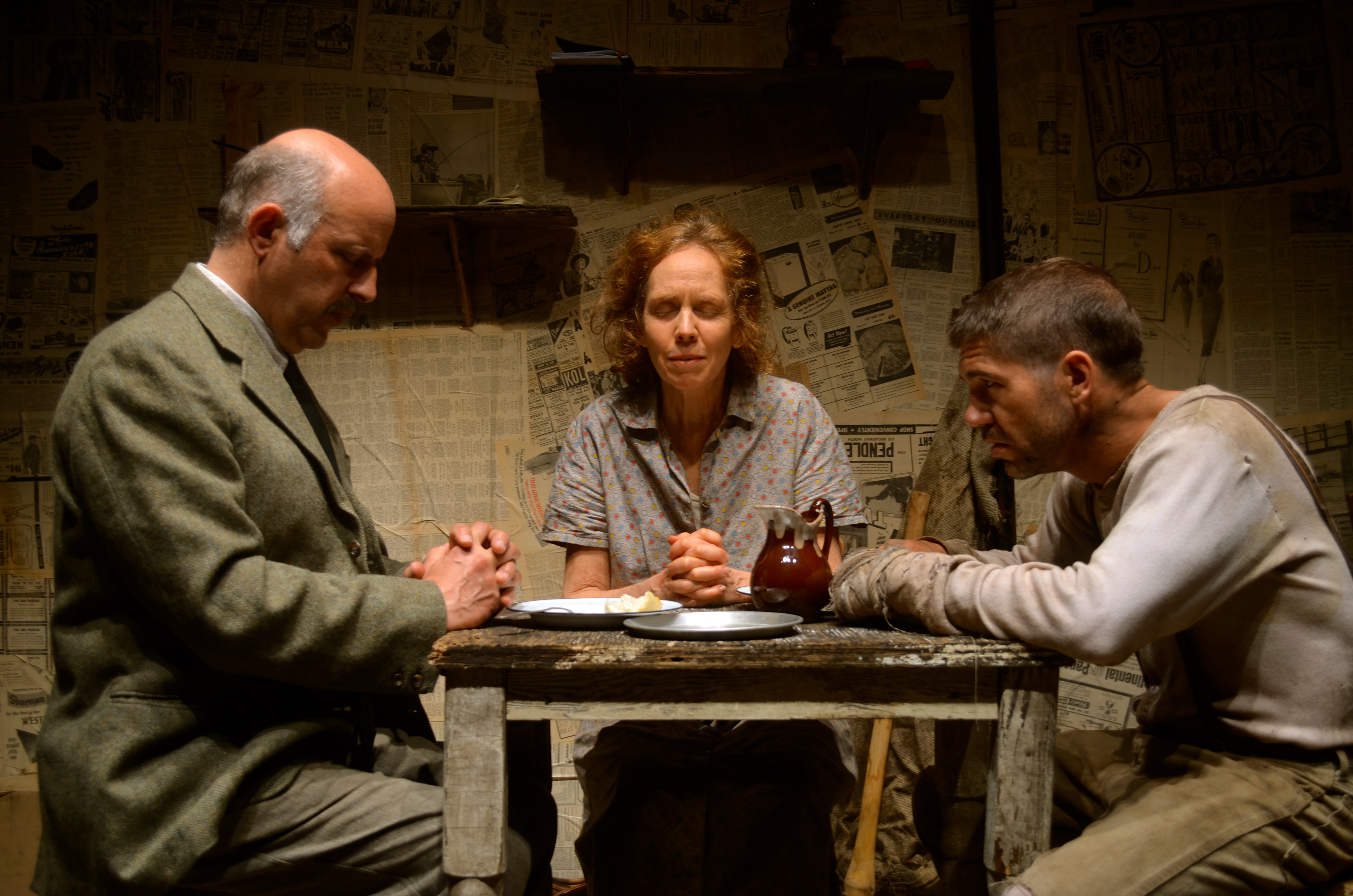
George Catalano, Mary Ewald, and Tim Gouran say grace in Fornes’s Mud; (c) Anya Kazanjian

Theater done New City style tends as a rule to be remarkably intimate: its current production of MUD is staged with an unflinching up-closeness. With just one row of seats that can accommodate 20 audience members tops, you’re positioned on the same level as the performance space, separated only by a few feet and a fine mesh screen from MUD‘s primal misery.

Written in the early 1980s by María Irene Fornés (now 85) — who collaborated several times with New City in the late 1980s/early 1990s — this grimly concentrated one-act drama spans but a little over an hour yet feels as exhaustive as a classical Greek tragic trilogy in New City director John Kazanjian’s searing production.

The simple-looking but intricately detailed set co-designed by Nina Moser and Kazanjian is a claustrophobic hovel, a roughhewn, comfortless, rural outpost in which Mae (New City co-founder Mary Ewald) longs for “a decent life.” There she ekes out a caged existence with her mysteriously ailing “mate” Lloyd, who had been adopted into the family by Mae’s deceased father as a younger boy. Lloyd’s arrested development has made him a bitter parasite on Mae’s drudgery, and he stinks with resentment against her attempts to improve herself through education.

Into this dire menage enters the more refined-seeming Henry (George Catalono), whose relative (but in fact quite limited) literacy and manners suggest a beacon of civilized hope for Mae. She takes Henry on as her new lover, while the further demoted Lloyd stews in bitterness, rage, and self-pity. Nina Moser’s costumes draw maximal impact from the contrast of Henry’s modest suit and tie with Lloyd’s dirt-encrusted bare feet and soiled rags.

Mae has staked her hopes on an illusion, though, and Henry doesn’t fail to disappoint with his petty behavior when Lloyd steals his money to buy desperately needed medicine. Rendered an invalid following a sudden accident, Henry soon becomes an additional drain on Mae’s resources — even less articulate than the brutish Lloyd. Fornés’ script, filled with poetry of a severe, forlorn beauty, draws metaphorical connections between animals and these hapless humans (making memorable use of an image of the shelter-seeking hermit crab).

Kazanjian gets his superb cast to fathom the many angles of this dark parable by the Cuban-born Fornés, including its registers of black humor. Gouran play Lloyd as a sulking American Caliban but finds variety in a character who can too easily come across as a nasty stereotype. Physical gestures juxtapose his listless impotence in the first scenes against Lloyd’s savagely dancing joy over his rival’s downfall. Catalono brings out Henry’s self-important pomposity as well as his rage over being driven to rage by Lloyd’s theft — Henry knows this undoes his facade.

Mary Ewald is one of the too-little-sung gems of Seattle acting. I was deeply impressed by her portrayal of Hamlet at New City last fall — a prince tormented by his tendency to idealize — and she is a legendary interpreter of avant-garde roles. Ewald sets the tone for the shades of despair and longed-for hope with which Fornés structures her play. Her Mae is trapped but determined not to play the role of victim. She declares that she intends to “die clean” in a hospital. “in white sheets” — not in the filth Lloyd seems content to fester in. All of which intensifies the horror of the otherwise rather predictable denouement.

With snapshot-like black-outs punctuating each of Mud‘s brief 17 scenes, Lindsay Smith’s lighting — along with Smith’s sound design of elegant snippets from J.S. Bach — creates a subtle distancing effect that is crucial to Kazanjian’s production. For all the Dust Bowl social realism of its surfaces, Mud comes across not as documentary critique but as a dark modernist myth of struggle and abandon.

Mud, by María Irene Fornés, until June 13 at New City Theater, 1406 18th Ave., Seattle; tickets here.

(c)2015 Thomas May — All rights reserved.

Filed under: review, theater

Seattle Opera: Buffing the Buffa in Ariadne

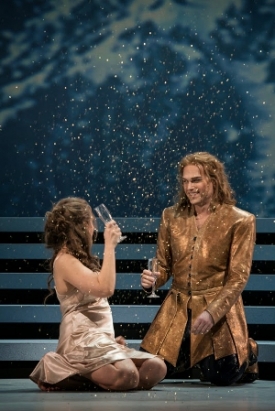
Kate Lindsey (The Composer) and Sarah Coburn (Zerbinetta); photo (c) Elise Bakketun

Kate Lindsey (The Composer) and Sarah Coburn (Zerbinetta); photo (c) Elise Bakketun

My review of Ariadne auf Naxos has now been posted on Bachtrack:

At the end of Seattle Opera’s previous production – a refreshing new staging of Handel’s Semele – the ill-fated heroine is burned by Jupiter’s glorious fire, but the god Bacchus emerges from her destruction: “born as my mother expired in the flames”, as Hugo von Hofmannsthal has the wine god explain in his libretto for Ariadne auf Naxos.

continue reading

Filed under: directors, review, Seattle Opera, Strauss

Pacific MusicWorks Retunes The Magic Flute

Cyndia Sieden and Mary Feminear

Cyndia Sieden and Mary Feminear

My review of Pacifc MusicWorks’ Magic Flute production has now been posted on the Musical America site. (The complete review is behind MA’s paywall.) This was a delightfully fresh take on the Mozart classic, matching historically informed performance values with a provocatively revisionist staging (including a newly commissioned translation/adaptaton of Schikaneder’s libretto):

SEATTLE — A couple years after the conductor, lutenist, and recent Grammy laureate Stephen Stubbs resettled in his native Seattle in 2006 — following three decades based in Europe (mostly in Germany) — he established Pacific MusicWorks, a production company focused primarily on presenting Baroque opera and oratorio in innovative collaborations. PMW’s latest project, which closed on Sunday, offered a fresh perspective on The Magic Flute by combining period instruments with a provocatively anti-traditional staging directed by Dan Wallace Miller and a newly commissioned translation and adaptation of the libretto by the playwright Karen Hartman.

continue reading

Filed under: directors, early music, Mozart, opera, review, Stephen Stubbs

After Life: Music of Remembrance Premieres New Opera

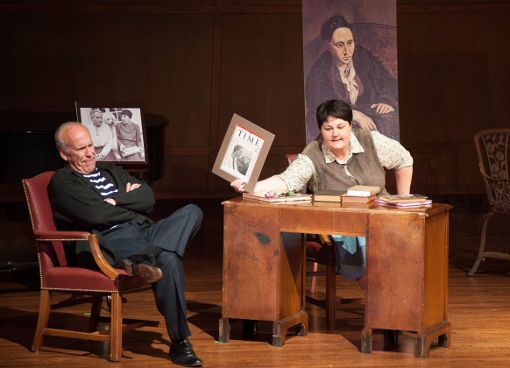
Robert Orth (Picasso) and Catherine Cook (Gertrude Stein); (c) Michael Beaton

Robert Orth (Picasso) and Catherine Cook (Gertrude Stein); (c) Michael Beaton

Just posted on Bachtrack, my latest review is of the world premiere of After Life by Seattle’s Music of Remembrance:

“Questions remember me,” sings the unnamed girl in After Life, the one-act opera by composer Tom Cipullo and librettist David Mason that received its world première on Monday evening in Seattle. Rounded up by the Nazis and sent from her orphanage in a French village to a concentration camp, the girl sings to us from the ‘other side’, the voice of a life stolen by the Holocaust. She knows she has been forgotten – yet the girl’s poignant questions make her presence indelible as she encounters the spirits of Gertrude Stein and Pablo Picasso in the afterlife: two famous figures who survived the war while also living in France.

continue reading

Filed under: Holocaust, Music of Remembrance, new opera, review

Orpheus Ascending: Mohammed Fairouz’s New CD

follow-poet

Mohammed Fairouz’s Follow, Poet is among the most inspiring CDs I’ve encountered in quite a while. For one thing, it documents two recent works by a composer who brings to the new-music scene not just a fresh voice but a powerful intellect and — most significantly — an unclouded vision of art’s potential for our jaded age. A vision that is ambitious without being naive.

Fairouz, still just south of 30, has already channeled his imagination into an astonishing gamut of genres, from intimate chamber works to concertos and major-scale symphonies (four to date!), choral pieces, and opera and other theater works. And with Follow, Poet, he is the youngest composer in the history of Deutsche Grammophon to have an entire album devoted to his works.

Such ample gifts could easily run aground with compromised or even downright hackwork production just to fulfill the commissions that seem to be piling up from all sides. (Alas, not an uncommon phenomenon.) But start listening to the song cycle Audenesque, one of the gems featured on Follow, Poet, and you find yourself in the hands of an artist who crafts the musical equivalent of a page-turner: the first song sets the stage for W.H. Auden’s masterful elegy In Memory of W.B. Yeats with a gripping blend of musical images, a mix of restless churning and numb melancholy.

In place of mere accompaniment or wallpaper “illustration” of Auden’s own images, Fairouz builds a sound world that vividly engages with the elegy’s aesthetic agenda, which is organized into three stages as three separate but interlinked songs. First is the despairing indifference of the “real world” in response to the artist’s death, followed by a reflection on the actual difference poetry can make. The elegy culminates in the moving breakthrough of renewal in the third song, with its promise of “the healing fountain.”

Fairouz’s music beautifully amplifies the oracular-in-the-ordinary tone characteristic of Auden. An additional layer enriches the cycle by bridging Auden’s elegy with the present era as Fairouz appends a fourth song, his setting of the late Irish poet Seamus Heaney’s Audensque.

Auden paid homage to Yeats as the exemplary poet, and Heaney’s poem feelingly, and with humor, eulogizes fellow poet Joseph Brodsky (who died in 1996 — on the same date on which Yeats had died). The music forges still another link in this chain of connection, becoming the composer’s elegy for Heaney (the poet had befriended Fairouz near the end of his life).

In a short booklet essay, the conductor/musicologist Leon Botstein provides an eloquent appraisal of Fairouz’s musical pedigree and approach. You can hear the sensibility he shares with Samuel Barber (the unforced lyricism, with its elegiac undertow), Kurt Weill (the accessibility that nevertheless forces you to listen actively, without the crutch of easy sentiment), and Gustav Mahler (the narrative punch, along with the pointed details of Fairouz’s chamber orchestration); an arresting harmonic pattern at the climax of the Auden poem meanwhile casts its Philip Glass-like spell. Yet the perspective Fairouz brings to his influences is strongly individual, never sounding eclectic.

The other musical work is Sadat, a chamber ballet being released here ahead of its stage premiere (to be given in late May 2015 by the Mimesis Ensemble at Carnegie Hall). Cast in five brief but representative scenes, Sadat distills a portrait of the slain Egyptian leader Anwar Sadat.

Like Audenesque, the wordless ballet score manifests the theatrical and narrative instincts that figure so prominently in Fairouz’s compositions. Whether the scene is of public mourning or an intimate encounter between the young army officer and his fiancée, a minimum of musical gestures is needed to establish the atmosphere.

Sadat‘s chamber orchestration centers around a characterful array of tuned and untuned percussion (including highly colorful writing for xylophone). Fairouz’s use of these instruments alludes more directly to the Middle Eastern sound world that contributes important elements to the Arab-American composer’s palette — he even calls for the sound of a shofar — though similar gestures are subtly present in his scoring of Audenesque as well.

The performances are sympathetic, alluring, dramatically crisp. Evan Rogister leads the Ensemble LPR, a group of 14 musicians associated with New York’s admired “alternative” performance venue, Le Poisson Rouge. With its warmth, variety of colors, and flexibility, Kate Lindsey’s mezzo is ideally suited to Fairouz’s vocal writing. His lines trace their own musical sense while remaining alert to the sounds and rhythmic life of the words.

Follow, Poet is also the inaugural release in an innovative series — Return to Language — that Elizabeth Sobol, the president of Universal Music Classics, has launched to explore the synergy between music and words.

To that end, the album includes separate tracks of the Pulitzer Prize-winning poet Paul Muldoon reciting the poems set to music by Fairouz, along with a couple of brief excerpts from speeches by President John F. Kennedy extolling the power of poetry.

“I believe in cultivating a respect and love for depth of language and reflection and expression, even in the age of Twitter and YouTube, when some of that seems in danger of being eroded,” says Sobol. “And it has always been the interrelatedness of literature and music that has touched me most deeply in art — the exponential power of storytelling when you join words and music.”

It’s a highly laudable effort that deserves to have a widespread audience — and the choice of music by Mohammed Fairouz to kick it off shows that UMC is on the right track.

–(c)2015 Thomas May. All rights reserved.

Filed under: CD reviews, Mohammed Fairouz, new music, poetry, programming, review

Seattle Symphony’s Sibelius Festival: Part III

Thomas Dausgaard

Thomas Dausgaard; photo (c) Morten Abrahamsen

My review of the final program in Seattle Symphony’s just-completed Sibelius Festival is now live at Musical America. The program included Symphonies 5-7. It’s a subscriber site with a paywall, so I can’t post more than the teaser here:

SEATTLE—-At the beginning of his  journey through the seven symphonies of Jean Sibelius, Thomas Dausgaard hinted at the big picture Seattle Symphony audiences could expect: “These works are about a search for the essentials…

complete review

Filed under: review, Seattle Symphony, Sibelius

Seattle Symphony’s Sibelius Festival: Part II

Pekka Kuusisto; photo (c) Kaapo Kamu

Pekka Kuusisto; photo (c) Kaapo Kamu

My review of the second program of the Seattle Symphony’s Sibelius Festival has now been posted on Musical America. MA is a subscriber site, so I’m limited to posting the link here:

The Seattle Symphony has been on a winning streak of synchronicity when it comes to favorably timed good news. Last year [Musical America Composer of the Year] John Luther Adams’s…

continue reading (The full review appears behind Musical America‘s subscriber paywall.)

Filed under: review, Seattle Symphony, Sibelius

Where the Weeping Willows Wave

Wonderful program over the weekend from Pacific MusicWorks: “An American Tune,” which was aimed at recapturing the sound of vernacular American music — through songs and instrumental pieces — from the nineteenth century.

The program was beautifully curated and beautifully, at times movingly, executed. For this occasion Stephen Stubbs exchanged his lute for a couple guitars. The recent Grammy Award-winner and artistic director of PMW conceived the program for a chamber-size group of colleagues. Stubbs was joined by Tom Berghan on banjo (Berghan was a lute duet partner from Stubbs’ early days in Seattle), mandolinist John Reischman of the Jaybirds, violinists Tekla Cunningham and Brandon Vance, and soprano Catherine (Cassie) Webster.

As a model, Stubbs decided to apply the ideas and practical skills of the “historically informed performance practice” movement, to which he’s devoted his career, to the wealth of musical traditions that were hybridized and became popular in America of the nineteenth century: the American of the expanding frontier, of the Civil War, of the parlor and the fairground.

Stubbs remarks that the skills of the early music movement evolved “to cope with filling in the blanks where notational records were incomplete and the aural traditions broken or hopelessly confused” — ergo, he realized, these skills “were the very ones that had a chance of penetrating the original spirit and sound of the vast panorama of ‘lost’ American music.”

And vast it is. For this program, instead of looking to European institutional models like the orchestra or other fixed ensembles — which many “classical” American music programs attempt to do — the idea was to focus on the following areas: the popular song model established by Stephen Foster, a gathering of songs associated with the Lincoln years, music of the frontier from the era of westward expansion, and American folk song in the specific form of the murder ballad subgenre. These sets were interspersed with instrumental numbers exemplifying the American folk fiddling tradition characteristic of Appalachia.

Stubbs et al. performed to a capacity audience in the Nordstrom Recital Hall at Benaroya (while the second program of the Sibelius Festival, acoustically secure and sealed off, was at the same time booming under Thomas Dausgaard’s baton in the big hall below). In place of the sentimental tinge of nostalgia that a familiar tune like “My Old Kentucky Home” usually evokes, it was intriguing to hear this in the context of lesser-known vocals and instrumentals. Webster’s soulful phrasing and timbre made it easy to fill out a throughline connecting singing styles of the era and popular idioms today. The quintet of plucked and bowed strings added a wealth of colors and expressive nuances.

Notoriously, Foster also wrote for black-face minstrel shows, represented here by the songs “Nelly Bly” and “Angelina Baker.” “This … unsettling phenomenon,” notes Stubbs “…was too pervasive to ignore. To take only the positive side into account, it was a vehicle for the influence of African music, dance, and instruments (particularly the banjo) to put down widespread and permanent roots in our musical culture.”

Richard Millburn’s “Listen to the Mockingbird,” we learned, was held in high regard by Lincoln. It’s a wistful song of a beloved who has died young: the mockingbird sings over her grave, is “still singing where the weeping willows wave.” The synergy between the ensemble and Webster reached fever pitch in the lengthy cowboy song “The Buffalo Skinners.” They also gave a haunting account of the murder ballad “Two Sisters/The Wind and the Rain” (a tune which left its mark on Bob Dylan’s “Percy’s Song”).

In preparing the four-part setting for violins and guitar of the Mormon hymn “Come, Come, Ye Saints,” “with the banjo taking an ornamental approach to the melody,” Stubbs writes that they experienced an “aha moment”:

The connection to the early seventeenth century sound of the English “broken consort” was immediate and unmistakable. In the earlier context, plucked and bowed strings provide the harmonic framework while the solo lute decorates the melody — this is the earliest form of specifically orchestrated music in the European tradition, and here it is again in a hymn from Utah!

(c)2015 Thomas May. All rights reserved.

Filed under: American music, early music, review, Stephen Stubbs

Seattle Symphony’s Sibelius Festival: Part I

Thomas Dausgaard; (c) Morten Abrahamsen

Thomas Dausgaard; (c) Morten Abrahamsen

My latest review is now posted on Bachtrack:

Only a few orchestras around the world have programmed a complete cycle of Sibelius symphonies this year to mark the 150th anniversary of the composer’s birth. The Berlin Philharmonic just completed its traversal under Sir Simon Rattle last month (in Berlin and London), and the Seattle Symphony – the only orchestra in the U.S. to undertake all seven symphonies in back-to-back programming for the jubilee year – embarked on its Sibelian marathon Thursday evening.

continue reading

Filed under: review, Seattle Symphony, Sibelius

A Ravishingly Entertaining Semele Alights in Seattle

Brenda Rae (Semele) and Alek Shrader (Jupiter); (c) Elise Bakketun

Brenda Rae (Semele) and Alek Shrader (Jupiter); (c) Elise Bakketun

My review of Seattle Opera’s latest production is now live on Bachtrack.com (Happy 330th, George Frideric!)

It’s amusing to imagine the pitch Handel must have used to convince the presenters of Covent Garden’s oratorio concert series for the 1744 Lenten season to back his latest creation. Why not schedule his theatrical treatment of a myth that portrays the head of the pagan gods setting his human mistress up in a pleasure palace? After all, the moral is clearly stated at the end: “Nature to each allots his proper sphere”. Still, you can’t send your audience home on a such a grim choral note, so all the more reason to end things with a cheerful ode to the powers of Bacchus!

continue reading

Filed under: directors, Handel, review, Seattle Opera

Archive

Enter your email address to follow this blog and receive notifications of new posts by email.