MEMETERIA by Thomas May

Music & the Arts

Taste the Whip: Seattle Rep’s Venus in Fur

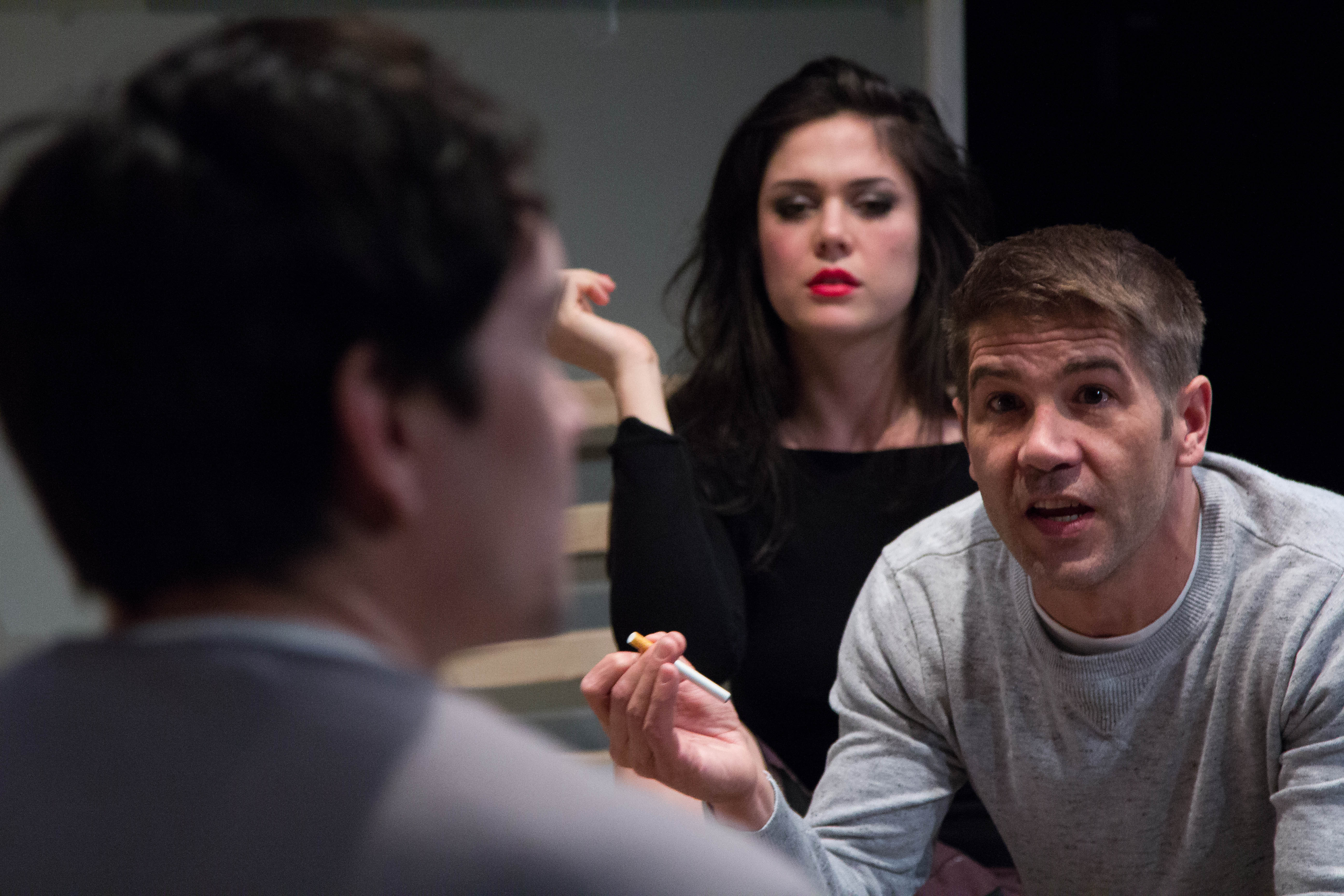
Michael Tisdale and Gillian Williams in Seattle Repertory Theatre’s Venus in Fur; photo by Chris Bennion.

Michael Tisdale and Gillian Williams in Seattle Repertory Theatre’s Venus in Fur; photo by Chris Bennion.

It’s not just the topic of sexual power dynamics combined with S&M role play that makes it seem as if David Ives has taken on something risqué in his Tony-nominated Venus in Fur, which premiered in 2010. He dares a lot formally by writing an evening-length, two-character play set in a drab rehearsal room.

In terms of ambition, he dares even more in his obvious desire to probe the personal politics and psychological complexity of our “theatrical” selves: the rotating, evolving, ever-variable selves we present in our daily encounters.

Seattle Repertory Theatre’s staging — a co-production with Arizona Theatre Company — offers a smart, riveting, often unsettling take on Ives’s much-hyped play. It makes for a largely persuasive theater experience, though without managing to overcome all the dramaturgical stumbling blocks in the script — most of all, the unconvincing swerve that marks the drama’s culmination.

Ives is, to start with, a masterful writer of dialogue, attuned to the ways actors manipulate their subtexts as they monitor and mirror the variabilities of their stage partners. In the ongoing, intermissionless duologue that is the basic structure of Venus in Fur, his two characters assume and cast off multiple identities that continually keep the audience guessing about what the real stakes are.

Venus in Fur starts in quasi-sitcom mode: a frustrated playwright/director, Thomas Novachek, rails against the limitations of the women he’s seen audition for the lead in his new stage adaptation of Venus in Furs, the once-scandalous novella published in 1870 by the Austrian writer Leopold von Sacher-Masoch (part of the first volume of a large-scale fictional cycle he had planned under the overall title Legacy of Cain).

In blusters Vanda Jordan in a scenery-chewing entrance. She’s an actress who presents herself as desperate for the part — so desperate, she ends up convincing the reluctant Thomas to stay on and see her audition, even though she’s hours late and all the others have already left.

But Ives cleverly uses the familiar patterns of lightweight humor to disarm his audience, to set up expectations that repeatedly trip us up — exactly mirroring the dance of role-playing and sudden change of tack Vanda stage manages vis-a-vis Thomas.

Sibyl Wickersheimer has designed an imposingly affectless rehearsal loft — we’re told it’s been converted from a former sweatshop (its identity around the time Sacher-Masoch’s novella was written) — and tilts it to an angle, adding yet another layer of obliquity. Geoff Korf’s lighting starts with unfriendly late afternoon light and descends into terrifying darkness

Thomas wants to be appreciated for having written what he believes to be an important play — his Fur is a gloss on the “furs” of Sacher-Masoch and the mirror of Titian. He loathes being misunderstood for tackling the trendy “issues” of the day. Vanda pretends to be clueless about his artistic aspirations, describing the novella that’s the basis for his play as “S&M porn” and hastily showing off the up-to-date dominatrix outfit (Harmony Arnold’s witty costume design) that she picked out for her audition.
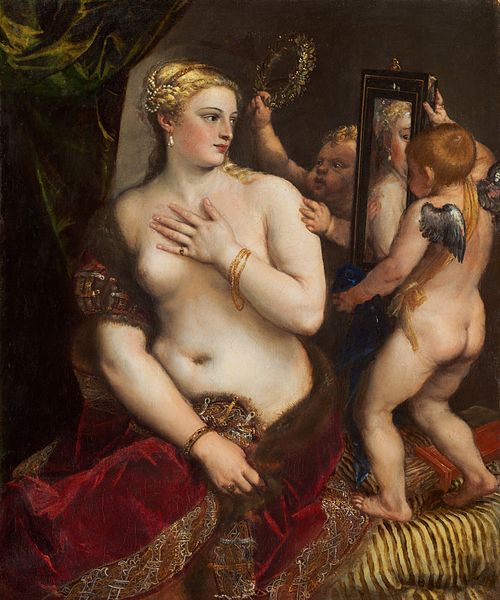
Titian, Venujs with Mirror, c. 1555 (National Gallery of Art)

Titian, Venus with Mirror, c. 1555 (National Gallery of Art)

Director Shana Cooper sustains the slow burn of tension that underlies the rapidly shifting scenario as Thomas starts to realize Vanda has been dissembling and is intimately familiar with the nuances of Sacher-Masoch. Like a staged Droste effect, ironies begin to proliferate within the play-within-a-play setup. Vanda the over-emoting, stressed-out New Yawk actress suddenly seems to be more authentic when she casts her “real” self aside to play the fictional role of the nineteenth-century, velvet-gown-clad Wanda von Dunajew.

Ives’s play is completely dependent on the effectiveness of his lead actress. Gillian Williams gives an untrammeled and multifaceted performance, toggling back and forth between “acting” and — to the evident unease yet fascination of Thomas — taking over his role as the playwright and director. It’s also an intensely physically aware performance, her shifts in tone mirrored by a virtuosic range of gestures and physical expression.

As Thomas, Michael Tisdale (like Gilliam Williams, making his Seattle Rep debut) doesn’t project the sheer arrogance needed at the beginning to give substance to Vanda’s fury — he’s too fussy — but grows more convincing in the transformation into Sacher-Masoch’s alter ego Severin von Kusiemski, which he willingly undergoes.
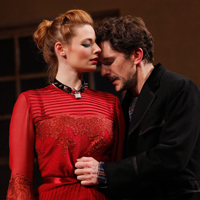
(l to r) Gillian Williams and Michael Tisdale; photo by Chris Bennion.

Gillian Williams and Michael Tisdale; photo by Chris Bennion.

The real interest of the dramatic arc lies in its unpredictability: shocks of recognition intensify and begin to align Thomas’s script with the power play developing between him and Vanda, but Ives counterpoints this with a movement away from the realism at the start of the play toward an ambivalent surrealism.

And there the chief difficulty lies. As Vanda’s rage gathers righteous feminist force and we’re led to expect a straightforward revenge plot, Ives changes the fundamental tone again — and makes her an archetype, an avatar of the pagan classical world.

But it ends up evoking a bit of old-fashioned stagecraft: a dea ex machina come to deliver a moral lesson for our times. The rattling thunder of a storm raging outside (Robertson Witmer’s atmospheric sound design) isn’t enough to pull off the transformation.

Venus in Fur runs through Sunday, March 9, at Seattle Rep at Seattle Center.

(c) 2014 Thomas May – All rights reserved.
Filed under: review, theater

Morlot, Seattle Symphony, and Berlioz: An Explosive Match

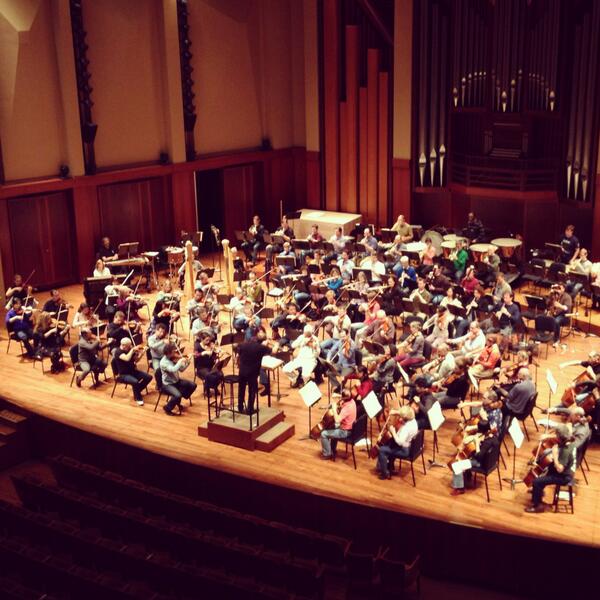
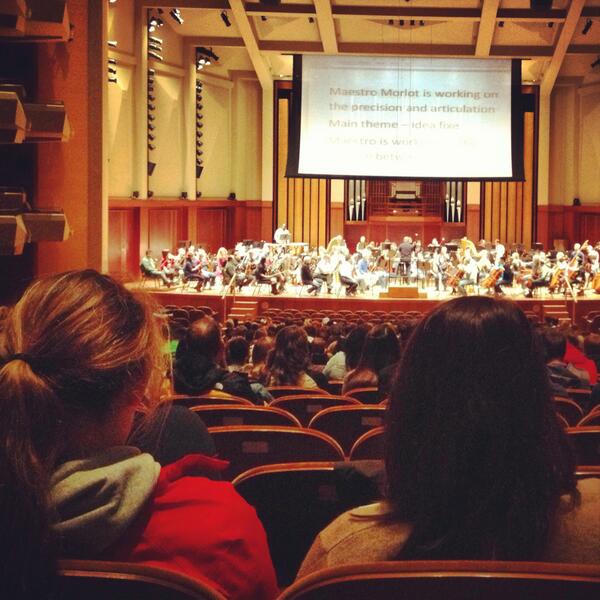
High school students discovering the world of Berlioz at a Seattle Symphony rehearsal

High school students discovering the world of Berlioz at a Seattle Symphony rehearsal

Ludovic Morlot is now back from his winter duties as chief conductor at La Monnaie in Brussels (where he just led performances of Janáček’s Jenůfa). And in its most incandescent moments, last night’s program — his first with the Seattle Symphony following the hiatus — blazed with the impatient passion of lovers meeting after an enforced absence.

The players were champing at the bit to whip up the energy of the brief concert opener, Emmanuel Chabrier’s Bourrée fantasque. Despite the nice thematic tie-in of the title, Chabrier’s piano piece felt like a mere diversion from the heart of the matter. The orchestration by the famous fin-de-siècle Wagnerian Felix Mottl layered lavish, high-calorie toppings over Chabrier’s zesty piano piece – frankly, at times, threatening to smother it.

Morlot has a genuine affinity for the music of the Romantics, so there’s a fascinating opportunity in this program to compare his approaches to the subjectivity of Robert Schumann versus Hector Berlioz. The issue of Schumann’s mental illness is by now such a cliche that it was refreshing to encounter a performance so alert to the astonishing mindfulness of his poetic reveries. In other words, what came across in the Cello Concerto wasn’t so much a sequence of “moody,” unsettled and changeable emotions as one lengthily sustained poetic fantasy.

The three chords in the orchestra that launch and unify the piece were shaped with an appropriately evanescent dreaminess, setting the tone for the Concerto’s primarily meditative as opposed to show-offy quality. The soloist, the French cellist Xavier Phillips, was especially memorable in the slow middle section of the three interlocking movements, when his orchestral “doppelgänger” (SSO principal cellist Efe Baltacıgil) engages him in a duet.

Phillips played with an inviting warmth and intimacy well-suited to Schumann’s elaborate lyricism, but the moment when the cello “rouses” the orchestra from the fantasy at the very end of the Concerto sounded underwhelming. Acoustic imbalances with the orchestra — a particular peril of cello concertos, and one reason composers avoided them for so long — were a persistent distraction. Still, there was breathtaking beauty to be enjoyed in Phillips’ sensitive and musically intelligent phrasing.

A good concert then became great in the program’s second half: Berlioz’s Symphonie fantastique, that blockbuster of Romanticism that flips the bird to the conventional polarities of French/German, Classical/Romantic, fact/fiction.

Too often we hear the Symphonie as a manifesto of its moment in time, a “textbook” of Romanticism with the usual checklist — and the result is a performance that sounds like the epitome of a museum piece (in the bad old sense of museums, before the smart ones started updating themselves).

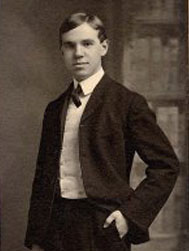
Young Berlioz in 1832, around the time of the Symphonie fantastique ; painting by Émile Signol

Young Berlioz in 1832, around the time of the Symphonie fantastique ; painting by Émile Signol

Last night it suddenly occurred to me that Morlot’s understanding of Berlioz is of the same category as Leonard Bernstein’s identification with Mahler: apart from all the technical knowledge and even sensibility he brings to Berlioz, it’s as if Morlot internally identifies with this music and so is able to give his interpretations a uniquely compelling stamp.

That’s the only way I could make sense of the 3-D vividness of last night’s performance: colors and textures I’ve never noticed before, for sure, but most of all a sense of what’s at stake with the emotions and obsessions of Berlioz’s score. I found myself grinning with near disbelief at how shocking and still over-the-top parts of it can still sound.

Morlot got the SSO musicians to tap into that sense of conviction. There were memorable achievements from every single section of the orchestra. None of this would have worked without the artistry of Michael Crusoe (timpani), Valerie Muzzolini Gordon (harp), Stefan Farkas (English horn), Christie Reside (flute), Ben Haussman (oboe), Seth Krimsky (bassoon), for example, not to mention the thrilling playing by the strings and brass, particularly in the witches’ “orgy” of the last movement.

This wasn’t the usual colorful story of young Hector going all wild after seeing the actress Harriet Smithson and getting tangled in an insanely obsessive/possessive love attachment – the whole business is really a MacGuffin, anyway — just as it wasn’t the corny 1960s-flavored rethink of an orchestra on an LSD/mushroom/opium-fueled trip.

Morlot understands that Berlioz’s “protagonist” in the Symphonie fantastique is an artist above all else — that the Eros, the drive, the alienation, the hallucinations, all of it, are all components of a universe he imagines into being, not mere triggers of emotions that require expression. And that the entire epic he lays out for us in this score is an “instrumental drama” (the composer’s own phrase) that expertly transforms his musical material to give voice to a radical subjectivity.

I especially like how Morlot refuses to settle for one overall approach — stressing Berlioz’s Classical underpinnings, say, or staying focused on his novel orchestration. He understands the multidimensional character of this score and allows its widely varying facets to come out when they make sense in the dramatic context.

There was a particularly persuasive hint of Beethoven of the Pastoral in the beautifully played woodwind writing of the third movement. (Beethoven cast an enormous shadow over Berlioz at this point in his career.) Some of the “spatial” effects of offstage timpani and shepherd’s pipe anticipate Mahler.

The March to the Scaffold, sardonic as hell, actually helped set the scene for what usually seems an abrupt shift of tone in the Witches’ Sabbath/nightmare finale. And in that fantastic musical phantasmagoria, despite all the humiliations and horrors the protagonist endures, it’s the image of the cocky young artist Berlioz who emerges, dominating and enthralling his audience.

So what is it with Berlioz and obnoxiously intrusive noise in Benaroya? Two years ago, smack in the middle of one of my favorite Morlot performances to date — Berlioz’s La Damnation de Faust — a patron’s alarm actually forced the music to a halt for several minutes. Last night someone spoiled the carefully built-up atmosphere by ringing heedlessly away, audible at a good distance. Now that should be a damnable offence.

There’s one more chance to hear this program: Saturday night at 8:00 pm at Benaroya Hall.

(c) 2014 Thomas May – All rights reserved.

Filed under: Berlioz, review, Seattle Symphony

Shostakovich Meets John Adams at Seattle Symphony

Estonian conductor Olari Elts

Estonian conductor Olari Elts

I realize it’s hard to believe, but this weekend in Seattle actually includes some worthwhile activities not related to (or even conflicting with) monitoring the Super Bowl. To wit: the latest music-making by the Seattle Symphony, either in the condensed “untuxed” version this evening or on Saturday 1 February in the complete program designed by guest conductor Olari Elts.

And a damn fine program this is, featuring a combo that might at first seem a bit unusual but that actually makes a lot of sense: Dmitri Shostakovich and John Adams. I’ve grown tired of the hyperbole that compares the pressure to conform to serialism in the West during the postwar decades to the Soviet Union’s cultural watchdogs — it’s insulting, to say the least, to equate whatever American composers who chose not to adhere to the predominant fashion had to face with the year-to-year dread about their very survival that was the experience of Shostakovich and his peers.

Still, there are some valid parallels: composers on other side of the Iron Curtain had to deal with implicit or explicit guidelines as to what was considered the “proper” music to be writing — guidelines that were diametrically directed, as it happened, toward populism in the East and “elitism” in the West. Both Shostakovich and John Adams in his early breakthrough years discovered ways to navigate the fault lines between these putatively incompatible realms, exploring new imaginative possibilities that could balance complexity with accessibility, experimental vigor with a recognizable and rooted vernacular.

Olari Elts, a native of Tallinn, Estonia, as well as this week’s guest soloist, the Moscow-educated Alexander Melnikov, were both teenagers during the waning years of the Soviet Union. So, while still relatively young, they bring a perspective that hasn’t yet forgotten how a composer like Shostakovich could manipulate expectations to write music whose meanings are more ambivalent than what seems on the surface to be the case.

Russian pianist Alexander Melnikov

Russian pianist Alexander Melnikov

And bravo to both for selecting the lesser-known Second Piano Concerto, a later work Shostakovich wrote for his son Maxim to premiere at his graduation from the Moscow Conservatory. Melnikov, in what I believe marks his Seattle debut, revealed why he’s regarded as a leading Shostakovich specialist — his recording of the complete Preludes and Fugues has been heaped with awards — and used his impressive technical precision to make eminent musical sense.

The Second Piano Concerto is a most unusual Shostakovich score — almost neoclassical in sensibility, but without the sense of parody that often goes along with that (especially in Prokofiev), and certainly lacking the ironic air you’d expect from Shostakovich himself. At the same time, it’s not entirely innocent or naive. That hard-to-define zone in between is what emerged from Melnikov’s performance.

He managed to articulate the straitjacketed, percussive metrics of the first movement’s big solo as a joyful romp, discovering a sense of freedom amid its strictly regimented confines. Especially memorable was his dialogue with the SSO strings in the Andante, paced here like a Chopin nocturne. Wistful without giving in to sentimentality, this builds into some of the tenderest moments to be found in Shostakovich — as if he were conjuring in music a hoped-for but knowingly unrealistic future for his son.

Returning after his SSO debut two years ago, Elts maintains a serious podium demeanor but conjures a sensuous and scintillating palette from the players, as his take on Adams’s The Chairman Dances at the top of the program revealed. (Was Daniel Licht listening closely to the woozy middle section when he wrote the theme music for Dexter?) A bit foursquare in his overall approach to the score’s intricate cross-rhythms, Elts was more spontaneous with the beguiling sound picture of this Nixon in China-vintage music.

He similarly showcased Adams’s masterful orchestral thinking in The Black Gondola a late-period, experimental piano score by Franz Liszt which Adams orchestrated in 1989: so many shades of dark, drawing the listener into a black hole of melancholy.

With The Black Gondola as its prelude, Elts apparently also wanted to signal that there’s a good deal more to the Symphony No. 9 by Shostakovich than its allegedly “cheerful” character. He then led a riveting account eager to plunge into the enigmas posed by this compact score, not smooth them over — or explain them away as defensive irony.

A kind of “revocation” of Beethoven’s affirmative Ninth (if not in the spirit of Thomas Mann’s protagonist composer in Doktor Faustus), Shostakovich’s No. 9 caps his epic “wartime symphonies” with a tightly condensed, often lightly textured work that makes for a fascinating contrast with the completely different “lightness” of the Second Piano Concerto.

The performance features some first-rate solo playing by bassoonist Seth Krimsky and flutist Christie Reside as well as Ko-ichiro Yamamoto on trombone and David Gordon on trumpet. Elts brings out the inner logic that connects Shostakovich’s elliptical thinking, above all in the almost cinematic dissolves of the last three movements. It’s rare to find yourself so pleased by being teased and puzzled.

(c) 2014 Thomas May. All rights reserved.

Filed under: concert programming, review, Seattle Symphony

Garrick Ohlsson’s Seattle Recital

My ears and nerves are still buzzing from the excitement of last night’s recital by the always-dependable Garrick Ohlsson (at the University of Washington’s Meany Hall). What generous programs he offers: Beethoven’s Op. 109 Sonata, Schubert’s Wanderer Fantasy (D760), a triptych of selections by Charles Tomlinson Griffes, and Chopin’s Third Piano Sonata in B minor. And as if that weren’t enough, two superbly characterized Chopin waltzes for encores: the Op. 18 Grand Valse Brillante and the Waltz in C-sharp minor (Op. 64, no. 2).

I tend to think of Ohlsson as one of today’s least pretentious and fussy pianists, an artist to be counted on to give performances that are filling and satisfying. Of course that’s possible only because of his utterly confident technique — that left hand! — and his deep knowledge and love of the repertoire. What seems at times to be a “straightforward” approach turns out to reveal subtle insights. In the miracle of late Beethoven, for instance, he was able to explore different facets of the last movement’s variations (the new angle on the ultra-minimal two-note motif over which Beethoven obsesses in the first movement) without seeming to short-shrift the larger architecture beauty.

The Schubert Fantasy emerged as it should: a virtuoso showpiece on the surface, sure, but far more exhilarating for its sheer scope of invention and the pleasure Schubert takes in the powers of transformation of a basic idea. Ohlsson left no doubt as to why the next generation of Romantics fell so deeply in love with this spectacular but anomalous example of Schubertian ambition.

The Chopin Sonata may have been the most satisfying interpretation among these three well-known works. What struck me as especially successful was Ohlsson’s understanding of Chopin’s rhythmic articulation, both in his swooningly beautiful skeins of melody and in the robust, hell-bent momentum of the finale. But this didn’t come across as an affected exaggeration, or at the expense of those other aspects essential to this magnificent score. The whole picture is always in view – it’s just that it resembles getting a higher resolution, more dpi for clarity and detail.

Charles Tomlinson Griffes (1884-1920)

Charles Tomlinson Griffes (1884-1920)

And then there were the pieces by the early-twentieth-century American composer Charles Tomlinson Griffes. Two of the Roman Sketches, Op. 7, from 1916 (“The Fountain of the Acqua Paola” and “The White Peacock”) and the Scherzo from his Op. 6 Fantasy Pieces (1913). I found these to be an utterly delightful discovery. Hints of Griffes’s infatuation with then-new French music abound, but there’s something fresh about it all. The killer-energy Scherzo made for a nice cross-link with the Schubert.

Ohlsson recently released a recording devoted to this fascinating artist who died very young, a victim of the influenza pandemic. A gay man from Elmira, New York, Griffes was still of the generation when studying abroad was the done thing to gain any cred as a “classical music” composer.

Here’s what Aaron Copland had to say about this predecessor (in 1952, 32 years after Griffes’s death):

Charles Griffes is a name that deserves to be remembered … What he gave those of us who came after
him was a sense of the adventurous in composition, of being thoroughly alive to the newest trends in
world music and to the stimulus that might have derived from that contact.

Review (c) 2014 Thomas May – All rights reserved.

Filed under: Beethoven, piano, review, Schubert

The Cursed Clown Returns: Seattle Opera’s Rigoletto

Marco Vratogna; photo by Elise Bakketun

Rigoletto (Marco Vratogna) at work in the court; photo by Elise Bakketun

It’s no surprise that general director Speight Jenkins opted to reprise Seattle Opera’s production of Rigoletto, staged by the American director Linda Brovsky, for his farewell season (which also coincides with the company’s 50th anniversary). Introduced a decade ago, this Rigoletto is of fine vintage and remains hands-down the most satisfying Verdi production I’ve seen at Seattle Opera (a close tie being the Falstaff directed by Peter Kazaras).

Seattle can hardly be called a Mecca for Regie opera in the usual sense in which that term is bandied about. But that doesn’t mean it’s a haven for boringly conservative “traditional” stagings. The company actually is director-centric in that it places a high premium on theatrical values: it prizes directors who can contribute a sensitively close reading so that musical and dramatic meanings enhance each other. (Jenkins is, after all, a Wagnerian, and a good deal of the success of Seattle’s Ring has hinged on director Stephen Wadsworth’s ability to do just that.)

Rigoletto is certainly an opera amenable to directorial transposition, and the concept applied by Brovsky and the design team is to set the swiftly moving plot in the lurid “court” of a Benito Mussolini-like duce in the 1930s, at the height of Italian fascism. Rigoletto serves as a kind of spy who can feed him information and of course also as his procurer. The decadence of the duce/Duke of Mantua and his cronies turns out to be an expression of their unchecked power — the way they “loosen up” when not arrogantly terrorizing the citizens into submission.

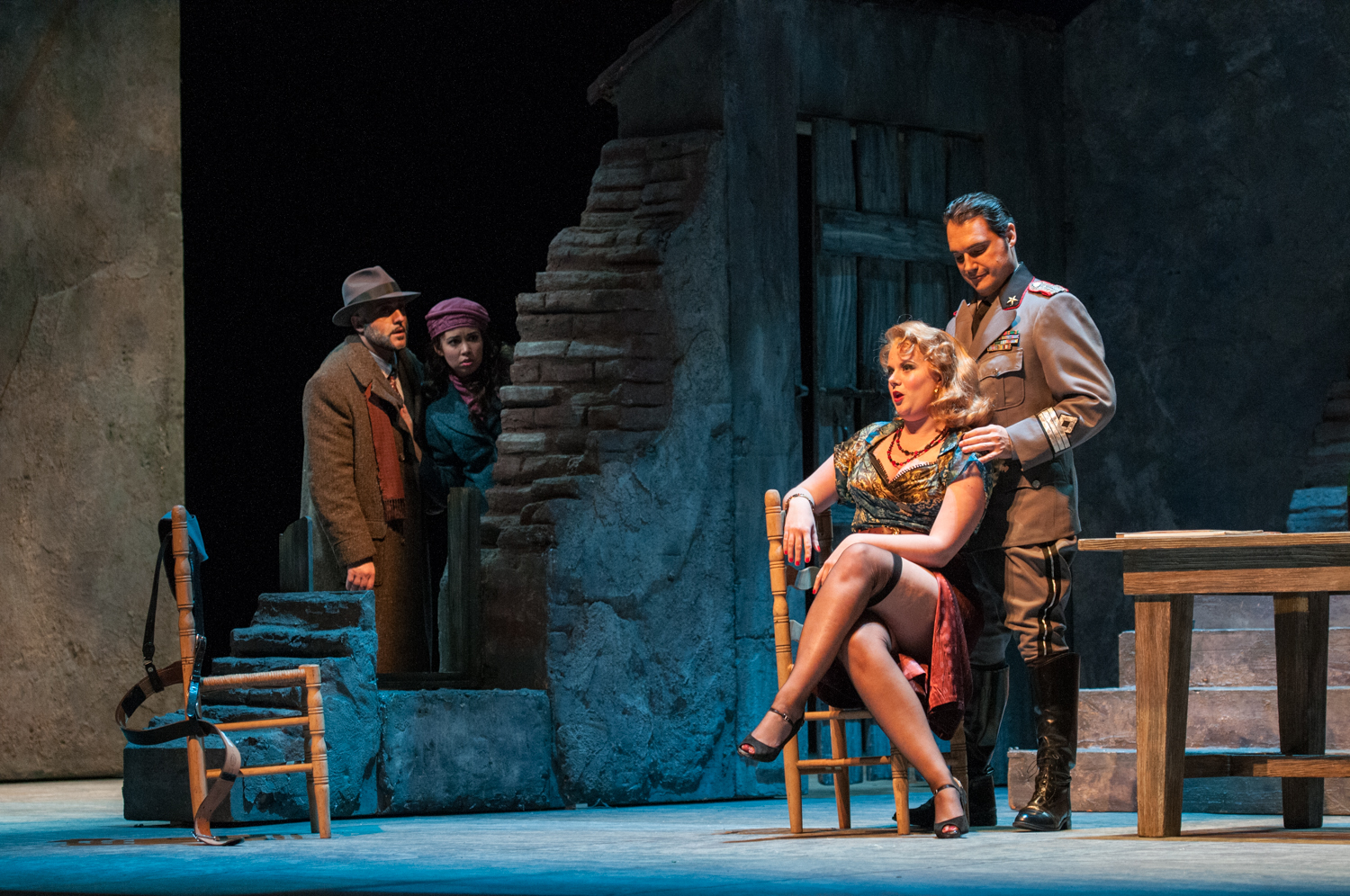
Marco Vratogna as Rigoletto, Nadine Sierra as Gilda, Sarah Larsen as Maddalena and Francesco Demuro as the Duke of Mantua; photo by Elise Bakketun

l to r: Marco Vratogna (Rigoletto), Nadine Sierra (Gilda), Sarah Larsen (Maddalena), Francesco Demuro (Duke of Mantua); photo by Elise Bakketun

Robert Dahlstrom’s sets and Thomas C. Hase’s lighting dramatically contrast the two poles of Rigoletto‘s world. The palace, thrumming with lust, is sleekly decked out with the spoils of art (a version of Bernini’s Rape of Proserpina sculpture serves as a prop littered with dirty champagne glasses), while the dimly lit, claustrophobic backstreets where the jester lives with his daughter Gilda are creeping with menace, an underworld that mirrors the cynical brutality of the rulers — only without their stylish veneer and classical trappings. The scenery of the last act, with its storm-swept cityscape across a river, is especially evocative. Marie Anne Chiment’s elegant gowns and chic suits make exceptionally eye-catching costumes.

All this provides more than a mere backdrop against which the familiar melodrama plays out. By anchoring what otherwise might seem a far-fetched series of unfortunate coincidences in a repulsive political and moral order, the fascist setting pushes buttons. When the nobleman Monterone reproaches the Duke for “seducing” his daughter — it’s clear that she’s been traumatized — Brovsky shows the old man wearing a yarmulke and dragged off to prison on the Duke’s orders: a voice of protest silenced by anti-Semitic thuggery. (Could this explain the family secrets Rigoletto keeps hidden from Gilda, including the mystery of her mother?)

Rigoletto will find himself in the same position as Monterone when he mourns the ruin of Gilda. The opera’s denouement is fueled by the jester’s plan for vengeance, his realistic version of the curse pronounced by Monterone. Marco Vratogna portrays an uncommonly sympathetic Rigoletto, making for a harrowing final scene. The problem is that he’s essentially too “nice” for the production’s milieu — particularly in the opera’s opening scene, where Verdi shows his cynical persona at work. The less-than-imposing curse delivered by Donovan Singletary’s Monterone should be the climactic focus of the scene, but the jester’s reaction barely registers.

Vratogna’s baritone admirably balances sturdiness and lyricism — it can be thrilling in a cabaletta wrap-up — but on opening night didn’t display the variety of colors essential to making this character vivid. You need to experience Rigoletto’s jabbing viciousness for his final sorrow to earn its full impact. Vratogna’s pivotal second-act solo lacked the differentiated phrasing Verdi calls for when Rigoletto, accustomed to his role as a performer, at last gives vent to his rage but then quickly changes tack to plead for his daughter.

Francesco Demuro as the playboy Duke; photo by Elise Bakketun

Francesco Demuro as the playboy Duke; photo by Elise Bakketun

A similar drawback applies to Francesco Demuro’s depiction of the Duke. A lyric tenor with a gorgeous command of legato, Demuro brings out the careless playboy side of the role quite convincingly. It’s just that he’s too suave, too effortlessly mellifluous to generate the effect of a feared, ruthless leader. In fact, the emotional depth Demuro gave to his richly sung “Ella fu mi rapita!” scene (the Duke’s most interesting solo and the one eclipsed by the popularity of his other two famous numbers) ends up jarring against the rest of his characterization. The Duke’s moment of interiority of course goes nowhere — and that’s one dramaturgical lapse Brovsky’s smart production doesn’t solve.

On the other hand, the really, really dark side of this Rigoletto is supplied in spades by Andrea Silvestrelli as the assassin-for-hire Sparafucile. His bass sounds as fathomless as an unlit, echoing cave, and Silvestrelli telegraphs noirish menace with just a flick and boot crush of his cigarette. As his sister and partner-in-crime Maddalena, Sarah Larsen channels a touch of Carmen, working out an entire character transformation in the course of her one scene.

Andrea Silvestrelli (Sparafucile); photo by Elise Bakketun

Andrea Silvestrelli (Sparafucile); photo by Elise Bakketun

But no one else matched the art of transition displayed by American soprano Nadine Sierra, making her Seattle Opera debut as Gilda. It’s not hard to discern what wowed the judges when they chose her as the youngest-ever winner of the Metropolitan Opera National Councils a few years ago. Sierra — and you’ll most definitely want to pay attention to her name — has an alluring, immediately identifiable voice that encompasses dark-hued deep notes as well as spectacularly spun, floating light notes at the very top of her range.

And that’s only a starting point for Sierra: her remarkable control allows her to venture an exciting variety in her phrasing. Her characterization complements this vocal richness: Sierra shows Gilda not as the innocent “tabula rasa” we usually see at first but as a loving daughter who already has desires of her own. The pain of her humiliation in the second act is so palpable it’s hard to watch. And her Gilda’s persistent attachment to the Duke isn’t a sentimental weakness but a desperate attempt to salvage some kind of meaning within the opera’s heartless environment. An especially effective touch is the shudder of terror she reveals even after she’s resolved to sacrifice herself.

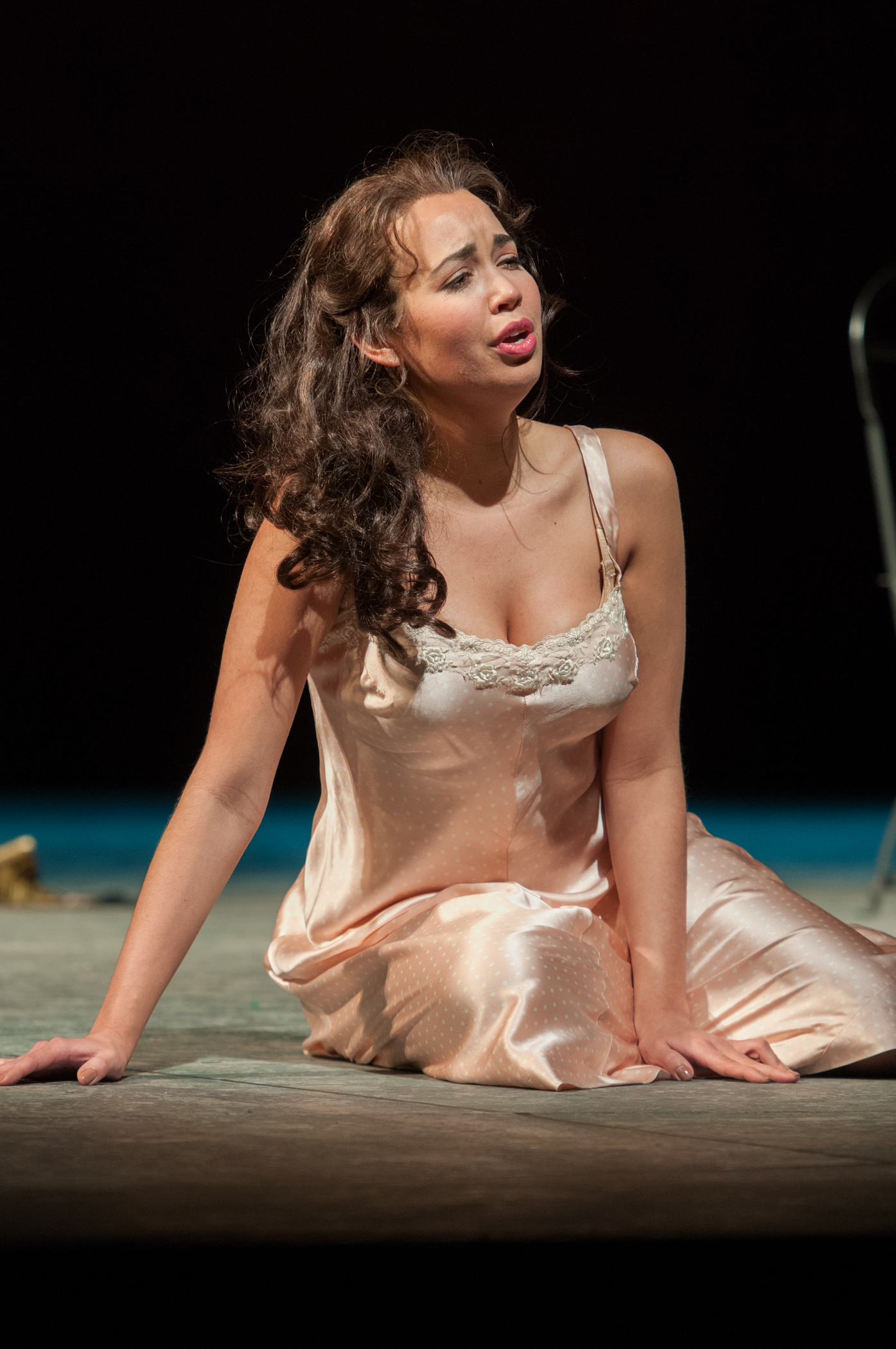
Nadine Sierra; photo by Elise Bakketun

Nadine Sierra; photo by Elise Bakketun

Another indispensable contribution is made by conductor Riccardo Frizza, doing the best work I’ve heard from him. The orchestra itself wasn’t on quite the same level on opening night, and some sloppy intonation crept into the mix, but the musicians are clearly responsive to the conductor’s reading of the score. Frizza understands that these immortal melodies get their punch precisely from the contexts Verdi creates. As a milestone experiment on the way toward the mature Verdi, Rigoletto is all about restyling the conventions of Italian opera within a context of breathless, dramatically compelling momentum.

Frizza was able to stretch a phrase here and there, effortlessly accommodating the singers, but all the while maintaining the needed tension. He also has a terrific ear for the telling, sometimes ironic details Verdi uses to punctuate the lyrical flow. The first scene especially benefited from a snarling energy that supplied in sound what the staging meant to evoke. The chorus (prepared by John Keene) also used details to excellent effect in the two palace scenes, hinting at a whole spectrum of implicit back stories for the audience’s imagination to supply.

One especially memorable detail from Brovsky: her treatment of “La donna è mobile,” the opera’s most-famous (and ironic) number, as a kind of prop. Here it’s a pop hit that obviously gets a lot of play on the state radio. We hear it (i.e., the orchestra’s preliminaries) as the Duke tunes in the radio while he’s out slumming for sex, prompting him to sing it himself. It’s when Rigoletto hears the Duke’s version again, after his presumed stabbing, that the corpse’s identity becomes a chilling question.

Brovsky’s conceit is right in keeping with Verdi’s own “high concept” interpolation of the tune, which refuses the expected cadence but has the melody fade away. Verdi begins the tune with a false start, and it never really ends — the Duke is left unscathed, ready for his next conquest, leaving us with a catchy tune. Fascism, as Walter Benjamin famously pointed out, is the “aestheticization of politics.”

Seattle Opera’s production of Rigoletto runs through January 25. Tickets available here.

Review (C) 2014 Thomas May. All rights reserved

Filed under: review, Seattle Opera, Verdi

CD Review: Hochman/Homage to Schubert

Benjamin Hochman

Benjamin Hochman; photo by Jürgen Frank

I haven’t yet had the pleasure of encountering Benjamin Hochman in live performance, but I come away from his new release, Homage to Schubert, with a remarkably vivid sense of what he brings to the competitive scene of today’s young pianists. This is his second solo album and debut recording for the AVIE label, and it amply reveals Hochman’s qualities as an interpreter as well as the creative and original programming style that appears to be a signature.

A native of Jerusalem now based in New York, Hochman counts Claude Frank and Richard Goode among his mentors. He made his New York debut in 2006 with a Met Museum recital juxtaposing Bach, Berg, Schubert, and a newly commissioned piece. A similar imaginative leap ties together his program here: two lesser-known Schubert sonatas and a pair of contemporary pieces “commenting” on the Austrian’s legacy — by György Kurtág (Hommage à Schubert) and Jörg Widmann (Idyll und Abgrund), respectively. Hochman performs on a Steinway and benefits from the tasteful production and engineering (Eric Wen and Dennis Patterson).

Of course there’s lots of powerful competition even when it comes to these less-familiar Schubert sonatas. Paul Lewis, the spiritual scion of Alfred Brendel, has recently staked an irresistible claim to this territory, and Mitsuko Uchida is another eloquent advocate. (She also began linking Schubert’s piano music with Schoenberg back in the ’90s.) A fundamental attraction of Hochman is that he allies a natural sympathy for Schubert’s brand of musical thinking with superbly balanced technique, all the while effacing any temptation to showboat or force a newfangled reading onto these scores.

In other words, Hochman’s overall stance toward Schubert himself is pretty traditional, while smartly allowing the “moderns” sharing his program to provide a contemporary angle. It’s a daring and subtle strategy, and one that rewards the listener. Which is by no means to imply that there’s anything even remotely stodgy or routine here: Hochman initiates the proceedings with the gorgeously spun lyrical flow of the Sonata in A major D664 (from 1819), his control of the pulse so mesmerizing that it seems as if this music has always been going on — a stream we’ve been graced to chance upon.

Hochman is fully alert to the potential of Schubert’s wild contrasts. That’s the premise, after all, of pairing the gentle, smaller-scale A major with the hugely ambitious and even aggressive Sonata in D major D850 (the so-called “Gasteiner,” after the spa town where it was written in 1825, the year Schubert sketched most of the “Great” C major Symphony). Yet Hochman doesn’t overload these contrasts with melodrama, but lets the few outbursts in D664 take us by surprise within the larger context.

At several points I could almost imagine D664 versus the “Gasteiner” as a precursor for Schumann’s Eusebius (especially in the melancholy appoggiaturas of D664’s Andante) and Florestan dichotomy. But what excites me the most about Hochman’s deeply satisfying approach to D850 is his implicit understanding of the Schubert-Beethoven connection. By this point, Schubert’s acquired admiration of the German composer had begun inspiring a new level of ambition (he was a Beethovenian convert).

Hochman seems to hint at the uncanny echoes of late Beethoven, as in the “Gasteiner”‘s widely wandering second movement, where one passage of reiterated chords suddenly approaches the radiance of the Arietta in Beethoven’s Op. 111. But he avoids any impression of Schubert as an imitator or epigone: these moments occur as genuine Schubertian epiphanies within a remarkably different musical landscape.

Between Schubert and Beethoven, there is an almost diametrically opposed sense of drama, as Hochman points out in his excellent booklet essay, alluding to Brendel’s famous image of Schubert “the sleepwalker” in contrast to Beethoven “the architect.” That groping around unforeseen corners to alight on a new vista that is so characteristic of Schubert is especially apparent in the weirdly mercurial variants of the finale’s rondo theme as Hochman performs it.

As for the contemporary homages, Hochman has chosen two utterly distinct ways of thinking about Schubert. Kurtág’s lapidary piece (lasting about a minute) distills the contradictory ingredients that make up Schubert into an intense poetic reverie — a musical life that flashes before our ears.

The German composer Widmann — who is just 7 years older than Hochman — has meanwhile written a miniature suite of “six Schubert reminiscences” in Idyll and Abyss (originally conceived as a companion work to the great final B-flat Sonata D960). Teasing direct references to cadences and phrases slip a reflective scrim over the distance between Schubert and us. Alternately playful and disturbing, Widmann’s suite rudely juxtaposes the many sides of Schubert’s personality, purposely emphasizing the paradoxical nature of a genius that encompassed sweet melody, leisured reflection, and savagely violent outbursts. Widmann and Hochman leave it up to the listener to put the pieces together.

(c)2013 Thomas May. All rights reserved.

Filed under: CD review, new music, review, Schubert

Protected: Stairway to Heaven: A Major Seattle Symphony Premiere

This content is password-protected. To view it, please enter the password below.

Filed under: Beethoven, composers, new music, review, Seattle Symphony

Fascinating Boulez, Problematic Mahler 6

It’s good to have Ludovic Morlot back in town for his first Seattle Symphony program since September’s marvelous all-Ravel feast. And there’s been a lot of interest building up for this week’s offering, since – well, that’s usually the case with a Mahler symphony (even if the over-programming of Mahler in general is tempting burnout), but all the more since Maestro Morlot has been approaching this rep with understandable caution.

But first to the program’s “hors d’oeuvre,” Nos. 1-4 of the Notations by Pierre Boulez. This is prime Morlot territory: thrillingly prismatic music, brimming with intellectual and sensual complexities that complement rather than cancel each other out. The orchestra, massively expanded and crowding the entire stage to realize Boulez’s scoring requirements, played the first four of this set of miniatures originally written as a sequence of 12 for solo piano (back in 1945). Boulez began revisiting these early works decades later and so far has completed orchestral elaborations of seven of them. In their orchestral guise, they resemble lavish plants grown from the starker seeds of the piano originals.

Morlot gave a brief, excellent introduction to their concept and design and paired each of the four with renditions of the originals by pianist Kimberly Russ. I’ve never understood why some of my fellow critics kvetch about this sort of commentary from the podium during a concert. Morlot’s manner isn’t even remotely condescending, and he’s able to home in on a few pregnant details that really do enhance listening.

And Boulez is hardly a familiar quantity in Seattle. This was the first time I’ve heard the SSO grapple with music by the French maverick; is it possible Boulez has never been programmed in its history? Quel scandale! Regarding his ongoing investigation of French musical tradition with the orchestra, Morlot remarked that to overlook Boulez would be like visiting Paris “and not going to see the Eiffel Tower.”

The pieces in Notations – all related to a shared 12-note theme – are epigrammatic and fleeting, yet so frighteningly complicated in their working out (the articulation of harmonic, rhythmic, and textural layers) that it’s like a speeded-up musical Big Bang, tracing vast consequences from simple origins. Or so it seemed in Morlot’s meticulous account. Most impressive for me was his ability to convey a graspable sense of passion and drama alongside Boulez the “researcher” of sounds.

In his “Ask the Artist” conversation after the concert, Morlot mentioned that he’d initially hoped to get Boulez to come to Seattle to conduct this program himself, thus giving the SSO a direct connection to the tradition Boulez still embodies. (Now 88, the French maestro’s health essentially precludes such travel.) Yes, irony of ironies, the firebrand revolutionary of yore is one of the last keepers of a tradition connected both to French modernism from Debussy onwards and to Schoenberg and his Vienna colleagues. (Berg was particularly fascinated by the music of Mahler’s Sixth Symphony.)

Morlot and SSO rehearsing Mahler 6

Morlot and SSO rehearsing Mahler 6

I found this interpretation of the Mahler Sixth only halfway satisfying – and, oddly, in a completely unpredicted way. Long one of the most marginalized of his symphonies, the Sixth has actually received a good deal of advocacy over the past 15 years or so. Michael Tilson Thomas inaugurated his complete cycle with the San Francisco Symphony with No. 6 (on September 12, 2001, no less), winning a Grammy. Since that year the SSO’s conductor laureate Gerard Schwarz has led two Mahler Sixths (2001, 2008).

Presenting the Boulez as an entrée results in the interesting effect of seeing the orchestra downsize a tad for the Sixth, which happens to employ the largest orchestra Mahler ever called for (in purely instrumental terms – obviously excluding the Eighth, with its ginormous choral forces). The SSO even managed to procure one of the cowbells originally used for the premiere in 1906. (I’ve got to investigate that back story.)

Yet just a few paces into the grim straitjacket march-time opening the first movement, Morlot uncharacteristically failed to achieve the sort of sonic balance you can usually count on him to effect – a tremendously challenging task in this score, to be sure. Morlot’s modus operandi in general is precisely not to go for the obvious “throughline” but to tune us in to the nuances of multiple layers and textures interacting, but too many of the accents seemed tentative, a “work in progress,” so that the players got bogged down in local details and the big picture lost focus.

Breathtaking, sensitively shaped moments awaited in the enormous development section – it’s like a dream sequence escaping from the harsh “real world” surrounding it – and, along with many admirable solos, concertmaster Alexander Velinzon’s contributions enraptured the ear. Still, as a whole the first movement lacked the persuasiveness and sheer, unrelenting terror it needs to set the symphony on course.

The Scherzo sounded even more bogged down by moment-to-moment bursts of color and emotion without a convincing larger context: all-too-careful playing that just didn’t take fire with any sense of risk. But with the Andante – Morlot chose Mahler’s original order for the inner movements – the long delay until reaching this oasis paid off. The SSO became not just thoroughly engaged, but convincing and supremely eloquent. Morlot took a relatively rapid pace, allowing the beauty of this music to breathe as simply as a song instead of relying on exaggerated distensions.

Cowbells used by Seattle Symphony (including one from 1906 premiere of No. 6)

Cowbells used by Seattle Symphony (including one from 1906 premiere of No. 6)

And then what really took me by surprise: in every live performance of the Sixth I’ve heard, it’s in the immense sound world of the finale that everyone loses steam, exhausted and struggling just to make it through. But this was the most exhilarating playing of the evening, starting with the hallucinogenic sweep of colors with which Mahler launches this enigmatic movement.

Here Morlot guided the musicians through an enthralling labyrinth of events which really did begin to cohere and connect. In the coda, the threnody of brass sustained enough mystery to hint, however slightly, at a possible hopeful outcome so that the shock of Mahler’s most tragic symphonic ending had a thrilling dramatic impact.

A quick note on the other chief musicological controversy – besides the order of the movements – which is part of the Sixth’s performance tradition. Morlot chose the version with two rather than three “hammerblows” in the finale, later explaining that withholding the third ax-like shattering intensifies the suspense. The two blows we heard were in any case both sonically and visually memorable, thanks to the impressive box and hammer percussionist Michael Werner (see video at top).

There’s one more chance to experience this program live: on Saturday, 9 November 2013, at 8.00 pm. Tickets here.

(C) 2013 Thomas May. All rights reserved.

Filed under: Mahler, review, Seattle Symphony

What Fire in the Ears: Much Ado c. 1953

Jennifer Lee Taylor as Beatrice and Matt Shimkus as Benedick; photo by John Ulman

Jennifer Lee Taylor as Beatrice and Matt Shimkus as Benedick; photo by John Ulman

Linguists like David Crystal are fond of pointing out that shifts in pronunciation over the centuries cause modern audiences to miss out on some of the key puns and subtexts in Shakespeare’s plays. The claim that “nothing” and “noting” were all but indistinguishable in Elizabethan English is a case in point. I don’t know who first observed that “Much Ado About Noting” might be a far apter title for Shakespeare’s perennially popular comedy of misalignments realigned, but it’s become a widespread idea by now.

Certainly the play’s momentum is driven by acts of noting, of hearing or seeing things that cause perceptions to be changed dramatically. Most of these eavesdroppings are intentionally stage-managed by other characters – for benevolent if somewhat mischievous purposes (Benedick and Beatrice being led to believe they are the object of each other’s affection) and for nefarious ones (the framing of Hero as unfaithful).

What I find most striking about Seattle Shakespeare’s current production of Much Ado About Nothing is how gullible the main characters prove to be. A good portion of the comedy in the Beatrice-Benedick stand-off arises from the exaggerated language both use to express their mutual disdain – with Beatrice scoring more stinging zingers in Jennifer Lee Taylor’s arch, glib-as-a-movie-starlet delivery. Yet it doesn’t take much trickery to soften them up and make the pair willing to thrust their necks “into a yoke” same as all the rest.

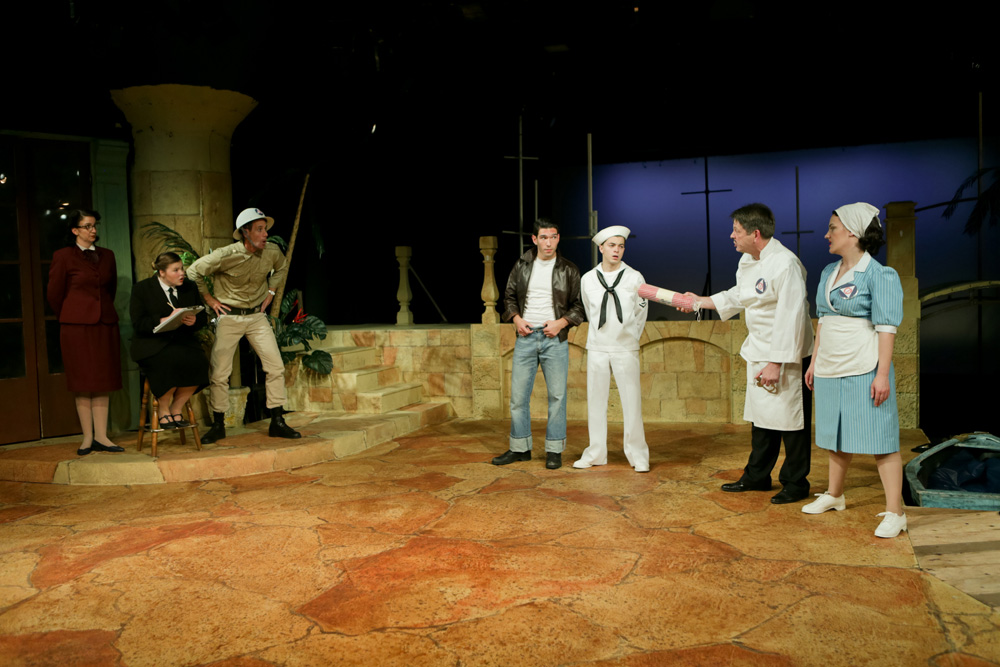
Justin Huertas as Balthasar, Jim Gall as Don Pedro, Jay Myers as Claudio, and Peter A. Jacobs as Leonato; photo by John Ulman.

Justin Huertas as Balthasar, Jim Gall as Don Pedro, Jay Myers as Claudio, and Peter A. Jacobs as Leonato; photo by John Ulman

More tellingly still, Claudio reverses his Prince Charming poses even more readily than he’d pressed his lightning-fast courtship of Hero. She, in turn, is just as content to have the hot-head back after he’s been compelled to “note” her fake funeral.

All this manipulation and puppet-like flexibility can make Much Ado seem pretty arbitrary. The fundamental problem Shakespeare’s comedy poses for the performers is that it nestles a potential tragedy at its core. The notions of love that the two main couples hold on to, imagining they represent the real thing, must be put to the test; they have to enter crisis mode before any genuine change can take place.

Merely “noting” appearances or trying to preempt disappointment is a passive stance, and it can’t substitute for experience. It’s one thing for this testing to take the form of obstacles – standard procedure in comedy – but to be presented as the nightmare which erupts at the play’s center is deeply unsettling.

Hero (Brenda Joyner) rejected; photo by John Ulman

Hero (Brenda Joyner) rejected; photo by John Ulman

Or…maybe that’s just making much ado about nothing after all. Maybe the play really should be enjoyed for its witty slant on romance and friendship triumphant, served up with abundant linguistic virtuosity (and a virtuosic reversal of all that when it comes to the malapropic snares in which Dogberry gets entangled). As directed by George Mount, artistic director of Seattle Shakes, this production doesn’t show much interest in digging beyond that, but it still adds up to a pleasurable performance for the most part.

The production’s design elements are a particular attraction. They effectively translate the cheerful Mediterranean clime of Shakespeare’s Renaissance Messina to a tony seaside resort in 1953, with sailors coming home from the (presumably Korean) war, now ready to relax and get back to the pleasures of life. Craig B. Wollam’s elegantly evocative set, Roberta Russell’s sun-kissed lighting scheme, and the delightful period details of Doris Black’s costumes work together to reinforce this background.

Seattle Shakes is also embarking here on the first of two collaborations this season with Seattle Repertory Jazz Orchestra: Michael Brockman composed music for the songs Shakespeare embeds in the play. The jazz ensemble pre-recorded this incidental score. Justin Huertas (Balthasar) does double duty as the resort’s Sinatra-smooth entertainer and also sings a lovely threnody at the tomb of Hero before her “resurrection.”

Dogberry (David Quicksall) and crew; photo by  John Ulman

Dogberry (David Quicksall) and crew; photo by John Ulman

These elements so successfully evoke a concrete sense of place that it seems to encourage some of the cast to adopt a looser, more-relaxed style vis-a-vis Shakespeare’s language – as if to match the “realism” of the setting. Taylor’s Beatrice and Matt Shimkus as Benedick stand out not only for their engaging interactions, spinning off each other’s whip-snap repartee, but for their attention to the textures and rhythms of their words. And Peter A. Jacobs brings a suave edge to Leonato as the entitled party-giver while remaining authoritative in his speech.

As Hero and Claudio, on the other hand, Brenda Joyner and Jay Myers tend toward blandness, failing to voice the different registers of their language. Myers also remains too much the nice guy who’s been duped to give his final transformation its full effect. Especially flat is the one-note resentment displayed by Nick Rempel as the scheming villain Don John.

Noah Greene layers a Fonzie-ish attitude on the rascal-for-hire Borachio, who is the first in the play to set off its chain-reaction of conversations overheard. Most of these are staged, but he chances on Claudio’s spontaneous confession of his love for Hero. And by the play’s symmetry, it’s when Borachio is overheard by chance bragging about his nasty deed that the solution to the crisis is introduced. But before everything can be untangled, the night watch set up by Constable Dogberry (David Quicksall) – who do that bit of overhearing – restore the comic tone that’s so suddenly been sucked out of the play with Hero’s slander. This layer was, to my taste, the least successful, too reliant on extraneous gimmicks at the expense of the hilarity already there in the language.

When all is restored in the finale (the captured Don John notably awaiting his punishment offstage, to be dealt with later), this production infuses an infectious joie de vivre that makes this Much Ado about something after all.

Seattle Shakespeare Company’s production of Much Ado About Nothing, directed by George Mount, continues through November 17, 2013, at the Center Theatre at Seattle Center. Tickets online.

(c) 2013 Thomas May. All rights reserved.

Filed under: review, Shakespeare, theater

Azeotrope’s City-Country Double Bill

 Richard Nguyen Sloniker, Tim Gouran and Mariel Neto in Red Light Winter; photo: Benito Vasquez

Richard Nguyen Sloniker, Tim Gouran and Mariel Neto in Red Light Winter; photo: Benito Vasquez

My recent profile of Seattle’s remarkable Azeotrope Theatre is up on Crosscut:

What makes people want to attend live theater? Sure, it’s an art that dates back to the origins of human culture, but why put up with the hassle when it’s become so easy to find entertainment from the comforts of home? Even the allure of films is no longer enough to guarantee the future of movie theaters.

But Azeotrope has a way of making you remember what’s so unique about theater in the first place. No amount of digitalized special effects can trump the raw, gritty emotional power or the gripping depictions of desperate characters who populate Azeotrope’s latest project.

 Richard Nguyen Sloniker in Red Light Winter; photo: Sebastien Scanduzzi

Richard Nguyen Sloniker in Red Light Winter; photo: Sebastien Scanduzzi

Over the next month the company is presenting a double bill of plays in rotating repertory at the Eulalie Scandiuzzi Space, a tiny black box theater located downstairs at ACT. Both plays are less than a decade old: Adam Rapp’s Red Light Winter (2005), which was a Pulitzer finalist, and the Seattle premiere of the recent 25 Saints by Joshua Rollins (who will be on hand for post-play discussions on Nov. 2 and 3).

“When I when I first read Red Light Winter, it just kicked me in the balls,” says Richard Nguyen Sloniker, an actor, writer, teacher and co-founder of Azeotrope. “It hit me in a way I couldn’t quite grasp, and I had to try to parse out why.”

Rapp’s scenario is a bleak examination of the need for intimacy. It explores the consequences of a night two former college friends spend with a beautiful young prostitute in Amsterdam. “Sure, it’s not a very cheery play,” Sloniker explains, “but I identified with these lost, broken, human characters. A good play doesn’t necessarily have to give you a catharsis.”

continue reading

Filed under: review, theater

Archive

Enter your email address to follow this blog and receive notifications of new posts by email.