Julia Bullock and Davóne Tines in a scene from John Adams’s El Niño. Photo: Evan Zimmerman / Met Opera
My Musical Americareview of the Metropolitan Opera’s new production of John Adams’s El Niño has now been posted:
NEW YORK—At the end of El Niño’s opening chorus, during the transition to the Annunciation scene, the orchestra begins to vibrate in steadily intensifying waves of ecstatic energy—a moment of sonic transfiguration that is one of the signatures of the composer John Adams. …
Shiyeon Sung conducts cellist Alisa Weilerstein and the Seattle Symphony; photo (c) Carlin Ma
Thursday evening’s program with Seattle Symphony brought the season’s latest guest conductor, Shiyeon Sung, whose international career took off when she won the Sir Georg Solti International Conductors’ Competition in 2007. Typically introduced as the first female conductor from South Korea to achieve international renown, Sung brought musical intelligence and sensitivity to her collaboration with the players, beginning with an effervescent account of Carl Maria von Weber’s Oberon Overture.
Jeff Fair’s evocative “magic horn” call established the wonderland atmosphere of early German Romanticism, and Benjamin Lulich followed suit with his beautifully shaped clarinet solo. A few balance issues with the strings aside, Sung brought out the blend of wonder and zestful joy of Weber’s fine score from his last opera, which was written in English for the London stage and premiered in 1826 (the year of Mendelssohn’s Overture toA Midsummer Night’s Dream).
The evening’s other guest was the intrepid cellist Alisa Weilerstein (who made her belated Seattle Chamber Music Society debut last summer with memorable results). Performing as the soloist in Witold Lutosławski’s Cello Concerto is about much more than a fearless display of virtuosity. Clad in vivid red, Weilerstein inhabited the role of Lutosławski’s determined, feisty, and ultimately transcendent solo protagonist with passion and persuasiveness, underscoring the piece’s riveting theatricality.
Incredibly, this marked the SSO’s first-ever performance of the landmark concerto written by the Polish composer in 1970 for Mstislav Rostropovich. Weilerstein made a powerful case for the work, whose four movements unfold without a pause and call for strenuous, nearly continuous participation from the soloist. It is up to the cellist, for example, to hold our attention in an opening soliloquy lasting several minutes. Lutosławski indicated that this passage should be played “indifferently,” even frivolously, but Weilerstein intensified the suspense, her repeated D’s implying a ticking time bomb that is eventually set off by the brutal interruption of the brass.
At the same time, the cellist tapped into a deeply Romantic reserve of soul-stirring expression for the cantilena’s lyrical refuge. Always, though, Weilerstein projected a bravely independent and defiant persona, whether with insouciant pizzicatos or in her vertiginous flights in the uppermost register. The conductor is at times relegated to overseeing traffic control and cueing the aleatoric orchestral responses. Shiyeon Sung led the orchestra sympathetically, giving ample rein to the soloist. After the orchestra’s monstrous, full-force chord near the end, Weilerstein emerged in the epilogue with renewed energy and insistence, a voice crying out against the collective insanity.
As an encore, Weilerstein turned to her recent preoccupation with Bach’s Cello Suites (cf. her Fragments project), offering a moving interpretation of the Sarabande from Suite No. 4 that was especially notable for its unusual degree of probing fragility.
The program’s second half was devoted to Dvořák — the under-programmed Sixth Symphony of 1880, to be precise. Shiyeon Sung showed herself a wonderful colorist in possession of an admirable technique, eliciting Dvořák’s ingratiating blends of woodwinds with sensitivity and refinement, especially in the Adagio. The elegantly controlled diminuendo she shaped near the end of the first movement illuminated a major turning point in the symphonic journey before the concluding flare-up to full, joyful sonority. Rollicking energy dominated, as it should, in Dvořák’s scherzo, its furiant syncopations defiantly exuberant despite the minor key. Rambling detours make the finale the weakest part of the Sixth and pose a challenge to the conductor, but Sung guided the SSO through its leisurely musings with a sense of purpose.
Kahchun Wong led the Seattle Symphony in Mahler’s Third Symphony. (Photos by Carlin Ma)
My review for Classical Voice of Kahchun Wong’s return engagement with Seattle Symphony to conduct Mahler’s Third:
SEATTLE — In 2016, Kahchun Wong’s final hurdle before taking first prize in the Gustav Mahler Conducting Competition was to win the jury over with his interpretation of Mahler’s Third Symphony. The conductor reaffirmed his special connection to the work that helped launch his international career during his return engagement with the Seattle Symphony. In the first of three performances of Mahler’s Third, on April 11, Wong reached and sustained a peak of mutual understanding with the musicians for which our era seems to have lost the vocabulary — words like “sublime” having long since gone out of style.
Simon Trpčeski with Seattle Symphony; photo (c) Carlin Ma
My review of the SSO’s latest program has been posted:
Any suspicions that the best-loved piano concerto in the repertoire might sound routine or stale were dispelled from the outset in this performance by Simon Trpčeski, by turns majestic, heaven-storming, intimate, dreamy and terpsichorean. The Macedonian pianist immediately warmed to the orchestra and audience, bringing an intensity of focus and purpose to his interpretation. …
How many pianists does it take to play Philip Glass’ etudes? In Los Angeles, it took Lara Downes, Anton Batagov, Timo Andres, Jenny Lin, and Maki Namekawa. (Photos by Halline Overby for the Los Angeles Philharmonic)
An unforgettable evening this week spent with the Complete Etudes of Philip Glass, presented by Pomegranate Arts at Walt Disney Concert Hall as part of the Los Angeles Phiharmonic Green Umbrella series:
LOS ANGELES — The tradition of etudes for solo piano, by definition and connotation, evokes a single performer embarked on a Gradus ad Parnassum, a lonely and sometimes Sisyphean pilgrimage toward elusive perfection.
Randall Goosby, Christian Reif and the Seattle Symphony; photo (c)Brandon Patoc
While the search for a permanent music director continues, versatility has been in high demand at Seattle Symphony in recent seasons. Week after week, the musicians have had to adjust to the remarkably varied styles of a revolving door of guest conductors. But the latest visitor to the podium, the German conductor Christian Reif, brought the added challenge of a program calling for drastic shifts in style from one work to the next ….
Natalie Christa Rakes performed the roles of Elaine and the narrator in Steven Mackey’s ‘Memoir.’ (Photos by Carlin Ma)
SEATTLE — “Slipping into sepia” is Steven Mackey’s phrase for a composer’s process of signaling an act of memory. “Ostensibly odd musical grammar in the present tense can be understood as an artifact of the past tense when it accompanies a remembered event, like a film’s sepia hue telling us that the scene is meant to be a recollection,” he writes in his commentary on Mnemosyne’s Pool(2014), a symphonic saga that is paired with his violin concerto Beautiful Passing(2008)on the most recent recording of Mackey’s music….
Kevin John Edusei makes his Seattle Symphony debut conducting Widmann, Strauss, and Beethoven (with Steven Osborne in the Piano Concerto No. 5 in E-flat major); image (c) James Holt
An impressive Seattle Symphony conducting debut last night with Kevin John Edusei on the podium. Absolutely captivating account of Richard Strauss’s Ein Heldenleben, exquisitely tailored to give full weight to the more introspective moments — and reminding us that there’s even a touch of self-doubt in this score. The gorgeously shaped solos from concertmaster Noah Geller were especially thoughtful, while Jeff Fair and the horn section made a spectacular contribution. Overall I found this showcase of sonic theater more moving than usual in its effect.
Scottish pianist Steven Osborne emphasized poetry over heroics in Beethoven’s Emperor Concerto — sheer loveliness in the slow movement, where Edusei’s placement of the strings (basses and cellos to his left) enhanced the finely veiled sound. Osborne played the transition into the finale as if snapping out of a dream. The unannounced encore was apparently music of Keith Jarrett — an unexpected but beautiful choice.
A clever bit of Beethoven-related programming for the opener: German composer Jörg Widmann’s Conbrio, a deliciously paradoxical parody-of-pastiche that is serious and original, never actually quoting Beethoven yet evoking his personality at every turn through abstract gestures — as if trying to recuperate what it all once meant…. Two more chances to hear this excellent concert (Sat evening and Sunday matinee).
Conductor Kahchun Wong and Chorus master Joseph Crnko with Seattle Symphony and Chorale and soloists Katie Van Kooten, Sara Couden, Thomas Cooley, and Hadleigh Adams (left to right); image (c) Jorge Gustavo Elias
Seattle Symphony performed its very first concert on this day in 1903: 24 musicians conducted by Harry F. West (details in Greg Lange’s History Link article here).
Meanwhile, the 21st-century incarnation of SSO is ringing in the New Year with guest conductor Kahchun Wong at the helm in performances of Beethoven’s Ninth Symphony. Yes, it has become cliché to do the Ninth at year’s end, but last night’s opening performance for a very full house genuinely stood out as a memorable event — particularly in comparison with the disappointments of last year’s go.
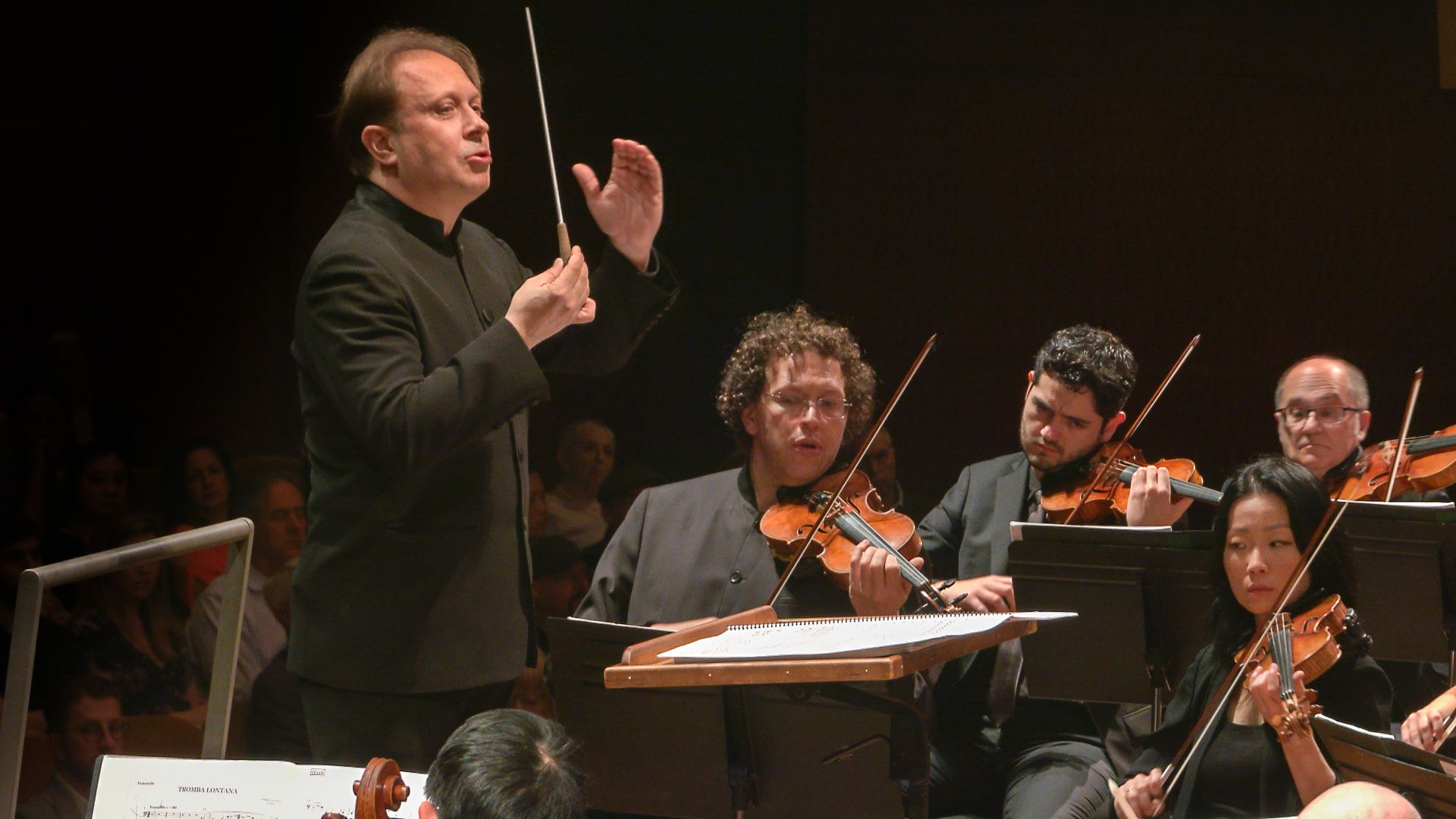
The Singapore-born Wong conducted the entire score from memory, drawing on a fascinating and idiosyncratic repertoire of gestures to communicate with the musicians: sweeping, circular motions, painterly hand waving, finger wiggles, a variety of crouching positions and leaps. It was clear how deeply he has internalized this music, allowing him to keep it flowing on multiple tracks at once. Phrases had compelling, dramatic shape, while he kept the larger arc of each movement, and of the entire Ninth, continually in view. The thunderous dive into the first movement’s recapitulation, for example, was breathtaking — a rare instance where the shift to major sounds not triumphant but catastrophic.
Especially noteworthy: Wong’s astonishing sensitive to dynamics and ability to shape and blend the sound to such fine gradations. Crescendos in the first two movements in particular were extraordinarily effective and dramatic. For the Scherzo, he opted for a somewhat more-measured tempo in lieu of the infernal machine that is frequently whipped into operation, and he likewise steered clear of the speeded-up pacing that has become fashionable for the slow movement, making a proper differentiation between the Adagio and Andante double variations. Nothing extreme, just a thorough immersion in the musical thought and feeling itself. Again, Wong’s loving attention to details of texture — the gentle throb of the violas not as accompaniment but part of the Adagio’s first theme — added immeasurably to this interpretation.
Also in contrast to last year, the Seattle Symphony Chorale sounded much better prepared and present, producing waves of glorious sound, as well as genuine mystery in the section where Beethoven re-enacts Gregorian chant — though the unnecessary use of amplification was an unfortunate choice. The soloists — soprano Katie Van Kooten soprano, alto Sara Couden, tenor Thomas Cooley, baritone Hadleigh Adams — didn’t blend particularly well, though some individual contributions made a powerful impact (especially Cooley’s exhortation in the high-flying march variation).
In Wong’s reading, only the “terror fanfare” that initiates the finale disappointed as too restrained. But his understanding of this massive structure as a miniature drama came through resoundingly, making for the finest overall Ninth I’ve heard in several years. Nothing else shares this program, so the focus is entirely on Beethoven. Even if you think you’ve heard the Ninth enough times for now, this one is worth seeking out. Wong returns to conduct Mahler’s Third in April. And judging from this success, we may be seeing a good deal more of him ….
I reviewed the Tannhäuser production currently onstage at the Met:
Could there be something like a Tannhäuser ‘curse’? Wagner fretted until the end of his life about how to improve his first opera inspired by medieval German sources. Like a beckoning Venus, the work tempted him at various points in his life to return and tinker away at what he perceived as its imperfections. Wagner’s most significant revision, fashioned for his operatic debut in Paris in 1861, spurred the most humiliating fiasco of his mature career – not because of the ‘content’ but because of protests in part related to Napoleon III’s policies involving the Austrian Empire….