MEMETERIA by Thomas May

Music & the Arts

Gerard Schwarz and His All-Star Orchestra Embark on Season Five

Celebrating Unity around the World is the title of  inaugural program of the All-Star Orchestra’s 10th-anniversary season; the program aired on September 28, 2023. Founded by the conductor Gerard Schwarz in 2012, soon after he concluded his 26th season as music director of Seattle Symphony, the All-Star Orchestra comprises prominent musicians from leading orchestras across the United States, including members of the New York Philharmonic and Metropolitan Opera Orchestra, Boston Symphony, Cleveland Orchestra, National Symphony, and San Francisco Symphony, among several other ensembles. 

The name evokes the kind of showcase team of outstanding athletes familiar from the sports world, or perhaps a supergroup of highly successful rock stars — but with the All-Star Orchestra, the focus is first and foremost on the music itself. Schwarz, who also serves as music director, devised the orchestra as a project through which top-level musicians could join together to cultivate symphonic music and share their love of this living tradition through public broadcasts. Each concert/program lasts about an hour and includes the maestro’s commentary — a latter-day response to Leonard Bernstein’s Omnibus concerts that spread the word about classical music a half century ago. 

One unusual aspect of this multiple Emmy Award-winning project is that the All-Stars do not play for live audiences but record their performances in a ballroom at the Manhattan Center with an array of 18 high-definition television cameras and a team of top audio engineers. The results are not only broadcast on member PBS stations but released as DVDs on the Naxos label, and ensuring the highest quality for both the visual and the audio dimensions has been essential to the project’s success. 

Along with the musicians he handpicked to be members of the All-Star Orchestra, Schwarz thus invited the eminent producer Dmitriy Lipay, winner of five Grammy Awards, to serve as audio director and producer for the project. The audio engineering team for the present program provided excellent sound — an especially notable feat in view of the vast spectrum of orchestral sonorities Schwarz selected to showcase, ranging from Richard Wagner to the 20th-century master Alberto Ginastera to the contemporary American composer Valerie Coleman. 

Schwarz chose a thrilling opening work with music from Wagner’s early opera Tannhäuser. Rather than simply present the Overture from the original 1845 version, however, he leads the musicians in an engrossing account of the expanded version Wagner created for the Paris production of 1861 — an event of unique music historical importance despite the provocations of the composer’s opponents, which forced the production to close after just three performances. Schwarz thus segues from the Venusberg music at the center of the original Overture to the extended ballet Wagner devised for the opening scene in Paris. 

The ballet depicts both the orgiastic transports sponsored by Venus in her forbidden realm, where Tannhäuser has been sojourning, and a feeling of languor from the bacchantes’ overstimulation. Schwarz seamlessly move from the vocabulary of Wagner’s earlier style to the chromatically saturated harmonies he had explored in Tristan und Isolde and imported into his revision of Tannhäuser. The overlap of languages from different eras of Wagner’s creative life intensifies the fundamental conflict between sacred and profane love that gives Tannhäuser its universal appeal.

A very different ballet music emerges in Alberto Ginastera’s dance suite from Estancia. The Argentine composer wrote this ballet score commissioned in 1941 by the forerunner of New York City Ballet. Schwarz coaxes the players to revel in Ginastera’s vibrant use of rhythms, majestically clashing harmonies, and boldly colorful orchestration as he pairs percussion and horns to evoke a sense of raw, elemental power. But the quasi-Impressionist evocation of the cattle ranch’s shimmering horizons is also well-calibrated. For the climatic dancing tournament that ends the suite, Schwarz coordinates a kaleidoscopic battery of percussion and trumpets.

The final selection is Umoja: An Anthem for Unity by the American composer and flutist Valerie Coleman, also known as the founder of the pioneering Imani Winds ensemble. Coleman initially composed Umoja for women’s choir; in 2019 the Philadelphia Orchestra commissioned her to write an expanded instrumental version. The title comes from the Swahili word for “unity” and refers to “the first principle of the African Diaspora holiday Kwanzaa.” 

In her interview segment on the program, Coleman discusses how Umoja is the kind of music that “not only sends a message but is also part of a vast tradition of passing stories down, passing heritage, just through the element of intuition and feel.” She situates the sonority of African drums within a classical framework, evoking a sense of the vast Serengeti: “You feel the wildlife — you feel all of these things that are truly what I think is Mother Earth … the core of unity,” according to Coleman. “And we’re truly celebrating the moment and the message of unity.”

Ultimately, Schwarz has said that his vision for the All-Star Orchestra project is to make great music as accessible as possible. This first program of the latest season is proof that with the right elements in place, he can offer an appealing alternative to the many distractions competing for our attention span. 

Review (c) 2023 Thomas May. All rights reserved.  

Filed under: All-Star Orchestra, audio engineering, Gerard Schwarz, review

Marking a Double Anniversary, Seattle Symphony Revels in Blasts from the Past

Ludovic Morlot conducts the SSO and soprano Alexandra LoBianco in excerpts from Götterdämmerung; photo (c)Brandon Patoc

My Bachtrack review of opening night at Seattle Symphony, which paired pieces played on the orchestra’s first-ever concert in 1903 and at their concert inaugurating Benaroya Hall 25 years ago. The fact that about two-thirds of the seats remained empty didn’t dampen the musicians’s spirits, but what a pity that so many missed out on a substantial, gloriously played program — not the lineup of frothy showpieces that orchestras so often put together for their season curtain raiser.

Review:

Though it ended with the downfall of a whole civilization, the Seattle Symphony’s opening-night concert radiated the excitement of a brand new season just getting under way, with all its attendant fresh hopes. 

continue

Filed under: Ludovic Morlot, review, Schubert, Seattle Symphony, Wagner

Seattle Opera Mines a Novel, Futuristic Rheingold

From left: Frederick Ballentine as Loge, Michael Mayes as Alberich and Greer Grimsley as Wotan in “Das Rheingold” at Seattle Opera. (Philip Newton)

I reviewed Seattle Opera’s new production of Das Rheingold:

Richard Wagner once described his trailblazing brand of opera as “deeds of music made visible.” The new production of “Das Rheingold” that opened Seattle Opera’s 60th season Saturday adds a literal twist to that concept by having the orchestra share the stage with the singers.

continue

Filed under: review, Seattle Opera, Wagner

Mount Green: Monteverdi in Santa Fe

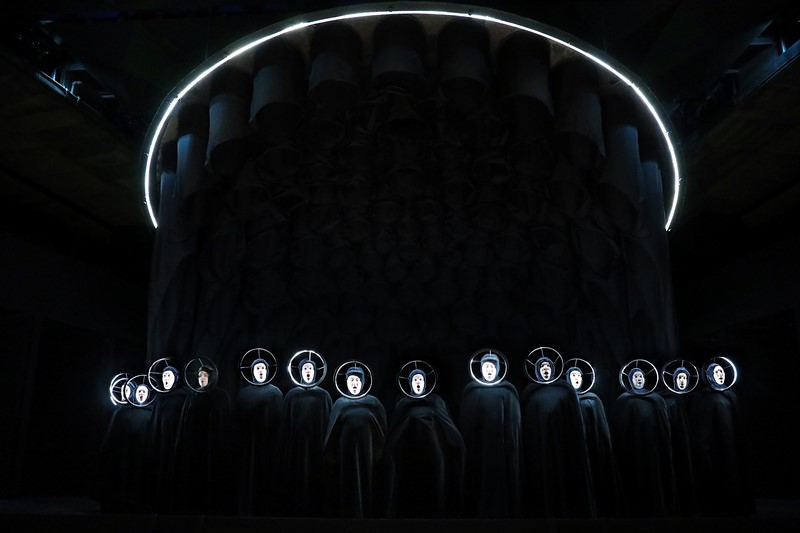
Santa Fe Opera Chorus | Photo: Curtis Brown

I wrote for Opera Now about Yuval Sharon’s Monteverdi production this summer at Santa Fe Opera:

The rousing fanfare that famously calls the audience to order for Orfeo was preceded by the sound of a modern orchestra tuning up – a preliminary signal of many surprises to come in Santa Fe Opera’s first-ever staging of the epochal work by Claudio Monteverdi.
continue

Filed under: directors, Monteverdi, review, Santa Fe Opera

Triplet of Trios Sets the Tone for Seattle’s Summer of Chamber Music

Steven Osborne, James Ehnes and Alisa Weilerstein; (c)Jenna Poppe

Seattle Chamber Music Society’s 2023 Summer Festival is now in full swing. My review of the opening night concert:

Opening night concerts can be an invitation to default to lightweight programming, letting extramusical distractions become the focus. Not so at Seattle Chamber Music Society. The 2023 Summer Festival kicked off with a concert that kept the audience’s attention avidly fixed on the music at hand…

continue

Filed under: chamber music, James Ehnes, Maurice Ravel, review, Seattle Chamber Music Society

Osmo Vänskä’s Precision-Calibrated Mahler with Seattle Symphony

Osmo Vänskä led the Seattle Symphony in a breathtaking account of Mahler’s Symphony No. 2. (Photos by Carlin Ma)

I reviewed the final concert of the Seattle Symphony season — an excellent performance of Mahler’s “Resurrection” Symphony No. 2 with guest conductor Osmo Vänskä:

SEATTLE — The Seattle Symphony’s season of guest conductors concluded with a visit by Osmo Vänskä. On June 24, he led a breathtaking, meticulous performance of Mahler’s Symphony No. 2. Conventional program structure offers a chance to experience each visiting conductor’s skills with a variety of pieces and styles. But with the entire concert devoted to this single work, Vänskä took on the additional test of sustaining the musical narrative over the length of a feature film.

continue

Filed under: Classical Voice North America, conductors, Mahler, review, Seattle Symphony

Three takes on Romeo and Juliet: Marin Alsop conducts the Seattle Symphony

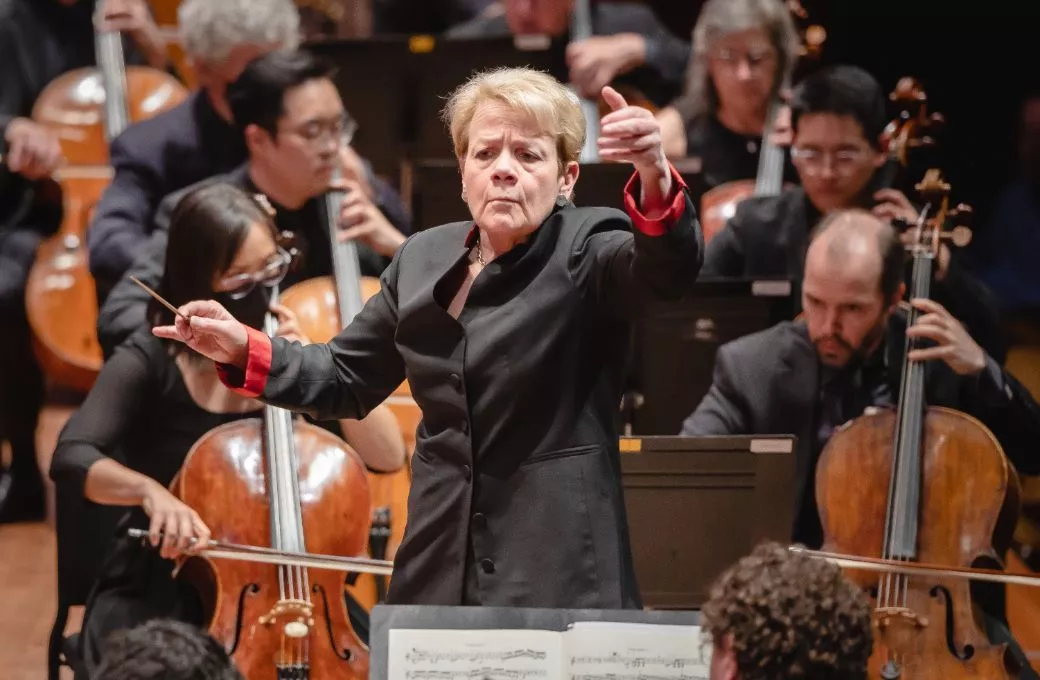
Marin Alsop conducts the Seattle Symphony © Carlin Ma

I reviewed this past weekend’s Seattle Symphony program with guest conductor Marin Alsop:

There was nothing star-crossed about Marin Alsop’s guest appearance with the Seattle Symphony. Fortune turned its wheel to allow for a happy, if long-overdue, collaboration following an absence of almost two decades from Benaroya Hall….

continue

Filed under: conductors, review, Seattle Symphony

Music Of Shostakovich Brings Fresh Drama To Silent Film ‘Potemkin’

Music from Shostavich’s Fourth, Fifth, Eighth, Tenth and Eleventh Symphonies was performed live to Eisenstein’s film. (Seattle Symphony photo)

I wrote about a very interesting film + live symphony event at Seattle Symphony with guest conductor Frank Strobel:

In 1925, Sergei Eisenstein made cinematic history with the release of Battleship Potemkin, his feature debut. Dmitri Shostakovich, still a precocious teenager, was hard at work on his First Symphony, which also caused a sensation when it was premiered the next year by the Leningrad Philharmonic.

continue

Filed under: Classical Voice North America, film, film music, review, Seattle Symphony

Abel Selaocoe Brings His Spirited Musicianship to Seattle

Abel Selaocoe and the Seattle Symphony; photo (c) Carlin Ma

What a memorable concert this was — my latest Seattle Symphony review:

“I feel very welcome here,” said Abel Selaocoe just before making his debut with the Seattle Symphony. Not only did he seem completely at home: in remarks introducing Four Spirits, his new work for cello, voice and orchestra, the young cellist-composer invited the audience to enter into his musical world, indicating that he would cue them when to sing along at the appropriate moment. “I’ll see you on the other side,” he winked, just before taking up his position to launch the piece.

continue

Filed under: Berlioz, cello, new music, review, Seattle Symphony

Seattle Symphony Delivers Playful Ligeti, High-tensile Bartók, and Reconsidered Rachmaninoff

David Robertson conducts the Seattle Symphony; photo (c)Brandon Patoc

David Robertson guest conducted the Seattle Symphony last week in a program of Ligeti, Bartók, and Rachmaninoff. My review:

Since it lacks a music director, the Seattle Symphony is presenting a smorgasbord of guest conductors throughout the season. These have been mostly younger artists still early in their careers, but David Robertson’s engagement marked the return of a seasoned conductor already well-liked by the players and in full command of a formidable talent….

continue

Filed under: Bartók, Ligeti, Rachmaninoff, review, Seattle Symphony

Archive

Enter your email address to follow this blog and receive notifications of new posts by email.