MEMETERIA

Icon

Arts writing by Thomas May

A First-Rate Beethoven Ninth

Conductor Kahchun Wong and Chorus master Joseph Crnko with Seattle Symphony and Chorale and soloists Katie Van Kooten, Sara Couden, Thomas Cooley, and Hadleigh Adams (left to right); image (c) Jorge Gustavo Elias

Seattle Symphony performed its very first concert on this day in 1903: 24 musicians conducted by Harry F. West (details in Greg Lange’s History Link article here).

Meanwhile, the 21st-century incarnation of SSO is ringing in the New Year with guest conductor Kahchun Wong at the helm in performances of Beethoven’s Ninth Symphony. Yes, it has become cliché to do the Ninth at year’s end, but last night’s opening performance for a very full house genuinely stood out as a memorable event — particularly in comparison with the disappointments of last year’s go.

The Singapore-born Wong conducted the entire score from memory, drawing on a fascinating and idiosyncratic repertoire of gestures to communicate with the musicians: sweeping, circular motions, painterly hand waving, finger wiggles, a variety of crouching positions and leaps. It was clear how deeply he has internalized this music, allowing him to keep it flowing on multiple tracks at once. Phrases had compelling, dramatic shape, while he kept the larger arc of each movement, and of the entire Ninth, continually in view. The thunderous dive into the first movement’s recapitulation, for example, was breathtaking — a rare instance where the shift to major sounds not triumphant but catastrophic.

Especially noteworthy: Wong’s astonishing sensitive to dynamics and ability to shape and blend the sound to such fine gradations. Crescendos in the first two movements in particular were extraordinarily effective and dramatic. For the Scherzo, he opted for a somewhat more-measured tempo in lieu of the infernal machine that is frequently whipped into operation, and he likewise steered clear of the speeded-up pacing that has become fashionable for the slow movement, making a proper differentiation between the Adagio and Andante double variations. Nothing extreme, just a thorough immersion in the musical thought and feeling itself. Again, Wong’s loving attention to details of texture — the gentle throb of the violas not as accompaniment but part of the Adagio’s first theme — added immeasurably to this interpretation.

Also in contrast to last year, the Seattle Symphony Chorale sounded much better prepared and present, producing waves of glorious sound, as well as genuine mystery in the section where Beethoven re-enacts Gregorian chant — though the unnecessary use of amplification was an unfortunate choice. The soloists — soprano Katie Van Kooten soprano, alto Sara Couden, tenor Thomas Cooley, baritone Hadleigh Adams — didn’t blend particularly well, though some individual contributions made a powerful impact (especially Cooley’s exhortation in the high-flying march variation).

In Wong’s reading, only the “terror fanfare” that initiates the finale disappointed as too restrained. But his understanding of this massive structure as a miniature drama came through resoundingly, making for the finest overall Ninth I’ve heard in several years. Nothing else shares this program, so the focus is entirely on Beethoven. Even if you think you’ve heard the Ninth enough times for now, this one is worth seeking out. Wong returns to conduct Mahler’s Third in April. And judging from this success, we may be seeing a good deal more of him ….

(c) 2023 Thomas May

Filed under: Beethoven, conductors, review, Seattle Symphony

Tannhäuser at the Met

Elza van den Heever (Elisabeth) and Christian Gerhaher (Wolfram) © Evan Zimmerman/Met Opera

I reviewed the Tannhäuser production currently onstage at the Met:

Could there be something like a Tannhäuser ‘curse’? Wagner fretted until the end of his life about how to improve his first opera inspired by medieval German sources. Like a beckoning Venus, the work tempted him at various points in his life to return and tinker away at what he perceived as its imperfections. Wagner’s most significant revision, fashioned for his operatic debut in Paris in 1861, spurred the most humiliating fiasco of his mature career – not because of the ‘content’ but because of protests in part related to Napoleon III’s policies involving the Austrian Empire….

continue

Filed under: Metropolitan Opera, review, Wagner

David Robertson with Seattle Symphony in Mahler … and Robertson

David Robertson led the Seattle Symphony; photo by Brandon Patoc

SEATTLE — So far this season, the Seattle Symphony has played under no fewer than seven conductors as part of its central masterworks subscription series. The musicians have shown remarkable flexibility in adapting to a dramatically varied range of podium styles and personalities for each program as the search for a permanent music director continues.

continue

Filed under: conductors, Mahler, review, Seattle Symphony

Antony & Cleopatra in Barcelona

The European premiere of John Adams’s most recent opera at the Gran Teatre del Liceu in Barcelona marked the debut of soprano Julia Bullock in the role specifically written for her. I reviewed this remarkable production for Classical Voice North America:

BARCELONA — Though this is a city known for its proud celebration of culture, it still came as a delightful surprise to be greeted at the Barcelona-El Prat Airport by posters announcing the Gran Teatre del Liceu production of John Adams’ Antony and Cleopatra.…

continue

Filed under: American opera, John Adams, review, Shakespeare

Brooklyn Rider and Kinan Azmeh: Starlighter

My review of Starlighter, the latest Brooklyn Rider release featuring the quartet’s collaboration with clarinetist/composer Kinan Azmeh, is in the November issue of Gramophone:

Ever since they formed nearly two decades ago, Brooklyn Rider have been reimagining the string quartet’s potential both in their playing style and in their devotion to new repertoire. …

continue

Filed under: Brooklyn Rider, CD review, Gramophone, Kinan Azmeh, review, string quartet

Rachel Barton Pine and Kristiina Poska Dazzle with the Royal Scottish National Orchestra

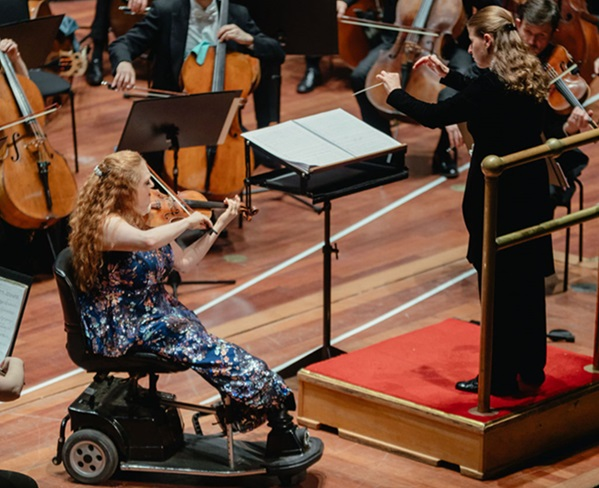
Kristiina Poska conducts violinist Rachel Barton Pine and the RSNO © Leighanne Evelyn Photography

I had the pleasure of covering the Royal Scottish National Orchestra’s latest concert in Edinburgh, which featured two guest artists in remarkable sync:

Although the most recent work on this weekend’s Royal Scottish National Orchestra programme dates from 1952, audiences are still just beginning to make its acquaintance. The ongoing reappraisal of the twentieth-century African American composer Florence Price would not be possible without the contributions of performers who have championed her music….

continue

Filed under: Aaron Copland, conductors, Florence Price, review, Sibelius, violinists

Azrieli Music Prizes: Review of London Debut Concert

Bows (l to r): Georgia Mann, Pouyan Biglar, Iman Habibi, Jessika Kenney, Sharon Azrieli, Steven Mercurio, Zhongxi Wu, Rita Ueda and Naomi Sato (photo: Chris O’Donovan Photography)

The Toronto-based Azrieli Music Prizes recently presented the European premieres of all three works by the 2022 laureate composers in AMP’s London debut concert at Cadogan Hall. Here’s my report:

Launched a little less than a decade ago, the Azrieli Music Prizes (AMP) have already grown to become Canada’s largest competition devoted to music composition. The biennial initiative has expanded to embrace an international scope and last weekend made its London debut at Cadogan Hall with a programme of all three prize-winning works from the 2022 rounds. Steven Mercurio, a member of the AMP Jewish Music jury, led the Philharmonia Orchestra and guest soloists.

continue

Filed under: commissions, competitions, music news, review

Gerard Schwarz and His All-Star Orchestra Embark on Season Five

Celebrating Unity around the World is the title of  inaugural program of the All-Star Orchestra’s 10th-anniversary season; the program aired on September 28, 2023. Founded by the conductor Gerard Schwarz in 2012, soon after he concluded his 26th season as music director of Seattle Symphony, the All-Star Orchestra comprises prominent musicians from leading orchestras across the United States, including members of the New York Philharmonic and Metropolitan Opera Orchestra, Boston Symphony, Cleveland Orchestra, National Symphony, and San Francisco Symphony, among several other ensembles. 

The name evokes the kind of showcase team of outstanding athletes familiar from the sports world, or perhaps a supergroup of highly successful rock stars — but with the All-Star Orchestra, the focus is first and foremost on the music itself. Schwarz, who also serves as music director, devised the orchestra as a project through which top-level musicians could join together to cultivate symphonic music and share their love of this living tradition through public broadcasts. Each concert/program lasts about an hour and includes the maestro’s commentary — a latter-day response to Leonard Bernstein’s Omnibus concerts that spread the word about classical music a half century ago. 

One unusual aspect of this multiple Emmy Award-winning project is that the All-Stars do not play for live audiences but record their performances in a ballroom at the Manhattan Center with an array of 18 high-definition television cameras and a team of top audio engineers. The results are not only broadcast on member PBS stations but released as DVDs on the Naxos label, and ensuring the highest quality for both the visual and the audio dimensions has been essential to the project’s success. 

Along with the musicians he handpicked to be members of the All-Star Orchestra, Schwarz thus invited the eminent producer Dmitriy Lipay, winner of five Grammy Awards, to serve as audio director and producer for the project. The audio engineering team for the present program provided excellent sound — an especially notable feat in view of the vast spectrum of orchestral sonorities Schwarz selected to showcase, ranging from Richard Wagner to the 20th-century master Alberto Ginastera to the contemporary American composer Valerie Coleman. 

Schwarz chose a thrilling opening work with music from Wagner’s early opera Tannhäuser. Rather than simply present the Overture from the original 1845 version, however, he leads the musicians in an engrossing account of the expanded version Wagner created for the Paris production of 1861 — an event of unique music historical importance despite the provocations of the composer’s opponents, which forced the production to close after just three performances. Schwarz thus segues from the Venusberg music at the center of the original Overture to the extended ballet Wagner devised for the opening scene in Paris. 

The ballet depicts both the orgiastic transports sponsored by Venus in her forbidden realm, where Tannhäuser has been sojourning, and a feeling of languor from the bacchantes’ overstimulation. Schwarz seamlessly move from the vocabulary of Wagner’s earlier style to the chromatically saturated harmonies he had explored in Tristan und Isolde and imported into his revision of Tannhäuser. The overlap of languages from different eras of Wagner’s creative life intensifies the fundamental conflict between sacred and profane love that gives Tannhäuser its universal appeal.

A very different ballet music emerges in Alberto Ginastera’s dance suite from Estancia. The Argentine composer wrote this ballet score commissioned in 1941 by the forerunner of New York City Ballet. Schwarz coaxes the players to revel in Ginastera’s vibrant use of rhythms, majestically clashing harmonies, and boldly colorful orchestration as he pairs percussion and horns to evoke a sense of raw, elemental power. But the quasi-Impressionist evocation of the cattle ranch’s shimmering horizons is also well-calibrated. For the climatic dancing tournament that ends the suite, Schwarz coordinates a kaleidoscopic battery of percussion and trumpets.

The final selection is Umoja: An Anthem for Unity by the American composer and flutist Valerie Coleman, also known as the founder of the pioneering Imani Winds ensemble. Coleman initially composed Umoja for women’s choir; in 2019 the Philadelphia Orchestra commissioned her to write an expanded instrumental version. The title comes from the Swahili word for “unity” and refers to “the first principle of the African Diaspora holiday Kwanzaa.” 

In her interview segment on the program, Coleman discusses how Umoja is the kind of music that “not only sends a message but is also part of a vast tradition of passing stories down, passing heritage, just through the element of intuition and feel.” She situates the sonority of African drums within a classical framework, evoking a sense of the vast Serengeti: “You feel the wildlife — you feel all of these things that are truly what I think is Mother Earth … the core of unity,” according to Coleman. “And we’re truly celebrating the moment and the message of unity.”

Ultimately, Schwarz has said that his vision for the All-Star Orchestra project is to make great music as accessible as possible. This first program of the latest season is proof that with the right elements in place, he can offer an appealing alternative to the many distractions competing for our attention span. 

Review (c) 2023 Thomas May. All rights reserved.  

Filed under: All-Star Orchestra, audio engineering, Gerard Schwarz, review

Marking a Double Anniversary, Seattle Symphony Revels in Blasts from the Past

Ludovic Morlot conducts the SSO and soprano Alexandra LoBianco in excerpts from Götterdämmerung; photo (c)Brandon Patoc

My Bachtrack review of opening night at Seattle Symphony, which paired pieces played on the orchestra’s first-ever concert in 1903 and at their concert inaugurating Benaroya Hall 25 years ago. The fact that about two-thirds of the seats remained empty didn’t dampen the musicians’s spirits, but what a pity that so many missed out on a substantial, gloriously played program — not the lineup of frothy showpieces that orchestras so often put together for their season curtain raiser.

Review:

Though it ended with the downfall of a whole civilization, the Seattle Symphony’s opening-night concert radiated the excitement of a brand new season just getting under way, with all its attendant fresh hopes. 

continue

Filed under: Ludovic Morlot, review, Schubert, Seattle Symphony, Wagner

Seattle Opera Mines a Novel, Futuristic Rheingold

From left: Frederick Ballentine as Loge, Michael Mayes as Alberich and Greer Grimsley as Wotan in “Das Rheingold” at Seattle Opera. (Philip Newton)

I reviewed Seattle Opera’s new production of Das Rheingold:

Richard Wagner once described his trailblazing brand of opera as “deeds of music made visible.” The new production of “Das Rheingold” that opened Seattle Opera’s 60th season Saturday adds a literal twist to that concept by having the orchestra share the stage with the singers.

continue

Filed under: review, Seattle Opera, Wagner

Archive

Enter your email address to follow this blog and receive notifications of new posts by email.