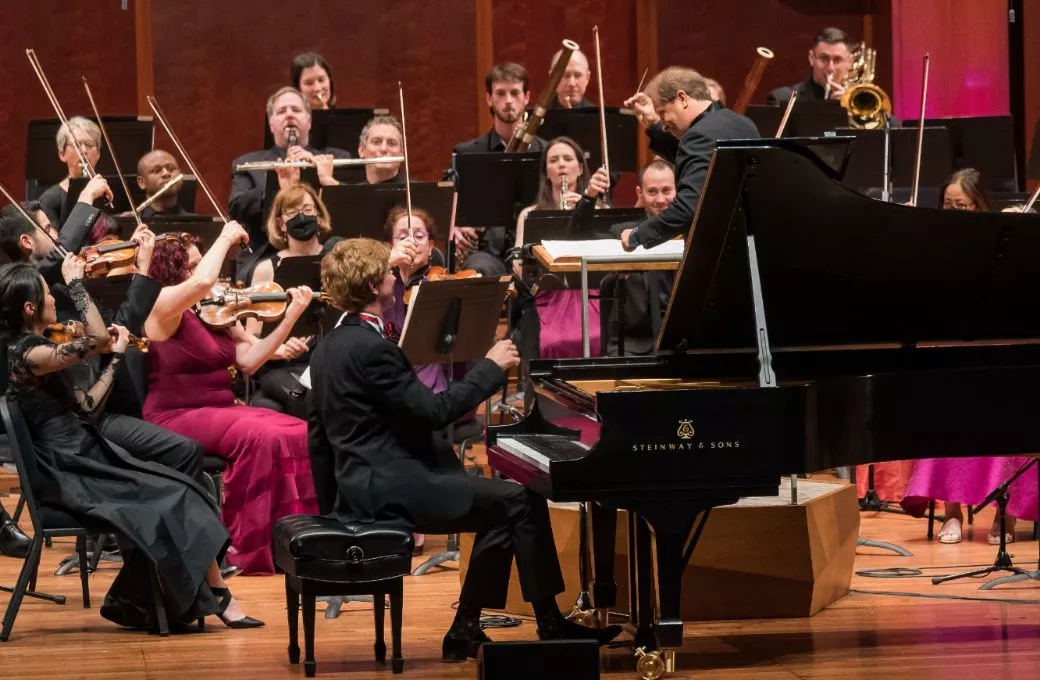
Jan Lisiecki, Ludovic Morlot and the Seattle Symphony; image (c) Brandon Patoc
My review of this weekend’s opening night concert:
Mixing the familiar with some discoveries, the Seattle Symphony offered a pleasingly varied program to open its new season. The event also brought an element of reassurance by evoking welcome memories of a more stable era as former music director Ludovic Morlot reunited with the orchestra…
Guest contributor Thomas Luce on the recently concluded BBC Proms season:
The British Broadcasting Corporation’s 72 Promenade Concerts, which started in mid-July, ended two days before the Last Night of the Proms originally scheduled for 10 September. This is because such hugely joyful and triumphant public events would be inconsistent with the National Mourning following Her Majesty Queen Elizabeth’s deeply and widely grieved death on 8 September.
The 2022 edition of the Proms very successfully delivered the gigantic and demanding variety of classical, modern, and some populist music summarised in my post here on 3 May. All of the programmed orchestras turned up, including those from Australia, Ukraine, Berlin, Finland, Norway, Cologne, and Philadelphia. And, generally, there were huge audiences in London’s Royal Albert Hall, which in the Promenade season can accommodate nearly 6,000 people.
All this year’s Prom concerts remain available on BBC Sounds until 10 October. Of the concerts we attended or heard, I would especially recommend the huge and powerful choral and orchestral programmes — which, until the end of Covid pandemic-related public restrictions (though not, of course, of the pandemic), were not allowable in public. So, for the first time in a couple of years, there were huge choruses with full orchestras: on Verdi’s Requiem(14 July), Mahler’s Resurrection Symphony (24 August), 29 August (Bach’s B minor Mass), Elgar’s The Dream of Gerontius (31 August), Beethoven’s Choral Symphony (2 September) performed by the ethnically diverse Chineke! Orchestra supplemented by English choral societies, and Beethoven’s Missa Solemnis (7 September) in a phenomenal performance by the Monterverdi Choir and the Orchestre Révolutionnaire et Romantique conducted by John Eliot Gardiner. Also very worthwhile were the two evenings by the world-famous Berlin Philharmonic on 3 and 4 September, which included Mahler’s Seventg Symphony, Schnittke’s interesting Viola Concerto, and Bruckner’s Fourth Symphony, as well a the superb performance by Sir Andras Schiff on Sunday morning (4 September) of Beethoven’s last three piano sonatas.
In addition to its recently broadcast public concerts, BBC Sounds makes all of its musical programmes available for a month or so. These include regular daily or weekly programmes, such as each day’s 24-hour playlist. Each Saturday morning also presents interesting record reviews. And each week a different composer is featured in hour-long discussions each day, which are informative and educational. Recently featured composers have included Dieterich Buxtehude and Ralph Vaughan Williams.
Another advantage of the performances available on BBC Sounds is that they are not interrupted by advertisements. The intervals usually contain musically illustrated and informative discussions of the programme and its performers. A good recent example was the interval discussion during the Prom of 5 September, which included works by the Franco-American Betsy Jolas and Mahler’s First Symphony, which provided fascinating information on the music as well as on professional performances of both composers.
The last of the dozen Proms that my wife and I went to was by the Philadelphia Orchestra on 8 September. We reached the hall a short time after the Queen’s death was announced. The orchestra was on the stage, but it was announced that because of her death the intended programme would not be performed and there would solely be the National Anthem and the Nimrod Variation from Elgar’s Enigma Variations: a sombre and subtly sad piece that beautifully reflects public grievance, just as Samuel Barber’s Adagio for Strings comparably does in America. It was very movingly played by the Philadelphia musicians, conducted by Yannick Nézet-Séguin.
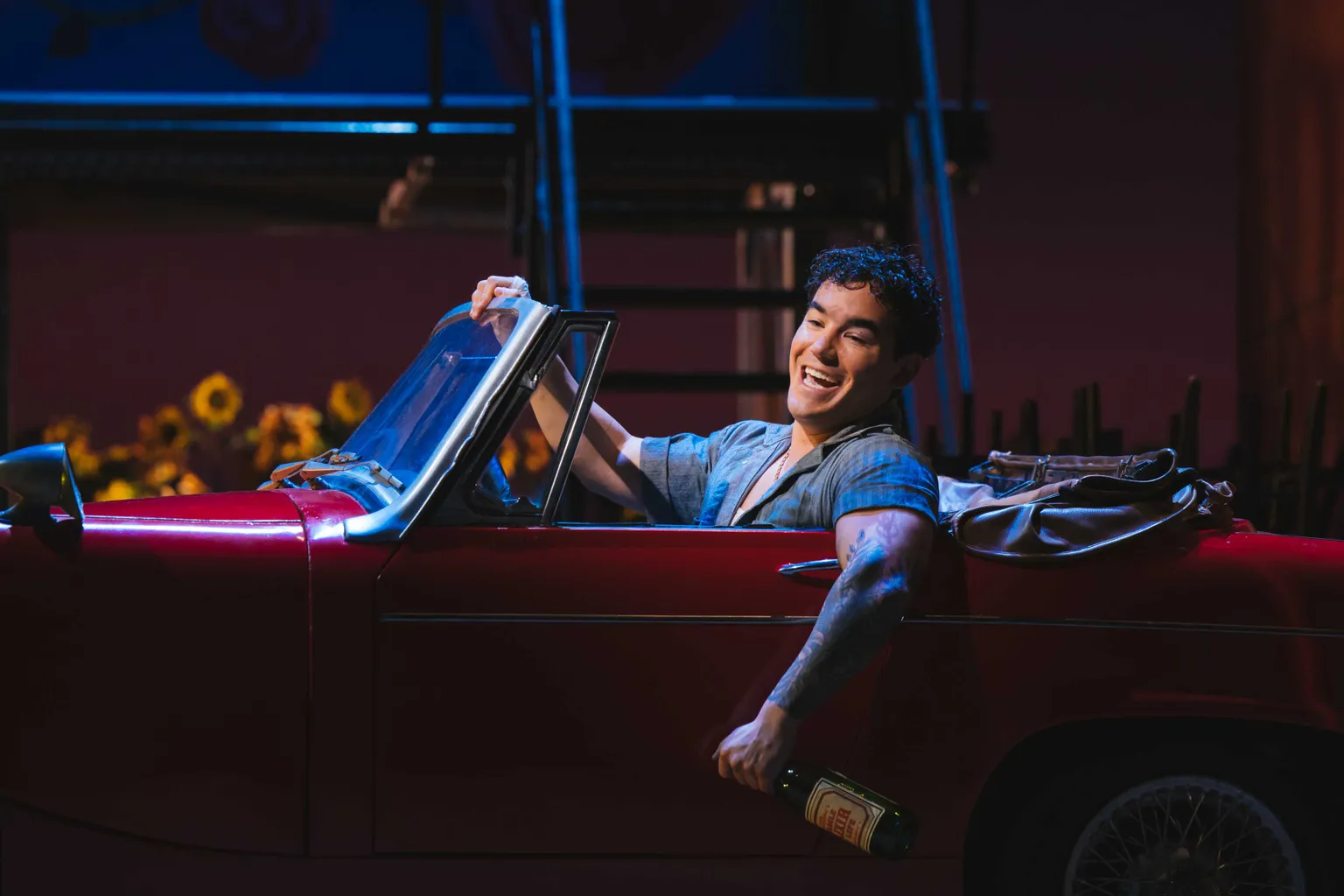
Andres Acosta as Nemorino in Seattle Opera’s production of “The Elixir of Love.” (Sunny Martini)
Seattle Opera’s new season has opened with a production of The Elixir of Love, Donizetti’s melodrammagiocoso from 1832. Although I have to miss these performances, I reviewed the company’s production directed by David Gately when it was presented at the height of the pandemic virtually, as a film (with a different cast and a very small ensemble):
While the world pins its hope on a coronavirus vaccine, another elixir is getting top billing at Seattle Opera…
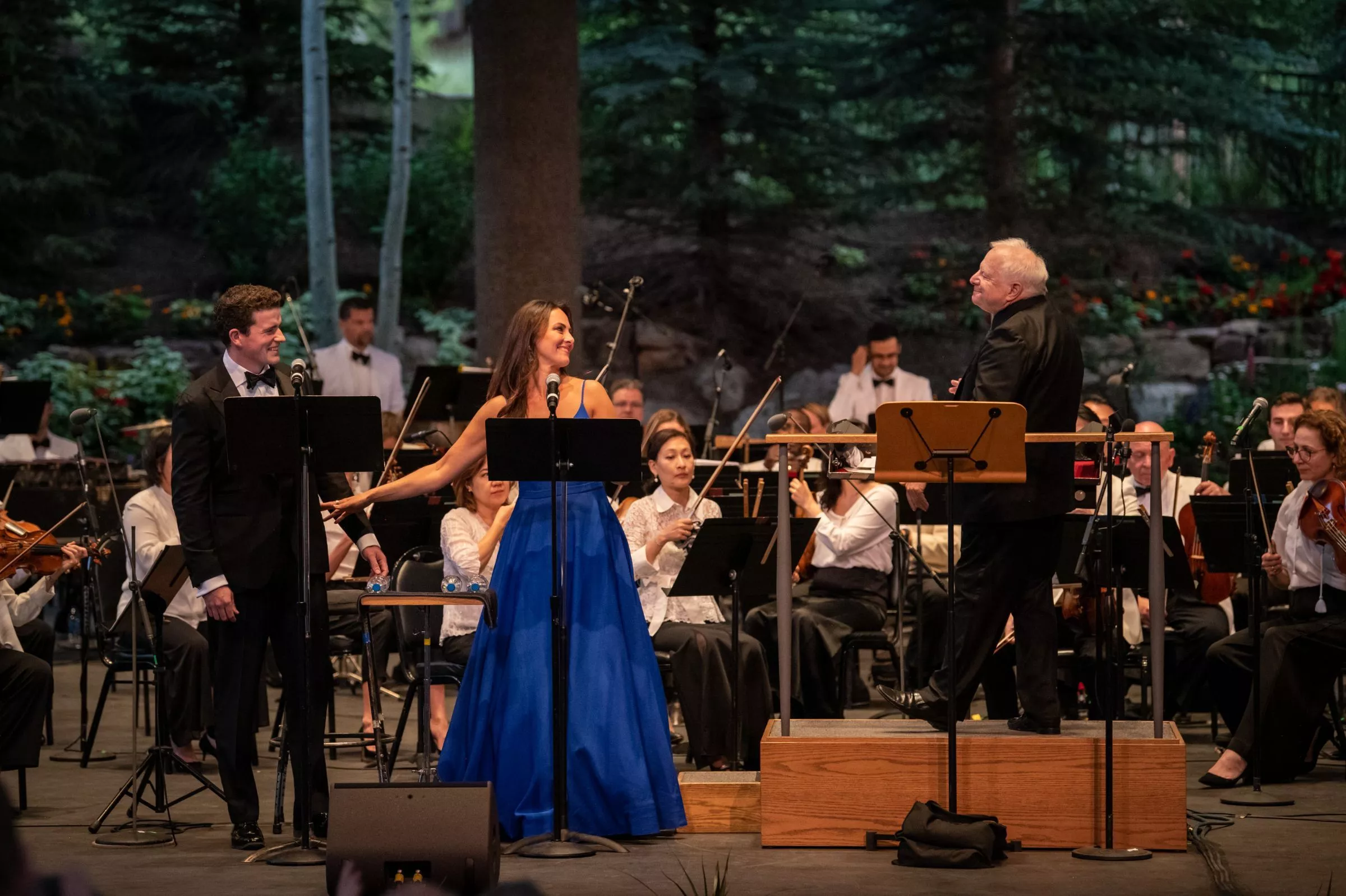
Emmett O’Hanlon, Isabel Leonard, Leonard Slatkin; photo (c)Carly Finke
Here’s my report on the New York Philharmonic’s closing orchestral concert of the 2022 Bravo Vail Music Festival:
One of four orchestras appearing at Bravo! Vail this summer, the New York Philharmonic brought along six different programmes, the first four of which were led by music director Jaap van Zweden – including a cathartic Mahler Sixth. Leonard Slatkin took over the reins for the remaining two programmes in the open-air main venue: an all-Tchaikovsky evening and this concluding concert, “A Sondheim Celebration”….
And they’re off to an auspicious start… Here’s my review of opening night for Bachtrack:
Nothing could stop this show from going on — not even a popped viola string nearly midway through Béla Bartók’s grueling String Quartet no. 6 at the center of the program that opened the Seattle Chamber Music Society’s 2022 Summer Festival…
Etienne Dupuis as Don Giovanni; Photo: Cory Weaver/San Francisco Opera
I wrote about Michael Cavanagh’s production of Don Giovanni currently being presented by San Francisco Opera.
SAN FRANCISCO — The flames are already flickering as the overture begins in the new production ofDon Giovanni directed by Michael Cavanagh at San Francisco Opera. Set and projection designer Erhard Rom’s accompanying visuals establish a scenario of civilizational destruction as the backstory for what we’re about to see transpire onstage.
I reviewed the Figaro production that just opened at Seattle Opera for Bachtrack:
There’s a moment in Seattle Opera’s end-of-season production, as the threads are being steadily pulled ever tighter in the final act, when Figaro reaches out from his hiding place behind a tree, trying to make contact with Susanna…
Roderick Cox conducting the Seattle Symphony Orchestra; photo (c)James Holt
I left last night’s performance convinced that Roderick Cox is a major talent destined for something great. Winner of the 2018 Sir Georg Solti Conducting Award, Cox had caught my interest last year leading a Barber in San Francisco Opera’s return to live performance. Those were unusual circumstances dictated by social-distancing rules (with a parking lot as the auditorium, the music transmitted to our car radios), so it was splendid to get to experience this young conductor in the limelight, with a full orchestra, unhampered by any pandemic restrictions more cumbersome than a mask. [UPDATE: Check out the film Conducting Life, an intimate portrait of Roderick Cox and his path toward his vocation.]
Cox chose a challenging program that revealed an impressive gift for communicating his musical vision. The first half was given to William Levi Dawson’s Negro Folk Symphony of 1934–a landmark of early 20th-century American symphonic writing has been shamefully, disgracefully neglected while so many tireless mediocrities continue to clutter the repertoire.
This performance had the quality of a double epiphany, confirming what an excellent piece of music we’ve allowed ourselves to be missing out on and at the same time shedding light on the journey Dawson’s symphony traces–outwardly, the harrowing passage from Africa to the New World, but also an implicitly personal journey. He clarified the originality of Dawson’s response to the challenge Dvořák had issued to cultivate an authentically American voice. For Dawson, that meant writing a symphony that, as the composer put it, “is unmistakably not the work of a white man.”
Negro Folk Symphony is a marvel of the imaginative, indeed, symphonic, transformation of simple, ready-made folk material–Dawson draws on three spirituals in particular–into a complex, multi-faceted structure. Cox led a dramatically compelling account that highlighted Dawson’s elaborate use of rhythmic mottos as a unifying device, while also lavishing attention on the orchestral details that give this score such resonance. His spacing of the implacably tragic minor chords ending the “Hope in the Night Section” was especially memorable. This was the SSO’s first performance of the Dawson, and part of the excitement came from the sense of the players sharing in these discoveries along the way, clearly inspired by Cox’s guidance.
Concertmaster Noah Geller gave a deeply felt and polished interpretation of the 1904 Violin Concerto in A minor by Alexander Glazunov–who, like Dawson, straddled a period of drastic change in musical values and pressures. Basking in his warmly expressive lower register in the opening passage, the violinist kept the audience at an attentive hush in Glazunov’s extended cadenza, counterbalancing the piece’s gentler lyricism with its giddy high spirits and vivaciously articulated virtuosity.
Cox proved fearless in Belá Bartók’s Suite from The Miraculous Mandarin, a piece that doesn’t tolerate weak-willed, insecure conducting. He drew an electrifying performance from the outset, never letting go of the ominous, hair-raising tension and danger that animate this early Bartók score. The music echoes, though in a very original way, impulses from Stravinsky’s RiteofSpring and Strauss’s dancing Salome, also hinting at the spirit of film noir to come. Cox emphasized its brutal violence but also knew how to bring out the delicacy and spookily muted colors of Bartók’s orchestration, loosening the reins to give the platform to Benjamin Lulich for his arresting clarinet solos.
The glowing rapport between the players and Cox left me hoping to see much more of this conductor on the Benaroya stage. Thursday’s audience, though relatively sparse, was enthusiastic and grateful. What a pity it would be to miss this excellent program, which repeats Saturday at 8pm and Sunday at 2pm.
Ruth Reinhardt conducting Seattle Symphony in Bernstein’s Candide Overture during her tenure as an SOO Conducting Fellow (2017)
Last week’s subscription concerts launched Seattle Symphony’s Sibelius Symphony cycle, which had been anticipated as a highlight of Thomas Dausgaard’s return since the pandemic. In the wake of the now-ex-music director’s sudden departure announced last month, a handful of replacement conductors has been enlisted to take over Dausgaard’s commitments for the rest of the season.
First up this month was Ruth Reinhardt, a remarkable conductor of the young generation. She had the formidable task of taking on the first program of the Sibelius cycle, in which the Finnish composer’s symphonies are being combined with newly commissioned compositions. The Pulitzer Prize-winning Ellen Reid responded to Sibelius’s First Symphony with a work titled TODAY AND TODAY AND TODAY AND TODAY AND TODAY AND TODAY AND TODAY AND TODAY AND TODAY AND TODAY. Lasting about a quarter-hour, it showed Reid as a composer who not only creates intriguing soundscapes but is able to illuminate them with psychologically resonant significance.
The Macbethian title (even more despairing than “tomorrow and tomorrow and tomorrow”) refers to the patterns of repetition and monotony endured during the pandemic. But her music stages various escapes — lyrical fantasias, utopian dreaming, even a down-to-earth party — from the stasis and repetition that threaten to drain each day of the joie de vivre. Reid uses the resources of the orchestra with great imagination and variety.
Moreover, as became clear in Reinhardt’s sweeping, panoramic vision of the Sibelius, Reid seems to have found a pandemic-era equivalent for the vision conveyed by Sibelius’s extraordinary debut symphony, which builds to a seeming lyrical breakthrough or even oasis, only to find it illusive. That connection certainly seemed apparent in Reinhardt’s overview of both works. Between them, we were treated to an exquisitely phrased, completely beguiling interpretation by Garrick Ohlsson of the Rhapsody on a Theme of Paganini, followed by thunderous, bell-like chords in his encore, the C-sharp minor Prelude.
What a gift to have Asher Fisch back in town after a long absence. The program he conducted on Thursday evening paired George Walker and Gustav Mahler, and the pairing works beautifully. Fisch infused Lyric for Strings with genuine warmth and underscored the fascinating entanglement of folk and modernist elements in the much later Folksongs for Orchestra, which dates from 1990. It continues to defy belief that this great American composer remains such a rarity in our concert life. How long is it going to take to change that?
Fisch was in his element with Das Lied von der Erde, and the Mahler-starved audience — the pandemic has been especially unkind to the composers who require enlarged orchestras — drank it up with rapt attention. I especially admired his flexible rhythms and feeling for Mahler’s Jugendstil ornamentation, but he also kept the emotional destination of the cycle clearly in view, illuminating the way to, and the journey within, the vast final song. Problems of balance left tenor Russell Thomas largely drowned out for stretches of the opening “Trinklied,” but his passionate delivery conveyed the flashes of bitter epiphany Mahler expresses.
Mezzo-soprano Kelley O’Connor brought a rich, dark timbre to her three songs, carefully building the sense of inevitable leave-taking in “Der Abschied.” The expanded woodwind section was a special highlight, with eloquent contributions from flutist Demarre McGill and oboist Mary Lynch in particular. Fisch’s unpretentious, unfussy clarity allowed each detail to fall into place with memorable impact.
The program will be repeated on Saturday at 8pm and Sunday at 4pm. It would be a shame to miss it.
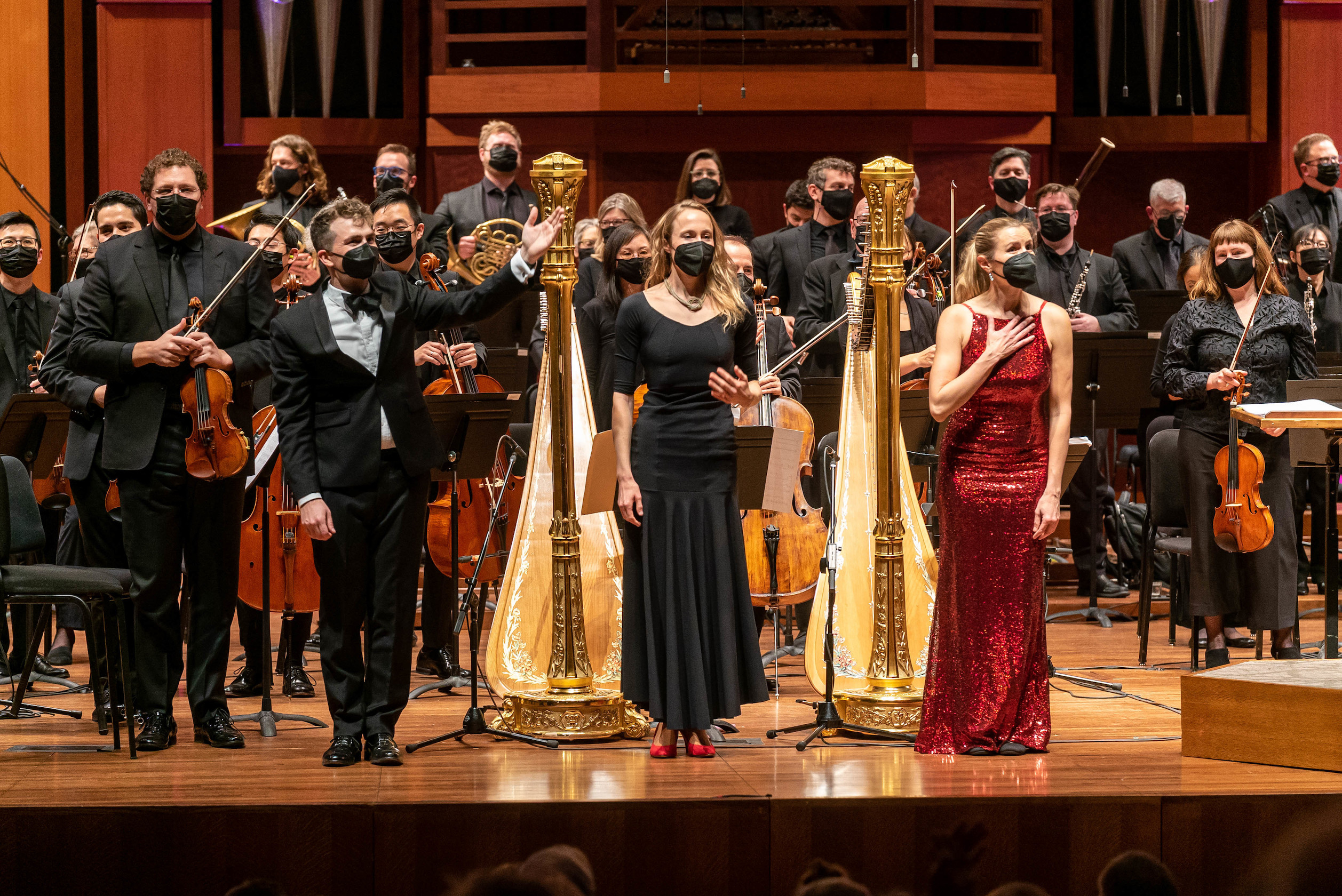
Lee Mills with soloists Hannah Lash and Valerie Muzzolini and the Seattle Symphony (photo: James Holt / Seattle Symphony)
I reviewed Seattle Symphony’s latest program: a world premiere of a new double harp concerto by Hannah Lash and Amy Beach’s “Gaelic” Symphony:
SEATTLE — An unexpectedly last-minute round of musical chairs reshuffled the lineup for one of the most unusual and original programs of the Seattle Symphony season. As a double harp concerto, Hannah Lash’s The Peril of Dreams, an SSO commission, in itself represents a rarity in the orchestral literature. That it was paired with the seldom-programmed “Gaelic” Symphony by Amy Beach made the occasion all the more remarkable….






 MEMETERIA by Thomas May