TIM MIX (KING DODON) PHOTO CREDIT: PAUL HORPEDAHL FOR SANTA FE OPERA, 2017
Even though it’s still more or less a rarity for American audiences nowadays, Nikolai Rimsky-Korsakov’s The Golden Cockerel can seem surprisingly — indeed, unnervingly — familiar to audiences enduring the current political moment.
At least that’s one of the main premises of the new production Santa Fe Opera is presenting this season (a co-production with Dallas Opera). Also marking its company debut, Rimsky’s final opera (better known by its French title, Le coq d’or) actually has a direct American connection as regards its source.
The libretto by Vladimir Belsky is an adaptation of a verse fairy-tale by Pushkin, who got the story from none other than Washington Irving (specifically, from The Legend of the Arabian Astrologer, one of his Tales of the Alhambra inspired by the American writer’s travels in Spain).
Despite those far-flung historical connections, Cockerel — the final opera by the prolific Rimsky (completed in 1907) — posed a trenchant contemporary critique of Tsar Nicholas II that, especially in the aftermath of the disastrous Russo-Japanese War, was obvious enough to cause trouble with the censors. Rimsky died before the opera could be premiered (in 1909 in Moscow).
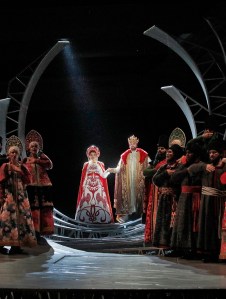
VENERA GIMADIEVA (QUEEN OF SHEMAKHA) AND TIM MIX (KING DODON) PHOTO CREDIT: KEN HOWARD FOR SANTA FE OPERA, 2017
Cockerel involves an odd, both beguiling and baffling combination of dramaturgical registers such that it’s a challenge to stage the work outside its Russian context, which boasts a rich performance tradition of Rimsky’s operas (despite or even because of the composer’s posthumous hurdles with Soviet cultural authorities).
The framework is standard-issue fairy-tale: in a land long ago, King Dodon hopes to put an end to the threat of warfare from beyond his borders and even considers building a wall. As he seeks advice, a mysterious Astrologer presents him with the ideal solution: a beautiful Golden Cockerel that only needs to be perched atop a building to keep watch. It acts as a kind of early-warning system, allowing the King to indulge in his love of sleep and food worry-free.
But when the warning comes, he goes on a pre-emptive war, only to be seduced by his enemy, the Queen of Shemakha. She cajoles him into a marriage to gain his kingdom, and they return to the capital. But the Astrologer had extracted a promise that the grateful Tsar would give him anything he requested. Naturally, the Astrologer now demands the new Queen for himself. The King reacts violently, and the Golden Cockerel fatally pecks him.
That’s just the scaffolding. Infused into the fairy-tale story line are elements of political satire, allegory, Orientalism, and intoxicating late Romanticism. The Golden Cockerel even became an inspiration for modernist trends thanks to the Paris production by Sergei Diaghilev’s Ballets Russes company in 1914, which put a distancing wedge between the music and story by keeping the singers to the sides while dancers enacted the roles.
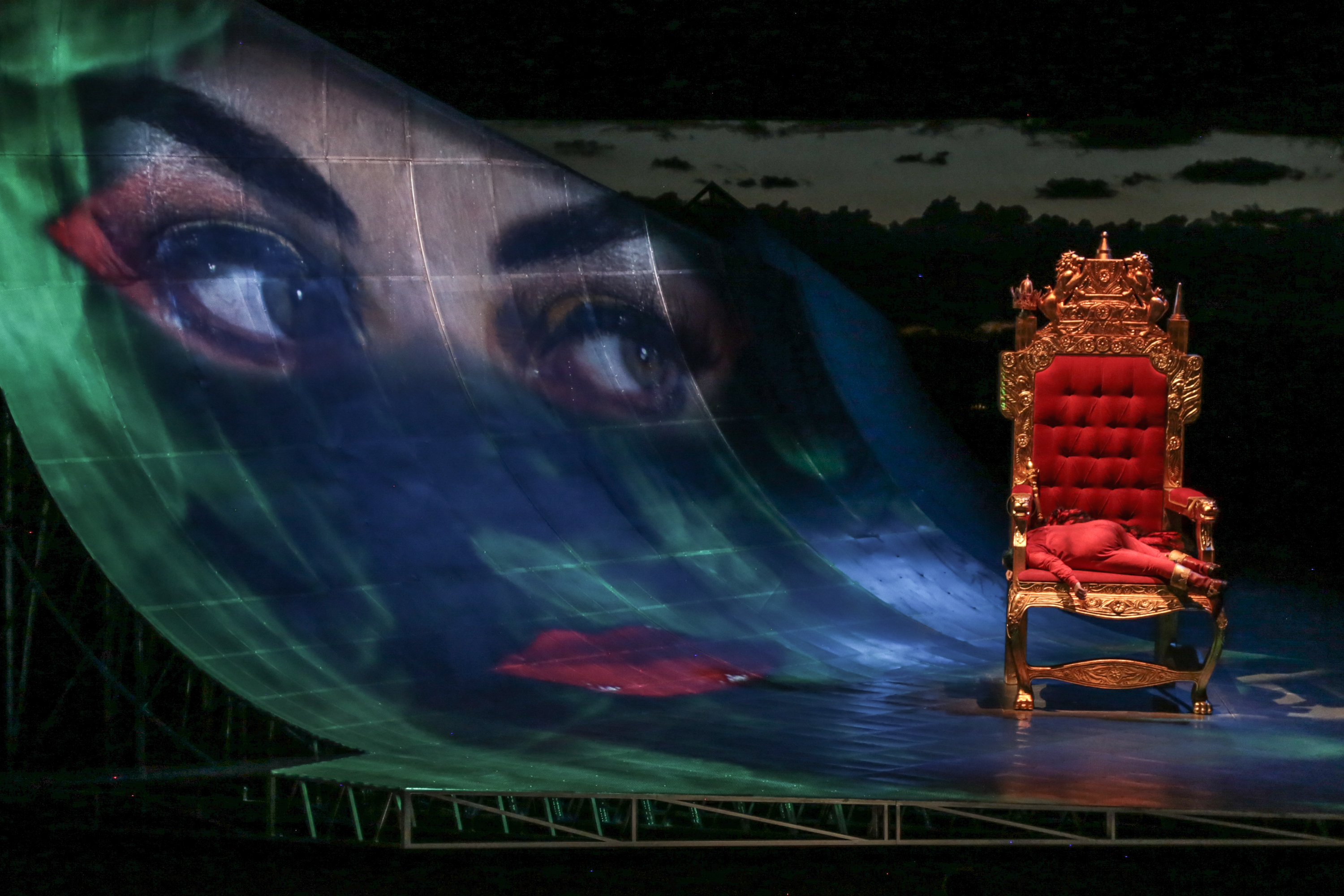
Director Paul Curran and the creative team accentuate the satirical elements with a kind of broad comedy that wouldn’t be out of place in a Saturday Night Live skit. Gary McCann (responsible for the set and costumes) imprisons Tsar Dodon in a fat suit, his jello-y bulges on display when he snoozes in his long red underwear (though he is hilariously undersized for a throne many times too big for him).
Near the culmination, this master of blustering incompetence appears decked out in a modern suit with a flaming red tie (yes, that‘s the blowhard he’s meant to evoke, tho Dodon possesses certain charming aspects that undo the implied comparison). His new Queen is wearing a smart white pantsuit.
The clowning and pratfalls grow a bit tiresome, however, and make for a dragging first act. In the second, when Dodon heads off to the Queen’s neighboring land and is engaged by her entrancing musical and choreographic come-on, the shtick really begins to wear thin.
By way of compensation, the visuals added something of the missing note of mystery, fantasy, and even potentially sinister undertow. McCann’s costumes, alluding to the Ballets Russes era, exploded with color and folk exuberance, as well as the trendy Orientalism of that period. Enhanced by Paul Hackenmueller’s lighting, his set design relied on a large wavy metal curve and Constructivist-inspired swirls (a way of paying homage to the opera’s Modernist connections).
The curve was used for Driscoll Otto’s projections, whose beautifully intriguing imagery included opulent patterns and disturbingly surreal dreamlike sequences — dreams and the psyche figure heavily in the story — though the projections for the Golden Cockerel itself were surprisingly unimpressive (and difficult to see because of the angling of the large curve). During last night’s performance (July 28), a dramatic lightning storm provided perfectly counterpointed timing for the dark “invasion” scene, into which the Queen of Shemakha enters, Kundry-like, ready to disarm the enemy with her own brand of warcraft.
The cast ranged from adequate to wonderful. After Eric Owens bowed out of the assignment, baritone Tim Mix took on the role of King Dodon. He showed a delightful sense of comic timing and sang with musical intelligence but lacked power and needed depth. As his main general Commander Polkan, bass Kevin Burdette was scene-stealingly funny, a very effective character singer who gets a nasty comeuppance.
As Dodon’s sons, who end up slaughtering each other in battle, Richard Smagur and Jorge Espino underscored the fatal hereditary mix of arrogance and idiocy. Singing offstage, Kasia Borowiec lent her lovely soprano to the Cockerel’s (a-little-too-repetitive) crowings. (The Cockerel is conceived as a female role in the tradition of so many other ornithological characterizations, despite the bird’s sex.)
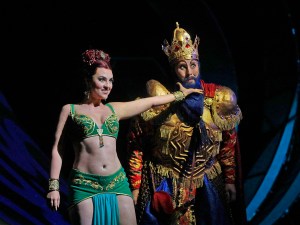
VENERA GIMADIEVA (THE QUEEN OF SHEMAKHA) AND TIM MIX (KING DODON) PHOTO CREDIT: KEN HOWARD FOR SANTA FE OPERA, 2017
The star of the evening was the Russian soprano Venera Gimadieva in the virtuosic role of the Queen of Shemakha. Rimsky lavishes his most alluring, exquisitely ornamented music on her (including in the number “Hymn to the Sun”). Aside from some lingering insecurities with intonation, Gimadieva handled her gorgeous coloratura with nuance and panache, executing some breathtakingly tapered notes. She also showed graceful and arresting stage presence, a delightful foil in her dancing to the fat-footed, bloated King as she wraps him around her finger.
Also superb was alto Meredith Arwady as Amelfa as a loyal royal servant, a substitute Mom to the King whose voice by itself is like a character, immense, sturdy, amber, and richly reverberant in the astonishingly low notes Rimsky writes for the part.
He also writes a double-take-inducing high E for the high-flying tenor Astrologer, who frames the opera as an it’s-just-make-believe-after-all mise-en-abyme. Barry Banks, brandishing moody sunglasses and an Andy Warhol air, suggested a hint of the eerie, E.T.A. Hoffmann-esque in his portrayal, contributing another layer that otherwise tended to be sacrificed in favor of the satirical.
Actually, there was another star of the evening: conductor Emmanuel Villaume, who coaxed consistently expressive, multi-hued, luminous playing for Rimsky’s scintillating score. He clearly treasures its shimmering beauties and gave the musicians time to indulge in the soloistic writing, but judiciously, and in ways that enhanced the theatricality onstage.
If you go: Santa Fe Opera’s production of The Golden Cockerel by Nikolai Rimsky-Korsakov continues through Aug. 18. Information and reservations here.
Review (c) 2017 Thomas May — all rights reserved
Filed under: review, Santa Fe Opera