The wonderful Nicholas McGegan pays a visit to the Seattle Symphony podium in this live concert of Bach and Schubert. (Video above is from the April 26 concert, with Farkhad Khudyev conducting Schumann.) The program (available to watch through May 20):
JOHANN SEBASTIAN BACH Orchestral Suite No. 1 in C major, BWV 1066
Overture Courante Gavotte I & II Forlane Menuet I & II Bourrée I & II Passepied I & II
FRANZ SCHUBERT Symphony No. 5 in B-flat major, D. 485
Allegro Andante con moto Menuetto: Allegro molto Allegro vivace
Two of the most famous names in the classical canon — Beethoven and Ravel — appear on the program for Seattle Symphony’s upcoming livestream on Feb. 25. But the concert’s opening work was written by a composer, currently 36 years old, whose boldly individual, exquisitely crafted music sounds completely at home in their company…
And some excerpts that got cut from the published version:
In addition to her orchestral music, Jonathon Heywqrd conducted the Royal Opera House production of “The Knife of Dawn” and has been entrusted with the premiere of her opera-in-progress “Tan-Tan and Dry Bone.” The new opera is based on an Afrofuturist story and is being written for the experimental vocalist and movement artist Elaine Michener.
Heyward points out that Kendall’s gifts as a storyteller echo Ravel and his ability in the Mother Goose Suite “to encapsulate vivid worlds through texture.” With Beethoven’s Piano Concerto No. 4, which will feature Seattle favorite Conrad Tao as the soloist, he emphasizes the role of the very short slow movement and its powerful contrast with “this gargantuan first movement and jubilant finale.The sense of stillness, of time stopping here, is another thing that Hannah does amazingly in her work.”
Cellist Seth Parker Woods and the Seattle Symphony with David Robertson conducting; image (c) James Holt
I reviewed the world premiere of Tyshawn Sorey’s extraordinary new Seattle Symphony commission for Musical America. Here’s a longer version of the opening paragraphs (including some details that had to be cut for length):
Like an artfully spliced film sequence, the highlight of Seattle Symphony’s concert on November 19 seemed to bridge the painful months separating us from the pre-COVID-19 era. Tyshawn Sorey’s For Roscoe Mitchell for cello and orchestra transmitted all the excitement that comes with a “normal” world premiere of an important composition.
The account featuring Seth Parker Woods as the soloist and guest conductor David Robertson on the podium cast such a powerful and lasting spell that I occasionally forgot this was an online stream. Performing live in real time from the Benaroya concert hall, the musicians felt more present than is usually the case in the virtual medium.
The initial round of shutdowns in the spring had cheated us of hearing the piece as originally intended: in the context of a Beethoven festival juxtaposing several new commissions with a complete symphony cycle, which had been planned as last season’s culmination. Sorey’s new work is his first SSO commission and the final project envisioned by former vice president of artistic planning Elena Dubinets before her lamented departure from the organization.
In September, SSO began a new online season, using its own streaming service, Seattle Symphony Live, as a platform to disseminate live performances from its home concert hall (sans audience). For Roscoe Mitchell barely escaped a second postponement. This concert was the last event allowed to proceed before new statewide mandates for Washington caused all remaining 2020 concerts to be canceled.
Watch Ludovic Morlot’s reunion with Seattle Symphony on Thursday 5 November at 7.30pm PT. You can watch the livestream on Seattle Symphony Live* here.
The program includes THOMAS ADÈS/Three Studies from Couperin; DEBUSSY: Danses sacrée et profane; MARTIN/Ballade for Flute and Orchestra; and HONEGGER/ Symphony No. 2.
*Monthly passes to Seattle Symphony Live are $12.99/monthand include a free 7-day trial with no commitment required.
Another disappointing development in the Covid-19 era American orchestral landscape. Brendan Kiley reported this evening in the Seattle Times that the Seattle Symphony Orchestra’s management has decided to furlough three-quarters of its 250-person staff temporarily, bringing it down to 58.
The 88 SSO musicians will enter a temporary furlough projected to last from April 13 to June 1.
According to Kiley: “The decision was reached in negotiation with the musicians’ union — ‘a joint resolution,’ said SSO CEO Krishna Thiagarajan. “That’s really important — we want musicians to get the credit.'”
Fortunately, SSO will continue to provide health insurance coverage for everyone.
Kiley adds: “SSO has not yet seen any relief funding, either from the federal government or local, arts-specific measures — and, Thiagarajan added, they probably wouldn’t have come fast enough to alleviate the organization’s immediate needs.”
In another, more promising development: the National Symphony Orchestra musicians have reached an agreement with Kennedy Center management to take a 35% pay cut rather than an outright furlough, as reported here by The New York Times.
All hell broke lose last month when it was announced that Kennedy Center management planned to deal with the crisis by furloughing the musicians “for an undetermined amount of time so as to address the financial shortfalls from the coronavirus pandemic,” as Julia Jacobs reported. Following as this decision did on the allocation of $25 million for the Kennedy Center as part of the federal emergency stimulus package, the announcement sparked widespread outrage — and was used like red meat to stir up the anti-art frenzy of the MAGA base. That base, however, may have appreciated the quintessentially Trumpian tactics of announcing a unilateral furlough in the first place.
According to Peggy McGlone’s report in The Washington Post, “the musicians [said] they were blindsided” by the original announcement of the furlough. “They said they had contacted NSO Executive Director Gary Ginstling to negotiate some cuts but didn’t hear back. Instead, [Kennedy Center President Deborah] Rutter informed them that they would be furloughed [after April 3] until the arts center reopened.”
Fortunately, a more equitable process of grievance resolution was subsequently pursued: “Ed Malaga, president of American Federation of Musicians Local 161-710, said the musicians were pleased to resolve the grievance and avoid furloughs,” according to McGlone.
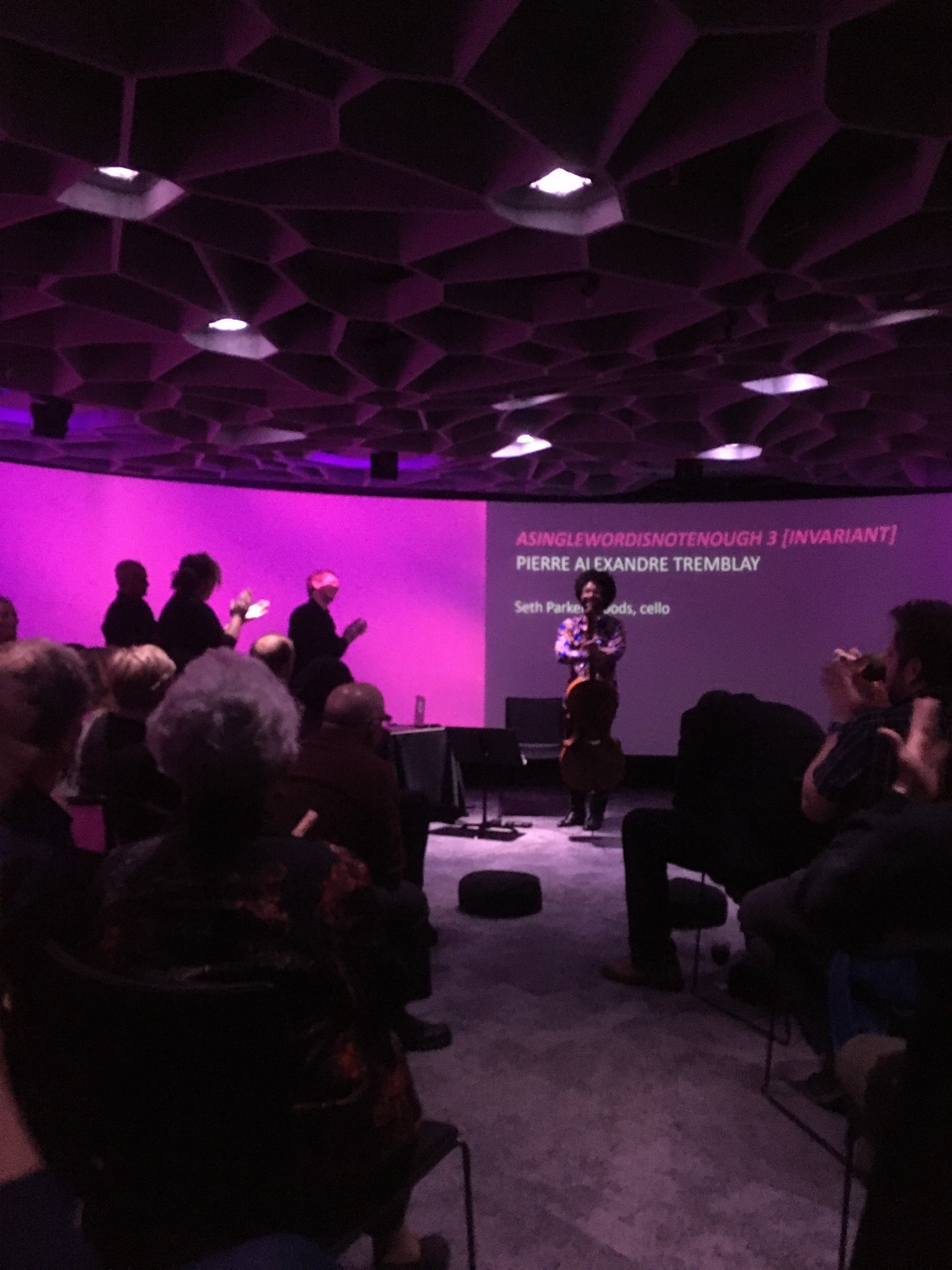
Seth Parker Woods and Friends in Difficult Grace at Seattle Symphony’s Octave 9.
It’s been very difficult trying to think about anything other than the Covid-19 pandemic. Already several loved ones have become ill with the disease, and one admired acquaintance has died.
With so much angst and sorrow, we are only 10 days into the state of emergency declared for Washington State, while other areas — in the unconscionable absence of federal guidance and leadership — are recklessly carrying on as usual.
Here’s what now seems a surreal glance back to happier times, which I wrote only a little over a month ago for Gramophone magazine’s April issue: some thoughts on Seth Parker Woods, Patricia Kopatchinskaja, and Gidon Kremer at Seattle Symphony’s Octave 9 space.
If you’re in the Seattle are, there’s a lot to choose from this weekend. One more chance to catch the incomparable violinist Gidon Kremer, who has become a major champion of the long-neglected Mieczysław Weinberg (1919-96). Earlier this week, Kremer gave an intimate performance at Octave 9, playing his transcriptions of half of Weinberg’s 24 Preludes for Solo Cello as well as his vast First Sonata for solo violin and the Bach D minor Chaconne.
Under Dausgaard’s baron, he will perform Weinberg’s Violin Concerto (from 1960) again on Saturday evening. Last night’s account was a major discovery, leaving me moved, thrilled, enraptured–and hungry for more. Weinberg is routinely compared to Shostakovich (same thing happens to Galina Ustvolskaya), but for all the superficial resemblances, I was drawn to Weinberg’s distinctive lyricism and the pockets of hopefulness he weaves into this score. It delighted me no end that Kremer chose what I immediately selected as my favorite of the Preludes for his encore.
The rest of the program was magnificent: Dausgaard mixed rich oil with theatrical flair in the Romeo and Juliet Fantasy Overture — Tchaikovsky’s early breakthrough — and brought out many a smile from the musicians in a heartfelt, vibrant, even deliriously unbuttoned interpretation of Dvořák’s Symphony No. 8. SSO principal flutist Demarre McGill’s exquisite solos alone negated any excuse to miss this.
Sunday brings a real feast. Octave 9, which has been on overdrive lately with not-to-be-missed concerts, will present one of the most compelling young cellists at work today: Seth Parker Woods, in a program titled Difficult Grace. The teaser reads: “Inspired by Dudley Randall’s poem “Primitives,” this interactive concert features five world premieres and one Seattle premiere by Monty Adkins, Nathalie Joachim, Pierre Alexandre Tremblay, Fredrick Gifford, Ryan Carter and Freida Abtan. ‘Difficult Grace’ showcases an array of visual art and music by some of today’s most imaginative storytellers.”
Parker Woods is also a brilliant curator, so there’s bound to be some excellent discoveries here. More background on the cellist.
Elsewhere in the Benaroya Hall complex on Sunday evening, Byron Schenkman & Friends will perform a program enticingly titled Baroque Bacchanalia. The wonderful harpsichordist Byron Schenkman has curated an evening of selections on mythological themes by Bernier, Campra, Jacquet, and Rebel, with bass-baritone (and composer) Jonathan Woody as the featured vocalist.
Earlier on Sunday, Early Music Seattle presents a semi-staged production of Vivaldi’s Motezuma at Town Hall. This version was reconstructed and reimagined by Matthias Maute, music director of the Montreal-based Ensemble Caprice Music Director. The Other Conquest, a response to Vivaldi’s colonialist distortions by composer Héctor Armienta and Seattle poet Raúl Sánchez, is being presented Saturday evening (free of charge) at Broadway Performance Hall.
Also Sunday afternoon: Temple de Hirsch Sinai on Capitol Hill (1441 16th Ave) is presenting a free concert at 2pm featuring pianist Judith Cohen, SSO clarinetist Eric Jacobs, and violinist Hal Grossman. Their program is titled Bernstein, Copland, Bloch, & Gershwin: Legendary Jewish Composers of the 20th Century. I’m especially looking forward to hearing Copland’s Vitebsk Trio, a study in quarter-tones from 1929. The concert is actually just one of a weekend-long series of events at Temple de Hirsch Sinai celebrating Shabbat Shirah (Shabbat of Song).
Tonight at Seattle Symphony’s Octave 9 experimental space: the extraordinary cellist Seth Parker Woods, as part of his residency this year with SSO, has put together a program titled “That Which Is Fundamental.”
Pieces by Anton Lukoszevieze, Pelle Gudmundsen-Holmgreen, Vinko Globokar, Tonia Ko, Gustavo Tavares, and Julius Eastman explore “language and essential truths of the human condition” and show “inspiration from the simplicity and complexity of speech and text.” Joining Parker Woods is the percussionist Bonnie Whiting. The program begins at 7.30 at Octave 9 at Benaroya Hall.
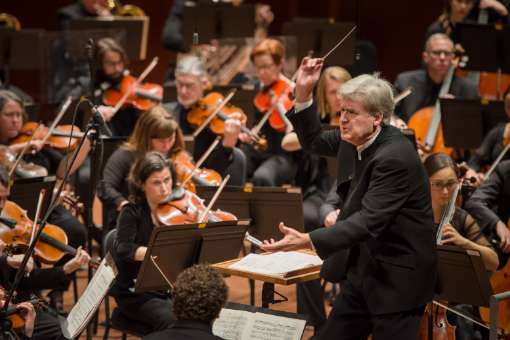
Thomas Dausgaard conducts the Seattle Symphony; photo (c) Carlin Ma
My review of the most recent program performed by Seattle Symphony under Thomas Dausgaard:
As Thomas Dausgaard continues along in his inaugural season as Seattle Symphony’s Music Director, it’s gratifying to see his intense rapport with the musicians expanding to different areas of the repertoire…





 MEMETERIA by Thomas May