
Filed under: Uncategorized

October 13, 2015 • 5:45 am Comments Off on Hughes, Shakespeare, and the Goddess
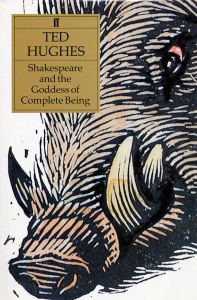
There’s no shortage of “upstart crows” when it comes to Shakespeare studies: scholar-mavericks who challenge the self-appointed gatekeepers in academia. And it’s no surprise that (after discounting the obvious crackpots) many of these turn out to offer little more than half-baked theories that crumble under closer scrutiny.
But one of the most significant unconventional readings of Shakespeare of recent years belongs to a class of its own: the poet Ted Hughes’ Shakespeare and the Goddess of Complete Being. Is this a truly paradigm-shifting vision or an absurdly reductive idea that sacrifices too much to in pursuit of a “hedgehog” theory?
Ann Skea offers a sympathetic portrayal of the scope of Hughs’ great project:
In his long introduction, Ted outlined the religious and psychological conflict caused by the Calvinist Puritan suppression of Old Catholicism in which the goddess of earlier pagan beliefs still flourished. The religious aspect of this conflict…
View original post 194 more words
Filed under: Uncategorized
July 30, 2015 • 8:45 pm Comments Off on Alien Earworm
I’ve been working on a note for Howard Hanson’s most-popular composition — the Symphony No. 2 (“Romantic”) from 1930, a Boston Symphony commission (same vintage as Stravinsky’s Symphony of Psalms).
And this is an earworm I cannot dispel (the second theme from the first movement, which cycles back several times later on):
So what is it that makes for an earworm?
Filed under: Uncategorized
July 3, 2015 • 9:30 pm Comments Off on Da Vinci’s Viola Organista
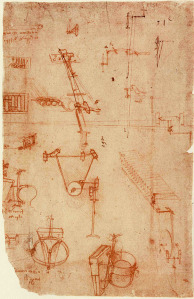 Sketches from Leonardo da Vinci’s Codex Atlanticus
Just ran across This Is Colossal‘s report on the Polish pianist Slawomir Zubrzycki’s realization of one of tne wildly imaginative hybrids Leonardo da Vinci dreamed up in his notebooks. Sketches for this “viola organista” – a mating of the principles of stringed and keyboard instruments – are found in da Vinci’s massive collection of sketches known as the Codex Atlanticus.
Zubrzycki demonstrated his new version of this invention at the recent International Royal Cracow Piano Festival. The Colossal‘s story links to this more-detailed account at The History Blog of the background of the viola organista and attempts to realize it, including this early one:
Almost a hundred years [after the da Vinci sketches] in 1575, church organist Hans Hyden of Nuremberg created the first functional bowed keyboard instrument operated by a foot-treadle. He used gut strings (later switched to metal…
View original post 295 more words
Filed under: Uncategorized
June 29, 2015 • 9:54 pm Comments Off on The Sea, The Sea
To prepare for a new essay, I spent some of last week immersed in Ralph Vaughan Williams’s breakthrough composition from 1910, A Sea Symphony – also known as the First Symphony (though he didn’t get around personally to numbering the first three of his nine symphonies).
While it has its weak moments, I wish this work were performed more often, but it’s never really caught on with American audiences, and the score poses a huge challenge for the chorus. By a remarkable coincidence, A Sea Symphony premiered exactly one month after Mahler’s Eighth (that incredible amalgam of medieval Church hymn and the final scene of Faust). Both works represent unclassifiable hybrids of cantata, symphony, and oratorio, taking the “model” of Beethoven’s Ninth to new extremes. And five years before that, Debussy’s La mer was first performed in Paris. (There was also a growing body of sea-oriented compositions by Vaughan…
View original post 244 more words
Filed under: Uncategorized
June 20, 2015 • 9:35 am Comments Off on Déjà Vu
Updated with some more comments.
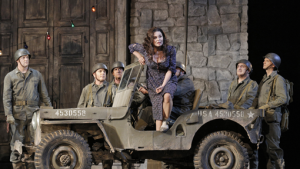 Two Women by Marco Tutino
San Francisco Opera’s world premiere last night of Two Women by the Italian composer Marco Tutino raises interesting and important issues about making opera today. I intend to get into this more substantially after dealing with some crushing deadlines….
Joshua Kosman’s extensive review expertly nails the key problems with this opera, as well as its larger aesthetic implications:
But Tutino — along with General Director David Gockley, who commissioned the work from him on the recommendation of Music Director Nicola Luisotti — has also taken this opportunity to mount a rather forceful esthetic argument. In its strongest form, the claim is that the history of 20th century music has been a nightmare that we need to wake up from, and that the path to redemption lies in a wholesale return to the ancient traditions.
[…]
Ultimately, such pleasures as “Two Women” can provide are the…
View original post 1,027 more words
Filed under: Uncategorized
June 13, 2015 • 12:16 am Comments Off on Latin: Quo Vadis, Quo Vasisti?
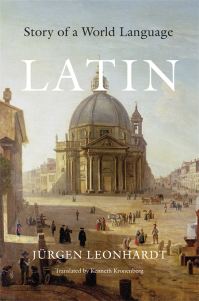
The history of Latin as a world language, in Jürgen Leonhardt’s excellent account, involves a surprisingly diverse range of topics — many of which have an ongoing relevance that extends far beyond the use of Latin for educational purposes: the effects of globalization (ancient and contemporary) on the development of a language, the “diglossia” of literary and spoken languages, the interplay of emerging European nationalism with the status of Latin (not as linear as you might expect), the unexpected twists and turns of canon formation — and dissolution (likewise not a simple linear development). And, ultimately, the issue of cultural extinction and the inaccessibility of a vast fund of accumulated knowledge.
Indeed, the book is replete with information that seems even counterintuitive. The entire corpus of extant ancient Latin literature from the Roman period, for example, comprises “less than 0.01% of all extant Latin texts.” This is because Latin continued…
View original post 1,183 more words
Filed under: Uncategorized
May 25, 2015 • 10:23 am Comments Off on Orpheus Ascending: Mohammed Fairouz’s New CD
Tomorrow, Tuesday 26 May, brings the NY premiere of “Sadat” — one of the works featured on this release. The Mimesis Ensemble will perform at Carnegie Hall: http://www.mimesisensemble.org/may-26-2015/
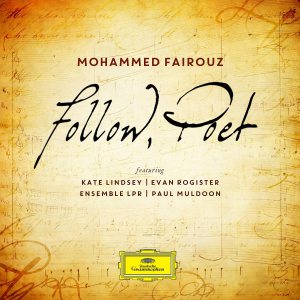
Mohammed Fairouz’s Follow, Poet is among the most inspiring CDs I’ve encountered in quite a while. For one thing, it documents two recent works by a composer who brings to the new-music scene not just a fresh voice but a powerful intellect and — most significantly — an unclouded vision of art’s potential for our jaded age. A vision that is ambitious without being naive.
Fairouz, still just south of 30, has already channeled his imagination into an astonishing gamut of genres, from intimate chamber works to concertos and major-scale symphonies (four to date!), choral pieces, and opera and other theater works. And with Follow, Poet, he is the youngest composer in the history of Deutsche Grammophon to have an entire album devoted to his works.
Such ample gifts could easily run aground with compromised or even downright hackwork production just to fulfill the commissions that seem to…
View original post 780 more words
Filed under: Uncategorized
April 23, 2015 • 9:44 am Comments Off on Hercules vs. Vampires: Opera Goes to the Movies
This starts tonight at LA Opera.
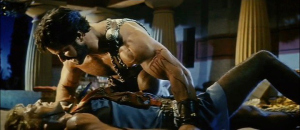
Los Angeles Opera truly has become a company interested in innovation. Next month brings Hercules vs. Vampires, an opera-meets-cult film mashup between Mario Bava’s 1961 film (Hercules in the Haunted World) and LA-based composer Patrick Morganelli.
Here’s my interview with Mr. Morganelli:
A century ago, the budding film industry borrowed pretty heavily from opera—which makes a lot of sense, considering how the larger-than-life gestures of operatic acting suited the new medium of silent film so effectively.
And film has been repaying the favor in recent years: Jake Heggie’s Dead Man Walking, Kevin Puts’ Silent Night, Howard Shore’s The Fly, André Previn’s Brief Encounter, even a new opera by Giorgio Battistelli inspired by the controversial Al Gore documentary An Inconvenient Truth, set to premiere in May at La Scala.
Filed under: Uncategorized
April 20, 2015 • 12:57 pm Comments Off on Finding the Key: Anthony Doerr’s All the Light We Cannot See
Congratulations to Anthony Doerr for a well-deserved Pulitzer 2015 win.
“What do we call visible light? We call it color. But… really, children, mathematically, all of light is invisible,” is the lesson that beams in on the short-wave radio. The hyper-curious, gifted, white-haired German orphan Werner Pfennig and his sensitive sister Jutta listen in, escaping through the invisible waves for a moment from the coal-mining town of Zollverein.
This is just one of many memorably etched moments in Anthony Doerr’s new novel, All the Light We Cannot See. I became a fan of Doerr’s writing last year when his short story collection Memory Wall fell into my hands. Doerr possesses the rare gift of a distinctive style that avoids mannerism and that endows his characters — well, most of them — with depth and compassionate believability.
The beauty of Doerr’s fiction is both stylistic and structural. His lyrical, keenly observed prose in All the Light We Cannot See supports…
View original post 458 more words
Filed under: Uncategorized
 Arts & Culture Stories from NPR
 MEMETERIA by Thomas May