MEMETERIA by Thomas May

Music & the Arts

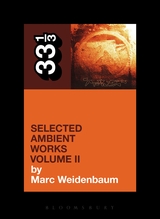
Bleeding Together, Falling Apart: Marc Weidenbaum on Aphex Twin

Thomas May's avatarMEMETERIA by Thomas May

aphex-twin

There are some real gems in the innovative, ongoing 33 1/3 series from Bloomsbury (which now numbers 90 crisp little volumes) — and I’m not claiming that just because I personally know several of the authors. Or because two of the most dazzling of those gems are by friends: Mike McGonigal on My Bloody Valentine’s Loveless and the latest in the series, on Aphex Twin’s seminal Selected Ambient Works Volume II by Marc Weidenbaum.

If you haven’t discovered it yet, I also highly recommend Weidenbaum’s fascinating and long-running webzine disquiet — named in honor of the Portuguese poet, critic, and philosopher Fernando Pessoa — where you can find his fascinating collaborations, interviews, experiments, and musings on ambient and electronic music.

Just published last month, his new book is already harvesting a bumper crop of impressive reviews — and deservedly so. Any in-depth consideration of a musical landmark needs to offer…

View original post 557 more words

Filed under: Uncategorized
The Golden City and Its Opera

Thomas May's avatarMEMETERIA by Thomas May

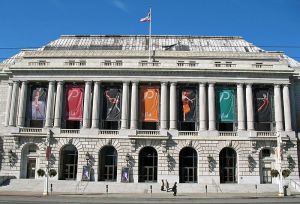
photo by  Mike Hofmann photo by Mike Hofmann

My cover story on San Francisco Opera and how it reflects the city’s love affair with the art is now online in the Spring issue of Opera America magazine.

On October 15, 1932, while the country was sinking deeper and deeper into the quicksand of the Great Depression, San Franciscans took time out to ignore the prevailing gloom and celebrate the official opening of the long-coveted home for their new opera company, the $5.5 million War Memorial Opera House. The Naples-born conductor and cultural impresario Gaetano Merola, who had founded San Francisco Opera and inaugurated its first season nine years previously with La bohème, turned once again to Puccini for the occasion and led a performance of Tosca. Addressing the packed audience during intermission, Wallace M. Alexander, the company’s new president, proudly announced: “Ladies and gentlemen, this is your opera house, your own rich heritage.”

[

View original post 19 more words

Filed under: Uncategorized
The Devil Made Me Do It

Thomas May's avatarMEMETERIA by Thomas May

Levack

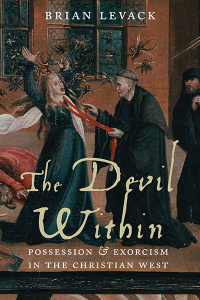
I came across this very interesting London Review of Booksdiscussion of Brian Levack’s The Devil Within Possession and Exorcism in the Christian West by Terry Eagleton. According to the jacket copy by one of my erstwhile employers, Yale University Press, Levack’s examination of the epidemic of reported demonic possessions in Reformation Europe takes into account “the diverse interpretations of generations of theologians, biblical scholars, pastors, physicians, anthropologists, psychiatrists, and historians.”

The “common sense” model today of course ascribes what was believed to be or presented as possession to the symptoms of mental or physical illness. But Levack’s contextual approach argues that “demoniacs and exorcists—consciously or not—are following their various religious cultures, and their performances can only be understood in those contexts.”

Eagleton, a prominent literary critic who delivered the Terry Lectures in 2008, homes in on this cultural contextualization as a problematic method:

“In [Levack’s] view, falling prey to…

View original post 499 more words

Filed under: Uncategorized
Walk on the Wilde Side

Thomas May's avatarMEMETERIA by Thomas May

Wilde

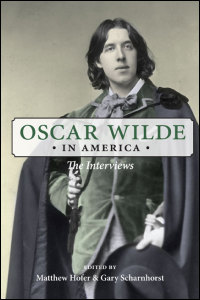
Creating quite the stir was of course second nature to Oscar Wilde, and he set many tongues wagging throughout the course of his extensive North American tour in 1882. Nowadays we have complex PR machines. Back then it was Oscar giving interviews to the local papers to generate buzz for his series of lectures on “the science of the beautiful.” He set the tone immediately upon disembarking in New York after his less-than-pleasing encounter with the Atlantic Ocean by (allegedly) proclaiming to the customs agent: “I have nothing to declare except my genius.”

Wilde ended up making some 140 appearances at cities and towns across 15,000 miles of the continent, alighting in gilded age salons and mining town saloons alike. Anthony Paletta sums up some of the press reaction to his first lecture, in New York, billed as having something to do with the “English Renaissance”:

[It] seems to have…

View original post 559 more words

Filed under: Uncategorized
How Do They Do It?

Thomas May's avatarMEMETERIA by Thomas May

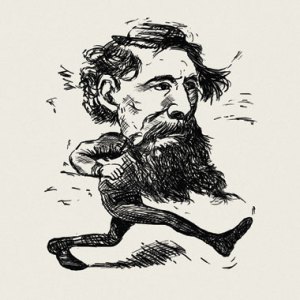
Charles Dickens, by a Boston Daily Advertiser cartoonist (March 1868) Charles Dickens, by a Boston Daily Advertiser cartoonist (March 1868)

So is genius really “1% inspiration, 99% perspiration,” as Thomas Edison declared (his variation on the “there are no accidents” meme, you might say)?

Mason Currey’s new book, Daily Rituals: How Great Minds Make Time, Find Inspiration, and Get to Work, looks at the varied routines some of the great artists and thinkers have devised to make the most of their moments with the Muses.

Reviewer Christopher Hart points out that the book offers fascinating examples of the many ways creative types “discover for themselves Flaubert’s famous advice that one should live like a bourgeois and put one’s bohemianism into one’s work.”

Thomas Mann evidently loved his kip, rising at 8am, enjoying a good hour’s nap in the afternoon and going to bed around midnight, in a separate bedroom from his wife. Richard Strauss appears to have slept a…

View original post 287 more words

Filed under: Uncategorized
Nights at the Opera

Thomas May's avatarMEMETERIA by Thomas May

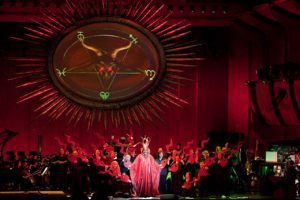
Ligeti's Le Grand Macabre presented by the New York Philharmonic in 2010; (c) Chris Lee 2010 Ligeti’s Le Grand Macabre presented by the New York Philharmonic in 2010; (c) Chris Lee 2010

My new feature for Symphony magazine’s Fall 2013 issue is available online now:

Total immersion: that was the radical brand of opera Richard Wagner hoped to inaugurate at Bayreuth. To enhance its effect, he famously made the “invisible orchestra” an integral part of his design. Yet the overall ideal of intensified theatrical illusion remained frustratingly out of reach, hampered by the limitations of the stage technology of the time. Cosima Wagner reported her husband’s sardonic joke in the aftermath of his deep disappointment over the first complete Ring: “Now that I’ve created the invisible orchestra, I’d like to invent the invisible stage!”

The concert hall has meanwhile long provided an appealing milieu in which to experience opera with another kind of immediacy—one that focuses on the musical dimension of this most collaborative of the…

View original post 162 more words

Filed under: Uncategorized

Rossini’s Comic Genius in Barber

Filed under: Uncategorized

Suit the Accent to the Word

Thomas May's avatarMEMETERIA by Thomas May

Shakespeare-OP

The British Library Board has released some online samples illustrating recent theories about the kind of pronunciation that would have been current in Shakespeare’s time. And it’s a far cry from the Very Serious Accent that sounds so at home among the aristos at Downton Abbey.

David Crystal, a British linguist who has also written about the social impact of texting, is a prominent expert in the field known as “original pronunciation.” OP is about putting the theory of how Shakespeare and his colleagues would have pronounced the Bard’s words into practice. You might think of it as a sort of linguistic equivalent to the historically informed performance practice movement familiar from early music. OP has been going strong for about a decade, starting with landmark productions of Romeo and Juliet and Troilus and Cressida at the Globe Theatre in London.

davidcrystal2
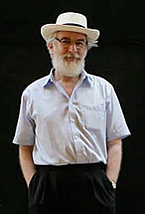
(David Crystal)

On his website devoted to information…

View original post 147 more words

Filed under: Uncategorized
The Misinformation Age

Thomas May's avatarMEMETERIA by Thomas May

Dame Edna Jeunehomme
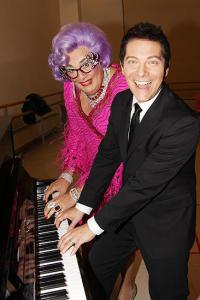
Dame Edna or “Miss Jeunehomme”?

We all know about the paradox of the New Media Age: information everywhere, our memories now downloaded onto our phones, instant access to any fact, but…is this overflow of info making us less critical? Just which of those “facts” are actually true?

Nowadays it’s not just the ocean of information that’s the problem: it’s how much bad information is out there, from dangerously misguided “medical” advice to half-baked assertions and those incorrect/half-correct little memettes on which music writers rely far too much — and in the process keep in circulation.

This is where the new media ironically end up working against the diffusion of knowledge. The problem is that certain factoids that sprouted up somewhere eons ago, in a seriously outdated book or note, might have represented the best knowledge back then (or sometimes just a brazen guess), but these end up getting repeated thanks…

View original post 594 more words

Filed under: Uncategorized
How Much Does That Picture Cost?

Thomas May's avatarMEMETERIA by Thomas May

Rothko-No. 61
Mark Rothko: No. 61 (Rust and Blood), 1951; LAMOCA

The Florida-based art historian and curator Daniel A. Siedell reflects on art’s spiritual cost in a recent interview with Meaghan Ritchey for The Curator:

Being human means dealing with limitations. I think that the overly romantic idea that somehow creativity only takes place when you’re free of restrictions keeps a lot of good art from entering the world—or, perhaps, it actually prevents a lot of bad work from entering the world…What makes the existence of art in the world so remarkable is that it comes at great cost, sometimes through enormous challenges, but almost always through the slow drip of inconveniences, frustrations, and self-doubt.

This is why I am fascinated by what happens in the studio as the artist devotes her life to making artifacts that have no apparent use in the world, artifacts that are often ignored…

View original post 143 more words

Filed under: Uncategorized

Archive

Enter your email address to follow this blog and receive notifications of new posts by email.