My report on the 2019 Concours Musical International de Montréal:
The 2019 edition of the Concours musical international de Montréal (CMIM), devoted this year to the violin, started off with added pressure – for the organisers, that is. Because of the convergence of several of the most high-profile violin tournaments elsewhere this spring – from Auckland to Augsburg, from Sendai to Brussels – the recently completed CMIM also had to compete with the competitions.
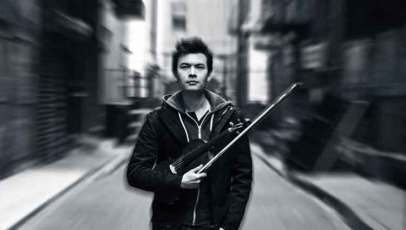
Hao Zhou for the first time playing the brand-new violin and bow handmade by the Maker’s Forum — gifted to him as first prize winner
Heartiest congratulations to U.S. violinist Hao Zhou, who won first prize at the 2019 Concours musical international de Montréal, as well as the Radio-Canada People’s Prize. And to second prize winner Johanna Pichlmair, who played the Brahms concerto, and Fumika Mohri, who took third prize for her account of the Sibelius concerto.
Mr. Zhou’s prize includes $30,000 from the City of Montreal, the Joseph-Rouleau career development grant of $50,000 from the Azrieli Foundation, a violin and bow handmade by the Maker’s Forum (valued at $20,000), an artist residency at Canada’s Banff Centre for the Arts, and a concert engagement at the New Generation Festival.
The distinguished jury was presided over by Zarin Mehta and included Pierre Amoyal (France), Kim Kashkashian U.S.), Boris Kuschnir (Austria), Cho-Liang Lin (U.S.), Mihaela Martin (Romania), Barry Shiffman (Canada), Dmitry Sitkovetsky (UK/U.S.), and Pavel Vernikov (Israel/Switzerland).
Here is Hao Zhou in his prize-winning performance last night of the First Violin Concerto by Dmitri Shostakovich (with the Orchestre symphonique de Montréal conducted by Alexander Shelley):
Here is Johanna Pichlmair’s soulful Brahms Concerto:
And the remarkable Fumika Mohri plays the Sibelius here:
Patricia Kopatchinskaja is an ideal choice to be this year’s music director of the Ojai Festival. In advance of the festival’s northern edition, Ojai at Berkeley, here’s my profile of this incomparable artist for Cal Performances:
Matters of technical proficiency are well accounted for in the arsenal of words that critics have at their disposal to describe what sets a musician apart. What is sorely lacking is …
My profile of the violinist Stefan Jackiw is on the cover of Strings magazine’s February 2018 issue — and available online:
A sense of modesty may seem incompatible with the drive required to remain successful in the highly competitive realm of classical performance. Yet violinist Stefan Jackiw has made it central to his artistic credo..
More musical revelations at Lucerne Festival: thrilling Bartók Violin Concerto No. 2 featuring Patricia Kopatchinskaja in an unimprovable program of Bartók and Haydn by Mahler Chamber Orchestra led by the impeccable François-Xaver Roth.
The Haydn (Symphonies 22 and 96) was sleek and proto-Modernist in Roth’s interpretation, overflowing in invention and brought to life by the exquisitely fine-tuned playing of the Mahler Chamber Orchestra.
The Bartók Second — nicely complemented by the Dance Suite — spurred all Kopatchinskaja has to give: from her feistiest, most earth-rooted playing to star-drunk lyricism.
And then there was a post-concert treat in the “Interval,” from Kopatchinskaja plus her parents (dad Viktor on cimbalom and mom Emilia playing violin), with Venezuelan double-bassist Johane Gonzales: incisive Kúrtag and wonderful folk music arrangements.
Last night brought out still another side of Kopatchinskaja’s all-embracing artistry, in a Late Night concert with the Lucerne Festival Academy Orchestra led by Matthias Pintscher.
It’s clear that the Moldovan soloist regards Ligeti’s Violin Concerto as one of the ultimate masterpieces of the repertoire. Hearing her play it, you feel this is the only music in the world that matters, a world within world of where the concept of virtuosity itself is reimagined from the ground up.
Kopatchinskaja is the perfect violinist to advocate Ligeti’s wildly imaginative ideas, but also the formal ingenuity and, yes, melodic grace of this score. She also brought out the best from the incredibly gifted young Academy musicians. I can’t wait to hear the full ensemble shine in Monday’s all-Cerha concert.
The program also included fascinating performances of composer-in-residence Michel van der Aa’s Hysteresis for clarinet, ensemble, and tape, with Martin Adámek as the soloist and Ligeti’s Piano Concerto, with pianist Dimitri Vassilakis.
A link to my feature story, in this month’s Strings magazine, on the inexhaustible appeal of the Sonatas and Partitas for solo violin:
Bach’s works for solo violin and cello are the Shakespearean monologues of the string world: The indefinable balance of technical mastery and interpretive insight they require is the touchstone of a great artist.
My profile of violinist Augustin Hadelich and his Grammy Award-winning interpretation of Henri Dutilleux with the Seattle Symphony and Ludovic Morlot will appear in the August 2016 issue of Strings magazine. A brief sample:
Augustin Hadelich just missed being in Los Angeles to receive his first-ever Grammy Award. He had even traveled to LA for a chamber concert the day before the ceremony but was already en route to his next engagement — with the Bournemouth Symphony Orchestra in Poole on England’s coast — when congratulations for winning the Grammy Award for Best Classical Instrumental Solo starting pouring in via social media.
Among this year’s lineup of newcomers at Seattle Chamber Music Society’s 2016 Summer Festival was American violinist Noah Bendix-Balgley — which gives you an idea of the level of luxury casting to which chamber music lovers have been treated.
The North Carolina native switched from his position as Pittsburgh Symphony concertmaster to become first concertmaster with the Berlin Philharmonic in 2014 — and he’s currently only 32.
For this edition of the Summer Chamber Festival, Bendix-Balgley took part in four programs, and I made sure to catch all of them. He made his debut here with Dvořák’s Op. 87 Piano Quartet in E-flat, joined by violist Jonathan Vincour, cellist Bion Tsang, and pianist George Li (I’m not exaggerating about the “luxury casting”).
This was the kind of playing that can change your attitude toward Dvořák, make you realize that we need to hear more and more of him, not just the warhorses. They sustained their intensity across the generous arc of the piece, not merely settling for its lyrical pleasures: the Piano Quintet as a page-turner epic novel.
For appearance no. 2, Bendix-Balgley joined Bion Tsang and Yura Lee (on cello) for Mozart’s Divertimento for String Trio in E-flat (K. 563), which made for a fascinating contrast with the overbrimming Romanticism of the Dvořák: the graceful restraint of his phrasing revealed emotional depths and the power of implication.
During his third concert Bendix-Balgley teamed with fellow violinist David Chan for Prokofiev’s remarkably far-ranging Sonata for Two Violins in C major, Op. 56. Along with expertly sounding its acoustical surprises and trompe-l’oreille effects, I admired how the musicians explored Prokofiev’s independence of line — of musical thought — from two similar voices, interrogating notions of “harmony.”
Beethoven was the focus of Bendix-Balgley’s final appearance (July 25), when he convened with SCMS artistic director James Ehnes (on first violin), Beth Guterman Chu and Rebecca Albers (violas), and Raphael Bell (cello) for the “Storm” Quintet in C major, Op. 29.
The Summer Festival is known for its mix of musicians who have regularly played for years as partners and ad hoc ensembles working together for the first time, and their account could have easily fooled listeners into taking this particular group for the former. By that I don’t mean only the level of risk-taking and involvement in the playing, but the conviction they seemed to share about the “Storm” Quintet’s emotional landscape and structural quirks.
Here’s a sample of Bendix-Balgley’s captivating, richly characterful playing:


 On Friday Leonidas Kavakos and Yuja Wang come to Seattle as part of their current tour. My
  A link to my


