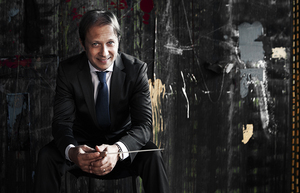
composer-vocalist Lisa Bielawa; photo by Daniel Clark
The Seattle Chamber Music Society’s 2017 Summer Festival has now reached its midway point, with a delicious program last night devoted to French music (in honor of Bastille Day). The Taiwanese-American violinist Paul Huang in particular stood out (in the free prelude concert) with an account of César Franck’s Violin Sonata that was simultaneously passionate and also lucidly constructed. Paige Roberts Molloy matched Huang’s intensity with her strong keyboard personality.
Molloy played a big role in the main course itself, teaming with Max Levinson for a pair of four-hands piano delights: Debussy’s early Petite Suite and Bizet’s Jeux d’enfants (source of the orchestral Petite Suite we heard not long ago from the Seattle Symphony and Morlot).
The duo teased out the textural richness of the four-hands writing and also enjoyed teasing the audience with the ample humor of music-as-mimicry (especially in Bizet’s sonic imaginings of children at play). A similar angle, but magnified to a small ensemble of ten players, enlivened the concluding work, Saint-Saëns’ Carnaval des Animaux. Each of the composer’s clever vignettes was neatly etched and characterized, from the two-note joke of “Le coucou au fond des bois” (Anthony McGill as luxury casting on clarinet) to lightly shaded mystery in “Aquarium.”
Together with the less-often-heard piano suites, the hyper-familiar Saint-Saëns acquired a fresh coat of childlike wonder — or the wonder resulting from grown artists reimagining and trying to recapture something of that wonder. In that context, it also provoked some interesting questions about this particular subfield of “program music.” In contrast, say, to a grandiose R. Strauss tone poem, is it the miniaturism here — in terms of instrumentation as well as size — that makes these pieces tend to be more “about” a textural gesture?
Those works in turn made for an unusual context in which to revisit the String Quartet in F major by another great poet of childhood, Maurice Ravel. Huang, playing first violin, was joined by violinist Tessa Lark, Cynthia Phelps on viola, and Ronald Thomas on cello. They gave an engaging performance that paid special attention to Ravel’s fascinating rhythmic language, with remarkably vivid ensemble playing for the second and fourth movements. They also succeeded in balancing structural clarity with a drive and boldness that, from less-experienced musicians, might have risked murkiness.
Fictional Migrations
This Summer Festival week began with the excitement of a world premiere. The program on Monday (10 July) unveiled this year’s commission by the SCMS Commissioning Club: Fictional Migrations by Lisa Bielawa. An important and original voice among today’s composers, she is also a performer and has toured as a vocalist with the Philip Glass Ensemble.
The prolific Bielawa, born in San Francisco in 1968, has recently been earning widespread attention in the contemporary-music scene for her ambitious, trail-blazing, highly collaborative Vireo: The Spiritual Biography of a Witch’s Accuser. It’s a “made-for-TV-and-online opera” in a dozen episodes focusing on a gifted teenage girl who becomes obsessed with female visionaries across history.
Somehow among her many other projects, Bielawa found time to write the 12-minute Fictional Migrations. The fact that the piece is scored for flute, French horn, and piano is your first clue to its unusual character. Bielawa pointed out that she was initially intrigued — if not intimidated — by the challenge inherent in working with such an apparently “absurd” sonic combination.
Her approach is to avoid futile attempts at “homogenizing” these three instruments into something tamer but rather to accentuate, even exaggerate, their distinctive characters. In her introductory note, Bielawa points out that she also wanted to develop some “reveries” prompted by another composer she deeply admires, Olivier Messiaen. The latter was a household staple when she was growing up, since both of her musician parents were fans of the French master. Fictional Migrations is dedicated to the memory of Messiaen (in observance of the 25th anniversary of his death).
The most obvious Messiaenic influence is Bielawa’s allusion to birds and birdsong, a signature inspiration for Messiaen’s musical language. She writes that she had in mind the story of Alcyone from ancient Greek mythology “who, thinking her lover Ceyx is dead, throws herself into the sea, only to find herself transformed into a bird, flying towards him (also now in bird form).”
Bielawa also notes an impetus from “speculative fiction and the new surge of minority and feminist writers who are embracing this form — a cousin of science fiction that poses the question ‘What if?’ in relation to current cultural narratives.”
Fictional Migrations is not a piece of straight-ahead program music. Bielawa has instead constructed a “fictional” encounter among these very different sonorities. There’s not even an obvious throughline correspondence between the instruments and characters of the Alcyone story. Rather, Bielawa translates the pattern of Ovidian metamorphosis into instrumental terms: the flute and horn in particular at times play “themselves” but more often than not seem to be attempting to transcend their identities, to become something else — and to negate the gendered stereotypes of how they should sound. Bielawa shows that process at the very beginning, with an aleatoric section for piccolo at its most aggressive and shrill.
What’s more, the writing is hyper-virtuosic and highly individual for each instrument, so they are not encouraged to fuse into pleasant but bland “harmony.” The players were all first-rate. Lorna McGhee’s piccolo/flute conveyed an astonishing array of moods and affects, brilliantly articulated, while hornist Jeffrey Fair never lost his golden tone amid the dangerously difficult registral transitions. Bielawa had collaborated with pianist Andrew Armstrong, but a last-minute “cooking accident” sidelined him; in his stead, Jeewon Park accomplished the heroic feat of mastering the keyboard part, which is replete with thunderous, heavy waves and intricately nuanced figurations.
Bielawa has created an immersive, provocative soundscape, filled with “made-up birds,” she writes, that “exist in a world where prisoners fly out of captivity effortlessly, and we all magically transcend death and suffering.”
Framing the premiere were two pieces that also deviate from the chamber music “norm” in their scoring. The opener was Mozart’s K. 423 Duo for Violin and Viola in G major, with violinist Augustin Hadelich’s silky, exquisite phrasing itself was worth the price of admission; his partner was Michael Klotz, playing his viola with patrician refinement.
And a blockbuster to conclude: Schubert’s “Trout” Quintet, with its double bass instead of a second violin to give an ampler sound. The players — Andrew Wan (violin), Richard O’Neill (viola), Ronald Thomas (cello), Joseph Kaufman (bass), and George Li (piano) — collaborated with in-the-moment flashes of color and expression that are what you hope for in live chamber music.
Review (c) 2017 Thomas May — All rights reserved
Filed under: chamber music, new music, review, Seattle Chamber Music Society


 Yayoi Kusama’s Infinity Mirrors is this year’s big blockbuster exhibit at Seattle Museum of Art. (Kusama moved to Seattle in 1957 for a year before heading to New York. In Seattle she had her first important American show at the legendary Zoë Dusanne Gallery.)


 Good timing: here’s my Strings magazine