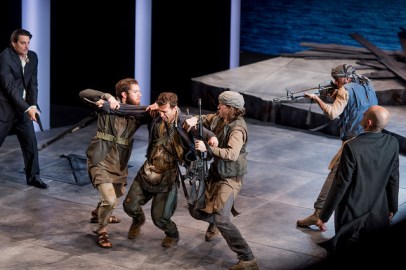
Michèle Losier as the Boy, with Delphine Haidan as the Dragonfly and Alexandre Sylvestre as the Tree; image (c) Brandon Patoc
I was able to catch the final performance (Saturday night) of this week’s Seattle Symphony program led by Ludovic Morlot: a fascinating semi-staged presentation of Maurice Ravel’s one-act opera L’enfant et les sortilèges, combined with a Mozart piano concerto and a bit of orchestral Bizet as appetizer.
The program would have sated most appetites perfectly with the second half alone, the Ravel, so it was a special added delight to have Mozart’s K. 271 Piano Concerto on the bill (the so-called — inaccurately — “Jeunehomme” Concerto).*
“Mozart is absolute beauty, perfect purity,” Ravel believed — in so doing, of course, describing his own aesthetic of perfectionism. I’m always reminded of the Mozart-Ravel connection whenever I hear Jean-Yves Thibaudet perform the latter’s Concerto in G (as he has done more than once with Morlot).
I can’t say that was the case with the soloist in K. 271, Jan Lisiecki. The 22-year-old Canadian pianist, acclaimed especially for his Chopin, arrived on the scene as a prodigy and already commands an impressive resume of partnering with world-class conductors and ensembles. His performance of the Mozart exhibited some very sensitive playing, but to this taste, overall, left little of a lasting impression.
Well-executed passagework and spirited moments abounded, but I missed a strong point of view about what it can all add up to, as well as the — well, Ravel-like — iridescence that Mozart can evoke with even the simplest of phrases.
But there was nothing lackluster in the account from Morlot and the SSO. Again and again, I marveled at being reminded of just what an astonishingly original score this pre-Vienna concerto is, composed at such an early stage — particularly the epic flair of the first movement and the window-framed dance interlude plopped right into the middle of a bustling finale.
The unusual choice of the minor key for the slow movement was underscored by the stirring pathos of this reading. Here Mozart is already transforming the keyboard concerto into substitute opera, which made the choice of K. 271 all the more appropriate for the Ravel.
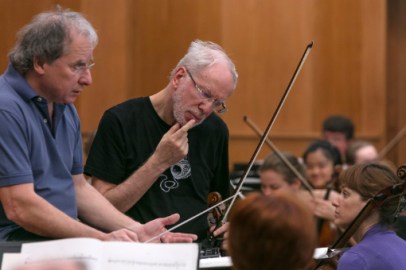
Morlot intoned the theme of childhood at the start with George Bizet’s Petite Suite from 1871 — a sequence of five numbers the composer orchestrated from a set of 12 miniatures originally written for piano duet (known as Jeux d’enfants and later choreographed by Balanchine). The SSO played with considerable polish, zest, and charm.

image (c) Brando Patoc
The semi-staged performance of L’enfant et les sortilèges in the second half of the program has to be accounted one of the season’s highlights. Ravel felt a deep kinship with children and with what he called “the poetry of childhood,” consciously tapping into his own memories of the fantasies of childhood for inspiration.
In fact, I’d say this sensitivity, when combined with his watchmaker-like precision and perfectionism, is among Ravel’s most fascinating aspects.
Like the Bizet suite, his beloved Ma mère l’Oye (Tales of Mother Goose) actually began as a composition for piano duet (intended for the children of a couple that had befriended Ravel).
L’enfant et les sortilèges — usually translated “The Child and the Spells” — is the second of the two operas Ravel managed to complete, each consisting of only one act. The first, the rarer L’heure espagnole, premiered in 1911; L’enfant, more prolonged in gestation, was conceived during the First World War and composed several years after. The initial idea was for a ballet, which eventually became a “fantaisie lyrique” in two parts — a fantasy opera, which was premiered in 1925 in Monte Carlo (with the young Balanchine providing choreography).
Both Ravel and his librettist Sidonie-Gabrielle Colette — the eminent French novelist known simply as Colette — were both deeply affected by their involvement in the war effort and by the loss of loved ones. This sensibility even seeps into the texture of L’enfant, on the surface such a disarmingly innocent and playful evocation of a child’s unbridled imagination.
The story recounts the “education” of a temperamental young boy (a trousers role, sung by mezzo). After being scolded by his mother, he experiences the aftermath of his temper tantrum: the objects of his rage come to life and confront the boy with the results of his behavior.
Morlot and the SSO enlisted a fantastic creative team for their first-ever presentation of an opera together on the Benaroya stage: director and production designer Anne Patterson, projection designer Adam Larsen, and costume designer Zane Philstrom.
Patterson, whose bio points out that she has synesthesia, conjured an appealingly surreal visual environment — sort of a cross between Lewis Carroll and Sendak in feeling, though with entirely original iconography. Her team conveyed the sense of wonder in Ravel’s music, thankfully steering free of unwanted cuteness or sentimentality, which have no place in this score.
The singers positioned mostly far downstage (though at times elsewhere in the hall), sometimes even occupying a corner of Morlot’s podium. Even within that confined space, with the cast acting in front of both the orchestra and several layers of dangling ribbons that formed a permeable, dreamlike screen, the story was engaging.

image (c) Brandon Patoc
Larsen’s beautifully changing light scheme and his projections of the animated objects as transient emanations offered a spellbinding counterpoint to Ravel’s exquisite score.
Philstrom’s large white head sculptures, worn by the objects that come to life, served as emblems to distinguish the very large cast of characters triggered by the boy’s theatrical imagination.
Morlot gathered a distinguished cast that would be just as home with this material in a full-scale opera house production. Especially outstanding were Michèle Losier as the Child, after her initial rampage passing through an enormous spectrum of emotions within the opera’s compact duration, and soprano Rachele Gilmore in the delirious coloratura roles of the Hearth Fire, the storybook Princess, and the Nightingale.
With her rich mezzo, Delphine Haidan morphed from the stern Mother to a broken china teacup (was some of the libretto’s “pidgin” — offensive to today’s sensibilities — expurgated?) and, finally, a plaintive captured dragonfly.
Colette’s large cast calls for an armchair, a grandfather clock, a shepherd and shepherdess from the wallpaper pattern the feisty boy has ripped up, assorted animals and garden creatures, even the numbers from a math lesson come to life in a kind of Pythagorean nightmare … and much more.
Portraying multiple roles, the rest of the cast was uniformly strong, including sopranos Rachele Gilmore and Soraya Mafi, mezzo Allyson McHardy, Jean-Paul Fouchecourt (a star of French Baroque opera, hilarious in his turns as the torn math book and the tree frog), baritone Alexandre Duhamel, and bass-baritone Alexandre Sylvestre.
On top of all this, the Seattle Symphony Chorale and Northwest Boychoir (both prepared by Joseph Crnko) were part of the cast as well, at times contributing a subtle wall of sound (with the Chorale positioned upstage behind the orchestra).
It was quite an ambitious array of forces for such a short work, yet not a moment felt superfluous. Morlot had his players basking in Ravel’s delectable score — one of those miracles of remarkably far-ranging stylistic references that transcends being merely “eclectic.”
There were far too many moments of superb musicianship to recount them all in detail — such as Demarre McGill’s (in a welcome guest return) flute solos to the storybook Princess’s lament of what could-have-been (Rachele Gilmore).
Best of all was the loveliness of the garden scene that takes over in the second part. This luminous and stirring music transports L’enfant onto an altogether different plane of magic and perception — childlike innocence as recaptured by the knowing adult’s memory. And it was utterly stunning on Saturday night.
A downside to this adventure: just a little over a month since Morlot announced his plans to leave the SSO in 2019, the sense of joint accomplishment feels bittersweet, as it must with the knowledge that the clock is ticking away.
____________________________________________________________________________________________* I do wish the music biz would acknowledge the important work of scholars and get rid of the annoying faux-name “Jeunehomme” — and, along with it, the false history that is continually reiterated in program notes.
I’m referring here to the research of musicologist Michael Lorenz, who has brought to light the fascinating figure of this very specific female pianist –Victoire Jenamy (1749-1812) — for whom Mozart wrote this concerto.
The perpetuation of the musty old nonsense about poor “Mademoiselle Jeunehomme” being lost to history is the sort of thing that makes “classical music” appear so sadly out of step with the living, breathing reality. We still have plenty to learn about Mozart — all that is to be known has not been already revealed!
Review (c) 2017 Thomas May. All rights reserved.
Filed under: Ludovic Morlot, Maurice Ravel, Mozart, review, Seattle Symphony


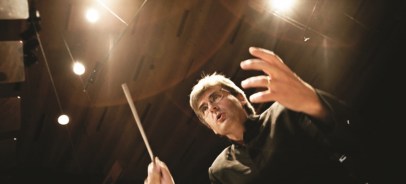 The Seattle Symphony’s
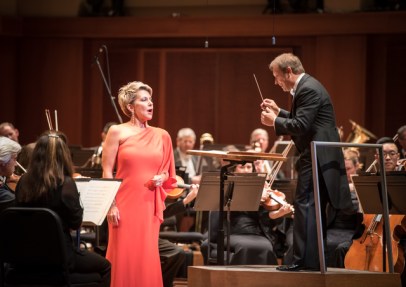 Opera star Joyce DiDonato is shown with Ludovic Morlot and the Seattle Symphony last September. Morlot and DiDonato will appear together in Berlin later this week. (Carlin Ma)