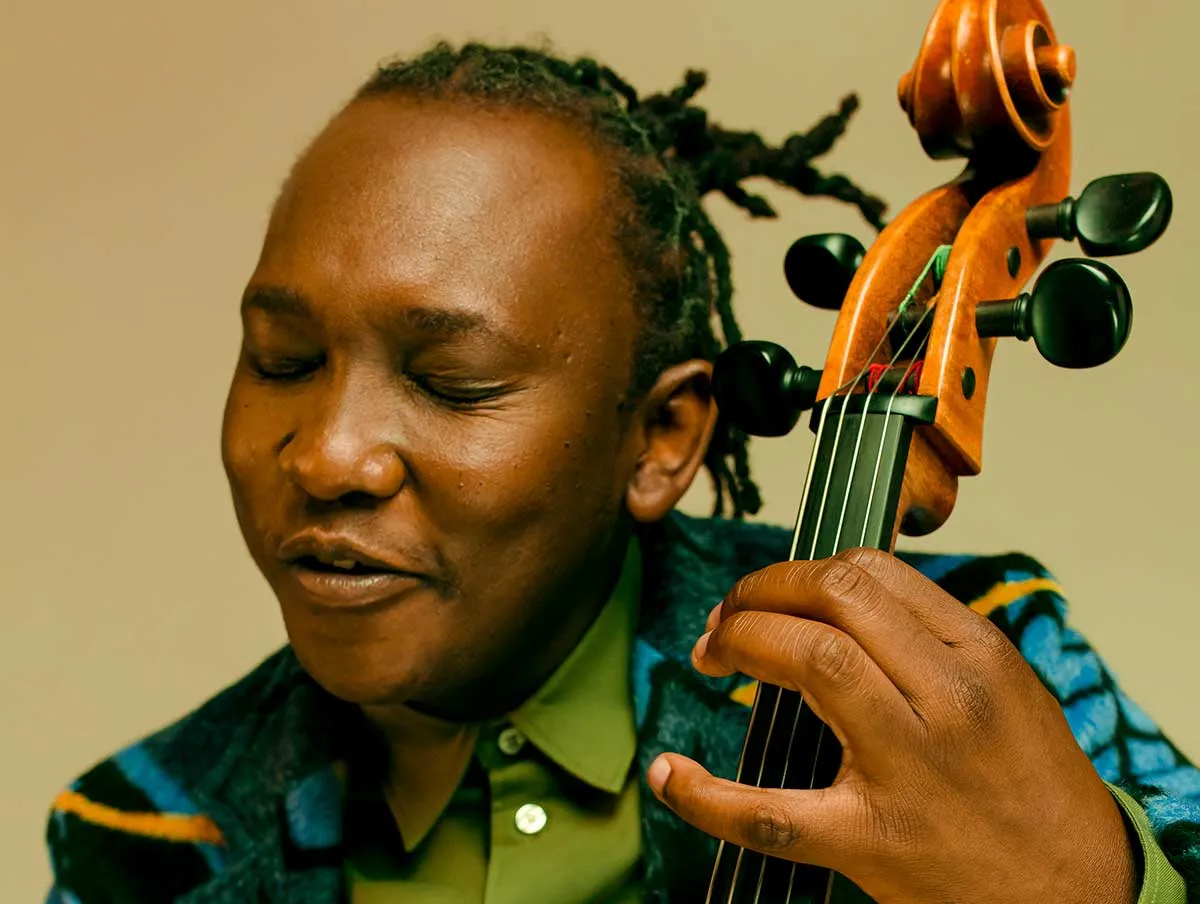
I had the privilege of speaking with the unclassifiable musical phenomenon Abel Selaocoe for this month’s Strings magazine cover story.
Any attempt to label Abel Selaocoe’s artistry is bound to fall short. While many of today’s young musicians defy easy categorization, Selaocoe ventures even further into uncharted realms. His expansive philosophy of communication views the cello as the extension of a larger voice—a storytelling device to navigate multiple dimensions of identity and community. Selaocoe uses his cello in tandem with singing, improvisation, body percussion, and ensemble energy to amplify a fundamental impulse to express, to connect, to belong. continue
This weekend brings another of my picks for the first few months of 2025: Cappella Romana presents the world premiere of the complete Canon for Racial Reconciliation, a collaboration between composers Isaac Cates and Nicholas Reeves that fuses the sound worlds of Orthodox and Gospel church music.
Cates and Reeves have set a remarkable poem in the form of an ancient Byzantine canon written by Dr. Carla Thomas, one of the leaders of the Fellowship of St. Moses the Black, whose mission is “to share the Orthodox Christian faith with African Americans and people of color.”
Combining two choirs – each coming from Orthodox and Gospel traditions, respectively – Canon also calls for violin, trumpet, guitar, piano, a Hammond B-3 organ, and pre-recorded sound samples of sermons and related material.
James Bash has written an excellent preview for Oregon.live here, which includes this observation from co-composer Nicholas Reeves: “This piece was not a response to anything specific that is happening at the moment. It touches on issues that have been part of America for a long, long time. There are no political positions in the piece. The Canon of Racial Reconciliation comes from a compassionate and reconciliatory perspective. It recognizes misdeeds and violence and justice and tries to find a way forward that moves everyone ahead. The goal is healing in America. We move ahead even when there is no forgiveness or justice present. The music is an expression of mutual and peaceful co-existence.”
Performances are Friday 28 February at 7.30pm at Town Hall in Seattle and Saturday 1 March at 7.30pm at First United Methodist Church in Portland. Go here for tickets or call 503-236-8202 (use the code CANON for a 20% discount in advance). There will be a conversation with the composers and conductors right before the performances (free with registration).
Brandie Sutton as Pamina, In Sung Sim as Sarastro and Duke Kim as Tamino with members of the Seattle Opera Chorus in “The Magic Flute” at Seattle Opera. (David Jaewon Oh)
My Seattle Timesreview of opening night of the popular production of Mozart’s final opera by Barrie Kosky and 1927 Theatre:
A remarkable synergy of musical and visual storytelling enlivens Seattle Opera’s current production of “The Magic Flute,” running through March 9….
Here’s the essay I wrote for the Cleveland Orchestra’s program this week featuring guest conductor and composer Thomas Adès:
Among the preeminent composers of our era, Thomas Adès has likened the practice of creating art — whether music, literature, or painting — to fashioning “a simulacrum of the real world, a reflection”…
Image from Barrie Kosky’s production of Mozart’s “The Magic Flute,” taken from a revival of the original production at Komische Oper Berlin in November 2023. Seattle Opera presents this “Magic Flute,” which mixes live performance with projected animations and references to the world of silent film, Feb. 22-March 9. (Jaro Suffner)
Here’s my Seattle Times preview of the well-traveled production of Mozart’s opera that arrives in Seattle for the first time this weekend:
The Magic Flute has enchanted audiences ever since it opened in 1791, just months before Mozart’s untimely death.
On the surface, Flute is a fairy tale about a prince who sets out to rescue a supposedly kidnapped princess — only to discover that both are destined for a journey of enlightenment. Along the way, the Queen of the Night loses her struggle to topple the high priest Sarastro, who is revealed to be a benevolent ruler….
Today Seattle Opera announced the lineup for the company’s first full season with General and Artistic Director James Robinson at the helm.
I’m especially pleased to see Gregory Spears’s Fellow Travelers – more timely than ever – among the three company premieres. Last summer’s Santa Fe Opera season included The Righteous, a collaboration between Spears and poet Tracey K. Smith, and the production knocked me out. Fellow Travelers is set during the McCarthy era and is based on the Thomas Mallon novel about the “Lavender Scare” that affected workers in the federal government.
Budget tightening obviously plays a big role here, but the rest of the season is quite a mixed bag: Seattle Opera’s first venture into Gilbert & Sullivan territory with The Pirates of Penzance; a Richard Strauss rarity, Daphne, but in concert format, which will star Heidi Stober as the mythic protagonist and with David Afkham conducting; and the perennial Carmen, which will star Sasha Cooke in her role debut (alternating with J’Nai Bridges in one of her signature parts). Another plus: Ludovic Morlot will conduct.
So we’re now done to just four mainstage productions, one of them in concert format, and no more season opener in August – when the Ring used to be the center of attention, so long ago.
Here’s the complete program:
Performance Information (see full cast lists at seattleopera.org)
The Pirates of Penzance Music by Arthur Sullivan
Libretto by W.S. Gilbert Conducted by David Charles Abell Directed and Choreographed by Seán Curran October 18, 19, 24, 26, 28, 29, November 1, 2025 McCaw Hall (321 Mercer St, Seattle, WA 98109) seattleopera.org/pirates
Gay Apparel: A Holiday Show
December 12 & 13, 2025 The Opera Center (363 Mercer St, Seattle, WA 98109) seattleopera.org/gayapparel
Daphne in Concert Music by Richard Strauss Libretto by Joseph Gregor January 16 & 18, 2026 McCaw Hall (321 Mercer St, Seattle, WA 98109) seattleopera.org/daphne
Fellow Travelers
Music by Gregory Spears Libretto by Greg Pierce
Conducted by Patrick Summers Directed by Kevin Newbury
February 21, 22, 25, 27, 28, & March 1, 2026 The Opera Center (363 Mercer St, Seattle, WA 98109) seattleopera.org/fellowtravelers
Carmen Music by George Bizet
Libretto by Henri Meilhac and Ludovic Halévy Conducted by Ludovic Morlot Directed and Choreographed by Paul Curran May 2, 3, 8, 9, 10, 13, 16, & 17, 2026 McCaw Hall (321 Mercer St, Seattle, WA 98109) seattleopera.org/carmen
replica of a Viennese fortepiano built by Rodney Regier that will be used for the Mozart concertos
A week after its sold-out immersion in Winterreise with baritone Charles Robert Stephens (on Schubert’s birthday), Seattle Chamber Orchestra presents a program exploring the fortepiano – the kind of keyboard Mozart knew.
Mozart had to carve out his own path as a freelance artist in Vienna during the final decade of his career. He relied on his reputation as a celebrity virtuoso to cultivate a core audience, largely through his dazzlingly inventive series of piano concertos (as we call them), which he typically premiered in subscription concerts that doubled as crucial fundraising opportunities.
Conductor and pianist Lorenzo Marasso, SCO’s founder and music director, has curated a program around two of these concertos, which will be performed using a fortepiano: K. 449 in E-flat major and K. 488 in A major, with Tamara Friedman and Marasso as the soloists. He will also conduct SCO in Mozart’s Divertimento in D major, K133, and the great G minor Symphony, K. 550.
“A fortepianois an early piano,” Marasso explains. “In principle, the word fortepiano can designate any piano dating from the invention of the instrument by Bartolomeo Cristofori in 1698 up to the early 19th century. Most typically, however, it is used to refer to the mid-18th- to early-19th-century Viennese instruments, for which composers of the Classical era, especially Haydn, Mozart, and Beethoven, wrote their piano music.”
The concertos will be performed on a replica of just such a Viennese fortepiano, which was built by Rod Regier and is borrowed from the collection of historical keyboards of Prof. George Bozarth and Tamara Friedman.
The concert will be held on 7 February 2025 at Plymouth United Church of Christ in downtown Seattle (1217 6th Ave). A pre-concert talk will take place at 7:15pm; the performance begins at 8pm. Admission includes the pre-concert talk and the performance, accompanied by drinks and appetizers. Tickets here.
The newly formed SCO is rooted in our cherished Pacific Northwest’s casual and open culture and brings together the region’s top instrumentalists to create an all-sensory experience of music where you are invited to be part of the experience rather than merely witnessing it. Founded in 2021, the Seattle Chamber Orchestra seeks to bring music lovers tantalizing combinations of the traditional and contemporary repertoire, performed by world-class professional musicians. Brought to life through thoughtful programming that educates as much as it inspires, SCO seeks to reinvigorate live classical music by providing opportunities for musicians and audiences to explore traditional and new music and challenge established boundaries.
Ludovic Morlot’s return to Seattle Symphony during the first month of this already profoundly troubled year has been a balm, offering some reassuring proofs of music’s ability to uplift in times of uncertainty and upheaval. Earlier in January, he led members of Seattle Symphony at Seattle Opera in an immersive account of the second part of Les Troyens, the grandest and yet most personal of Berlioz’s masterpieces at Seattle Opera.
Even without full staging, this performance of the “Carthage” part of the epic opera was spellbinding from start to finish. Incredibly, Seattle Symphony’s conductor emeritus insisted on continuing with the engagement despite losing his home and entire musical archive to the recent wildfires in the LA region.
The connection they made with Berlioz’s multi-dimensional score turned out to be the perfect preparation for this weekend’s all-French program back in the concert hall. Fauré’s Suite from Pelléas et Mélisande instantly brought back treasured memories of Morlot’s early years with the orchestra. (They recorded it on their all-Fauré album on Seattle Symphony’s in-house record label in 2014.)
Morlot also reminded us of his commitment to contemporary composers. It’s always a risk-taking venture, but one that during his tenure resulted in some wonderful new music by John Luther Adams, for example. He led pianist Jean-Yves Thibaudet and principal harp Valerie Muzzolini in the world premiere of Hanoï Songs, a duo concerto commissioned from French composer Benjamin Attahir that strives for a Ravelesque combination of fantasy and meticulous clarity.
The best part of the program was the all-Ravel second half. Introduction and Allegro, written as a showpiece for the double-action pedal harp, benefited from Morlot’s gently fluctuating sonic choreography, subtly balancing ensemble and soloist. Muzzolini, now fully in the spotlight, played with luminous charm.
Morlot then led the orchestra in the complete Mother Goose — not just the suite but the expanded ballet score that Ravel fleshed out with connecting material to create a more coherent sense of narrative. It was sheer bliss to experience how deftly Morlot conjured each atmosphere, leaning into exquisite sound colors that were both transparent and intricate while articulating the score’s rhythmic subtleties with grace. The musicians played with rapt attention and obvious enjoyment.
Much more than an endearing string of fairy-tales, Morlot’s MotherGoose conveyed an opera’s worth of emotions, along with a sense of tonal refinement that has deepened and matured. The concluding “Enchanted Garden” at times even radiated an almost “Parsifal”-like serenity that, for some precious minutes, kept the chaos outside at bay.
Midori offers a provocatively thoughtful account of the Brahms concerto, with Anja Bihlmaier making her Seattle Symphony debut on the podium. Photo (c) Jorge Gustavo Elias
My review for The Strad of Midori’s recent performance with Seattle Symphony:
In the more than 15 years since Midori last performed with Seattle Symphony, the orchestra has undergone dramatic transformation, yet the violinist, now 53, returned with the same intense focus and uncompromising artistry that have long defined her career…. continue
Friday night is the opening concert of Seattle Chamber Music Society‘s Winter Festival 2025 (over this weekend and next). Some wonderful programs to look forward to: Brahms Op. 34; a fecund piano quintet by Samuel Coleridge-Taylor, written when he was 18 (SCT is represented on this weekend’s Seattle Symphony program as well); Bartók’s Sonata for 2 Pianos and Percussion; Enescu’s Octet; Rebecca Clarke’s Viola Sonata; Schoenberg’s “Verklärte Nacht” in the original sextet version (with James Ehnes in the ensemble, and more.




 MEMETERIA by Thomas May