MEMETERIA by Thomas May

Music & the Arts

Igor Levit’s Big Win

There’s so much music news I’m still trying to catch up with: including the recent announcement of pianist Igor Levit’s big win. His mammoth account of three sets of variations — and it is a fantastic recording — was named 2016 Recording of the Year, the top prize from Gramophone.

My profile of Levit appeared in the Spring 2016 issue of Listen Magazine:

It’s early February, over lunch before his Seattle debut later in the evening, and Igor Levit can’t stop talking about how thrilled he is to be touring the United States. It was only two years ago that the Russian-German pianist made his first U.S. appearance — choosing the unusually intimate venue of the Board of Officers Room at the Park Avenue Armory (seating for about 150) — just a few days before jumping in at the last minute for Hélène Grimaud in a City of Birmingham Symphony Orchestra concert. (He did the same for Maurizio Pollini three months later.)

continue reading

Hugo Shirley interviewed Levit when Gramophone first reviewed the recording — Bach’s Goldberg Variations, Beethoven’s Diabelli Variations, and Rzewski’s The People United Will Never Be Defeated! (Sony Classical) — for the November 2015 issue.

When I meet Levit in Berlin he is quick to make clear that he sees these composers as a trinity of equal importance. He doesn’t feel for one moment any sense of special pleading in the inclusion of Rzewski, the radical, consonant-heavy American composer (the name is pronounced ‘jefski’) whose People United was composed in 1975 as a modern complement to Beethoven’s great set of 33 variations on Diabelli’s simple little waltz.

The fact that it has 36 variations, following the 33 and 30 ‘Veränderungen’ (the German word implies something more transformational than the somewhat flat English equivalent) of the Diabellis and the Goldbergs respectively, offers just one pleasing numerical development between these works, with Bach’s set providing a foundational lexicon of variation techniques that both Beethoven and Rzewski build upon.

Congratulations, Igor Levit!

Filed under: Bach, Beethoven, Frederic Rzewski, pianists, profile

The Joyce of Music: Opening Night with the Seattle Symphony

1617_Concerts_openingnight917_CarlinMa-2014.jpg

My review of Seattle Symphony’s opening night program with guest star Joyce Di Donato has now been posted on Bachtrack:

“Wishing your lover dead is a terrible way to come back to Seattle”, remarked Joyce DiDonato, her lips twisting in mock consternation as she faced the tumultuous applause following her outrageously over-the-top rendition of “Ove t’aggiri, o barbaro” from Giovanni Pacini’s 1845 dramma lirico Stella di Napoli (the title, too, of her 2014 release blending bel canto classics and rarities).

continue reading


Filed under: Ludovic Morlot, review, Seattle Symphony

Gabriel Prokofiev, Agata Zubel: A New Season of Commissions at Seattle Symphony

gprokofievMy latest piece for the Seattle Times (in the Sunday edition) has now been posted online:

What drives a composer to write music — especially for a group as complex as a symphony orchestra?

The Romantic era has conditioned us to look for the answer in lofty concepts like “self-expression” and “genius.” But that represents only one variable in an intricate equation.

continue reading

Filed under: commissions, Ludovic Morlot, new music, Seattle Symphony

John Adams in Berlin

09-adamsJohn Adams has just started his season as artist-in-residence with the Berlin Philharmonic — with a program in which he also makes his debut conducting the Berliners.
BP’s Digital Concert Hall will live stream tonight’s performance (19:00 Berlin time). My essay for the Berlin Philharmonic program is available on the labeled tab here.

Filed under: Berlin Philharmonic, John Adams

RIP Edward Albee (1928-2016)

Another great artist of our time is gone. From the New York Times obituary:

“All of my plays are about people missing the boat, closing down too young, coming to the end of their lives with regret at things not done, as opposed to things done,” he said in the 1991 Times interview. “I find most people spend too much time living as if they’re never going to die.”

Jeff Lunden for NPR:

“You know, if anybody wants me to say it, in one sentence, what my plays are about: They’re about the nature of identity,” he said. “Who we are, how we permit ourselves to be viewed, how we permit ourselves to view ourselves, how we practice identity or lack of identity.”

From Playbill:

His home in Manhattan was in a loft in a former egg warehouse in TriBeCa, which he bought long before the neighborhood became trendy. Always interested in art, he filled it with large African and pre-Columbian sculpture and abstract paintings.

Several years ago, before undergoing extensive surgery, Mr. Albee penned the following note to be issued at the time of his death: “To all of you who have made my being alive so wonderful, so exciting and so full, my thanks and all my love.”


Filed under: Edward Albee, theater

Miller Theatre’s Salute to Steve Reich

Tomorrow’s sold-out concert at Columbia University’s Miller Theatre opens the season with a focus on Steve Reich.

The program includes two somewhat lesser-known works, both variations: Daniel Variations and You Are (Variations).  Here is the program essay I wrote for the Miller Theatre:

“The function of music is to refresh the spirit and stimulate the mind.” Alluding to J.S. Bach’s title page to the third part of his Clavierübung, Steve Reich once contributed this response to a question about the function of contemporary music.

continue reading

Filed under: essay, Steve Reich, Uncategorized

Singing Archeology

That’s the term one of Philip Glass’s collaborators, Shalom Goldman, famously applied to the idea of transforming texts from ancient artifacts into the libretto for Akhnaten. Glass worked with Goldman and a handful of others to craft the libretto for this third in his trilogy of “portrait operas” including Einstein on the Beach and Satyagraha.

I’m completely spellbound studying this work now ahead of the Los Angeles Opera production directed by Phelim McDermott and starring Anthony Roth Costanzo  (which premiered to ecstatic reviews last spring at ENO).

Glass stated that he was drawn to these iconic figures as “people who changed the world through the power of ideas rather than through the force of arms.” Recalls Glass:

I came across a work by [Immanuel Velikovsky] that was new to m: “Oedipus and Akhnaten.” It is a concise and scholarly work in which Velikovsky attempts to trace the origin of the Oedipus legend to the period of Akhnaten, the 18th-Dynasty Egyptian pharaoh who, in modern times, is looked upon as the first monotheist. Like everything else about Akhnaten, though, this one-word description hides more than it reveals.

Filed under: Los Angeles Opera, Philip Glass

Remembering

Filed under: Steve Reich

New Season, New Intendant at Luzerner Theater

luzerner-theater

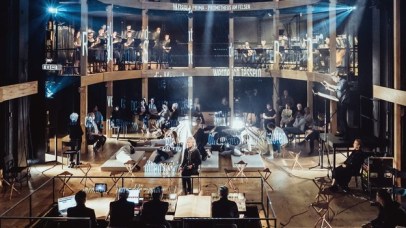
Luzerner Theater transformed into a space inspired by Shakespeare’s Globe: iamge by David Röthlisberger

Lucerne Festival isn’t the only arts organization to have introduced major leadership changes this year: down the Bahnhofstrasse from the KKL and the train station, the 39-year-old Peter von Benedikt  has just begun his tenure as new Intendant of the Luzerner Theater (aka Stadttheater Luzern).

The original 19th-century institution opened in 1839 with (what else?) Schiller’s Wilhelm Tell. The Luzerner Theater now ranks as the oldest still-operating repertory theaterin Switzerland (offering a varied season of opera, ballet, plays, etc.).

After being gutted by a fire in 1924, the theater reopened in 1929; it has been renovated since — including in a recent rethink for von Benedikt’s first season. Among his plans are experimentation with new spaces, new reconfigurations of the theater.

The native Kölner von Benedikt arrives with impressive credentials and has a notable passion for opera. He was part of the directing team for the world premiere of Péter Eötvös’ operatic treatment of Angels in America, and in 2011 he won the Deutscher Theaterpreis Der Faust as best director in the music theater category for his staging of Luigi Nono’s Intolleranza 1960.

Nono was von Benedikt’s choice as well to open his first season with a new production of the Italian composer’s  Prometeo: A Tragedy of Listening from 1984 — talk about challenging your audience!

The choice is also unusual in terms of the relatively small space (400-plus seats) for a work that’s encountered (when it is encountered live) mostly in concert halls. For this production von Benedikt had the theater reorganized to mimic the multi-level Globe theater of Shakespeare’s day — and to encourage an intimate, “egalitarian” experience of Nono’s remarkable, one-of-a-kind music theater.

More from the company’s description:

Die Komposition handelt zwar von Prometheus, der aber nicht als Figur, sondern als Prinzip vertreten ist. Nono setzt dem Vorwärtsstreben, der Fortschrittsgläubigkeit desjenigen, der in der Mythologie den Menschen das Feuer bringt, das Langsame, Leise, das Unspektakuläre entgegen.

Nono und sein Librettist Cacciari benutzen Texte von u.a. Aischylos, Rilke oder Benjamin, die jedoch nur fragmentiert und in verschiedenen Sprachen präsentiert werden. Man soll sie nicht verstehen, sondern ihr Inhalt bildet den Hintergrund für etwas, was wir erahnen, erspüren mögen.

Sie umkreisen auf höchst abstrakte, dichterische Weise Fragen wie: Wie autonom ist der Mensch? Oder aus der Sicht der Antike formuliert: Wie ist das Verhältnis von den Götter und den Menschen. Was ist Bestimmung, was Schicksal, haben wir aus der Geschichte gelernt, gibt es im 20. Jahrhundert noch Utopien oder leben wir in einer Zeit, in der die Hoffnung auf Veränderung erloschen ist.


Filed under: theater

A Summer of Changes in Lucerne

This coming weekend brings the close of the Summer Festival in Lucerne. Along with the usual Stendhal Syndrome-inducing concentration of great artists and great art, the 2016 edition introduced two major changes — if not exactly paradigm shifts — to Lucerne Festival’s organization and overall character: the inauguration of Riccardo Chailly as new Music Director of the Lucerne Festival Orchestra, succeeding the late Claudio Abbado, and, in the wake of Pierre Boulez’s death, the first Lucerne Festival Academy under new leadership, with Wolgang Rihm as Artistic Director and Matthias Pintscher as Principal Conductor.

Michael Cooper reports in The New York Times on how the Lucerne Festival is “reinventing itself”:

But behind the scenes, the Lucerne Festival, an increasingly important part of the classical music ecosystem, was being forced to reinvent itself. Within the past couple of years, the festival has lost not one, but both of its guiding artistic lights: Mr. Abbado died in 2014 at 80, and Mr. Boulez this year at 90. Their losses pose a challenge at a moment when Europe’s leading summer festivals hotly compete for artists, audiences and prestige.

Cooper also wrote about the 2016 Lucerne Festival theme of women in music, interviewing four of the eleven female conductors who appeared on the podium there this summer: Barbara Hannigan, Marin Alsop, Susanne Mälkki, and Mirga Gražinytė-Tyla.

And here’s a European perspective from one of the German-speaking world’s major music critics, Christian Wildhagen (who wrote his dissertation on Mahler 8, the work with which Chailly and the Lucerne Festival Orchestra opened the festival last month):

Niemand sei «in der Gewalt seelenvollster, rauschendster, visionärster Musik dem Himmel näher getragen worden» als Mahler, schwärmte Ernst Bloch in seinem Buch «Geist der Utopie». Eine Aufführung der 8.Sinfonie wäre indes nicht komplett, wenn auf diesem Weg nicht auch ein paar Unzulänglichkeiten Ereignis würden.


Filed under: conductors, Lucerne Festival, music news

Archive

Enter your email address to follow this blog and receive notifications of new posts by email.