
Filed under: playwrights

October 1, 2015 • 7:42 am Comments Off on András Schiff on Bach
September 29, 2015 • 1:13 am Comments Off on Remembering Auden

W.H. Auden died on this day in 1973 in Vienna. And just in time to mark the great poet’s legacy: Edward Mendelson’s splendidly edited series of Auden’s complete prose writings has been completed with volumes V and VI.
“This is what scholarly publishing is meant to be,” writes the critic Michael Dirda. His review continues:
Over the years I’ve collected Auden’s books — both his own and the works he edited — and so I feel reasonably familiar with his writing. But there’s much here I’d never seen before. At the same time, these pages refresh our appreciation of, say, the poet’s introduction to Anne Fremantle’s “The Protestant Mystics” or to his own selection of Dryden’s verse by showing them as products of a busy professional life.
Moreover, Mendelson’s notes and appendices contribute illuminating, and sometimes amusing, extra-textual detail….
[E]verything [Auden] says about poetry is sharp and authoritative: “In judging a poem, one looks for two things: craftsmanship — it should be a well-made verbal object; and uniqueness of perspective — nobody but the author could have written it.”
Filed under: anniversary, Auden, poetry
September 29, 2015 • 12:12 am Enter your password to view comments.
Filed under: music news
September 27, 2015 • 9:00 am 2

Stop right there: “Most educated people are uncomfortable admitting that Shakespeare’s language often feels more medicinal than enlightening.”
This absurd claim (“medicinal”??) is just one of the hopelessly faulty assumptions in John H. McWhorter’s Wall Street Journal piece “A Facelift for Shakespeare”, which attempts to argue the case for “translating” all of Shakespeare’s plays into contemporary English — an initiative commissioned by the Oregon Shakespeare Festival — “because Shakespeare’s English is so far removed from the English of 2015 that it often interferes [sic] with our own comprehension.”
This is the level of argument McWhorter puts forward: “It is true that translated Shakespeare is no longer Shakespeare in the strictest [sic] sense.”
Let’s not forget to rewrite those passages that make us “uncomfortable,” right? After all, they gave King Lear a happy ending back in the Restoration.
And why hesitate when it comes to the other arts? I guess Walter Murphy was way ahead of his time in 1976 when he translated Beethoven’s Fifth Symphony to “A Fifth of Beethoven,” making it safe and trigger-free for the disco era:
Filed under: Beethoven, Shakespeare, stupid ideas
September 24, 2015 • 6:10 pm Comments Off on Time Keeps on Shifting: Bloomsday at ACT
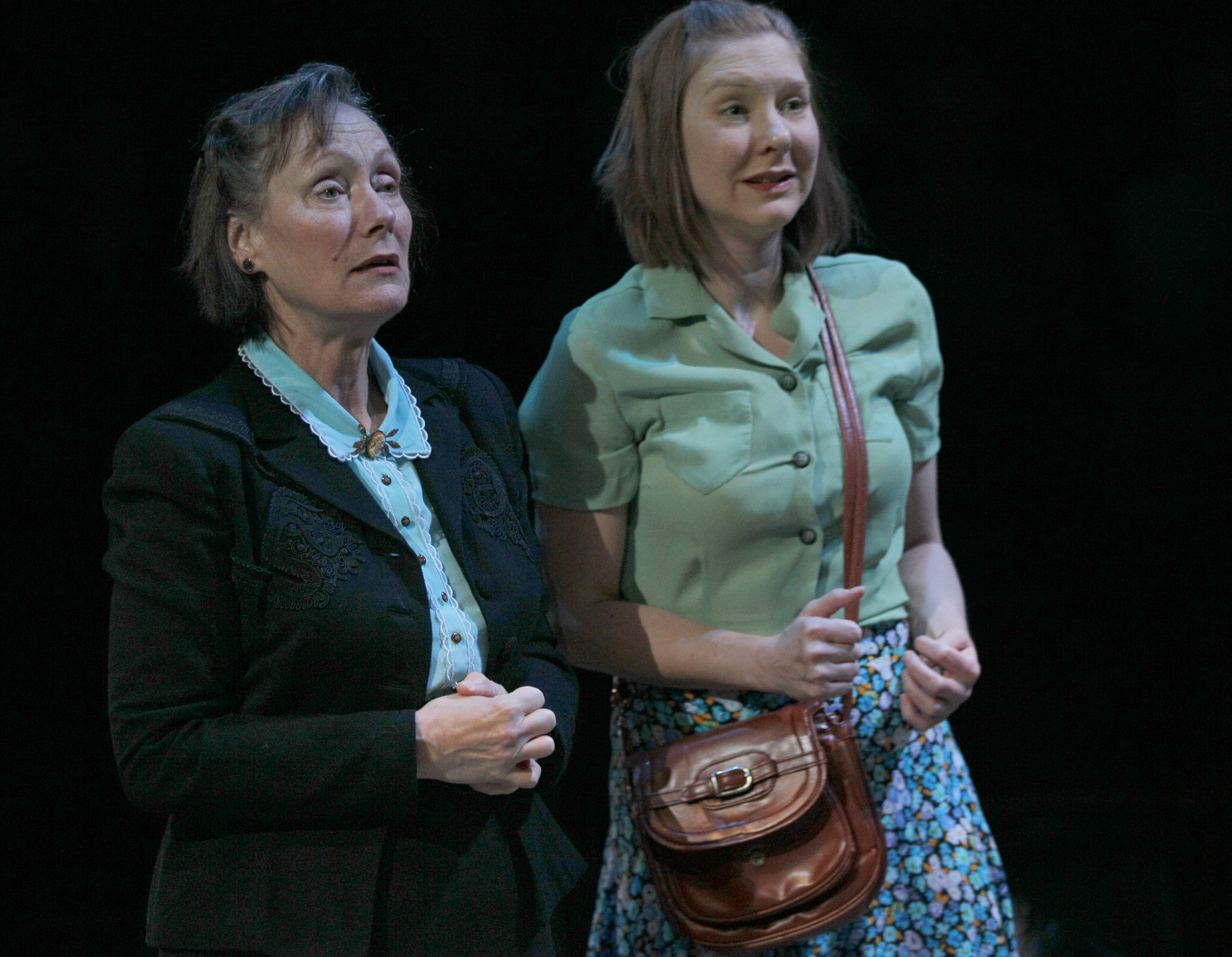
Marianne Owen and Sydney Andrews; photo: Chris Bennion
“Wait, I wanted to. I haven’t yet.”
In Ulysses‘ “Hades” chapter, this terse formula spontaneously occurs to Leopold Bloom: part of the copious flow of thoughts rippling through his mind as he thinks about what it’s like to die.
They could also serve as the elevator pitch for Bloomsday. Steven Dietz’s new play at ACT Theatre is an ode to the ache of regret.
Watching the burial of Paddy Dignam, Bloom ponders what the poor man must have felt at the moment he knew it was all over. The sight of his coffin prompts Bloom to embark on an internal monologue filled with such alas poor Yoricking.
“Wait, I wanted to. I haven’t yet”: those seven words “sum up” the whole mystery of life, according to Robert in one of Bloomsday‘s most poignant moments.
A 55-year-old American and a professor who has taught James Joyce for decades, Robert has ultimately arrived at a jaded view of Ulysses: as far as he’s concerned, that phrase of graveyard musing is the only bit of worth to be gleaned from what he now considers “a piece of drivel,” best used as a doorstop.
But Robert is projecting his own bitterness and regret onto Ulysses. The fear-inducing modernist classic was the topic responsible for bringing Caithleen into his life 35 years ago.
Back then Caithleen, a 20-year-old Irish loner, had a gig leading a walking tour around the Dublin spots Joyce immortalized in Ulysses. These are the locations where the novel’s external events unfold within the span of just one day, June 16, 1904, now internationally celebrated as “Bloomsday” by fans of Joyce.
Also 20, Robbie (the name Robert went by in his youth) was a greenhorn American abroad with lots of time to think about what to do with his life. Young Robbie had no clue about Joyce and was blissfully ignorant of Ulysses, a book he hasn’t even heard of.
But his attraction to Caithleen when he happened to run into her — as instant as Dante’s for Beatrice — motivated Robbie to follow along on the tour to try his chance at romance. But, as the mature Robert announces with a shudder of self-disgust, “I am made of something cold.” He let the chance slip away.

Eric Ankrim and Peter Crook; photo: Chris Bennion
Bloomsday involves only these two characters, but it requires a cast of four: two actors each to play Robert and Caithleen during two phases in their lives, 35 years apart. Dietz dramatizes and puts onstage what is past tense to the middle-aged Robert and Cait (the name the older Caithleen prefers).
The play’s dramaturgical conceit is that Robert has come back to visit Cait after this long hiatus. In the process they watch and interact with their younger selves, who are reliving the day when they first met — a day that might have gone in a very different direction.
On the surface, it sounds like the makings of another formulaic rom-com, bittersweet variety, using a time-loop setup that might bring to mind Groundhog Day or even Dickens’s A Christmas Carol, with a dash of Our Town.
What Dietz actually does is to lure us into thinking we’re getting something familiar in the first act, only to push us out of that comfort zone into a deeply moving meditation on lost time, on the painful dissonance that comes with memory.
In one of the play’s most trenchant images, Robert contrasts the experience of time as a sequence of notes — the way we normally experience it, moment to moment — with time as a chord, where “all the notes are played at once.”
Bloomsday is a time-chord that pits recrimination against the yearning for resolution. The wonder of Dietz’s achievement here is to dramatize both sides so effectively, without resorting to easy sentimentality or mushy nostalgia. Robert’s existential esprit de l’escalier brushes up against Cait’s gentle acceptance of the past.
Peter Crook vividly embodies Robert’s mix of despair and cynical humor vis-a-vis his younger self and compassion for the mature Cait, whom he learns to know in a very different light.
As the latter, Marianne Owen uses gesture and understatement to imply the silent agonies and loneliness her character has lived through in the interim with haunting effect.
Dietz offers a less interesting, less developed characterization of the young Robbie — perhaps intentionally, to underscore how he is a “blank slate” at this point in his life — but Eric Antrim touches on an appealingly varied spectrum of notes, from naivete to Robbie’s dawning awareness of possibilities he hadn’t previously imagined.
Sydney Andrews gives a stunning, beautifully textured performance as Caithleen, the character Dietz develops most richly. Her Caithleen initially creates the impression of a strong-willed, confident young woman, yet we come to see her deep-rooted anxiety take hold.
Caithleen experiences time as a distressing “chord” of overlaid moments. While Dietz leaves the issue of her inherited mental condition vague — it’s meant to be both realistic and metaphorical at the same time — Andrews makes her unease and her contradictions touchingly palpable without resorting to melodrama.
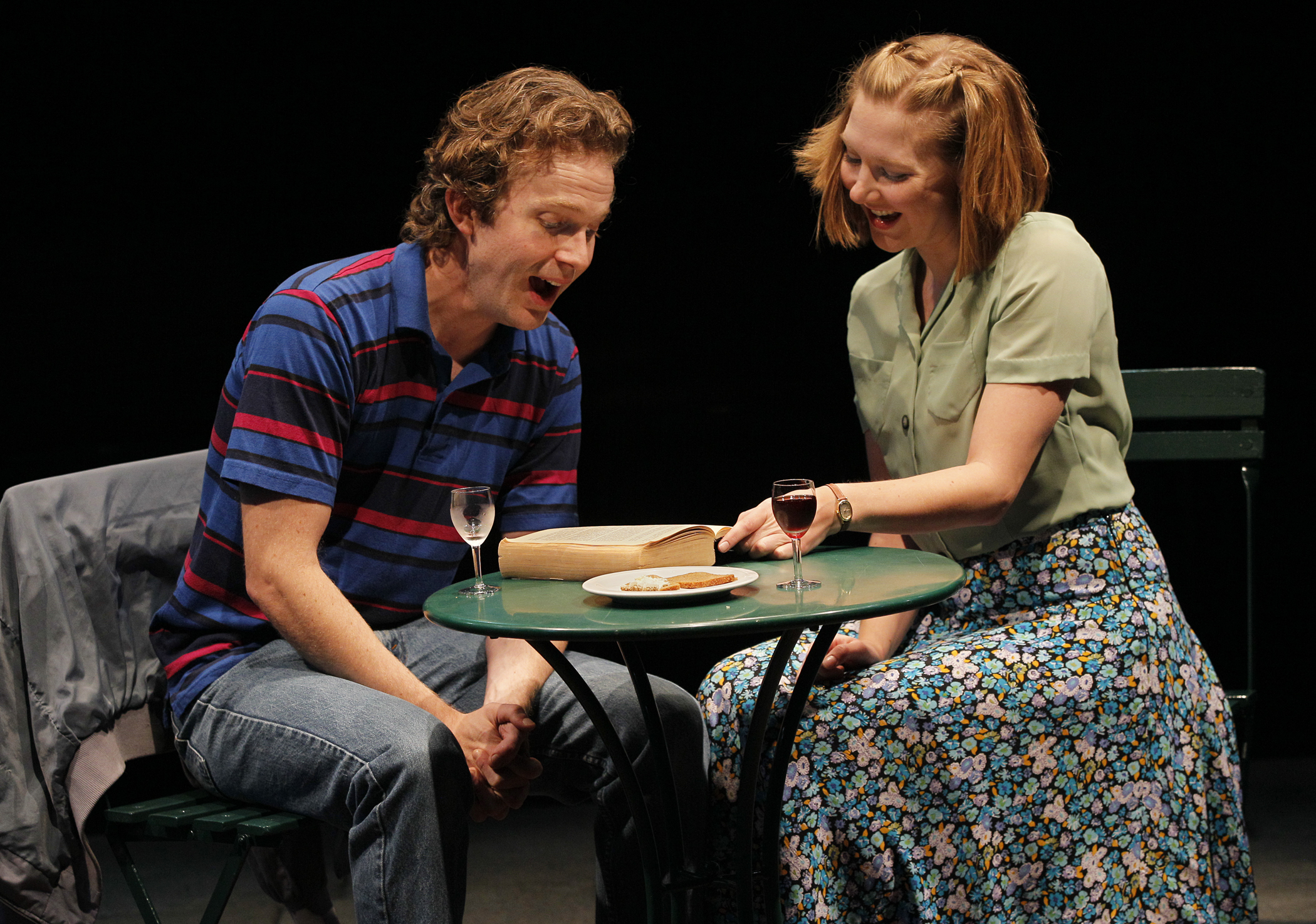
Eric Ankrim and Sydney Andrews; photo: Chris Bennion
The design work is admirably integrated: Robert Dahlstrom’s simple, efficient set of cobbled street surfaces provides the backdrop for the play’s instant shifts of scene and mood, which are enhanced by Duane Schuler’s subtle lighting and Chris Walker’s sound design.
Catherine Hunt’s costumes visually rhyme with the subtle irony of Dietz’s time-loops and overlays: the older couple is nostalgically attired in the Edwardian period dress of the fictional turn-of-century Bloomsday, while young Robbie and Caithleen carry on in “normal” clothes.
Bloomsday is the last production Kurt Beattie is directing at ACT before ending his long and fruitful tenure as the company’s artistic director. His long-term partnership with Dietz is clearly evident in the graceful, emotionally resonant cadence and tempo of his staging. (This is the 11th play by Dietz to have been premiered/produced at ACT.)
As a variation on the memory play, Bloomsday is also a strikingly fitting farewell gesture for Beattie. Dietz’s theatrical poetry, enacted by this well-knit cast, captures the intensity of experiences that pass by fleetingly and that at the same time can leave an indelible mark: the essence of theater itself.
Steven Dietz’s Bloomsday runs through October 11 at ACT Theatre, 700 Union St., Seattle (206-292-7676 or here to buy tickets online).
–(C)2015 Thomas May. All rights reserved.
Filed under: ACT Theatre, review, theater
September 23, 2015 • 8:14 am Comments Off on New General Director of San Francisco Opera
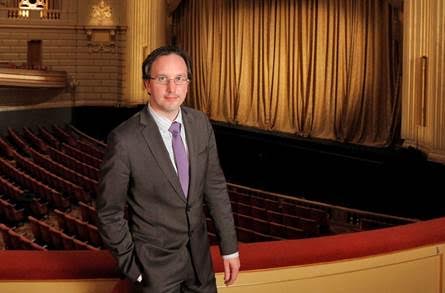
Matthew Shilvock
They sure know how to keep a secret. San Francisco Opera finally has finally announced who will succeed David Gockley, and it’s an insider: current Associate General Director Matthew Shilvock takes on the reins as the company’s seventh General Director starting August 1, 2016. His contract is for five years, through July 2021.
From SFO’s press release: “Mr. Shilvock, born and educated in England, joined San Francisco Opera in 2005 and has served as Associate General Director since 2010. As Associate General Director, Mr. Shilvock manages and leads five departments: Music Operations (orchestra, chorus, dancers, commissions); Electronic Media; Education; the San Francisco Opera Center (professional artist training programs); and Rehearsal. He currently also serves as Interim Director of Development.
Joshua Kosman observes: “In signing Shilvock, 38, to a five-year contract, the Opera has made a choice that emphasizes continuity in the company’s leadership over experience or a proven track record. Over the course of his decade in San Francisco, Shilvock has taken an active role in just about every aspect of the company’s activities, from artistic planning and labor negotiations to financial development and educational outreach. But this will be his first time at the helm of an opera company.”
Kosman offers the following roundup of Shilvock’s responses in regard to programming philosophy:
“We want to strengthen the brand of San Francisco Opera, so that people come to us not simply because they recognize a title, but because they have faith in what we’re doing. ‘Butterfly’ will always sell better than ‘Jenufa,’ but we want to give audiences the motivation to come to a piece like ‘Jenufa’ that may not be familiar to them.”
In response to a question about new and recent works that he had found particularly rewarding, Shilvock cited Jake Heggie’s “Moby-Dick,” Philip Glass’ “Satyagraha” and Carlisle Floyd’s “Susannah” as examples of the kinds of work the company should be doing.
Shilvock pointed in particular to the Diane B. Wilsey Center, the 299-seat theater scheduled to open next year in the newly renovated Veterans Building, as an engine for experimentation.
“The programming will have a shorter lead time, and we’ll be able to do works there with greater intimacy, or that find different resonances with the audience. There’s a wonderful sense of innovation that can happen there.”
“By choosing Shilvock, the San Francisco Opera has gotten to have it both ways: opting for the status quo by continuing Gockley’s tradition, while coming down on the side of youth and freshness,” remarks Anne Midgette in The Washington Post.
New York Times reporter Michael Cooper points out that the selection of Shivlock “signaled that the search committee — which had been grappling with whether to appoint someone with a background as an artist or an administrator —–saw his understanding of the practicalities of running the opera house as critical.”
Filed under: music news, San Francisco Opera
September 21, 2015 • 4:18 pm Comments Off on Still Fresh: Morlot and the Seattle Symphony Embark on a New Season

SSO: Opening Night Gala with Ludovic Morlot and Piano Competition winner Kevin Ahfat. Credit: Brandon Patoc Photography
I imagine some people are doing a double take when they realize Ludovic Morlot has just started his fifth season helming the Seattle Symphony. Well, it is hard to believe we’re almost a decade into his tenure: his approach to me feels as fresh as ever. But with the added benefit of confidence accruing. (Here’s another double take: this is the orchestra’s 113th season.)
Saturday evening’s season opener certainly had several Morlot trademarks: a lovely pairing of American and French composers that showed off the health and vigor of the musicians, along with a like-minded peer in the guest artist for the second half.
The performances also overturned a couple of pesky clichés. One is the matter of non-native-born Americans supposedly having a hard time with getting across an authentic feel for the “American” sound — meaning in this context primarily the jazz-inflected rhythms of such popular 20th-century composers as Leonard Bernstein.
Morlot was perfectly at home in the Overture to Wonderful Town and inspired a deliciously stylish reading from the players, complementing Bernstein’s warm lyricism with brash joie de vivre. Instead of over-emphasizing them, Morlot let Lenny’s meter shifts propel the music with an elegantly giddy, light-as-air verve.
The artistic high point came with the orchestral suite Copland fashioned from his original chamber-orchestra score for Appalachian Spring. Here was a touching example of Morlot’s fresh perspective. My reaction was similar to what I felt when he gave us the same composer’s Lincoln Portrait for the concert opener in 2012.
Copland’s suite sounded as if it were being sung in a single tender breath. The performance featured another Morlot trademark: mindful, deftly balanced timbral blending and well-judged phrasing that allowed a particular gesture to reverberate with maximal impact (as right after the final tutti variant of the “Simple Gifts” tune). The result made this music sound so much richer and affecting than you might expect from an aging chestnut. Contributions from the winds were particularly lovely, including guest clarinetist Frank Kowalsky.*
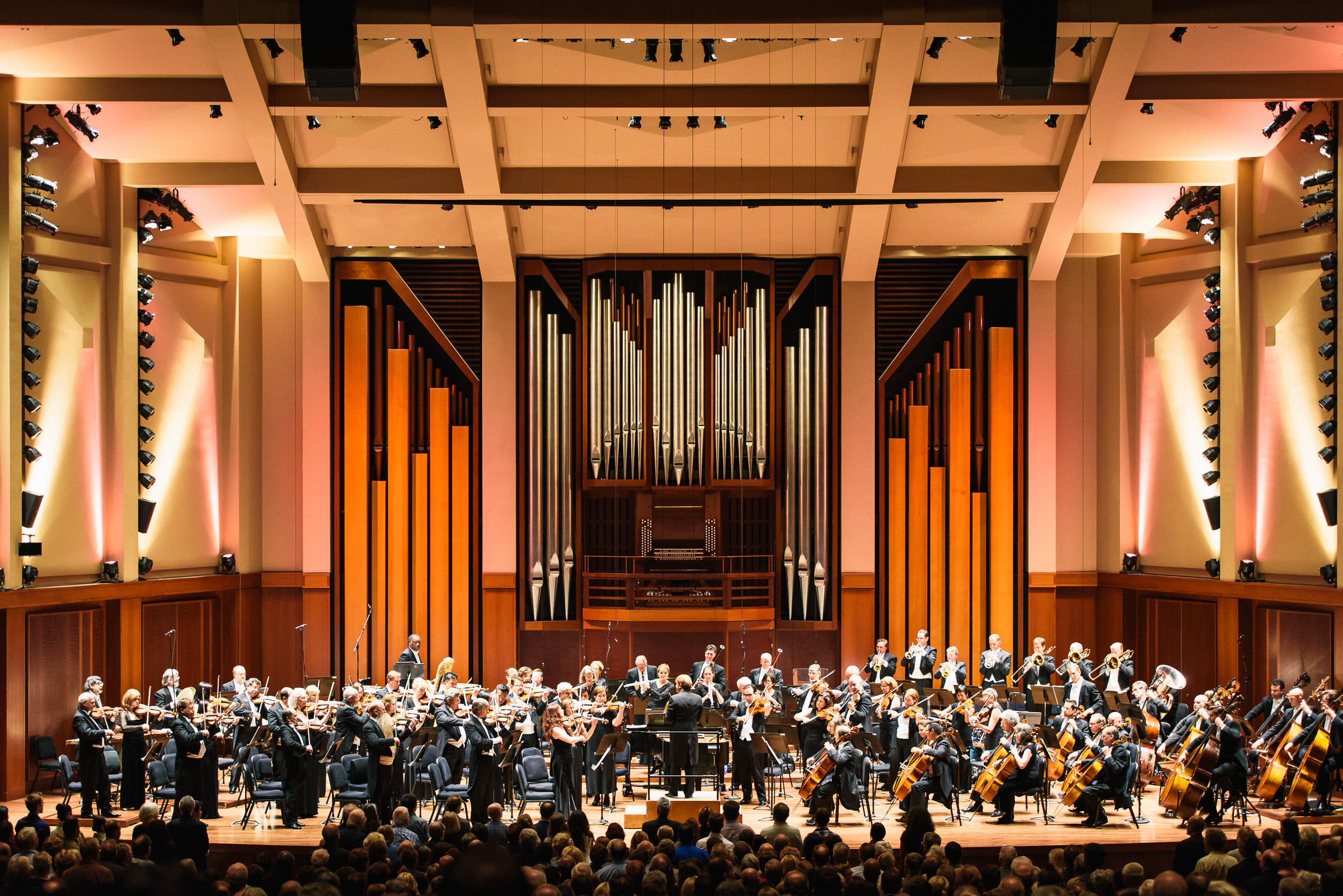
Opening Night Gala Credit: Brandon Patoc Photography
The piano dominated the rest of the program. I have mixed feelings about the prominence given to guest artists at a symphony orchestra’s opening concert: it often seems to decenter the musicians we should be celebrating and enjoying, making them secondary as the spotlight is turned over to a “star.” (And, yes, I get the necessity of this to stir up donor interest and create buzz.**)
But Jean-Yves Thibaudet was the perfect choice to fill the star role. Not only are he and Morlot natural artistic partners: he plays with the orchestra with genuine empathy and give-and-take. In addition to which, Thibaudet will be coming back several times this season in his role as artist in residence with the SSO.
So it was a treat to hear them join together for the fifth of Camille Saint-Saëns’s piano concertos, also known as “the Egyptian.” (Saint-Saëns wrote it while staying in Luxor and also alludes to music he heard in Egypt.) The second cliché that got overturned: the formula that composer X writes difficult music for the soloist whose “virtuosity is not an end in itself, but a vehicle for [fill in the blank with some “higher” purpose].”
Well, not so much in the Saint-Saëns. The virtuosity called for is often over the top, a vestige of the composer’s Lisztian side, and many stretches are exactly for the sake of virtuosity, period. But what fun when played by an artist of such refined taste and intelligence. Thibaudet truly dazzled and charmed, even eliciting a note of dreamy mystery in the Andante, with spirited collaboration from the orchestra.
The concerto was prefaced by the Danse Bacchanale from Saint-Saëns’s opera Samson et Dalila, extending the “Orientalist” theme (and pinpointing one source of Hollywood’s musical orientalism). Much of it is wonderfully trashy, sequence upon sequence, but Morlot had a way of making it sound better than it is.
The piano figured in the middle of the first half as well, when the young Canadian-born Kevin Ahfat took to the keyboard to play the final movement from Samuel Barber’s Piano Concerto. Ahfat had just been announced as the winner of the Seattle Symphony’s inaugural Piano Competition. Along with a $10,000 cash prize, the victory nets him a future performance with the SSO next season.
I had to miss the competition itself, so this was my first time hearing Mr. Ahfat, but he instantly made a powerful impression. I liked the choice of the too-seldom-heard Barber, and though this movement really exhibited only one side of his artistry — a very extroverted, showy side — his playing brimmed with personality and flair. If he can just grow out of the Juilliard mode of exhibitionistic technique-centrism…
To close the concert, Morlot pulled a shtick a la Itzhak Perlman, having Thibaudet come out (joined by Ahfat on another keyboard) for a pretend audition as they embarked on a humorously awkward account of “Les Pianistes” from Saint-Saëns’s Le carnaval des animaux, bringing the curtain down with the finale to the same suite.
*Although the “official” Seattle press has ignored this news, principal clarinetist Ben Lulich has been appointed “new acting principal clarinet” of the Cleveland Orchestra but will perform at some of the SSO’s concerts this season (where he’s technically on leave for the season).
**According to an SSO Tweet, $785,000 was raised for education and mentoring at the post-concert gala:
–(C)2015 Thomas May. All rights reserved.
Filed under: Ludovic Morlot, piano, review, Seattle Symphony
September 20, 2015 • 4:17 pm 3

Evidence of human presence
Yesterday afternoon Seattle’s Seward Park resonated with the sounds made by nearly a dozen-and-a-half percussionists, along with the contributions of nature, of everyday life in a human-inhabited environment, and of the spectator-participants.
On offer was John Luther Adams’s Inuksuit, a remarkable piece conceived for performance outdoors by an indeterminate collective of percussionists (anywhere from “9 to 99” players). Inuksuit had its West Coast premiere at the Ojai Festival in 2012, and percussionist and educator Melanie Voytovich organized this Seattle presentation.
The timing and location couldn’t have worked out better: hints of the coming fall tinged the mid-afternoon mood — the Autumnal Equinox just around the corner — while a changeable sky opted for outlooks from gloomy cloudcover to full-on sunbursts.
As Melanie points out, the word “inuksuit” (which is plural) connotes “a type of stone landmark used by native peoples of the Arctic region”; more generally, it can be a proxy or evidence of a human who has been present in a space.
Bernd Herzogenrath, a versatile author focused on American studies, observes that Inuksuit “enables listeners and performers to experience a place more fully, while subtly presenting a narrative of life on Earth.”
That’s one aspect I valued especially from yesterday’s performance: the sense that both the “audience” and the performers were absorbed in the same task, seeking a more intense experience together, without division or boundary between the two.

Almost reflexively, I initially settled down into position when I realized Inuksuit had actually begun. It was a moment of interesting awkwardness, as I’d been chatting with some friends as people kept on arriving, and we noticed a change of aura — but the piece commences so quietly that you need to have visual cues to notice it’s started. You suddenly become aware of a kind of subliminal wie ein Naturlaut of gentle blowing sounds — JLA out-Mahlering Mahler — which then turn more ceremonial, ritualistic.
That being-caught-short prompted my anxiety about maintaining proper “audience behavior” and made me instantly shut up and stay put. But as the work continued, I felt urged to explore it as much as possible from “inside” by getting up and wandering multiple times around the space, as if joining actors onstage for a play in progress.
It was wonderful: the shifting angles and perspectives — visual and aural — made it all the clearer that there simply is no way to take it all in, to gain a complete perception of what’s happening. And that, along with the John Cagean chance elements of any given performance, is inherent in the beauty of JLA’s conception of this work.
Much of the fascination emerges from such interactions: from seeing other listeners, active audience or chance passersby, as they take note of some gesture or shift in the sound source, in its level of intensity or texture. The unfeigned delight of small children was infectious to watch, and even the attending animals seemed mesmerized:

Usually when I’m attending an outdoor performance the ambient sounds are either a pleasant decoration or, in the case of manmade ones like a flight path overhead, disturbing annoyances that I pretend I’m not hearing in an effort to refuse them entry into the experience. But on this occasion I welcomed all that: I wanted these noises to break whatever vestigial fourth wall was there, to bleed their own music to this sound installation.
My colleague Roger Downey remarked that the experience, quite unexpectedly, was like “chamber music” compared to listening to the recording of Inuksuit.
In his preview, Roger points out that “it’s genuinely revolutionary work, representing a new way of playing and listening outside the traditional Western box.”
When I noticed one of the players in a distant corner switch to a siren, I couldn’t help thinking of its difference from the riotous and menacing note the sirens introduce into Varèse’s Amériques, for all their manic humor. Here the effect was almost of a subtle brushstroke.
The inclusiveness of Inuksuit is all. Its random elements gather together across the performance space over the piece’s duration, just as JLA has the players (who were sporting black T-shirts) in-gather in the final minutes, slowly approaching toward the center. This somehow all results in a sense of purpose that is fueled by the energy of everyone present. The music fades back out into inaudibility but has left behind its own evidence.
–(C)2015 Thomas May. All rights reserved.
Filed under: John Luther Adams, new music, review
 Arts & Culture Stories from NPR

