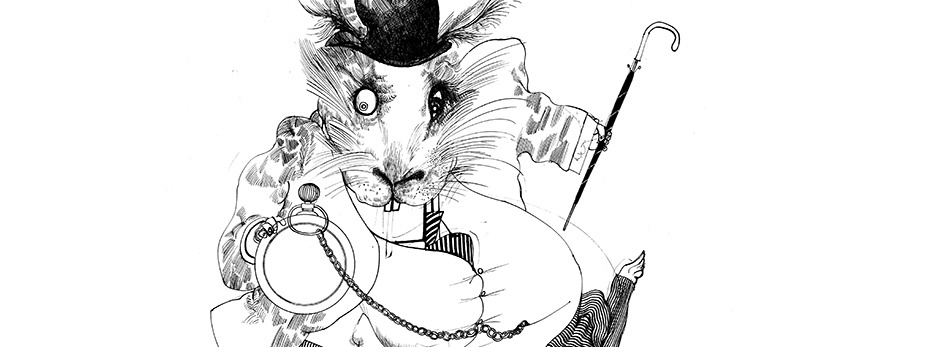
“White Rabbit” by Ralph Steadman
At the end of this month the Los Angeles Philharmonic will be presenting the West Coast premiere of Unsuk Chin’s opera Alice in Wonderland.
Here’s my program essay for the production:
The story of Alice in Wonderland’s creation is rooted in Los Angeles: this West Coast premiere in one sense represents a homecoming. It was Los Angeles Opera that originally commissioned Unsuk Chin to write her first opera, intending to unveil it as part Kent Nagano’s final season as music director (the 2005-06 season). When that plan became unfeasible because of budget cutbacks, Nagano brought the work-in-progress along with him for his inaugural season at Bavarian State Opera.
Alice in Wonderland therefore premiered at the National Theater in Munich in 2007 — the very theater (rebuilt, of course, after its bombing in the Second World War) that gave the world its first Tristan und Isolde in 1865. A certain fantasy narrative that would similarly go on to cast a spell over an enormous spectrum of admirers also happened to be published in that year by the brilliant mathematician, pioneering photographer, and Anglican deacon Charles Lutwidge Dodgson (1832-1898) — aka Lewis Carroll. Celebrations around the globe are marking the 150th anniversary of the first edition of Alice’s Adventures in Wonderland in 2015.
Yet well before the premiere of her opera, Unsuk Chin had written the song cycle snagS&Snarls — a kind of preliminary study to find her way into the world of Lewis Carroll (much as Wagner had done vis-à-vis Tristan with his Wesendonck Lieder). Four of the five songs comprising snagS&Snarls eventually made their way (with alterations) into the score of Alice in Wonderland. Nagano led the first performance at the Ojai Festival in 2004, the year in which Chin won the Grawemeyer Award for her Violin Concerto (more or less considered the music world’s Nobel Prize).
Other pieces by Chin have in the meantime been commissioned by the Los Angeles Philharmonic. Gustavo Dudamel in fact chose to include one of these during the first week of his tenure as music director in October 2009: Šu, a concerto for sheng (mouth organ). In 2013 came the orchestral work Graffiti, Chin’s ode to street art. The composer herself has described Graffiti in terms that could well apply to her method in Alice. She writes that the musical language of Graffiti “shifts between roughness and refinement, complexity and transparency. It is rich in contrast and labyrinthine, neither tonal nor atonal.”
Unsuk Chin’s engagement with Alice in Wonderland reaches even further back than the original LA Opera commission from just over a decade ago. Most fans of Carroll’s Alice books fell in love with these stories as children. Chin, though, is typically atypical in this regard. Instead of reading the work of Lewis Carroll as a child, she was already an adult when she encountered him for the first time as a conservatory student in her native South Korea. Chin recalls that her curiosity was triggered by reading the cognitive scientist Douglas R. Hofstadter’s Gödel, Escher, Bach. The rest of that seminal book’s title, it’s useful to know, is An Eternal Golden Braid. A Metaphorical Fugue on Minds and Machines in the Spirit of Lewis Carroll.
Chin found her title for snagS&Snarls in the chapter heading of another of Hofstadter’s books (Metamagical Themas). Hofstadter intrigued Chin by pulling back the surface layer of what many assume to be the mere “childlike” fantasy of Carroll’s writings and revealing a labyrinthine complexity underneath — a complexity animated by the pure joy of linguistic play. The unpredictable imagery and logic-defying antics of the world according to Lewis Carroll immediately resonated for Chin at her core, touching not just on her aesthetic outlook but on her perception of the centrality of dreams.
“The visions of my dreams represent a far more existential level of experience than anything I have known in my everyday life,” she has stated. “Dreams are for me an encounter with another world, in which utterly different physical laws prevail. Sometimes a dream is so complex that as soon as you wake up only a vague memory of it remains.… When you try to describe such a complex dream-state in words, the result is inevitably what we call ‘nonsense,’ because our language is subject to a very different type of logic.”

Unsuk Chin
Indeed when it came to adapting Alice in Wonderland to the opera stage, Chin decided to interpolate two of her own dream scenes as the opening and final scenes, respectively. She explains that she was “never fully satisfied with the beginning and the end” of Carroll’s published narrative, which seemed “so much more conventional than the rest of Alice” and may have possibly signaled “a concession to public taste, as otherwise the book would have been too daring for its time.” The new dreams — which present additional mysterious encounters for Alice — supply more than a neatly symmetrical framework. They’re organic to the sense of dream time and dream logic that pervades the opera and steer clear of a facile separation between dream and “the real world” (the kind of separation that gives, say, The Wizard of Oz its denouement). As Chin puts it: “I wanted the dreamworld to be the the reality in my opera.”
Chin teamed up with the distinguished playwright, librettist, and scriptwriter David Henry Hwang — a native Angeleno — who crafted a virtuoso text of eight interlocking scenes, with no intermission. The libretto artfully blends key episodes from Alice in Wonderland and the original language of Lewis Carroll with clever postdatings, from the maniacal word play for the acrosticized twisting of “Twinkle, Twinkle, Little Star” to a sly reference to the paradox of Schrödinger’s cat: a potent symbol for the overall philosophy of apparently “nonsense logic” that informs the opera as a whole.
Hwang also includes myriad details in his stage directions, and these are reflected in Chin’s musical realization. They likewise pose fascinating, at times Ring-level challenges for the staging — Alice falling through the rabbit-hole, swimming in a pool of her tears, growing a mile high, and so on.
“As humans, what we’re really interested in is storytelling and concept,” says director Netia Jones in a recent interview with Mark Powell about the high-tech elements that she has enlisted to realize her vision for Alice. “To fully benefit from the amazing sleight of hand that these techniques can offer — the coup de théâtre moment that amazes or confounds, as live performance has always sought to do — it’s vital that any technology behind a production is handled confidently enough to fade into the background.” She adds: “It’s a delicate balancing act between this air of creative anarchy, which Chin’s score definitely lays the foundation for, and the
almost militaristic technical precision required to support it.”
Carroll’s penchant for enigmas, puzzles, acrostics, and other language games also appeals to Chin’s sensibility. The composer made her international breakthrough as a composer in 1993 with Akrostichon-Wortspiel (“Acrostic-Wordplay”), a work that sets texts both by Carroll and by Michael Ende — the aptly named author of another beloved children’s classic, The Neverending Story. In this case, she turned to the conclusion of the Alice saga, drawing on the second book, Through the Looking-Glass, and What Alice Found There (published in 1871). snagS&Snarls actually begins at the end, so to speak, with the very final poem capping Through the Looking-Glass. The poem is an acrostic in which the first letter of each line yields the name of Carroll’s (perhaps erroneously) presumed model, Alice Pleasance Liddell. (This is the only number from snagS&Snarls that never found its way into the opera Alice in Wonderland.) Chin’s list of current projects includes a setting of Alice Through the Looking Glass, which has been commissioned by the Royal Opera in London for the 2018-19 season.
Another impetus behind Chin’s choice of subject matter came from her association with one of her key mentors, György Ligeti. Following her initial studies in composition in Seoul, Chin spent three years in Ligeti’s coveted composition seminar in Hamburg (and eventually resettled in Berlin, where she resides). The maverick Ligeti has treasured Alice in Wonderland ever since encountering Carroll in a Hungarian translation as a child, and before his death in 2006 he was discussing plans for an opera based on Alice. The cartoon- and comic book-inspired “anti-opera” he completed, Le Grand Macabre, shows a number of uncanny parallels with Carroll’s tale of his heroine’s underground adventures. As it happens, Chin shares with her teacher the ability known as synesthesia, that is, to perceive sounds in terms of other senses — chords as colors, for example.
But an Alice in Wonderland by Ligeti would have been utterly distinct from Unsuk Chin’s Alice in Wonderland. She possesses the uncanny talent of being able to tap into an astonishing diversity of sources — including, at times, the manifold web of Ligeti’s orchestral textures — without diluting her unique musical language in faceless eclecticism or tamping down her one-of-kind, magical vision. You can hear fragments that suggest The Rite of Spring, Petrushka, or Bartókian folksiness. The epic motto of Strauss’s Thus Spake Zarathustra is tucked into the fanfare announcing the witnesses in the grand ensemble trial scene. An ominous tolling motif in the lower depths recalls the Coronation music from Boris Godunov.
What results is a fascinating blend of unpredictability and irony that has little in common with, say, the neoclassical posturing of Stravinsky. Often as Stravinsky’s influence is felt in the score for Alice, Chin’s use of allusive gestures never resembles Stravinsky’s manner of being allusive.
Much of the lore of Carroll’s phantasmagoria has to do with its enormous impact on the “adult world” of interpreters. In an essay on the centrality of “imaginary theater” in Chin’s creative thinking, the musicologist Habakuk Traber remarks that “subsequent literary developments — Surrealism, Dadaism, and the Theater of the Absurd, and in particular the ominous literary world and imagery of Franz Kafka” have endowed the Alice books “with a prophetic, prescient dimension.” So, too, the post-Freudian drive to psychologize Carroll and his creations, to interpret his literary dreams. Even pop culture has tried to “explain” what happens. Ever since Jefferson Airplane’s big hit, it’s become alms impossible not to associate the White Rabbit with an afternoon spent experimenting with psychedelic drugs.
Alice in Wonderland “has so many layers,” Chin has remarked: “It can captivate experts and laymen, children and adults as well. That is also an artistic ideal for me.” She even points out that composing the opera entailed a radical shift in orientation toward writing something “much more direct and immediate than in my other pieces.” Speaking with the scientist Matthias Essenpreis, Chin says that once she committed to writing for the genre and to using the Alice material, “I attempted to break away from the traditions of contemporary music and in an instinctive and very fluent way to compose music that resembles a funhouse mirror and that is ironic.”
Chin’s infectious theatrical sensibility enhances her choice of vocal types to assign the characters — including an instrument for the Caterpillar (given a long bass clarinet solo), accompanied by written words — as well as her repertoire of types of vocalization. Alice in Wonderland contains a kind of pocket history of singing: a hint of blues in Alice’s plaintive aria “Who in the world am I,” fancy coloratura for the frantic White Rabbit, a children’s chorus of ethereal simplicity, harpsichord-accompanied recitative at the start of the Mad Tea-Party scene and a characterful Baroque aria as the Mad Hatter laments the cruelty of Time, high dudgeon vocals for the vengeful Queen of Hearts, all culminating in an ensemble of intricately ordered chaos.
Even in the version for reduced ensemble that was prepared as a counterpart to the original gargantuan (and impractical) ensemble used for the opera’s original production in 2007, the scintillating imagination of Chin’s orchestration is unmistakeable — and gives Alice in Wonderland its essential texture. From the first sounds we hear (following those of the actors’ gestures, lulling us into this dreamworld), Chin utilizes extremes of range to effect a sense of drastically elongated dimensions, for example. Yet the “nonsense” world of dream logic hardly means that anything goes.
By the same token, for all of her elaborate timbral and compositional structures, Chin knows the importance of spontaneous fantasy. She remarks that she tries “to avoid providing rigid interpretations of the book — whether psychoanalytical or otherwise. Let the story and its dialogues speak for themselves. What ultimately attracts her to Alice is “the effortless and unconscious way in which Lewis Carroll expresses deep philosophical questions. Alice is not solely a matter of dreams. It is also about a clash between the different ways in which we communicate and experience reality.”
(c)2015 Thomas May. All rights reserved.
Filed under: essay, Los Angeles Philharmonic, new music, opera