MEMETERIA

Icon

Arts writing by Thomas May

Carousel at the 5th Ave: A Byrd’s-Eye View

Donald Byrd

Donald Byrd

After creating a buzz with last week’s announcement of an especially appealing eight-show season for 2015-15, the 5th Avenue Theatre is about to unveil its new production of Carousel. Laura Griffith and Brandon O’Neill (on the heels of his Broadway debut in Disney’s Aladdin) star as Julie and Billy in a new production directed by 5th Avenue’s producing artistic director Bill Berry, with music supervisor Ian Eisendrath leading a 21-piece orchestra.

The early Rodgers & Hammerstein classic gets a fresh airing in this fourth major collaboration between the 5th Ave and Spectrum Dance Theater — for my money, one of the most creatively stimulating and innovative performing arts companies on the Seattle scene.

Donald Byrd, Spectrum’s artistic director, brings his dancers back to the 5th after choreographing a thought-provoking, insightful interpretation in 2012 of Oklahoma! – the groundbreaking Rodgers & Hammerstein musical from 1943 that preceded Carousel by two years.

I recently spoke to the Bessie Award-winning, Tony-nominated choreographer about his latest engagement with an icon of American musical theater.

What makes a work like Carousel, now seven decades old, still work for audiences today? How do you find it resonates for people today?

DB: The appeal is that it is a classic. We wouldn’t have the kinds of musicals we enjoy today if it wasn’t for these Rodgers & Hammerstein musicals. They invented the book musical in many ways. And it’s also important to be reminded of why they work so well and tell us something about storytelling in the musical theater that contemporary musicals often don’t do as well.

For me it’s exciting to go back to the source and see how they build a show with a classic arc and climax. As with any classic, you can learn something different and deepen your understanding every time you come back to it. For example, Oklahoma! says something about how dance can work in the modern musical. With Carousel it’s a much darker story, and that points to the range and breadth of what a musical theater piece can be and do.

You were personally encouraged by Agnes de Mille, the legendary choreographer of the original show, when you were embarking on your own career. What is significant for you about her contributions? How did she demonstrate that dance can fit into those possibilities?

DB: She was interested in how to tell a story and also in how to tell an American story. Even though the source material [the 1909 play Liliom by Hungarian writer Ferenc Molnár] is not American, they created a very American story in the way they told it.

De Mille really wanted to have an American dance and American themes and heroes and heroines. Sometimes her dances may look and feel old-fashioned, but if you keep in mind what she was after, you start to see beyond that.

How did you decide to approach or reference the original ballets De Mille choreographed for Carousel — and Oklahoma!, for that matter?

DB: I found myself wanting to honor what Agnes De Mille did and to make sure that somehow her values are embedded in what I do with the shows. I follow the scenario she created, but i don’t use her movement necessarily — though I do quote here. In the big ballet [the “Billy Makes a Journey” scene in the second act], the first thing is a quote.

Yet in your version of Oklahoma! you introduced an intriguing Freudian dream sequence.

DB: The dream sequence I used for the Oklahoma! ballet looked at how artists of that period were all talking about sex and Freud. Psychology doesn’t play such a deeply rooted role in Carousel, but one of the show’s themes is about how what we desire is both to be able to give and to receive love. This manifests itself in a desire to be accepted — and also in the impulse to push people away and to create the Other. Louise [the daughter of Julie and Billy] is definitely the Other.

Community is important in both Oklahoma! and in Carousel. And what a close-knit community creates is outsiders. At the same time, there’s a fascination with the Outsider. Carrie, Julie’s best friend, shows this when she considers her options regarding the person she can marry. She has a choice between someone very rigid, like Enoch Snow — a version of a young Tea Party Republican — or someone exciting like Billy Bigelow, the dangerous bad boy.

He’s like an animal that is caged. When he’s domesticated, what does he do? This manifests itself later in the show with his daughter Louise, who also has Billy’s spirit.

Tell me more about your take on the character of Billy Bigelow.

DB: In some ways Carousel is really about a type of person. It makes me think of the Heath Ledger character in Brokeback Mountain: here’s a person completely ill-equipped to deal with his situation, He has no tools to express his circumstances and his internal life to the outside world. I think [Carousel‘s hero] Billy Bigelow is somebody who has no tools to express a very essential part of life. How do you express that you love somebody?

On top of that — and this gets back to how Carousel still resonates for audiences of today — Billy is living in an America that’s changing in the 19th century. It’s a little bit like what we have going on now, for working people at least. Billy’s a barker at a carnival, but after he loses his job he discovers he doesn’t have any skills. So he’s in a situation of feeling forced to do something morally that he doesn’t agree with when he attempts the ill-fated robbery. And he’s unable to express his love for Julie. He resorts to domestic violence, a classic manifestation of his sense of being a failure. How do you cope when you’re not prepared to do the things you need to do to live in the world?

Another thread that runs through Carousel is a kind of ambition which is very American. Louise [Billy and Julie’s daughter] is an outsider because of what her father has done but she’s ambitious to succeed at something. In theory America is classless, but Louise finds she is somehow locked out. This seems to be one of the directions the country is moving into again. Read Thomas Piketty’s Capitalism in the Twenty-First Century, where talks about a new class of the super-rich that comes from inherited wealth, while the rest of us are locked outside of that. These are some ways of looking at this musical that show how it resonates with the America we live in today.

Photo by Jeff Carpenter

Photo by Jeff Carpenter

What stands out for you this time in your collaboration with 5th Avenue Theatre?

DB: Spectrum is even more integrated into the entire production than we were in Oklahoma!. For example, the famous clambake scene in the first act — “June is Bustin’ Out All Over” — is all about hormones flowing at springtime and all the hot-and-bothered excitement and horniness that goes along with that. But in the original there was a pretty dance for the women that but didn’t have much to do with what the song was about. It was followed by a number in which all the men had a hornpipe dance. We thought it was weird that in this number about sex there was no dancing together of couples. But in the movie (which De Mille didn’t choreograph), they did a big dance number for “June,” so we decided to add a newly invented dance number within that number.

Looking back, what do you make of the fact that your choreography for the dream sequence in Oklahoma! generated so much controversy? Do you expect any similar reactions this time around?

DB: The story itself is already controversial. There’s nothing I can do that can make it any more controversial. Carousel is not really what many people think of as typical “musical theater” material.
I think the production is adult but will not be controversial.

To me it seems people were overreactive with Oklahoma!. It was their interpretation of the staging that made it controversial: it resonated in a way that created discomfort. Places like Seattle that perceive themselves as being really progressive don’t like to have this brought it up for them.

A lot of it was generational: people who grew up in the Civil Rights era were in general more reactive than people who were younger. It’s about not wanting to revisit these issues. When they’re further back, like 12 Years a Slave, then it’s easier to handle, but not when we’re talking about history that is too recent. So part of it comes down to people not wanting that stuff to be there — references to lynching or to racist stereotypes of the oversexed Black man.

But those prejudices are there and we need to look at them. There’s nothing wrong with being uncomfortable! Sometimes you need to be uncomfortable to wake up to reality. When I first did The Minstrel Show, Yusef Hawkins was beaten to death by a gang of white kids in Bensonhurst. I remember thinking: How could this happen in 1989!” I thought all of that was over, but it really woke me up. We often assume things are done when it comes to social justice issues. But they’re not done.

What are some things that might make us feel productively uncomfortable in Carousel?

DB: The feeling that comes from being on the outside, recognizing that we do in fact have a class system. Carousel also shows people facing judgment about whether it’s appropriate to be in love with or to marry a certain person. And the issue of domestic violence runs through the show as well. Carousel shows us that it’s important to address the reason behind why people behave the way they do.

(C)2015 Thomas May. All rights reserved.

Filed under: dance, Donald Byrd, interview, musical, Spectrum Dance

Watching You

LA-Bway

Board-LA

Filed under: photography

Love Save the Queen: The Ghosts of Versailles

ghosts-la

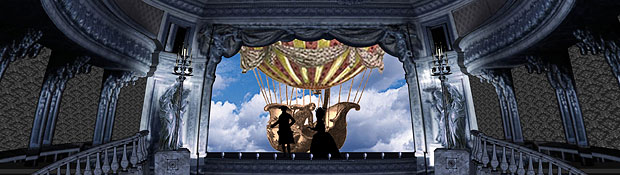
This Saturday brings the opening of Los Angeles Opera’s new production of The Ghosts of Versailles by John Corigliano and William Hoffman.
Here’s my essay for LA Opera’s program:

There’s an entire category of landmark operas that originally met with resistance from their own composers. Take Ariadne auf Naxos. In its first version, the work posed so many problems that a frustrated Richard Strauss shelved the project for several years. And when he was approached by director Peter Sellars with the concept for his first opera—a venture tentatively titled Nixon in China—John Adams initially kept a skeptical distance.

The inception of The Ghosts of Versailles couldn’t have offered a more encouraging set of circumstances. Desiring to present a brand-new work to celebrate its upcoming centenary season, the Metropolitan Opera was determined to pull out all the stops. What composer would not leap at the chance—especially given such a spectacular context for his debut opera?

continue reading

Filed under: American opera, essay, John Corigliano, Los Angeles Opera

Happy (Belated) Birthday, Philip Glass!

I’ve been so under the gun with deadlines of late I missed posting a birthday nod on the actual birthday — January 31 (78!) — but any season is a season for the music of Philip Glass as far as I’m concerned.

Along with the composer’s own forthcoming memoir, Words Without Music, Glass has confirmed that he will be scoring Josh Trank’s latest Fantastic Four film with Marco Beltrami. Trank is reportedly thrilled:

The first words out of his mouth were, “I just saw your movie and it’s very philosophical.” We were talking about the philosophy of Chronicle and it gave me goosebumps. We invited him out to set and he came to set for like three days and had a great time. He was blown away by the scale of the film. I’ve been working with him for almost a year now and he’s so inspiring. He’s such a humble, amazing guy.

Filed under: music news, Philip Glass

LA Afternoon

LA afternoon

Filed under: photography

Ivesian Revelations from Morlot and the Seattle Symphony

page from score of Ives/4th Symphony

page from score of Ives/4th Symphony

The last time Ludovic Morlot led the Seattle Symphony in a Charles Ives symphony (the Second), he paired it with Rachmaninoff’s Third Piano Concerto (and got pulses running with the Overture to Leonard Bernstein’s musical Candide as a curtain raiser).

I can’t say I get the connections he apparently sees between the conservative Russian and his maverick American contemporary. Maybe the idea is to add still another layer of meta-contrast on top of the already explosively varied mixtures that comprise Ives’ sound world. In any case, this week’s program brings another Rach-Ives pairing.

It was heartening to encounter such an unpredictable interpretation of Rach 3 in last night’s performance (I believe the third time in as many years that Morlot has conducted the work here). Though the previous Rachmaninoff-meets-Ives effort (back in June 2012) had featured the ever-fascinating Stephen Hough as the soloist, the Third Piano Concerto sounded a bit undercooked, the rapport between pianist and orchestra undeveloped.

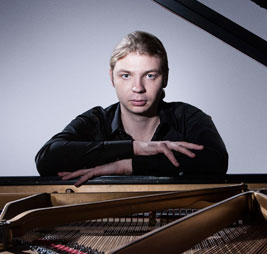
Some unusual angles were explored by the young Russian pianist Denis Kozhukhin. One of the Mighty Four pianists who took part in the complete Rachmaninoff piano concerto cycle at Benaroya two years ago in January (playing the Fourth Concerto), Kozhukhin has a straightforward, unexaggerated presence at the keyboard, concentrating his (and our) attention solely on the music.

kozhukhin_267

What particularly stood out in approach were the glistening, spun-silk textures in the Intermezzo and above all in the final movement. Kozhukhin executed these with such flawless grace I wished the massive chordal climax in the first movement — which was underpowered and lacked profile — had set up an even starker contrast to his gravity-defying elegance. Along with nuanced phrasing of the most lyrical moments, Kozhukhin showed a penchant for the giddier flights in Rachmaninoff’s writing. This reached a state of outright exuberance (ultimately downplaying the composer’s luxuriant moodiness) in the culmination of the finale, where a magnificent rallying of forces between the piano and orchestra joyfully reforges the theme that opens the Concerto.

Despite troublesome issues of coordination and balance between the orchestra and Kozhukhin (the Rach seemed frankly underrehearsed), Morlot coaxed a richly burnished sound from the players — particularly the string ensemble — and the wind solos gently underscored Kozhukhin’s feeling for the melodic currents amid the galaxies of notes in the solo part. (Question: When was the last time Seattle audiences didn’t leap up to give a standing ovation to a visiting soloist?)

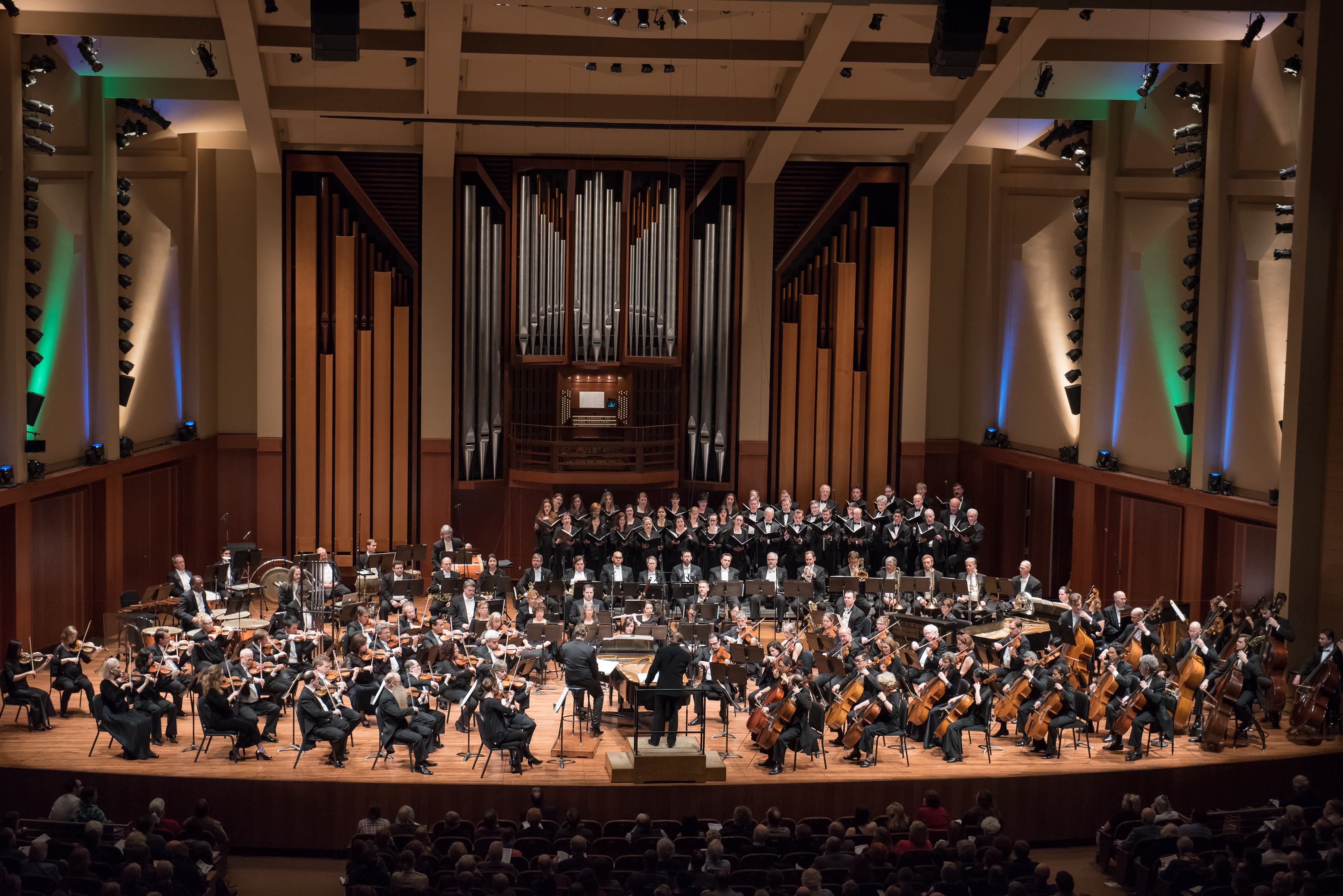
Rach 3 was of course the audience-luring part of the program, but the real reason not to miss it is the opportunity to encounter a live performance of the Fourth Symphony, that great Ivesian summa. As fas as I can tell, this was the SSO’s first time performing the work. (You can still catch it on Saturday night, 31 January.)

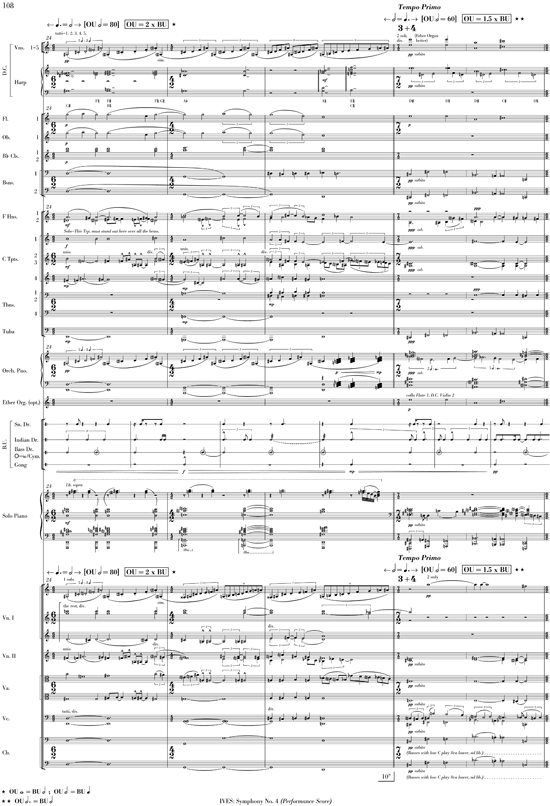
The Ives Fourth is something like the symphony’s version of The Great American Novel — which is to say, in terms of its aspirations and the impossibility of living up to them. The particulars of its scoring — the need for four conductors to orchestrate the simultaneous offstage performing forces, six keyboards (in this case, with the bells Ives asks for sampled from a keyboard), enlarged onstage orchestra and chorus — sometimes tempt people to describe it like some kind of concert hall circus act. (After all, the moniker “Symphony of A Thousand” was just a marketing ploy to drum up interest in Mahler’s Eighth Symphony, whose premiere around the time Ives was working in earnest on his Fourth — in 1910 — turned out to bring Mahler his greatest success as a composer during his own lifetime.)

In fact, for all the Mahlerian comparison that might be made with Ives, the latter’s Fourth Symphony is quite modest in duration (its length comparable to that of a Classical symphony). But its blend of familiar (even “homey”) elements with the most audacious complexities immediately forces the listener out of easy-going habits. And that gives it an enormous resonance, a field of implications, that may seem disproportionate to the dimensions of the composer’s architecture. Yet it all results in a thrilling rush — and a reset/reboot to your thinking about what music can do.

As he has shown with other musical pioneers like Edgard Varèse, Morlot has an impressive grasp on just that essential point. He knows that behind the show biz factor of all the paraphernalia, the bells and whistles, this is composing at its most ambitious — thinking in music the way writers, philosophers, scientists think with their respective tools.

Ives Concert

By way of a preface, Morlot gave a fairly extensive “show and tell” intro to the piece. He introduced his fellow conductors: Stilian Kirov, who shares the stage with him, positioned a bit further upstage; Julia Tai, heading the ethereal combo of strings, harps, and partially quarter-tone-tuned piano; David Alexander Rahbee coordinating the battalion of offstage percussion for the last movement (described in the score as a “subterranean percussion ensemble”); and Joseph Crnko, who had prepared the Seattle Symphony Chorale in advance. Morlot also illustrated examples of Ives’ radical concept of polyphonic layering and simultaneous, clashing sound worlds, remarking that “this incredible complexity is built up from the simplest basic elements.”

That dialectic of simplicity-complexity informed Morlot’s own overall vision of the Fourth. Instead of presenting a mere jumble of jarring contrasts, he clearly elicited the sense of enigma that is posed in the brief, preludial opening movement — the enigma that is the engine of this work and that successive movements try to “answer.” The simple hymn tune sung by the chorus in the first movement (“Watchman, tell us of the night”) signals a pilgrimage for meaning. But that pilgrimage soon goes astray — or wanders off into directions unforeseen and unforeseeable. As he molded the music’s progress, at times I noticed Morlot using conducting gestures I’ve never seen him make before.

In Morlot’s interpretation, “the searching question” that we “ask of life” (as the composer described his “program”) has to take account of all of it: the mystical meditations of the otherworldly (and offstage) strings and harps, the bright noon of chaotically colliding marches and cheerful anarchy in the second movement (Ives’ “Comedy”), the sober, ordered fugue of the third (more wonderful string ensemble playing here), and the cosmic rhythms that set the finale in motion.

Ives may have intended the more conventional beauty of the “religious” answer offered by the third movement to be heard as parody (perhaps like Strauss in the parallel section of Also Sprach Zarathustra?) — much as the “Comedy” of the second affectionately parodies secular, civic life. Morlot allowed all of these attempts to get at “the searching question” to have their say, as if each represents the answer at the moment it holds the stage. The outsize, raucous, yawping vitality of the second movement was overwhelming, a forerunner of the spell of sonic ecstasy-from-noise that later technology would allow rock and other popular genres to exploit.

Brandon Patoc Photography

Brandon Patoc Photography

The accumulated energy of the final movement had the effect of an epiphany. In his terrific commentary on the Fourth, Michael Tilson Thomas (a longstanding Ives champion) describes the offstage percussion as “the ticking of the universal clock” and captures what it is that makes Ives’ vigorous dissonances so revelatory:

It’s typical for Ives to represent this most exalted moment of spiritual search in ever more dissonant and blaring sound…. This to me has always suggested the Mount Sinai aspect of spiritual revelation. Man searches and searches, [but] as he gets too close to the divine it is more than he can bear, the sounds and the harmonies are just too much…. We have to turn away and a few little tendrils of singed nerve endings then lead to the beginnings of the long, luminous coda.

Morlot and the SSO are recording these performances for eventual release as part of their complete cycle of Charles Ives symphonies on the in-house label. Inevitably there will be details that come across with more refinement on the recording than they do in the concert hall. But there’s no substitute for the live experience — above all in a work so reliant on an acoustically spatial concept of symphonic abundance. To have both to compare is ideal.

(c)2015 Thomas May. All rights reserved.

Filed under: Ives, pianists, Rachmaninoff, review, Seattle Symphony

Down the Rabbit Hole

Angelenos have lot to look forward to in coming weeks — including the belated West Coast premiere of Unsuk Chin’s Alice in Wonderland by the LA Philharmonic (in a co-production with LA Opera). I’m more and more in love with this work.

Chin on her love of dreams and their “reality”:

The visions of my dreams are for me a much more existential level of experience than anything that I have known in my everyday life. They influence my personality and are the great joy of my life. Dreams are for me an encounter with another world, in which completely different physical laws prevail.

Sometimes a dream is so complex that as soon as you wake up only a vague memory of it remains … When you try to describe such a complex dream-state in words, there inevitably arises what we call nonsense, since our language is subjected to a completely different logic.

Filed under: Los Angeles Opera, Los Angeles Philharmonic, new music, opera

Finding the Light, Facing the Darkness

It seems — at least as of now — that tonight’s opening of the Met’s double bill of Tchaikovsky and Bartók will proceed as planned, despite the blizzard arriving. It’s a new production directed by Mariusz Trelinski and starring Anna Netrebko as the blind Princess Iolanta for the Tchaikovsky one-act.

Toi toi toi!

My program essay:

Only two decades separate the composition of Iolanta and Bluebeard’s Castle. Yet during these years, the music of fin-de-siècle Romanticism sounded the last gasps of a philosophy that was rapidly being made obsolete by the efforts of a diverse generation of radical younger composers. That, at least, is the narrative we’re usually told. In fact the shift toward modernism was not nearly so clean-cut or abrupt.

You can find the whole piece here (pdf: starting on p. 3 of the insert, after p. 36)

Filed under: Bartók, essay, Metropolitan Opera, Tchaikovsky

Heavy of Heart

heartbeat

“When your heart beats irregularly from heart disease, it does so in some predictable patterns. We think we hear some of those same patterns in his music,”says Professor of Internal Medicine Joel Howell about Beethoven, referring to findings in an article he recently co-authored: “The Heartfelt Music of Ludwig van Beethoven” (together with cardiologist Zachary D. Goldberger and musicologist Steven Whiting.

Their article, according to the abstract, “strengthens the hypothesis that Beethoven suffered from cardiac arrhythmias by placing Beethoven’s music in its historical context, and by identifying several compositions that may reflect Beethoven’s experience of an arrhythmia.”

Of course Beethoven’s best-known physical condition was his deafness, which started setting in around the turn of the century, when he was entering his thirties. The causes, however, remain a matter of speculation. In her post on the Futurity website, Beata Mostafavi remarks that additional claims have been made over the years that the composer suffered from “a litany of mysterious health problems including inflammatory bowel disease, Paget’s disease (abnormal bone destruction), liver disease, alcohol abuse, and kidney disease.”

As for the claim of an abnormal heartbeat, the new study zeroes in on such compositions as the late string quartets: in particular, the Cavatina from Op. 130 in B-flat major. Mostafavi cites the famous score indication in the middle of the Cavatina — “beklemmt” (“anguished,” “pinched,” “oppressed”), which the authors apparently render as “heavy of heart”:

[The] authors note that “heavy of heart” could mean sadness but may also describe the sensation of pressure, a feeling that is associated with cardiac disease. “The arrhythmic quality of this section is unquestionable,” they write.

I wonder, though, whether their premise might be working the wrong way. Scientists and artists approach unpredictability and patterns in a radically different way. Musical genius deliberately expresses itself via unpredictable patterns. One of the key factors that makes mediocre music mediocre and boring is precisely because (usually unconsciously) we can tell “where it’s going” as it repeats the same formulas over and over.
(Note this is NOT to be equated with the techniques of Minimalism: predictability can also be made artfully unpredictable.)

But to the extent that this study is trying to “explain” pattern aberrations, I think it may be on the wrong track. On the other hand, there are plausible arguments for a composer like Mahler — who we know did suffer from a serious heart ailment — inscribing his bio-rhythms into something like the halting rhythmic patterns at the start of his Ninth Symphony.

I’ve also seen convincing descriptions of the finale of Beethoven’s Second Symphony — one of the great examples of humor in music — as alluding to the composer’s digestive problems to create a musical joke:

Pay attention to how that chirpy opening figure is set against the rumble lower in the strings that follows it — the leap from this “hiccup” high up to the rumbles and quivers below, like a belch with belly-growl. The Second was actually considered bizarre and even shocking music at its premiere in 1803. One contemporary review on the piece as a whole: “a hideously writhing, wounded dragon that refuses to die, but writhing in its last agonies and, in the fourth movement, bleeding to death.”

Filed under: Beethoven, health, science

Happy Birthday, John Luther Adams!

jla

A birthday salute to the marvelous composer John Luther Adams, who was born on January 23, 1953 — and who was named Musical America’s Composer of the Year for 2015 — on the heels of winning last year’s Pulitzer Prize in Music for Become Ocean.

He also recently garnered Columbia’s William Schuman Award for Lifetime Achievement, it was announced last month.

My feature on JLA and the Seattle Symphony commission of Become Ocean appears in last fall’s issue of Listen magazine — but behind a paywall, so I can’t post the whole thing here.

Explore more of the world of JLA:

— a recent Radiolab feature on the composer

–WQXR’s Meet the Composer spotlight, hosted by Nadia Sirota

–NPR’s Tom Huizenga on JLA’s new CD, The Wind in High Places

–JLA’s essay (he’s also a gifted writer) titled “The Place Where You Go To Listen”

–Kyle Gann’s introduction to JLA [pdf]

–another JLA essay: “Global Warming and Art”

And just listen:

Filed under: American music, John Luther Adams, new music

Archive

Enter your email address to follow this blog and receive notifications of new posts by email.