MEMETERIA

Icon

Arts writing by Thomas May

The Dream Logic of Unsuk Chin’s Alice in Wonderland

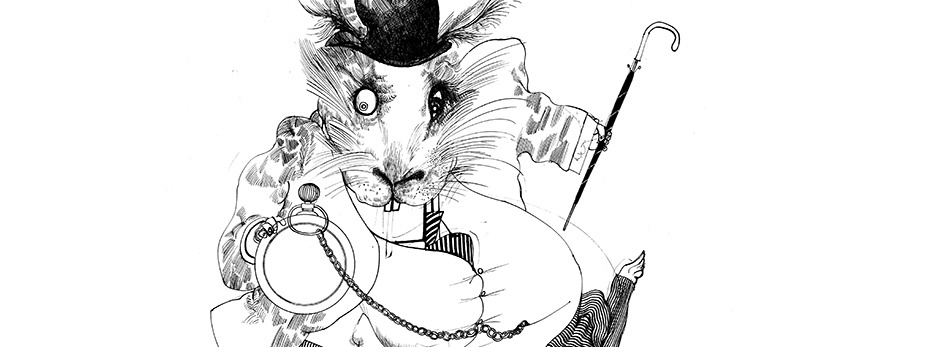
"White Rabbit" by Ralph Steadman

“White Rabbit” by Ralph Steadman

At the end of this month the Los Angeles Philharmonic will be presenting the West Coast premiere of Unsuk Chin’s opera Alice in Wonderland.

Here’s my program essay for the production:

The story of Alice in Wonderland’s creation is rooted in Los Angeles: this West Coast premiere in one sense represents a homecoming. It was Los Angeles Opera that originally commissioned Unsuk Chin to write her first opera, intending to unveil it as part Kent Nagano’s final season as music director (the 2005-06 season). When that plan became unfeasible because of budget cutbacks, Nagano brought the work-in-progress along with him for his inaugural season at Bavarian State Opera.

Alice in Wonderland therefore premiered at the National Theater in Munich in 2007 — the very theater (rebuilt, of course, after its bombing in the Second World War) that gave the world its first Tristan und Isolde in 1865. A certain fantasy narrative that would similarly go on to cast a spell over an enormous spectrum of admirers also happened to be published in that year by the brilliant mathematician, pioneering photographer, and Anglican deacon Charles Lutwidge Dodgson (1832-1898) — aka Lewis Carroll. Celebrations around the globe are marking the 150th anniversary of the first edition of Alice’s Adventures in Wonderland in 2015.

Yet well before the premiere of her opera, Unsuk Chin had written the song cycle snagS&Snarls — a kind of preliminary study to find her way into the world of Lewis Carroll (much as Wagner had done vis-à-vis Tristan with his Wesendonck Lieder). Four of the five songs comprising snagS&Snarls eventually made their way (with alterations) into the score of Alice in Wonderland. Nagano led the first performance at the Ojai Festival in 2004, the year in which Chin won the Grawemeyer Award for her Violin Concerto (more or less considered the music world’s Nobel Prize).

Other pieces by Chin have in the meantime been commissioned by the Los Angeles Philharmonic. Gustavo Dudamel in fact chose to include one of these during the first week of his tenure as music director in October 2009: Šu, a concerto for sheng (mouth organ). In 2013 came the orchestral work Graffiti, Chin’s ode to street art. The composer herself has described Graffiti in terms that could well apply to her method in Alice. She writes that the musical language of Graffiti “shifts between roughness and refinement, complexity and transparency. It is rich in contrast and labyrinthine, neither tonal nor atonal.”

Unsuk Chin’s engagement with Alice in Wonderland reaches even further back than the original LA Opera commission from just over a decade ago. Most fans of Carroll’s Alice books fell in love with these stories as children. Chin, though, is typically atypical in this regard. Instead of reading the work of Lewis Carroll as a child, she was already an adult when she encountered him for the first time as a conservatory student in her native South Korea. Chin recalls that her curiosity was triggered by reading the cognitive scientist Douglas R. Hofstadter’s Gödel, Escher, Bach. The rest of that seminal book’s title, it’s useful to know, is An Eternal Golden Braid. A Metaphorical Fugue on Minds and Machines in the Spirit of Lewis Carroll.

Chin found her title for snagS&Snarls in the chapter heading of another of Hofstadter’s books (Metamagical Themas). Hofstadter intrigued Chin by pulling back the surface layer of what many assume to be the mere “childlike” fantasy of Carroll’s writings and revealing a labyrinthine complexity underneath — a complexity animated by the pure joy of linguistic play. The unpredictable imagery and logic-defying antics of the world according to Lewis Carroll immediately resonated for Chin at her core, touching not just on her aesthetic outlook but on her perception of the centrality of dreams.

“The visions of my dreams represent a far more existential level of experience than anything I have known in my everyday life,” she has stated. “Dreams are for me an encounter with another world, in which utterly different physical laws prevail. Sometimes a dream is so complex that as soon as you wake up only a vague memory of it remains.… When you try to describe such a complex dream-state in words, the result is inevitably what we call ‘nonsense,’ because our language is subject to a very different type of logic.”

Unsuk Chin

Unsuk Chin

Indeed when it came to adapting Alice in Wonderland to the opera stage, Chin decided to interpolate two of her own dream scenes as the opening and final scenes, respectively. She explains that she was “never fully satisfied with the beginning and the end” of Carroll’s published narrative, which seemed “so much more conventional than the rest of Alice” and may have possibly signaled “a concession to public taste, as otherwise the book would have been too daring for its time.” The new dreams — which present additional mysterious encounters for Alice — supply more than a neatly symmetrical framework. They’re organic to the sense of dream time and dream logic that pervades the opera and steer clear of a facile separation between dream and “the real world” (the kind of separation that gives, say, The Wizard of Oz its denouement). As Chin puts it: “I wanted the dreamworld to be the the reality in my opera.”

Chin teamed up with the distinguished playwright, librettist, and scriptwriter David Henry Hwang — a native Angeleno — who crafted a virtuoso text of eight interlocking scenes, with no intermission. The libretto artfully blends key episodes from Alice in Wonderland and the original language of Lewis Carroll with clever postdatings, from the maniacal word play for the acrosticized twisting of “Twinkle, Twinkle, Little Star” to a sly reference to the paradox of Schrödinger’s cat: a potent symbol for the overall philosophy of apparently “nonsense logic” that informs the opera as a whole.

Hwang also includes myriad details in his stage directions, and these are reflected in Chin’s musical realization. They likewise pose fascinating, at times Ring-level challenges for the staging — Alice falling through the rabbit-hole, swimming in a pool of her tears, growing a mile high, and so on.

“As humans, what we’re really interested in is storytelling and concept,” says director Netia Jones in a recent interview with Mark Powell about the high-tech elements that she has enlisted to realize her vision for Alice. “To fully benefit from the amazing sleight of hand that these techniques can offer — the coup de théâtre moment that amazes or confounds, as live performance has always sought to do — it’s vital that any technology behind a production is handled confidently enough to fade into the background.” She adds: “It’s a delicate balancing act between this air of creative anarchy, which Chin’s score definitely lays the foundation for, and the
almost militaristic technical precision required to support it.”

Carroll’s penchant for enigmas, puzzles, acrostics, and other language games also appeals to Chin’s sensibility. The composer made her international breakthrough as a composer in 1993 with Akrostichon-Wortspiel (“Acrostic-Wordplay”), a work that sets texts both by Carroll and by Michael Ende — the aptly named author of another beloved children’s classic, The Neverending Story. In this case, she turned to the conclusion of the Alice saga, drawing on the second book, Through the Looking-Glass, and What Alice Found There (published in 1871). snagS&Snarls actually begins at the end, so to speak, with the very final poem capping Through the Looking-Glass. The poem is an acrostic in which the first letter of each line yields the name of Carroll’s (perhaps erroneously) presumed model, Alice Pleasance Liddell. (This is the only number from snagS&Snarls that never found its way into the opera Alice in Wonderland.) Chin’s list of current projects includes a setting of Alice Through the Looking Glass, which has been commissioned by the Royal Opera in London for the 2018-19 season.

Another impetus behind Chin’s choice of subject matter came from her association with one of her key mentors, György Ligeti. Following her initial studies in composition in Seoul, Chin spent three years in Ligeti’s coveted composition seminar in Hamburg (and eventually resettled in Berlin, where she resides). The maverick Ligeti has treasured Alice in Wonderland ever since encountering Carroll in a Hungarian translation as a child, and before his death in 2006 he was discussing plans for an opera based on Alice. The cartoon- and comic book-inspired “anti-opera” he completed, Le Grand Macabre, shows a number of uncanny parallels with Carroll’s tale of his heroine’s underground adventures. As it happens, Chin shares with her teacher the ability known as synesthesia, that is, to perceive sounds in terms of other senses — chords as colors, for example.

But an Alice in Wonderland by Ligeti would have been utterly distinct from Unsuk Chin’s Alice in Wonderland. She possesses the uncanny talent of being able to tap into an astonishing diversity of sources — including, at times, the manifold web of Ligeti’s orchestral textures — without diluting her unique musical language in faceless eclecticism or tamping down her one-of-kind, magical vision. You can hear fragments that suggest The Rite of Spring, Petrushka, or Bartókian folksiness. The epic motto of Strauss’s Thus Spake Zarathustra is tucked into the fanfare announcing the witnesses in the grand ensemble trial scene. An ominous tolling motif in the lower depths recalls the Coronation music from Boris Godunov.

What results is a fascinating blend of unpredictability and irony that has little in common with, say, the neoclassical posturing of Stravinsky. Often as Stravinsky’s influence is felt in the score for Alice, Chin’s use of allusive gestures never resembles Stravinsky’s manner of being allusive.

Much of the lore of Carroll’s phantasmagoria has to do with its enormous impact on the “adult world” of interpreters. In an essay on the centrality of “imaginary theater” in Chin’s creative thinking, the musicologist Habakuk Traber remarks that “subsequent literary developments — Surrealism, Dadaism, and the Theater of the Absurd, and in particular the ominous literary world and imagery of Franz Kafka” have endowed the Alice books “with a prophetic, prescient dimension.” So, too, the post-Freudian drive to psychologize Carroll and his creations, to interpret his literary dreams. Even pop culture has tried to “explain” what happens. Ever since Jefferson Airplane’s big hit, it’s become alms impossible not to associate the White Rabbit with an afternoon spent experimenting with psychedelic drugs.

Alice in Wonderland “has so many layers,” Chin has remarked: “It can captivate experts and laymen, children and adults as well. That is also an artistic ideal for me.” She even points out that composing the opera entailed a radical shift in orientation toward writing something “much more direct and immediate than in my other pieces.” Speaking with the scientist Matthias Essenpreis, Chin says that once she committed to writing for the genre and to using the Alice material, “I attempted to break away from the traditions of contemporary music and in an instinctive and very fluent way to compose music that resembles a funhouse mirror and that is ironic.”

Chin’s infectious theatrical sensibility enhances her choice of vocal types to assign the characters — including an instrument for the Caterpillar (given a long bass clarinet solo), accompanied by written words — as well as her repertoire of types of vocalization. Alice in Wonderland contains a kind of pocket history of singing: a hint of blues in Alice’s plaintive aria “Who in the world am I,” fancy coloratura for the frantic White Rabbit, a children’s chorus of ethereal simplicity, harpsichord-accompanied recitative at the start of the Mad Tea-Party scene and a characterful Baroque aria as the Mad Hatter laments the cruelty of Time, high dudgeon vocals for the vengeful Queen of Hearts, all culminating in an ensemble of intricately ordered chaos.

Even in the version for reduced ensemble that was prepared as a counterpart to the original gargantuan (and impractical) ensemble used for the opera’s original production in 2007, the scintillating imagination of Chin’s orchestration is unmistakeable — and gives Alice in Wonderland its essential texture. From the first sounds we hear (following those of the actors’ gestures, lulling us into this dreamworld), Chin utilizes extremes of range to effect a sense of drastically elongated dimensions, for example. Yet the “nonsense” world of dream logic hardly means that anything goes.

By the same token, for all of her elaborate timbral and compositional structures, Chin knows the importance of spontaneous fantasy. She remarks that she tries “to avoid providing rigid interpretations of the book — whether psychoanalytical or otherwise. Let the story and its dialogues speak for themselves. What ultimately attracts her to Alice is “the effortless and unconscious way in which Lewis Carroll expresses deep philosophical questions. Alice is not solely a matter of dreams. It is also about a clash between the different ways in which we communicate and experience reality.”

(c)2015 Thomas May. All rights reserved.

Filed under: essay, Los Angeles Philharmonic, new music, opera

Literary Criticism as Science?

Thomas May's avatarMEMETERIA

Franco Moretti Franco Moretti

Franco Moretti’s new collection of essays, Distant Reading, has been generating a lot of buzz. The National Book Critics Circle just honored it with its award for criticism last month (winning out over books by Jonathan Franzen and Janet Malcolm ).

Few critics, writes the Times Literary Supplement are “as hell-bent on rethinking the way we talk about literature.” Wired declares that “if his new methods catch on, they could change the way we look at literary history.” And Joshua Rothman recently offered this reflection on the revolutionary critic in The New Yorker:

Should literary criticism be an art or a science? A surprising amount depends on the answer to that question…. Almost no one…wants to answer the question definitively, because, for a critic, alternating between one’s artistic and scientific temperaments is fun—it’s like switching between the ocean and the sun at the beach. Franco Moretti…

View original post 258 more words

Filed under: Uncategorized

A Birthday Cheer for John Corigliano

Photo by Enid Bloch

Photo by Enid Bloch

February is the birth month of another of America’s greatest composers: today marks the 77th birthday of John Corigliano. A brilliant creative force, Mr. Corigliano has earned acclaim as a master of emotionally complex chamber and orchestral music as well as artful film scores, while his grand opera The Ghosts of Versailles helped pave the way toward the blossoming of new American opera over the last quarter-century.

Los Angeles Opera’s splendid new production of Ghosts, which is bringing this masterpiece to the West Coast for the first time, led the LA Times to suggest that the opera may have “a shot at immortality.”

As if his marvelous catalogue of compositions weren’t enough, Mr. Corigliano has garnered such accolades as the Pulitzer Prize, Grawemeyer Award, five Grammies, and an Oscar.

And he’s obviously a gifted and influential teacher and mentor, as evidenced by the success of such students as Mason Bates and Wlad Marhulets, whose debut opera The Property is about to be given its premiere in Chicago.

Yo-Yo Ma speaks for many of us who care deeply about the arts in our troubled times when he says: “I feel lucky that John and I are living in the same era.”

Filed under: American music, anniversary, John Corigliano

Another Birthday Salute: John Adams at 68

john-adams

A toast to John Adams, who needs no introduction. Today, as Mr. Adams turns 68, he continues to astonish with his inexhaustible creative drive.

Just last month the St. Lawrence String Quartet unveiled his Second Quartet at Stanford University. At the Grammies the St. Louis Symphony and David Robertson’s recording of City Noir and the Saxophone Concerto nabbed the award for Best Orchestral Performance. And next month brings the world premiere of Scheherazade.2, a “dramatic symphony for violin and orchestra.”

This very weekend, Opera Omaha is presenting a new production of his 2006 opera A Flowering Tree directed by James Darrah and conducted by Christopher Rountree.

Composed by John Adams, “A Flowering Tree” made its debut in 2006 and is still relatively unfamiliar to opera lovers. It has its roots in a 2,000-year-old Tamil Indian folk tale and is decidedly dark…
Although this all might seem narratively challenging to communicate in just a little over two hours, James Darrah delivered a mesmerizing production.

–Kim Carpenter, Omaha.com

The works Mr. Adams has given us since my anthology was published nearly a decade ago show this American master working at a sustained peak of creative power. Here’s to many more years to come!

Filed under: American music, anniversary, John Adams

Berlioz’s Roméo et Juliette Symphony toute entière

Berlioz

Hector Berlioz didn’t even know English when he saw his first stagings of Shakespeare in 1827 in Paris, performed by a British company on tour. But it didn’t matter. “Shakespeare, coming upon me unawares, struck me like a thunderbolt,” he later recalled. “The lightning flash of that sublime discovery opened before me at a stroke the whole heaven of art, illuminating it to its remotest depths.”

Those reverberations mixed with the young French artist’s discovery of the Beethoven symphonies around the same time. And both epiphanies propelled Berlioz along his adventurous course as a musical revolutionary.

The work that fuses Berlioz’s reimagining of what a symphony could be with his Shakespearean obsession is Roméo et Juliette. Last night the Seattle Symphony performed RnJ in its entirety — to my knowledge, for the first time in their history. Ludovic Morlot led the expansive forces called for by the score: three vocal soloists, chorus, and orchestra (in this case splitting the first and second violins to left and right). There’s even a touch of acoustical “space music” in the positioning of a brief double choir offstage.

It’s a mammoth score (all told, around an hour and a half — not counting the intermission that was inserted here after the “Queen Mab Scherzo”). The instrumental sections are played as a kind of abridged suite often enough, but encountering the whole megillah is a rarity that brings home how radical were Berlioz’s ideas about music and its relation to text and drama. The result is that RnJ is more or less an acknowledged masterpiece that contains some of this genius’s finest music, yet, oddly, as a whole the work remains more often talked about than heard.

Following Maestro Morlot’s work with specific composers since his tenure began here has been fascinating — and the Berlioz thread has proved particularly satisfying artistically (La Damnation de Faust in his first season, an electrifying Symphonie fantastique this time last year).

Morlot and his musicians are showering love on Roméo et Juliette. Sorry if that sounds schmaltzy, but there’s really no other way to put it: the breathtaking precision of their dynamic shadings, the intensified expressivity, their Zen-like focus on detail, the awareness of complicated, even contradictory emotions in this score.

Berlioz carries further the idea from the finale of Beethoven’s Ninth of the instruments trying to break out into words by doing the opposite: after an orchestral introduction — the discipline of fugal writing paradoxically depicts violent disorder and passion — he stages an overall summing up of the play’s main action in a prologue “act” that features chorus and two soloists positioned behind the strings. (Sylvie Brunet-Grupposo contributed her velvety mezzo and tenor Kenneth Tarver sang with elegant fervor.)

But already you sense the instruments straining to take over the telling, with solemn, commanding rebukes from trombonist Ko-ichiro Yamamoto and the brass ensemble standing in for the Prince of Verona. And Berlioz reserves the most sublime passages for his orchestra, above all in the scene of Romeo alone and the nocturne of the young lovers meeting in the garden of the Capulet residence, beneath Juliet’s balcony. The woodwinds played with soulful poignance, with admirably individualized phrasing from Mary Lynch on oboe and clarinetist Ben Lulich; bassoonist Seth Krimsky sustained a mood of deep, anxious melancholy later in the Tomb Scene.

(The playing was so precise and riveting that I encountered a novel torture to add to the usual litany of cell phones, coughers, page-turners, seat kickers, and other occupational hazards of the concert hall: the penetrating sound that a pair of leather shoes squeaking against each other can generate, as a patron helpfully demonstrated during one of the score’s most heartbreaking moments.)

Morlot tenderly shaped the ebb and flow of the scène d’amour, with its sudden pullings-back and renewed outbursts of pained passion. Richard Wagner (Berlioz’s junior by a decade) was there at the historic premiere of this “symphonie dramatique” in Paris in 1839, and it was an epiphany for Little Richard as well.

It’s enlightening to compare/contrast the passionate melody of this music with its transmogrification in Tristan: the Classical transparency of Berlioz’s sensibility survives his most radical harmonic ideas, so that the French composer’s love music still betrays a moving awareness of limits and fragility that is a far reach from the oceanic transports Wagner permits his lovers to experience.

The players’ crisp focus on detail paid off richly, too, in the gorgeously nimble, ear-tickling “Queen Mab Scherzo” — Berlioz’s rendition, purely through the means of orchestral language, of Mercutio’s ingenious speech about the “fairies’ midwife.” Jeff Fair’s horn solo was outstanding, and Michael Werner’s light-as-a-feather pings on hand-held crotales echoed dreamily against infinitesimally delicate pizzicati. The rehearsals must have been incredibly focused, resulting in a lightning speed tempo and crystal-clear textures that throw the sheer weirdness of this music in high relief.

It should be noted that the text set by Berlioz — no mean wordsmith himself — originated in his own paraphrasing and rewriting, only loosely based on Shakespeare’s original; he had the poet Émile Deschamps craft this into a libretto, thus avoiding direct “competition” with Shakespeare’s verse. The “words” and actions of the lovers themselves are reserved strictly for the orchestra to impart.

Another highlight was Juliet’s Funeral March and the Tomb Scene (in the third part or “act,” which was performed after the intermission). A smaller subset of Joseph Crnko’s Seattle Symphony Chorale had appeared for the narrative of the Prologue. Here they came out in full force and sang with clarity and power. The restraint of their single repeated unison E gave way to emotion-laden elegy, its resplendent polyphony expertly balanced.

Arguably the lengthy finale is the weak link in Berlioz’s conception of this symphony-opera-oratorio hybrid. All the pain, longing, and ecstasy — and violence — that lead to the denouement feel swept aside in a superficially rousing reconciliation, the most overtly operatic scena of the work. Here Berlioz gravitates more obviously back toward the Beethovenian Ninth model of a choral finale. Baritone David Wilson-Johnson — filling in at the last minute — delivered the significant part of the peace-maker Friar Laurence with flair and charisma.

But Berlioz knew that “the very sublimity of this love” is beyond words, though not beyond expression. To access this he focuses in Roméo et Juliette on, as he described it, “the language of instruments, a language richer, more varied, less restricted, and thanks to its very indefiniteness, incomparably more potent.”

There’s one more chance to hear this performance of Berlioz’s Roméo et Juliette: Saturday 14 February 2015 at 8 pm at Benaroya Hall. Tickets here.

UPDATE: I asked SSO staff about an odd commotion that took place just as concertmaster Alexander Velinzon came out. A man started shouting something in an agitated voice (I couldn’t make out what he was saying) and walked up the aisle holding a pen and pointing it at one of the ushers. Apparently police were notified and came to Benaroya Hall after the gentleman had exited the hall. I’m told there were no other problems and that he was given a refund for the ticket he had purchased.

On Twitter, Terry Miller wondered whether the disturbance was from the Montague or Capulet side.

(C)2015 Thomas May. All rights reserved.

Filed under: Berlioz, conductors, review, Seattle Symphony

The Bang on a Can Marathon Comes to Seattle

Bang on a Can All-Stars

Bang on a Can All-Stars: image (c) Peter Serling

Here’s a performance/happening you’re not going to be able to file away into one of the familiar musical categories. Is it classical (because, you know, strings and other traditional instruments, complicated scores being interpreted)? Experimental, maybe avant-garde? “Crossover” (whatever that‘s supposed to mean nowadays)? Let’s just call it a one-of-a-kind event: the first-ever Seattle edition of the annual Bang on a Can marathon. It takes over the Moore Theatre this Sunday, February 15, for six hours of blissful music-making.

You know how the phrase “classical music concert” used to imply a mostly predictable format? That’s no longer a safe assumption, thanks to the innovative thinking of orchestras like the Seattle Symphony and music director, Ludovic Morlot — thinking that involves not just the content of a concert but the venue where it’s performed.

By the same token, there once was a time when the prospect of a “new music” (aka “modern music”) program signaled a ritualistic exercise in high-toned concentration. Back in 1987, a trio of like-minded young composers — Julia Wolfe, Michael Gordon, and David Lang — put together a 12-hour marathon of adventurous music in a SoHo art gallery (when NYC’s SoHo was still SoHo). That one-off event was intended to attract curious ears to the energy and excitement and variety of music being composed in our time outside the commercial formulas of the pop industry — and outside the confines of the concert hall.

The inaugural marathon turned out to be the birth of a performing arts organization that’s now a major international force in the realm of contemporary classical music (another unsatisfactory term for a whole world of music that can’t be readily defined). More than a quarter century on, Bang on a Can remains “dedicated to the support of experimental music, wherever we would find it.” It commissions and records new works, develops programs to foster a new generation of audiences and musicians, and presents numerous events, including the annual Bang on a Can Marathon.

The appeal of the marathon format, according to co-founder and composer (and Dan Savage look-alike) Michael Gordon, is that it encourages people to “let down their guard. The event is aimed at people who are interested in broad listening, who come to listen with open hears. Many people know what they like and might come to the Marathon to hear that type of music. The next thing on the line-up will be completely different, something they would have never come across otherwise. Everything moves quickly and the sets are pretty short. So they start listening to things that they wouldn’t normally encounter. That’s basically the whole point: to broaden your listening and to have a good time with it.”

The venue is important for that context. Seattle’s Bang on a Can Marathon is being co-presented by Seattle Theatre Group and On The Boards at the Moore Theatre. Gordon refers to Bang on a Can’s MO of performing in “neutral spaces, audience-friendly spaces” that shed any of those lingering fears (however unjustified) of the concert hall as a place where only the musically initiated can feel comfortable. He points out that museums and public spaces like the Winter Garden in New York have served this purpose well.

Gordon also has praise for the Seattle Symphony’s recent initiatives under Ludovic Morlot: “They’re doing a lot of progressive work — not only reaching out into other communities but also by doing a lot of interesting commissioning. Orchestras have to change their attitudes. The SSO is on the forefront of finding a way to be relevant today.”

Bang on a Can’s Marathon will mix in work from adventurous Seattle-based or -associated composers and musicians with pieces by each of the organization’s co-founders. The whole event will be framed by new-music “classics” that have had a profound — and not always acknowledged — impact on the music world at large: Brian Eno’s ambient masterpiece, Music for Airports, and Music for 18 Musicians, one of Minimalist Steve Reich’s signature works.

“The Marathon is all about finding people who are pushing the boundaries of their kind of music and letting that be the thread that goes through each of the acts,” says Jherek Bischoff, who was asked to curate the Seattle festival. “Pushing boundaries is one thread.” Another is serendipity: “Someone might come for the hip-hop segment [featuring Shabazz Palaces] and then they’ll happen to hear some modern classical right next to it.”

Bischoff, who comes from a family of musicians, was raised on a sailboat and on Bainbridge Island. He began his career as a multi-instrumentalist: “I started with the saxophone, moved on to tuba and then to bass — and then things stated getting crazy with way too many instruments…” Not surprisingly, Bischoff channels his talents into myriad musical activities, from performing and composing to producing — and, now, curating.

“People I wanted to include sprang to mind right away,” Bischoff explains. “For me, it’s exciting to give them the opportunity to play at the Moore. One of those people is Morgan Henderson. He’s the perfect example of what Bang on a Can is doing, which is to take someone who totally goes under the radar and put them in the spotlight. Morgan is one of the most talented musicians I know. He plays bass in the hardcore band The Blood Brothers but then he also plays flute in the Fleet Foxes band — the exact opposite type of music and instrument.”

Jherek Bischoff

Jherek Bischoff

Another figure Bischoff was eager to add to the line-up is Seattle pianist Gust Burns. “He’s one of the most insanely technically proficient pianists I’ve heard, and at the same time he’s also a wonderful improviser. When you see him perform, you can’t believe that there’s just one person making all that sound with the piano.”

Bischoff, who moved to Los Angeles a few months ago, will also bring along his own recent efforts as a composer: “It’s ambient orchestral music that was inspired by my time out at the cistern in Fort Worden State Park [in Port Townsend], where I did a residency. The cistern is a two-million-gallon water tank underground that has a 45-second reverb. I improvised there for days and recorded the whole thing and ended up turning some of those improvisations into full-blown orchestral pieces.” The results will be performed by the Scrape Ensemble (strings) with Bischoff on bass and “a bunch of reverb piped in to give you a bit of a sense of that alternate space.”

Along with those mentioned above and the Bang on a Can All-Stars, other artists on the roster include the duo Jesssika Kenney & Eyvind Kang, Jim Knapp, Greg Campbell, and California-based red fish blue fish.

But isn’t four hours of musical discovery a bit overwhelming? Bischoff points out that it’s perfectly fine for the audience to weave in and out and take breaks — much as became the custom during performances of a mammoth work like Philip Glass’s Einstein on the Beach. “You can step out to get a drink. The Bang on a Can marathon I attended in New York took place in a big atrium and there was even a food court where you could go to eat and watch as the music played on.”

If you go: The Bang on a Can Marathon’s Seattle edition is being co-presented by Seattle Theatre Group and On The Boards at the Moore Theatre, Sunday, February 15, from 4 to 10 p.m. Tickets here.

(C)2015 Thomas May. All rights reserved.

Filed under: new music, preview, programming innovation

Ghosting in LA

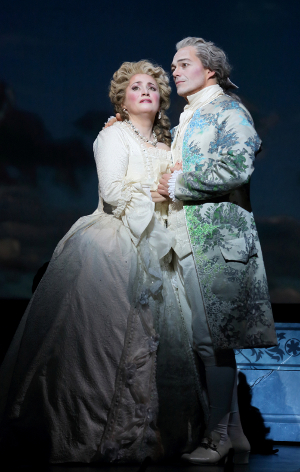
Patricia Racette (Marie Antoinette) and Christopher Maltman (Beaumarchais): © Craig Mathew | LA Opera

Patricia Racette (Marie Antoinette) and Christopher Maltman (Beaumarchais): © Craig Mathew | LA Opera

One of the most thrilling evenings I’ve experienced in years at the opera house — at the theater in general — was last weekend’s opening night of Los Angeles Opera’s new production of The Ghosts of Versailles.

Here’s a quick overview of the critical reaction so far:

It’s comic and serious, entertaining and erudite, silly and thoughtful, emotional and mysterious, harrowing and uplifting, intimate and over-the-top — and the more times you see it, the more you’ll find in it and the more you’ll get out of it. It helps to be an opera or history buff to get all of the references, reminiscences and send-ups, but it’s not necessary.

–Richard S, Ginell, Los Angeles Times

James Conlon in the pit showed an absolute mastery of the score and LA Opera Orchestra played like angels for him. Through an evening of very challenging harmonies and swift changes of tempo they alighted on each new melody with precision and a transparency that I hadn’t enjoyed in this work before…

A better performance of this large and complex work couldn’t possibly be hoped for and I can’t express strongly enough what a tremendous experience it was to see live. We were “in the presence of the composer’ last night as they say.

–Patrick Mack, parterre.com

In an achingly beautiful LA Opera production, the ghosts of monarchies and revolutions past materialize before our eyes at the Dorothy Chandler Pavilion. We are enveloped in an exquisite postmodern version of Marie Antoinette’s little theatre at Versailles, awash in dusty blues and pearlescent greens. It is the world of John Corigliano’s opera, The Ghosts of Versailles.

–Jane Rosenberg, The International Review of Music

It’s all interesting and entertaining if not invariably arresting. Written for the Metropolitan Opera, which gave the premiere in 1991, “Ghosts,” lasting nearly three hours on Saturday, seems rather loosely-knit and bloated. The jokes, pretty good though sometimes fairly broad, don’t always sit right with the ostensibly serious subject matter. When all is said and done, the whole is about as deep as an episode of “The Twilight Zone.”

–Timothy Mangan, Orange County Register

With an expensive stage set that rivals the royal opera house in Versailles and a large cast that includes a headless Marie Antoinette and a rabid army of French Revolutionaries — as well as an exotic temptress portrayed by a certain Broadway star who enters astride a hot-pink elephant — L.A. Opera’s production of The Ghosts of Versailles at the Chandler Pavilion is a visually stunning affair.

–Falling James, LA Weekly

Patricia Racette gives a commanding performance as Marie Antoinette, combining wistfully naïve nostalgia with nightmarish horror.

–Jim Farber, San Francisco Classical Voice

In the end, there wasn’t even enough room on stage! At the curtain call the cast stretched the entire width of it with several getting squeezed out of the final bow. Corigliano’s opera really is larger than life, and, appropriately, the last person brought out was the composer himself. The Ghosts of Versailles, over 20 years after its première, (which was 11 years after it was commissioned) was worth the wait. While the opera isn’t perfect, it is a colossal achievement. William M. Hoffman’s poetic libretto with Corigliano’s evocative fusion of styles makes not only an impressive spectacle of theater, but an opera of intense feeling and LA Opera’s production captures that magic exquisitely. It was a triumph.

–Matthew Richard Martinez, bachtrack.com

Filed under: American opera, directors, John Corigliano, Los Angeles Opera

Happy Birthday, John Luther Adams!

Reblogging this in honor of JLA’s Grammy win for “Become Ocean” — which also brings the Seattle Symphony Orchestra its first-ever Grammy. Congratulations!

Thomas May's avatarMEMETERIA

jla

A birthday salute to the marvelous composer John Luther Adams, who was born on January 23, 1953 — and who was named Musical America’s Composer of the Year for 2015 — on the heels of winning last year’s Pulitzer Prize in Music for Become Ocean.

He also recently garnered Columbia’s William Schuman Award for Lifetime Achievement, it was announced last month.

My feature on JLA and the Seattle Symphony commission of Become Ocean appears in last fall’s issue of Listen magazine — but behind a paywall, so I can’t post the whole thing here.

Explore more of the world of JLA:

— a recent Radiolab feature on the composer

–WQXR’s Meet the Composer spotlight, hosted by Nadia Sirota

–NPR’s Tom Huizenga on JLA’s new CD, The Wind in High Places

–JLA’s essay (he’s also a gifted writer) titled “The Place Where You Go To Listen”

–Kyle Gann’s introduction

View original post 13 more words

Filed under: Uncategorized

Going Organic

Hurricane_Mama

The other night it was lovely being reminded of how Hurricane Mama, Disney Concert Hall’s fabulous organ, holds court even when that gorgeous monster’s not being played. So I wanted to share this article on the resurgence of the organ in the concert hall, which included a focus on Paul Jacobs and Cameron Carpenter. I published this piece back in the spring of 2012 in Symphony magazine:

Going Organic: The King of Instruments Makes a Comeback in the Concert Hall

Blame it on Stravinsky. Explaining why he opted against using the organ in his Symphony of Psalms, the composer complained that “the monster never breathes.” His notorious putdown may have only mirrored a larger bias fashionable in the heyday of modernism. Still, as a revered musical icon, Stravinsky condemned the organ in a way that reverberated through much of the latter half of the 20th century. A similar attitude can still be encountered among those who write off the instrument as the concern of a specialist, even fringe constituency. Yet several recent trends indicate that the organ is earning a rediscovered sense of respect—and creating remarkable musical pleasure—in concert halls across North America.

In February, for example, California’s Pacific Symphony and music director Carl St.Clair gave the world premiere in Orange County’s Segerstrom Hall of Michael Daugherty’s organ concerto, The Gospel According to Sister Aimee, which dramatizes the life and career of “the first important religious celebrity of the new mass media era,” as the composer describes it. The piece represents one among an extraordinary range of fresh commissions intended to take advantage of the renaissance of pipe organs that have sprouted up in newly built or renovated concert halls during the past twenty years.

“The organ is like an orchestra in itself, so in effect a concerto is like writing for two orchestras,” says Daugherty, homing in on the special appeal of writing for organ and orchestra. “Yes, this is the king of instruments, but it can produce delicate sounds, too. It’s like the field of percussion, where you have a range from the powerful and loud to the very soft and subtle. You can get hundreds of different timbres from a great organ.” He adds that in the past few years, concerts of original music presented by his students at the University of Michigan have increasingly demonstrated an interest in the organ.

continue reading [Note: please navigate to p. 30 of the linked online magazine]

(c)2015 Thomas May. All rights reserved.

Filed under: American music, essay, organ, programming

Carousel at the 5th Ave: A Byrd’s-Eye View

Donald Byrd

Donald Byrd

After creating a buzz with last week’s announcement of an especially appealing eight-show season for 2015-15, the 5th Avenue Theatre is about to unveil its new production of Carousel. Laura Griffith and Brandon O’Neill (on the heels of his Broadway debut in Disney’s Aladdin) star as Julie and Billy in a new production directed by 5th Avenue’s producing artistic director Bill Berry, with music supervisor Ian Eisendrath leading a 21-piece orchestra.

The early Rodgers & Hammerstein classic gets a fresh airing in this fourth major collaboration between the 5th Ave and Spectrum Dance Theater — for my money, one of the most creatively stimulating and innovative performing arts companies on the Seattle scene.

Donald Byrd, Spectrum’s artistic director, brings his dancers back to the 5th after choreographing a thought-provoking, insightful interpretation in 2012 of Oklahoma! – the groundbreaking Rodgers & Hammerstein musical from 1943 that preceded Carousel by two years.

I recently spoke to the Bessie Award-winning, Tony-nominated choreographer about his latest engagement with an icon of American musical theater.

What makes a work like Carousel, now seven decades old, still work for audiences today? How do you find it resonates for people today?

DB: The appeal is that it is a classic. We wouldn’t have the kinds of musicals we enjoy today if it wasn’t for these Rodgers & Hammerstein musicals. They invented the book musical in many ways. And it’s also important to be reminded of why they work so well and tell us something about storytelling in the musical theater that contemporary musicals often don’t do as well.

For me it’s exciting to go back to the source and see how they build a show with a classic arc and climax. As with any classic, you can learn something different and deepen your understanding every time you come back to it. For example, Oklahoma! says something about how dance can work in the modern musical. With Carousel it’s a much darker story, and that points to the range and breadth of what a musical theater piece can be and do.

You were personally encouraged by Agnes de Mille, the legendary choreographer of the original show, when you were embarking on your own career. What is significant for you about her contributions? How did she demonstrate that dance can fit into those possibilities?

DB: She was interested in how to tell a story and also in how to tell an American story. Even though the source material [the 1909 play Liliom by Hungarian writer Ferenc Molnár] is not American, they created a very American story in the way they told it.

De Mille really wanted to have an American dance and American themes and heroes and heroines. Sometimes her dances may look and feel old-fashioned, but if you keep in mind what she was after, you start to see beyond that.

How did you decide to approach or reference the original ballets De Mille choreographed for Carousel — and Oklahoma!, for that matter?

DB: I found myself wanting to honor what Agnes De Mille did and to make sure that somehow her values are embedded in what I do with the shows. I follow the scenario she created, but i don’t use her movement necessarily — though I do quote here. In the big ballet [the “Billy Makes a Journey” scene in the second act], the first thing is a quote.

Yet in your version of Oklahoma! you introduced an intriguing Freudian dream sequence.

DB: The dream sequence I used for the Oklahoma! ballet looked at how artists of that period were all talking about sex and Freud. Psychology doesn’t play such a deeply rooted role in Carousel, but one of the show’s themes is about how what we desire is both to be able to give and to receive love. This manifests itself in a desire to be accepted — and also in the impulse to push people away and to create the Other. Louise [the daughter of Julie and Billy] is definitely the Other.

Community is important in both Oklahoma! and in Carousel. And what a close-knit community creates is outsiders. At the same time, there’s a fascination with the Outsider. Carrie, Julie’s best friend, shows this when she considers her options regarding the person she can marry. She has a choice between someone very rigid, like Enoch Snow — a version of a young Tea Party Republican — or someone exciting like Billy Bigelow, the dangerous bad boy.

He’s like an animal that is caged. When he’s domesticated, what does he do? This manifests itself later in the show with his daughter Louise, who also has Billy’s spirit.

Tell me more about your take on the character of Billy Bigelow.

DB: In some ways Carousel is really about a type of person. It makes me think of the Heath Ledger character in Brokeback Mountain: here’s a person completely ill-equipped to deal with his situation, He has no tools to express his circumstances and his internal life to the outside world. I think [Carousel‘s hero] Billy Bigelow is somebody who has no tools to express a very essential part of life. How do you express that you love somebody?

On top of that — and this gets back to how Carousel still resonates for audiences of today — Billy is living in an America that’s changing in the 19th century. It’s a little bit like what we have going on now, for working people at least. Billy’s a barker at a carnival, but after he loses his job he discovers he doesn’t have any skills. So he’s in a situation of feeling forced to do something morally that he doesn’t agree with when he attempts the ill-fated robbery. And he’s unable to express his love for Julie. He resorts to domestic violence, a classic manifestation of his sense of being a failure. How do you cope when you’re not prepared to do the things you need to do to live in the world?

Another thread that runs through Carousel is a kind of ambition which is very American. Louise [Billy and Julie’s daughter] is an outsider because of what her father has done but she’s ambitious to succeed at something. In theory America is classless, but Louise finds she is somehow locked out. This seems to be one of the directions the country is moving into again. Read Thomas Piketty’s Capitalism in the Twenty-First Century, where talks about a new class of the super-rich that comes from inherited wealth, while the rest of us are locked outside of that. These are some ways of looking at this musical that show how it resonates with the America we live in today.

Photo by Jeff Carpenter

Photo by Jeff Carpenter

What stands out for you this time in your collaboration with 5th Avenue Theatre?

DB: Spectrum is even more integrated into the entire production than we were in Oklahoma!. For example, the famous clambake scene in the first act — “June is Bustin’ Out All Over” — is all about hormones flowing at springtime and all the hot-and-bothered excitement and horniness that goes along with that. But in the original there was a pretty dance for the women that but didn’t have much to do with what the song was about. It was followed by a number in which all the men had a hornpipe dance. We thought it was weird that in this number about sex there was no dancing together of couples. But in the movie (which De Mille didn’t choreograph), they did a big dance number for “June,” so we decided to add a newly invented dance number within that number.

Looking back, what do you make of the fact that your choreography for the dream sequence in Oklahoma! generated so much controversy? Do you expect any similar reactions this time around?

DB: The story itself is already controversial. There’s nothing I can do that can make it any more controversial. Carousel is not really what many people think of as typical “musical theater” material.
I think the production is adult but will not be controversial.

To me it seems people were overreactive with Oklahoma!. It was their interpretation of the staging that made it controversial: it resonated in a way that created discomfort. Places like Seattle that perceive themselves as being really progressive don’t like to have this brought it up for them.

A lot of it was generational: people who grew up in the Civil Rights era were in general more reactive than people who were younger. It’s about not wanting to revisit these issues. When they’re further back, like 12 Years a Slave, then it’s easier to handle, but not when we’re talking about history that is too recent. So part of it comes down to people not wanting that stuff to be there — references to lynching or to racist stereotypes of the oversexed Black man.

But those prejudices are there and we need to look at them. There’s nothing wrong with being uncomfortable! Sometimes you need to be uncomfortable to wake up to reality. When I first did The Minstrel Show, Yusef Hawkins was beaten to death by a gang of white kids in Bensonhurst. I remember thinking: How could this happen in 1989!” I thought all of that was over, but it really woke me up. We often assume things are done when it comes to social justice issues. But they’re not done.

What are some things that might make us feel productively uncomfortable in Carousel?

DB: The feeling that comes from being on the outside, recognizing that we do in fact have a class system. Carousel also shows people facing judgment about whether it’s appropriate to be in love with or to marry a certain person. And the issue of domestic violence runs through the show as well. Carousel shows us that it’s important to address the reason behind why people behave the way they do.

(C)2015 Thomas May. All rights reserved.

Filed under: dance, Donald Byrd, interview, musical, Spectrum Dance

Archive

Enter your email address to follow this blog and receive notifications of new posts by email.