Benjamin Britten (r) and Peter Pears (l)
And so we arrive at the last of the big three composer anniversaries this year – the anniversaries that not so long ago seemed to loom on the other side of the apocalypse said to be awaiting us in 2012. November 22 – Saint Cecilia’s Day, the patron saint of music, as it has become obligatory to point out – marks the official centenary of the birth of Benjamin Britten.
I wish I could come up with something a fraction as eloquent as my colleagues to pay tribute to the creative genius of this endlessly fascinating figure, but my recent essay on the War Requiem will have to do the honors:
Ruin and Renewal: Britten’s War Requiem
“I was completely absorbed in this piece, as really never before, but with considerable agony in finding the adequate notes for such a subject (and such words!), and dread discovering that I’ve not succeeded.” So Benjamin Britten confided to a friend not long before the War Requiem‘s premiere in May 1962.
Britten’s agony produced not only one of the landmark compositions of his career but a testimony to the power of art to confront humanity’s failings and at the same time to offer hope. As for the dread of not succeeding, the War Requiem stands out as a rare instance in 20th-century music of a new work that was greeted with overwhelming approval by critics and audiences alike.
“The composer’s duty, as a member of society,” declared Britten in his famous speech accepting the Aspen Award in 1964, “[is] to speak to or for his fellow human beings.” From first note to last, the War Requiem holds true to this conviction of the role of music in society. The ethical perspective of the lifelong pacifist who had been a conscientious objector in the Second World War converges with the remarkable gifts that made Britten one of the supreme musical dramatists of the past century and a master of large-form architecture.
At the same time, the imperative to communicate by no means requires adhering to safe, comfortable formulas. In taking up one of the most tradition-laden texts of Western music, the Latin Mass for the Dead, Britten challenges and reinvigorates the very meaning of this ritual.
After the Second World War, the composer had actually considered Requiem-like works to commemorate the victims of the atomic bombings of Japan and, later, the assassination of Gandhi, but these plans never crystallized. Earlier, in 1940, he had written a purely instrumental Sinfonia da Requiem, but that work exists in a category all its own. The commission to supply a new score as part of the upcoming consecration of the newly rebuilt Coventry Cathedral provided Britten with the stimulus he needed at last to embark on a large-scale choral-symphonic composition.

Winston Churchill visits Coventry Cathedral in ruins after the bombing of 14/15 November 1940
Carpenter suggests that the composer’s sadness over the recent suicide of a former friend who had survived the war but struggled with depression may have also occasioned the need to compose the War Requiem as a more private response to tragedy. This may explain Britten’s puzzling statement: “That’s what the War Requiem is about; it is reparation.” In his recently published Benjamin Britten: A Life for Music, the biographer and journalist Neil Powell notes that “a work which had originated as a very public commission was increasingly concerned with a very private subtext.”
Bombing raids by the Luftwaffe during the blitzkrieg in 1940 had nearly destroyed the industrial city of Coventry in the West Midlands, including the Gothic Cathedral of St. Michael dating from the 14th century. The Scottish architect Basil Spence designed a new modernist structure, but not merely as replacement: he decided to retain the roofless, ruined shell of the earlier church, whose spire had been left standing, and link it to the new building.
The consecration ceremony thus offered an occasion to reflect on the destruction wrought by the war – at the height, it will be recalled, of the Cold War that was threatening outright annihilation of humanity. Just a few months after the War Requiem‘s premiere, the Cuban Missile crisis would bring the West to the brink of apocalypse.

Wilfred Owen
Britten wasn’t interested in a reassuring but simplistic idealism about the sacrifices of war that whitewashed or forgave war’s inherent atrocity. The War Requiem – the title itself suggests an uneasy juxtaposition – thus combines the traditional Latin texts (with one telling change, in the Agnus Dei) with the mordantly ironic antiwar poetry of Wilfred Owen, a victim of the First World War. (His brother Harold sent Britten a letter praising the War Requiem and expressing joy “that Wilfred’s poetry will forever be a part of this great work.”)
The implicit homoeroticism of Owen’s poetry also resonated with Britten, who had already set his words to music alongside several other poets in the song cycle Nocturne (1958); its sound world in fact foreshadows parts of the War Requiem. As an epigraph to the latter, Britten quoted a passage by Owen that mirrors his own vision here as a composer: “My subject is War, and the pity of War. The Poetry is in the pity. All a poet can do is to warn.”
To anchor his antiwar message, Britten taps into a tradition of sacred music which carries a plea for peace amid contemporary turmoil. Well-known examples from the sacred music canon are Haydn’s Missa in tempore belli and Beethoven’s Missa solemnis. Britten’s mixture of Latin liturgical texts with secular poetry is likewise not without precedent. Yet he juxtaposes the poems of Owen so that they become a provocative commentary on the familiar Requiem. The result is a complex yet ingeniously lucid six-movement structure in which is embedded an ongoing song cycle for tenor and baritone.
In a sense, this fusion of the ancient and the modern to underscore both the “pity” and the poet’s warning – the secondary level that comments on the primary, ritual, archaic level – might be interpreted as the composer’s musical and textual counterpart to Spence’s bold architectural design.
In his Aspen speech, Britten refers to the importance of suiting the music to the setting: “The best music to listen to in a great Gothic cathedral is the polyphony which was written for it, and was calculated for its resonance: this was my approach in the War Requiem. I calculated it for a big, reverberant acoustic and that is where it sounds best.”
But it’s more specifically Spence’s conflation of ruin and renewal that is replicated in Britten’s unique structure, which at several points subverts the expected biblical truths. This happens to especially devastating effect, for example, in Owen’s dark retelling of the sacrifice of Isaac, which intervenes in the Offertorium and inverts its message with terrible irony.
Immediately following this is the shockingly triumphant Sanctus, with its echoes of both ceremonial gamelan music and Monteverdi; this in turn is countered by Owen’s poetic denial of the afterlife’s consolation in the baritone’s solo. The apocalyptic and the personal, the archetypal pattern and the concretely, painfully historical moment – these are the different planes which intersect in fascinating ways throughout the War Requiem.
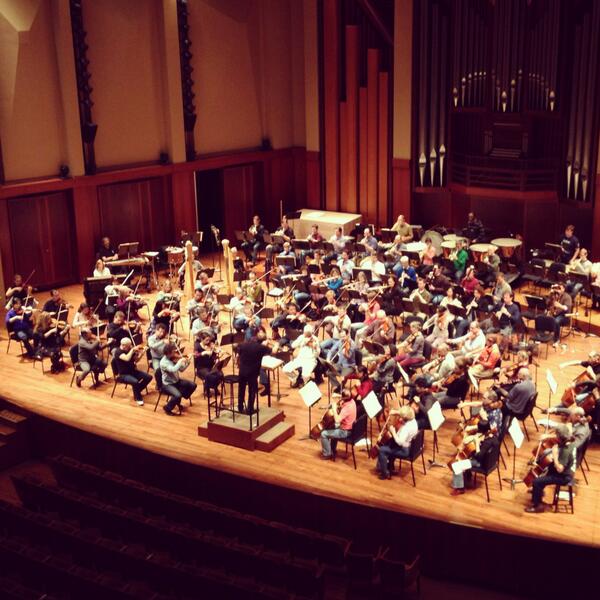
Britten’s vast array of performing forces further points to the architectural and spatial aspects of his conception. The scoring is divided into three groupings that are perceived to emanate from three distinct spheres. There is the conventional sound world of the full orchestra (including enlarged brass and percussion sections) and mixed chorus, which sings only the Latin texts, and the soprano solos.
If these performers are the world of humanity in general, facing our mortal condition, the boys’ choir, accompanied throughout by organ or harmonium, exists suspended beyond it as the voice of eternal, angelic innocence. (Britten specifies that their sound is to be “distant.”) The third level, with its reduced satellite orchestra and two male soloists, is closer to the world of art song and chamber opera. This is the real world of violence and meaningless death, not ideals – the plane on which innocence is corrupted.
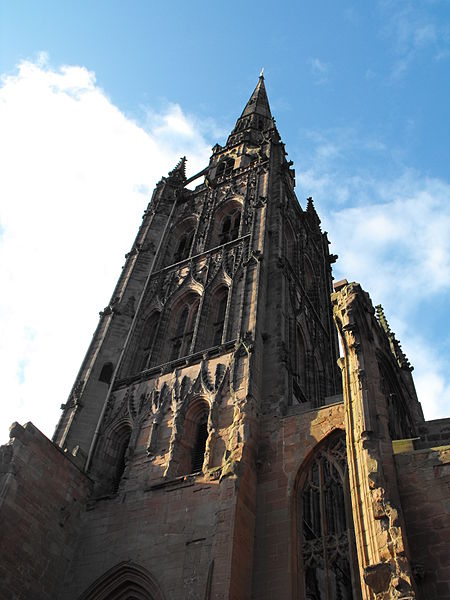
Spire of Coventry Cathedral
Mediating among all these spheres is the core harmonic idea of the War Requiem: the interval of the tritone (heard at the outset as C pitted against F-sharp), whose instability highlights the pervasive feeling of ambivalence. “There are very few easy resolutions in Britten’s later work,” writes Powell, “and ease, when it is attempted, is always troubled by ambiguity.”
This is how Powell reads the composer’s statement near the end of his life about the effect on him of witnessing Belsen and other former concentration camps during a tour he and Yehudi Menuhin undertook shortly after the Second World War. Britten said “that the experience had colored everything he had written subsequently,” as his partner Peter Pears disclosed.
In his unforgettable setting of the final Owen poem, Britten dissolves the scene of immense pathos of the former enemy soldiers meeting after death. As they choose eternal peace and oblivion, Britten leads us into the final Latin prayer In Paradisum, where, for the first time, he joins all the performing forces together. The chorus repeats the harmonic sequence that had concluded the first movement, but the composer forces us to wonder: is this merely the reboot of humanity’s eternally recurring pattern?
(C) 2013 Thomas May. All rights reserved.
Filed under: Britten, choral music, requiem