Joseph Bologne, Chevalier de Saint-Georges, posing with his fencing rapier, painted by Mather Brown, in 1787. (Public domain)
Here’s my Seattle Timesstory for Seattle Baroque Orchestra’s upcoming concert devoted entirely to music by Joseph Bologne, Chevalier de Saint-Georges:
Joseph Bologne, Chevalier de Saint-Georges, defies easy categorization.
For Seattle-based violinist, professor and filmmaker Quinton Morris, Bologne (1745-1799) combined “the entertainment appeal of Michael Jackson and the athleticism of Michael Jordan.” Morris’ award-winning film and performance project “Breakthrough,” which he has taken on tour around the world, presents Bologne’s many-layered story through a contemporary lens.
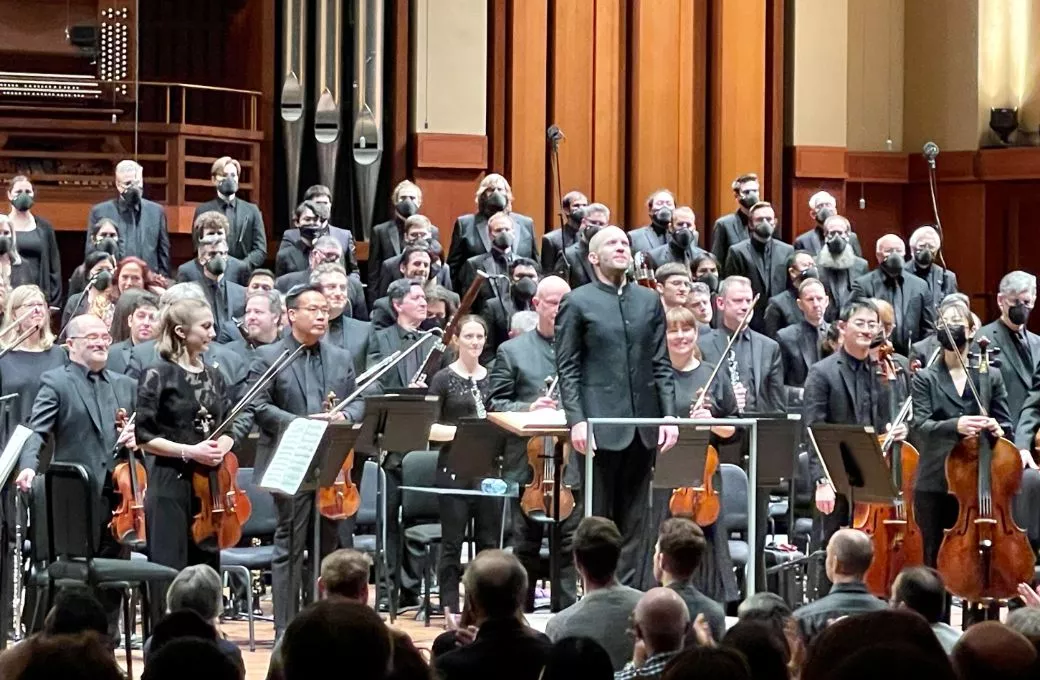
Pekka Kuusisto was the soloist in Enrico Chapela’s ‘Antiphaser,’ a concerto for electric violin and orchestra, with the Seattle Symphony under Andrew Litton. (Photos by Brandon Patoc)
My review of Enrico Chapela’s new violin concerto, Antiphaser, which Pekka Kuusisto premiered on Thursday with the Seattle Symphony under guest conductor Andrew Litton:
It’s been nearly a year since Thomas Dausgaard’s abrupt departure as the Seattle Symphony’s music director, but the projects initiated under his tenure and delayed by the pandemic continue to make their way to the Benaroya Hall stage. The latest of these is Antiphaser, a concerto for electric violin and orchestra by the Mexican composer Enrico Chapela. Trading his 1709 “Scotta” Stradivari for an electronically amplified instrument, Pekka Kuusisto joined the orchestra to perform the world premiere under the baton of Andrew Litton on Nov. 3….
Guadalupe Paz as Frida Kahlo and Alfredo Daza as Diego Rivera; photo credit: Karli Cadel
My review of the world premiere of Gabriela Lena Frank’s new opera about Frida Kahlo and Diego Rivera, which sets a libretto by Nilo Cruz, is available here at Musical America (no paywall through the weekend):
SAN DIEGO — At the center of El último sueño de Frida y Diego (The Last Dream of Frida and Diego), Frida Kahlo decides to cross over from the underworld and return to the realm of the living. It’s a conceit that cries out for operatic treatment, and composer Gabriela Lena Frank and librettist Nilo Cruz oblige with an inspired fusion of music and poetry.
My Seattle Timesstory on Tan Dun and his upcoming appearances next week with Seattle Symphony:
A transformative encounter in cave temples inspired Tan Dun, who will conduct his epic Buddha Passion as part of a Seattle Symphony mini-festival of his works Nov. 3-13.
Congratulations to cellist Zlatomir Fung, Musica; America’s New Artist focus for November. I had the pleasure of hearing his New York Philharmonic debut last summer at the Bravo! Vail Festival. Here’s my profile:
Competing with nature’s own surround-sound orchestra, open-air performances aren’t the optimal context in which a soloist can shine. But Zlatomir Fung kept me riveted at this past summer’s Bravo! Vail Festival, eager not to miss a single nuance from the moment…
To launch this milestone season, Music of Remembrance (MOR) founder and artistic director Mina Miller has curated a remarkable program that will take place at Benaroya Hall on Sunday, 30 October, at 5pm. The centerpiece is a new production of Josephine, Tom Cipullo’s one-act monodrama by based on the life of the legendary singer and dancer Josephine Baker, who found fame and success in France as an artist, a French Resistance hero, and a civil rights activist after escaping racism in America.
“Josephine tells a story that resonates with all of us today,” comments artistic director Mina Miller, “a story about a woman with the courage to fight back against prejudice and discrimination, and stand up for her art and ideals to make a difference in the world.” Starring sopranoLaquita Mitchell in the title role, the production is directed by Erich Parce and conducted by Geoffrey Larson.
Also a highlight will be the world premiere of Wertheim Park, a setting of the poetry of Susan de Sola by composer Lori Laitman, which was commissioned by MOR. Soprano Alisa Jordheim interprets this haunting song, a deeply moving elegy for the Dutch Jews lost to the Holocaust.
In addition, the program includes chamber works by two Holocaust-era composers. Erwin Schulhoff’s virtuosic Concertino for Flute, Viola and Double Bass showcases two of the Seattle Symphony’s principal chairs, violist Susan Gulkis Assadi and flautist Demarre McGill, along with double bassist Jonathan Green. The concert opens with the elegiac Lamento for viola and piano by Dutch composer Max Vredenburg. Vredenburg sought haven in the Dutch East Indies only to endure years of captivity there under Japanese occupation; Schulhoff perished in a Nazi prison camp.
MOR’s stellar instrumental ensemble, drawn from the Seattle Symphony Orchestra, features flutist Demarre McGill, clarinetist Laura DeLuca, violinist Mikhail Shmidt, violist Susan Gulkis Assadi, cellist Walter Gray, double bassist Jonathan Green, and pianists Jessica Choe and Mina Miller.
For a quarter century now, MOR remembers the Holocaust through music and honors the resilience of all people excluded or persecuted for their faith, nationality, ethnicity, gender or sexuality. In addition to rediscovering and performing music from the Holocaust, MOR has commissioned and premiered more than 30 new works by some of today’s leading composers, drawing on the Holocaust’s lessons to address urgent questions for our own time.
Lamento (1953)
Max Vredenburg
Susan Gulkis Assadi, viola
Jessica Choe, piano
Wertheim Park (2022)
Music by Lori Laitman Poetry by Susan de Sola
World Premiere
Commissioned by Music of Remembrance
Alisa Jordheim, soprano
Laura DeLuca, clarinet; Mikhail Shmidt, violin; Jonathan Green, double bass; Mina Miller, piano
Concertino for Flute, Viola and Double Bass (1925)
Erwin Schulhoff
Demarre McGill, flute; Susan Gulkis Assadi, viola; Jonathan Green, double bass
Josephine (2016)
Music and Libretto by Tom Cipullo
A Monodrama in One Scene
Laquita Mitchell, soprano
Music of Remembrance Instrumental Ensemble
DeMarre McGill, flute; Laura DeLuca, clarinet; Mikhail Shmidt, violin; Walter Gray, cello;
If Hilary Hahn restored a sense of continuity with familiar, and essential, musical values, the audience that packed Benaroya Hall for her return engagement with Seattle Symphony also had a wonderful surprise in store with guest conductor Alpesh Chauhan’s debut …
The “Último Sueño” team, photographed in front of a Diego Rivera-influenced mural in Chicano Park, in San Diego: from left, the writer Nilo Cruz, the director Lorena Maza, the composer Gabriela Lena Frank and the mezzo-soprano Guadalupe Paz.Credit…John Francis Peters for The New York Times
In today’s New York Times, my story on the new opera by Gabriela Lena Frank and Nilo Cruz:
“I hope the exit is joyful — and I hope never to return.” Frida Kahlo confided these remarks to her diary in 1954, just a few days before making her final exit.
In a new opera, “El Último Sueño de Frida y Diego” (“The Last Dream of Frida and Diego”), the composer Gabriela Lena Frank and librettist Nilo Cruz imagine Kahlo overcoming her reluctance to return from beyond. ..
Black Lodge is the first full-length feature film by the influential opera producer Beth Morrison Projects. andfeatures music by Grammy-nominated David T. Little, with a libretto by legendary Beat poet Anne Waldman. Drawing on the disturbing and complicated mythologies of the surrealist writer William S. Burroughs (Naked Lunch), Black Lodge uses dance, industrial rock, classical string quartet, and opera to take viewers through a Lynchian psychological escape room. Starring Timur and dancer Jennifer Harrison Newman, Black Lodge is now available for streaming on theOpera Philadelphia Channel.
Set in a nightmarish Bardo, a place between death and rebirth, a tormented writer (Timur) faces down demons of his own making. Forced to confront the darkest moment in his life, he mines fractured and repressed memories for a way out. A woman (Jennifer Harrison Newman) is at the center of all the writer’s afterlife encounters. She is the subject of his life’s greatest regret, and she materializes everywhere in this Otherworld. The writer cannot detach any thoughts of his life from her.
The groundbreaking Beth Morrison Projects developed and produced Black Lodge over the past ten years. Founded by “contemporary opera mastermind” (LA Times) Beth Morrison, who was honored as one of Musical America’s Artists of the Year/Agents of Change in 2020, BMP has grown into “a driving force behind America’s thriving opera scene” (Financial Times), with Opera News declaring that the company, “more than any other… has helped propel the art form into the twenty-first century.”
The project is attracting attention throughout the music industry. Renowned musician Thurston Moore, known as a member of Sonic Youth, serves as executive producer of Black Lodge. “This is opera ripping through the fabric of future vision psychosis where the integrity of classic form clasps the hands of radical possibilities,” said Moore. “David T. Little takes no prisoners here, in confluence with poet angel head Anne Waldman’s libretto of nature, irreality, and spirit consciousness, divining deliverance from life’s spectacle of chaos and love. You’re about to have your mind scorched, my friends!”
Composer Philip Glass (Akhnaten, Einstein on the Beach) is also a fan. “Black Lodge is a bold new operatic film,” said Glass. “It seamlessly blends poetry and music into a powerful cinematic experience.”
Devastating news that Geoff Nuttall has passed away. The beloved violinist and founder of the St. Lawrence String Quartet died today at his home in California at the age of 56. He had been undergoing treatment for pancreatic cancer.
The Spoleto Festival USA , where Nuttall was Director of Chamber Music, released the following press announcement:
October 19, 2022 — Violinist, music education advocate, and Spoleto Festival USA Charles E. and Andrea L. Volpe Director of Chamber Music Geoff Nuttall died today at home in California where he was undergoing treatment for pancreatic cancer. He was 56.
From center stage of Charleston’s historic Dock Street Theatre, Nuttall hosted the Festival’s iconic chamber music concerts since 2010, drawing enthusiastic audiences whose devout attendance owed as much to the series’ programming as the dynamism of its host and star performer. As director, he curated each of the 33 annual concerts and performed on many as a violinist and founding member of the St. Lawrence String Quartet, Spoleto’s quartet-in-residence, for more than 25 years.
Nuttall began playing the violin at age 8 after moving from Texas to Ontario, Canada. He received his bachelor’s degree from the University of Toronto, where he studied under Lorand Fenyves. Shortly after graduating, he co-founded the St. Lawrence String Quartet in 1989. The ensemble swiftly received top prizes at the Banff International String Quartet Competition and the Young Concert Artist Auditions, becoming a fixture at some of North America’s most celebrated festivals and concert halls.
St. Lawrence String Quartet is also ensemble-in-residence at Stanford University, where Nuttall served on the music faculty since 1999. With the quartet and as a solo artist, Nuttall played more than 2,000 concerts worldwide to critical acclaim, and was lauded as “intensely dynamic,” with “stunning technique and volatility” (The New York Times).
Nuttall was named to his role at Spoleto by longtime Festival chamber music director and Chamber Music Society of Lincoln Center founder Charles Wadsworth, who first invited Nuttall and the St. Lawrence String Quartet to Spoleto in 1995. Like his predecessor, Nuttall amassed a robust following—audience members who forged a strong connection to Nuttall’s onstage charisma.
The New York Times labeled him “chamber music’s Jon Stewart,” describing Nuttall as a “creatively daring, physically talented performer who can go goofball in a nanosecond, maintaining a veneer of entertainment while educating his base about serious matters…he is subtly redefining what a chamber music concert can be.”
Part of Nuttall’s genius as series host could be found in his pre-performance banter; engaging the audience in revelatory musical learning—facts about the composer or themes to anticipate. While this type of commentary has become de rigueur in many chamber music concert settings, Nuttall’s approach captivated novice listeners and experts alike.
Nuttall’s fervor for the music inspired colleagues both on and offstage. The sense of camaraderie Nuttall created between visiting artists contributed to a celebratory spirit felt in each concert, and a palpable camaraderie among players. He provided a platform for young musicians and composers to flourish. In recent years, next generation titans, including Benjamin Beilman, Anthony Roth Costanzo, Jennifer Frautschi, Arlen Hlusko, James Austin Smith, Paul Wiancko, and JACK Quartet, have appeared onstage in Charleston.
In addition to recording works by such composers as Schumann, Shostakovich, and Tchaikovsky, Nuttall and the St. Lawrence String Quartet were dedicated to the music of Joseph Haydn. In 2020, they were featured on the PBS Great Performances series, “Now Hear This,” in an episode that chronicled the composer’s life and work. Nuttall was also a steadfast champion of contemporary composers. He frequently worked with John Adams, Jonathan Berger, and Osvaldo Golijov—and received a Grammy Award nomination for the recording of Golijov’s Yiddishbbuk.
His passion for new music discovery permeated Spoleto Festival USA’s programming. He often placed contemporary works amongst lesser-known pieces from the canon, and emphatically promoted the works of his players and close friends such as Mark Applebaum, Todd Palmer, Stephen Prutsman, Joshua Roman, and Paul Wiancko. In 2019, Nuttall explained his programming style to Charleston magazine: “My closest friends are constantly curious, and I hope my audiences will share my enthusiasm for curiosity.”
In his final days, his wife, the renowned violinist Livia Sohn, who also serves as Spoleto Festival USA Assistant Director of Chamber Music, asked Nuttall if he had any unfulfilled aspirations on his bucket list. With his characteristic humor and grace, Nuttall replied, “my life has been my bucket list.”
In addition to Sohn, Nuttall is survived by their children, Jack and Ellis, as well as his mother and sister.
STATEMENTS
Mena Mark Hanna, Spoleto Festival USA General Director and CEO: “This is a loss not just for Spoleto Festival USA, but for music lovers around the world. Geoff was classical music’s greatest showman, eliciting a rowdy, raucous reception to Haydn that would sound more at home in a club than a concert hall. He didn’t care if people were clapping between movements; he didn’t care that people wore shorts and sandals to performances; he didn’t care for the rigid social formalities that govern classical music performance. All he cared about was the communitarian, cathartic power of music. And because of that, he changed chamber music in America.”
Alicia Gregory, Chair of Spoleto Festival USA’s Board of Directors: “Within the remarkable constellation of international talent featured every year at Spoleto Festival USA, Geoff Nuttall was consistently one of its brightest stars. His virtuosic artistry, combined with his deft skill in connecting with both artists and audiences, created transcendent performances. He will be remembered as one of the finest classical musicians and curators of our time.”
A celebration of Nuttall’s life and contributions to Spoleto Festival USA will be part of the 2023 chamber music program.
Geoff was able to continue living his life as fully as possible under the outstanding and thoughtful care of Dr. Christopher Chen. Geoff’s family has created The Geoff Nuttall Memorial Fund to advance Dr. Chen’s cancer research at Stanford University. In lieu of flowers, please consider making a tax-deductible donation. Gifts can be made three ways: 1) Online atmemorial.stanford.edu by selecting “Other Stanford Designation” and entering The Geoff Nuttall Memorial Fund in the “Other” text box, 2) By check payable to Stanford University with The Geoff Nuttall Memorial Fund indicated on the memo line, mailed to Development Services, P.O. Box 20466, Stanford, CA 94309, or 3) By phone at 650-725-4360.