The 2018 documentary Every Act of Life, now streaming on Amazon Prime, covers six decades of the quadruple Tony Award winner, along with his pivotal role in fighting for LBGTQ rights.
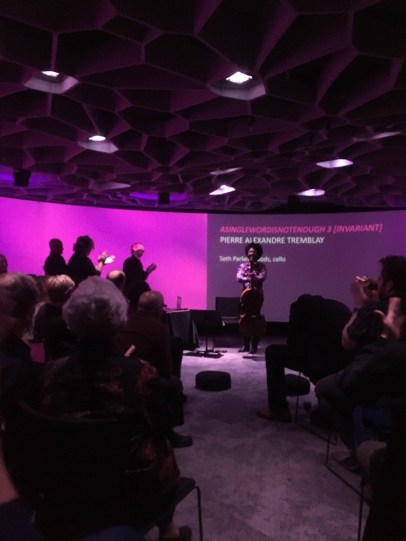
Seth Parker Woods and Friends in Difficult Grace at Seattle Symphony’s Octave 9.
It’s been very difficult trying to think about anything other than the Covid-19 pandemic. Already several loved ones have become ill with the disease, and one admired acquaintance has died.
With so much angst and sorrow, we are only 10 days into the state of emergency declared for Washington State, while other areas — in the unconscionable absence of federal guidance and leadership — are recklessly carrying on as usual.
Here’s what now seems a surreal glance back to happier times, which I wrote only a little over a month ago for Gramophone magazine’s April issue: some thoughts on Seth Parker Woods, Patricia Kopatchinskaja, and Gidon Kremer at Seattle Symphony’s Octave 9 space.
Here’s the emergency proclamation from Washington Governor Jay Inslee’s limiting large events to minimize public health risk during COVID-19.
FURTHERMORE, based on the above situation and under the provisions of RCW 43.06.220(1)(b) and
RCW 43.06.220(1)(h), to help preserve and maintain life, health, property or the public peace, I hereby
prohibit the following activities in King, Pierce and Snohomish counties related to social, spiritual, and
recreational gatherings, which restrictions shall remain in effect until midnight on March 31, 2020, unless
extended beyond that date:
Gatherings of 250 people or more for social, spiritual and recreational activities including, but not
limited to, community, civic, public, leisure, faith-based, or sporting events; parades; concerts;
festivals; conventions; fundraisers; and similar activities.
Violators of this of this order may be subject to criminal penalties pursuant to RCW 43.06.220(5).
My story on Michael Barenboim and the new West-Eastern Divan Ensemble for Stanford Live. The Ensemble is an offshoot of the West-Eastern Divan Orchestra his father, Daniel Barenboim, cofounded with Edward Said.
To mark the West-Eastern Divan Orchestra’s 20th-anniversary season, violinist Michael Barenboim is touring the United States with the newly formed West-Eastern Divan Ensemble, a chamber group of string players who will bring the organization’s cross-cultural vision to Stanford in March.
New York, NY (March 4, 2020) — The International Contemporary Ensemble (ICE) announces the appointment of Executive Director Jennifer Kessler, who joined the organization in January 2020. Kessler brings a breadth of experience in developing community, education, social justice, and artistic programs with arts organizations worldwide, including Orchestra of St. Luke’s, Willie Mae Rock Camp for Girls, and Carnegie Hall, and joins the organization as it embarks on continued growth in the lead-up to its twentieth anniversary season.
“Jennifer’s many years of experience within today’s musical landscape, along with her nuanced understanding of our mission and vision, is invaluable,” said Co-Artistic Director Rebekah Heller. “We are thrilled to be working side-by-side with her to shape the future of the International Contemporary Ensemble.”
“Jennifer comes to the International Contemporary Ensemble with deep experience in the non-profit and music education/social justice world,” said Claude Arpels, International Contemporary Ensemble Board President. “She is an accomplished musician herself, who appreciates the power of contemporary music. As we approach our twentieth anniversary season, Jennifer is the perfect person to join our Co-Artistic Directors in the leadership of the Ensemble into its third decade.”
“I’m thrilled to join the extraordinary artists of the International Contemporary Ensemble, which I’ve admired from my days as a horn player,” said Kessler. “For 18 years, the Ensemble has been a critical partner and incubator to hundreds of emerging composers, allowing them to stretch their imaginations and launch boundary-pushing new music onto the world’s stages. I am excited to build on ICE’s commitment to commissioning and developing the music of artists representing many voices, backgrounds, and perspectives; to continue to work with our outstanding partners to amplify these projects around the world; and to share in an ecosystem of learning to support the next generation of performer/composers in radical new ways of sharing powerful stories through music.”
About Jennifer Kessler
Prior to joining ICE, Jennifer served as Executive Director of Willie Mae Rock Camp for Girls, a music and social justice nonprofit that empowers girls and gender expansive youth. As the Director of Community and Education for Orchestra of St. Luke’s, Jennifer produced orchestral concerts for youth in partnership with Dance Theatre of Harlem, and launched an intensive music program called Youth Orchestra of St. Luke’s, modeled after Venezuela’s El Sistema youth orchestra program. At Carnegie Hall, Jennifer managed young musician training programs with world-renowned artists. Consultant projects include developing partnerships, producing festivals, designing education initiatives, and fundraising for the Los Angeles Chamber Orchestra, the Los Angeles Philharmonic, Bang on a Can’s Found Sound Nation, and the Inner City Youth Orchestra of LA. Jennifer has raised millions of dollars for arts and justice organizations, and has also overseen the Getty Education and Community Investment Grants through the League of American Orchestras as well as participated on multiple peer-review grant panels.
Jennifer holds degrees in French horn performance from Northwestern University in Illinois and Hanns Eisler Musikhochschule in Berlin, Germany. She was an El Sistema fellow at the New England Conservatory of Music in Boston, receiving a graduate certificate of nonprofit management with a focus on music for social change programs. After performing in her early career as a French horn player with the Berlin Philharmonic, Ensemble Modern, and the Israeli Opera Orchestra, Jennifer now sings and plays guitar in occasional rock bands.
About the International Contemporary Ensemble (ICE)
The International Contemporary Ensemble is an artist collective that is transforming the way music is created and experienced. As performer, curator, and educator, the Ensemble explores how new music intersects with communities across the world. The Ensemble’s 35 members are featured as soloists, chamber musicians, commissioners, and collaborators with the foremost musical artists of our time. Works by emerging composers have anchored the Ensemble’s programming since its founding in 2001, and the group’s recordings and digital platforms highlight the many voices that weave music’s present.
A recipient of the American Music Center’s Trailblazer Award and the Chamber Music America/ASCAP Award for Adventurous Programming, the International Contemporary Ensemble was also named the 2014 Musical America Ensemble of the Year. The group currently serves as artists-in-residence at Lincoln Center for the Performing Arts’ Mostly Mozart Festival, and previously led a five-year residency at the Museum of Contemporary Art Chicago. The International Contemporary Ensemble was featured at the Ojai Music Festival from 2015 to 2017, and at recent festivals abroad such as gmem-CNCM-marseille and Vértice at Cultura UNAM, Mexico City. Other performance stages have included the Park Avenue Armory, The Stone, ice floes at Greenland’s Diskotek Sessions, and boats on the Amazon River.
OpenICE, made possible with lead funding from The Andrew W. Mellon Foundation, offers free concerts and interactive, educational programming wherever the Ensemble performs. As the Ensemble in Residence of the Nokia Bell Labs Experiments in Art and Technology, the International Contemporary Ensemble advances music technology and digital communications as an empowering tool for artists from all backgrounds. Curricular activities include a residency and coursework at the New School College of Performing Arts, along with a summer intensive program, called Ensemble Evolution, where topics of equity, diversity, and inclusion build new bridges and pathways for the future of creative sound practices. Yamaha Artist Services New York is the exclusive piano provider for the Ensemble. Read more at http://www.iceorg.org and watch over 350 videos of live performances and documentaries at digitice.org.
My new profile of Jörg Widmann for the Juilliard Journal:
Which Jörg Widmann would you like to meet? The prolific artist who appears on Bachtrack.com’s list of the top 10 most frequently performed living composers for 2019 (alongside figures like Philip Glass and John Adams)? The virtuoso clarinetist who has inspired numerous new compositions? The conductor of major international orchestras? The erudite lecturer? The teacher and mentor of young musicians?
Press release from the City of Birmingham Symphony Orchestra:
CBSO Music Director Mirga Gražinytė-Tyla has shared the following news with us:
I would like to tell you about some happy news in my family. I am pregnant with our second child, with a due date in August. We will need to make some necessary changes in my schedule but I look forward to working together to realize some of our most exciting plans. My family and I are very grateful for your friendship and support.
Major projects and tours during the CBSO’s 2020-21 season will take place as planned, with some modifications to her schedule.
Everyone at the CBSO would like to congratulate Mirga on this exciting news.
Tonight at Pierre Boulez Saal, Guy Braunstein and Martha Argerich perform a sold-out program of Schumann, Prokofiev, and Franck. My program essay is available here. (It’s their first time collaborating as a duo, so the clip above is of Argerich with Gidon Kremer — not exactly a bad compromise — in Schumann’s A minor Violin Sonata.)
A very happy birthday to John Coolidge Adams, who turns 73 today. The clip above, City Noir, is one of the pieces on the program when Adams guest conducts the Seattle Symphony in April. He’ll also present Must the Devil Have All the Good Tunes, his brilliant new piano concerto, with Jeremy Denk as the fiendish soloist.
(I haven’t noticed yet whether Sony Classical has sent out a message celebrating “the composer of Become Ocean.”)