MEMETERIA by Thomas May

Music & the Arts

Dover Quartet in Seattle

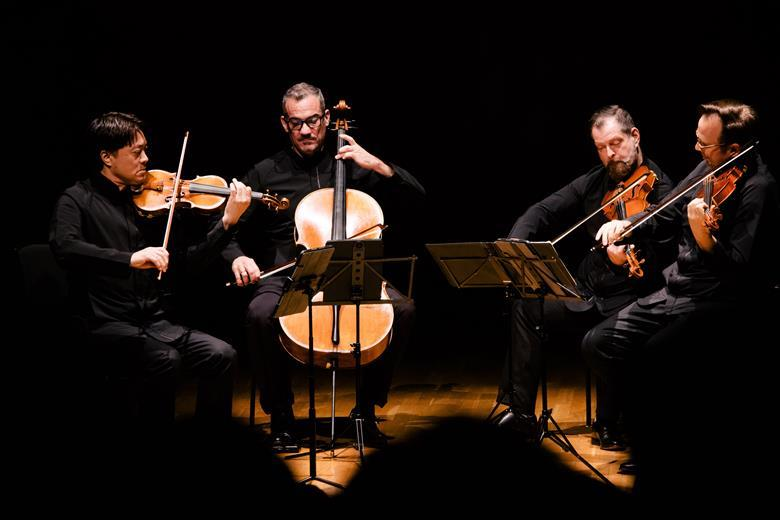
Dover Quartet: Joel Link, Bryan Lee, Camden Shaw, Julianne Lee; photo: Jorge Gustavo Elias

My review for The Strad of this past weekend’s Dover Quartet performance, presented by Seattle Chamber Music Society:

On a glorious spring Sunday in Seattle, the Dover Quartet drew a full house to the 536-seat Nordstrom Recital Hall for a splendid afternoon concert – no small feat given the lure of sunshine and blue skies on a holiday weekend. Notably, the audience included a sizable contingent of younger listeners – a testament to the Seattle Chamber Music Society’s outreach efforts and to the appeal of this Signature Series concert, which closed the organisation’s inter-season extension between its winter and summer festivals.
continue

Filed under: review, Seattle Chamber Music Society, string quartet

Philip Glass: Symphony No. 11

I had the honor of writing the program note for this week’s performances of Philip Glass’s Symphony Np. 11 by the New York Philharmonic, with Gustavo Dudamel conducting:

It wasn’t until he was 54 that Philip Glass began writing symphonies. With Symphony No. 1 in 1992, he opened up a new creative frontier that has remained an essential part of his work ever since….

continue

Filed under: Gustavo Dudamel, New York Philharmonic, Philip Glass, program notes

Anna Thorvaldsdottir: Notes on a First Concerto

San Francisco Symphony just gave the world premiere of Before we fall, Anna Thorvaldsdottir’s new cello concerto for Johannes Moser, with Dalia Stasevska on the podium.

My behind-the-scenes feature on its creation is the current Strings magazine cover story.

Here’s Lisa Hirsch’s review for the San Francisco Chronicle:

“Thorvaldsdottir’s new cello concerto, Before We Fall, is a banger, sonically and intellectually, dense with ideas and meriting repeat hearings. It launches explosively, which is not an unusual strategy for a concerto, but don’t be misled. This isn’t a conventional soloist-versus-orchestra showdown….
continue

Filed under: Anna Thorvaldsdottir, cello, new music, San Francisco Symphony, Strings

Seattle ProMusica at St. James: “The Charged World”

Chapeau to Karen P. Thomas and Seattle Pro Musica, whose various sub-ensembles sang sublimely and with luminous grace in last night’s season finale program – and to Nathan Chan, the eloquent cello soloist in Caroline Shaw’s “Its motion keeps,” Roxanna Panufnik’s “All shall be well,” and Thomas’s own “The world is charged,” a striking new work for cello and choir that closed a radiant evening in the warmth of St James Cathedral.

So many signature Pro Musica moments in this gorgeous program — from the perfectly contoured phrasing of Biebl’s beloved “Ave Maria” and the subtle rhythmic lilt of Shaw to a wrenching account of Herbert Howells’s Requiem, an a cappella expression of private grief laid bare. Britten’s inspired Auden setting in “Hymn to Saint Cecilia” found clarity and proportion in Thomas’s lucid direction.

Thomas also revealed her compositional eloquence in “The world is charged” – an imaginative and affecting setting of Gerard Manley Hopkins’s “God’s Grandeur,” which grapples with modern humanity’s estrangement from the natural world. I admired her musical evocation of Hopkins’s dense syntax and imagery, and of the quiet hope for renewal that pulses through the poem.

Filed under: choral music, review, Seattle Pro Musica

John Adams’s “Antony and Cleopatra” Arrives at the Met

Some thoughts on the Metropolitan Opera’s new production of Antony and Cleopatra by John Adams, published by Opera Now:

With its arrival on the stage of the Metropolitan Opera, Antony and Cleopatra reaches its most convincing form to date. John Adams’s newest opera has already had productions by co-commissioners San Francisco Opera (2022) and Barcelona’s Gran Teatre del Liceu (2023). As is customary with Adams, each outing has brought revisions — most conspicuously in trimming the score, a process he has continued for the Met version….

continue

Filed under: American opera, John Adams, Metropolitan Opera, Shakespeare

Fire, Water, Secrets, and Memory: Tan Dun Returns to Seattle Symphony

Tan Dun conducting Seattle Symphony, with harpist Xavier de Maistre; photo (c) James Holt / The Seattle Symphony. 

A concert built around the artistry of composer, conductor, and cultural connector Tan Dun offers no shortage of conceptual fascination. This week’s concerts mark his turn to the Seattle Symphony podium after a memorable debut here two and a half years ago, when he led his monumental Buddha Passion.

Raised in a remote village in China’s Hunan province and shaped equally by Western classical forms and ancient Chinese traditions, Tan – who since 1986 has been based in the US – brings a theatrical imagination and a deep sense of ritual to the concert stage. He framed last night’s program with a pair of short but intensely colorful works by two early 20th-century composers he admires, serving as explosive preludes to two large-scale pieces from his own catalog.

A vivid reading of Manuel de Falla’s Ritual Fire Dance, from his 1915 ballet El amor brujo, crackled with rhythmic energy and flared with instrumental color, setting one element against another as water came into protracted focus in the ensuing Concerto for Water Percussion and Orchestra, composed by Tan in 1998 and dedicated to Tōru Takemitsu. 

Tan draws out music’s ritual origins in intriguing ways. Percussionist Yuri Yamashita not only performed the solo part but dominated much of the piece with an almost shamanistic stage presence – from the way she mindfully released droplets from her fingers to the immersive sound world she conjured using bowls of wood or glass, as well as gongs dipped mesmerically into one of two large water bowls over which she presided. 

At some moments she even softly vocalized, as if engaged in a conjuring. Enhancing the theatrical experience were three video screens suspended above the orchestra –- one large at center and two smaller flanking it – which projected close-up footage of the bowls and the rippling water, inviting the audience into the tactile, elemental, organic world of the piece.

The orchestra functioned as a kind of elemental chorus, not so much a counterpart as a kaleidoscopic resonator. Specific voices occasionally emerged from the fabric – most memorably in a luminous duet between Yamashita and principal cellist Efe Baltacıgil, whose tone seemed to bloom out of the water’s surface. A long, improvisatory cadenza captivated with its focus on the physicality of sound.

Still, the Water Concerto’s meditative pacing and episodic structure began to feel diffuse over the span of the piece – though whether this observation reflects a Western bias about form or a real imbalance in proportions is a fair question. In any case, this was a welcome opportunity to hear the work in live performance. 

After intermission came a brisk, glittering account of Stravinsky’s Feu d’artifice (Fireworks), a four-minute burst of orchestral color dating from a little before the young Russian’s leap to international fame with The Firebird.

To this taste, the highlight of the program was Nu Shu: The Secret Songs of Women – a 13-part multimedia concerto that unfolded with greater emotional clarity and formal cohesion than the Water Concerto. Nu Shu originated as a commission for a harp concerto from the Philadelphia Orchestra but, inspired by Tan’s immersive research into a little-known linguistic and social tradition from his native Hunan Province, grew into a sui generis fusion of concerto, orchestral narrative, and ethnomusicological-sociological documentary.

The “secret songs” in question have to do with the vanishing Nüshu tradition — a secret, invented language once used by women in rural Hunan to communicate among themselves in calligraphy and through chanting and song. Tan painstakingly researched the small community of remaining Nüshu speakers, capturing their voices and stories in multiple videos. 

Nu Shu unfolds in 13 short video portraits created by the composer and his team – shown on the three screens above the stage – each anchored in the landscapes of the women’s daily lives and their stories of isolation and solidarity, which are shared from generation to generation.

For Tan, the harp represents “the most feminine of instruments,” writes Esteban Meneses in his excellent program note, and serves as “an intermediary between what the composer imagines as the future – the Western orchestra – and the past, represented by the microfilms.”

Xavier de Maistre was the eloquent soloist, playing a kind of bard who mediates these stories and showing remarkable dynamic and expressive range. Tan likewise assigns a crucial narrative role to the orchestra, which acted as a bridge translating memory into something shared and immediate.

Repeat performance on Friday, May 16, at 8 pm.

(c)2025 Thomas May

Filed under: review, Seattle Symphony, Tan Dun, , , ,

Helen Kim’s Thrilling Vivaldi

Associate Concertmaster Helen Kim conjures the seasons with Seattle Symphony colleagues. Photo: Jon Pendleton

My latest review for The Strad: Though the Seattle Symphony fielded a notably smaller ensemble for this week’s Baroque programme – some players are doubling in Seattle Opera’s Tosca, which opens on the weekend—the aesthetic impact was anything but modest…

continue

Filed under: review, Strad, Vivaldi

Rufus Wainwright’s “Dream Requiem” in Los Angeles

I’ve been a fan of Rufus Wainwright’s wonderful songwriting for decades, so it was a special pleasure to have the opportunity to write the program essay for the Los Angeles Master Chorale’s performance of his Dream Requiem – an epic project that is receiving its North American premiere on Sunday evening, 4 May. The amazing Grant Gershon conducts, with Liv Redpath as the soprano soloist and Jane Fonda as the narrator.
Rufus Wainwright and Jane Fonda in conversation

Filed under: Los Angeles Master Chorale, music news, requiem

Third Coast Percussion with Jessie Montgomery

Third Coast Percussion with guest artist violinist Jessie Montgomery. (Marc Perlish)

I spoke with Third Coast Percussion’s David Skidmore about their upcoming program on 3 May at Meany:

Think percussion is just about hitting things? Think again. 

With instruments that shimmer, thrum, ping and even gurgle underwater, Third Coast Percussion has spent the past 20 years expanding horizons for what a percussion ensemble can do. The Chicago-based quartet returns to the University of Washington’s Meany Center for the Performing Arts on May 3 as part of a milestone anniversary tour….

continue

Filed under: new music, percussion, Seattle Times, Third Coast Percussion

Fantasies and Afterlives: Kavakos and Pace at Pierre Boulez Saal

asset_image
The C major Fantasy for Violin and Piano in Schubert’s manuscript  (Wienbibliothek im Rathaus)

My essay for the recital by Leonidas Kavakos and Enrico Pace at the Pierre Boulez Saal on 29 April is here.

Complete program:

Ludwig van Beethoven: Sonata for Violin and Piano in A major Op. 47 “Kreutzer”

Richard Dubugnon: La minute exquise; Hypnos; Retour à Montfort-l’Amaury

Franz Schubert: Fantasy for Violin and Piano in C major D 934

The program that Leonidas Kavakos and Enrico Pace bring to the Pierre Boulez Saal offers three perspectives on the violin–piano duo, from the fire and drama of Ludwig van Beethoven to the rhapsodic lyricism of Franz Schubert—with a contemporary interlude of enigmatic, nocturnal miniatures by the Swiss-French composer Richard Dubugnon….

continue

Filed under: Beethoven, chamber music, Pierre Boulez Saal, Schubert, violinists

Archive

Enter your email address to follow this blog and receive notifications of new posts by email.