

Here’s the program essay I wrote for the Met’s production of Bizet’s Les Pêcheurs de Perles directed by Penny Woolcock.
Filed under: Georges Bizet, Metropolitan Opera

November 14, 2018 • 1:39 pm Comments Off on Bizet’s Pêcheurs de Perles at the Met
Here’s the program essay I wrote for the Met’s production of Bizet’s Les Pêcheurs de Perles directed by Penny Woolcock.
Filed under: Georges Bizet, Metropolitan Opera
November 13, 2018 • 9:40 am Comments Off on Pascal Dusapin’s New Double Concerto Soars in Seattle
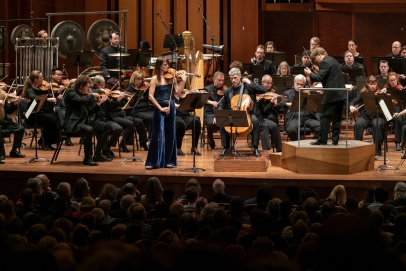
Viktoria Mullova and Matthew Barley, with Ludovic Morlot and Seattle Symphony; image (c) James Holt
For Musical America, I reviewed Seattle Symphony’s program of Pascal Dusapin’s wonderful At Swim-Two-Birds (in its U.S. premiere), Debussy’s Petite Suite, and Tchaikovsky’s Symphony No. 4:
SEATTLE—Making its U.S. premiere at the center of Seattle Symphony’s most recent program, Pascal Dusapin’s At Swim-Two-Birds (heard on November 8) immediately stood out as one of the most significant commissions in music director Ludovic Morlot’s tenure (which draws to a close at the end of this season).
continue [paywall]
Filed under: Debussy, Musical America, Pascal Dusapin, review, Tchaikovsky
November 11, 2018 • 10:27 am Comments Off on Eleventh Hour
In honor of Armistice Day, on the 100th anniversary.
Gustav Holst: Ode to Death, H. 144, Op. 38 (1919), which sets a passage from When Lilacs Last in the Dooryard Bloom’d by Walt Whitman.
Come lovely and soothing death,
Undulate round the world, serenely arriving, arriving,
In the day, in the night, to all, to each,
Sooner or later delicate death.
Prais’d be the fathomless universe,
For life and joy, and for objects and knowledge curious,
And for love, sweet love—but praise! praise! praise!
For the sure-enwinding arms of cool-enfolding death.
Dark mother always gliding near with soft feet,
Have none chanted for thee a chant of fullest welcome?
Then I chant it for thee, I glorify thee above all,
I bring thee a song that when thou must indeed come, come unfalteringly.
Approach strong deliveress,
When it is so, when thou hast taken them I joyously sing the dead,
Lost in the loving floating ocean of thee,
Laved in the flood of thy bliss O death.
From me to thee glad serenades,
Dances for thee I propose saluting thee, adornments and feastings for thee,
And the sights of the open landscape and the high-spread sky are fitting,
And life and the fields, and the huge and thoughtful night.
The night in silence under many a star,
The ocean shore and the husky whispering wave whose voice I know,
And the soul turning to thee O vast and well-veil’d death,
And the body gratefully nestling close to thee.
Over the tree-tops I float thee a song,
Over the rising and sinking waves, over the myriad fields and the prairies wide,
Over the dense-pack’d cities all and the teeming wharves and ways,
I float this carol with joy, with joy to thee O death.
Filed under: anniversary
November 9, 2018 • 12:02 am Comments Off on Joan Tower at 80
My profile of Joan Tower, who recently turned 80, is in the September issue of Strings magazine (starts p. 27).
Filed under: chamber music, Joan Tower, profile, string quartet, Strings
November 8, 2018 • 7:45 am Comments Off on A Reich Premiere and Mahler Recharged at the Los Angeles Philharmonic

It’s been a bracing week of the non-routine in Los Angeles: Philip Glass’s Satyagraha at LA Opera and, from the Los Angeles Philharmonic, John Cage’s Europeras 1 & 2 (with Yuval Sharon’s The Industry) and Susanna Mälkki’s first program of the season. Here’s my review of the Mälkki concert for Musical America:
LOS ANGELES–This past weekend’s program by the Los Angeles Philharmonic was both a newsworthy event and a rousing artistic triumph. Newsworthy because it offered the world premiere of the first composition Steve Reich has written for a full orchestra in more than three decades. And with Susanna Mälkki on the podium, the entire concert on Friday night (November 2) made the concept of a modern symphony orchestra itself feel vitally relevant. Juxtaposed against the pleasures of Reich’s exquisitely crafted piece, a familiar Mahler symphony–the Fifth–was transformed into a revelatory experience.
continue [paywall]
Filed under: Los Angeles Philharmonic, Mahler, review, Steve Reich
November 5, 2018 • 11:28 am Comments Off on Leisurely Morning, Roman Style

Filed under: photography
November 3, 2018 • 1:42 am Comments Off on Fiery and Apocalyptic, with a Melancholy Interlude: This Week’s Seattle Symphony

Alina Ibragimova
Thursday night’s concert offered the first chance I’ve had to hear Ludovic Morlot in action so far this season with Seattle Symphony, and my reward was a thrilling, full-bodied program. The first half included a fiery account of Bartók’s 1927 Miraculous Mandarin Suite (about two-thirds of the score from his earlier ballet, responsible for one of the scandal-premieres of European modernism).
Morlot focused on the score’s lurid colors and unsettling, suspenseful atmospheres, abetted by characterful wind solos (the “decoy music” on clarinet, for one) and superb string ensemble. (The choice of Noah Geller as new concertmaster has clearly been paying dividends.) Some conductors emphasize the influence of Stravinsky’s Rite, but Morlot seemed more interested in the surreal aspects of Bartók’s score, especially in how the ironic, decadent waltz of seduction emerges.
A wonderful match of soloist and concerto followed, with the 33-year-old Russian-British violinist Alina Ibragimova proving herself to be a deeply sensitive, account of the Op. 129 Concerto in C-sharp minor, the second of Shostakovich’s violin concertos.
The violinist is called on to maintain a virtually continual presence in this score, and Ibragimova held me spellbound, mining the varied facets of melancholy and sorrowing desperation embedded in this late-period work. Her tone was rich but unforced, and above all achingly expressive.
Morlot effectively stage-managed the prominent duologues of the soloist with the winds, though coordination went somewhat awry in the finale. Still, it was a moving, substantial performance — far more welcome than a flashy and breezy rep staple would have been, since Seattle Symphony has dedicated this week’s performances to victims of hate crimes: “to the lives lost and all those affected by recent hate crimes brought on by racism and bigotry, particularly those who died in the recent tragic shootings at the Tree of Life synagogue in Pittsburgh, Pennsylvania, and while grocery shopping in Jeffersontown, Kentucky.”
Filling the second half was Brahms’s mighty, promise-fulfilling First Symphony, which premiered just a few months after the first complete Ring cycle, in 1876. (I’ve always found that coincidence especially fascinating.) Morlot seemed to pick up on some of the fiery, driven energy from the opening Bartók, conjuring a passionately dramatic vision of the First.
This came at the cost of some clarity, I found, in the first movement above all, whose overarching architecture was occasionally obscured. The Adagio radiated emotional complexity and a touching sense of Brahmsian harmonic color; it only needed, again, a more transparent elucidation of the composer’s dramaturgy of light and shade. I wanted more time for the music to breathe.
Morlot was more convincing with the rest of the work: the third movement served as a brief shot of optimism, an interlude that tees off the apocalypse and triumph of this finale-centered score. Here, Morlot paced events with confidence and focus, acting as a kind of film director to ensure that each episode carried weight.
The program is repeated on Saturday 3 November at 8pm.
Filed under: Bartók, Brahms, review, Seattle Symphony, Shostakovich, Uncategorized
November 1, 2018 • 11:48 am 1

Nodoka Okisawa (c) Min-On Concert Association
Here is Part Two of my coverage of the 18th Tokyo International Music Competition for Conducting in 2018: a profile of first prize winner Nodoka Okisawa. (Part One is here.)
It took just a couple hours after her performance for the results to be announced: but the effect of Nodoka Okisawa’s victory at the 18th Tokyo International Music Competition for Conducting will continue to unfold for years to come.
Filed under: conductors, music news, Nodoka Okisawa
October 31, 2018 • 2:47 pm Comments Off on The Routes of Slavery Traces a Musical Journey of Resilience
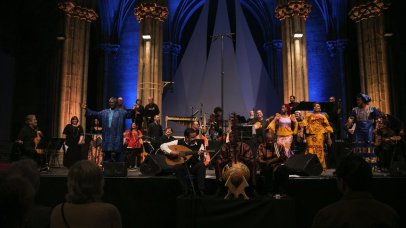
Performers in The Routes of Slavery, which comes to Seattle on Tuesday, Nov. 6. (Foundation Centre Internacional de Music Antiga)
My Seattle Times story on the upcoming Seattle performance of Jordi Savall’s The Routes of Slavery is now online:
Joined by a global array of musicians, music researcher and virtuoso Jordi Savall traces the relevant story of the African diaspora and its musical legacy across centuries and continents in The Routes of Slavery.
Filed under: early music, Jordi Savall, Seattle Times
October 26, 2018 • 10:25 pm 1

From left to right: Kanade Yokoyama, Nodoka Okisawa, and Masaru Kumakura
(c) Min-On Concert Association
Here’s Part One of my report on the 18th Tokyo International Music Competition for Conducting. (Part Two, an interview with first prize winner Nodoka Okisawa, is here.)
Competitions have become an essential rite of passage for professional classical musicians. Take a look at the artists’ biographies in a random program and lists of victories occupy a prominent position. The premise of powerful young talents finding the entrée to recognition through a public showdown has inspired art itself — think Wagner’s Die Meistersinger — and even ancient mythology (things could go very badly when daring to vie with the gods, as in the contest of the satyr Marsyas with Apollo).
continue
Part Two, a focus on the first prize winner Nodoka Okisawa, will be published shortly.
Filed under: conductors, music news
 Arts & Culture Stories from NPR
