MEMETERIA by Thomas May

Music & the Arts

ABIAH Sings Nina

a2537234916_16Hat tip to Seth Parker Woods for turning me on to this release by ABIAH, available on Bandcamp.

Here’s the artist on Nina Simone as his inspiration:

Nina Simone inspires me in unimaginable ways. Upon encountering her music as a college student, I was captivated by her voice and artistry. Her prodigious piano playing and unique voice spoke to my soul. When I heard her voice, I could see the text in an almost technicolor way. At that very time, I was studying the vocal art of text painting by composers such as Schubert and Schumann. From the first time I heard Nina, she was in full display in her vocal murals. I was transfixed and sought to do the same in my own music making. The beauty of her art was also congruent to the musicianship I was acquiring. Her aspirations of being a classical pianist were akin to mine as an opera singer of African descent. I believe we both found it daunting but attainable.

Filed under: vocal music

Patricia Kopatchinskaja Comes to California

ojai-at-berkeley@2xPatricia Kopatchinskaja is an ideal choice to be this year’s music director of the Ojai Festival. In advance of the festival’s northern edition, Ojai at Berkeley, here’s my profile of this incomparable artist for Cal Performances:

Matters of technical proficiency are well accounted for in the arsenal of words that critics have at their disposal to describe what sets a musician apart. What is sorely lacking is …

continue reading

Filed under: Cal Performances, Ojai Festival, Patricia Kopatchinskaja, profile, violinists

Musical America’s Artist of the Month: Louisa Proske

DSC_9631 (1)

Louisa Proske; photo by Russ Rowland

Congratulations are in order for the talented and brilliantly original director Louisa Proske, this month’s featured Artist of the Month at Musical America:

Only a week is left before tech rehearsals start for Heartbeat Opera’s fourth
annual spring festival, but Louisa Proske remains intently focused on our
conversation….

continue reading

Filed under: directors, Musical America, profile

A Very Palpable Hamlet from The Horse in Motion

Hamlet1

Kevin Lin as Hamlet; photo (c) Kyler Martin for The Horse in Motion

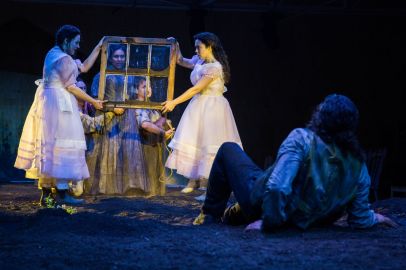
Hamlet is usually encountered as an object of reverent study or, in performance, a vessel of virtuosity. But in its recent staging at an old Seattle mansion, The Horse in Motion found a way to turn the play back into a visceral theatrical experience — one full of discovery for bardolaters and newcomers alike.

In lieu of a traditional theater, the action was set in (and around) the Stimson-Green Mansion, a meticulously preserved 1901 home with an English Tudor Revival exterior and a wonderfully eccentric, all-over-the-place interior, located on Seattle’s First Hill.

But the novelty of presenting Hamlet as a site-specific event turned out to be just one facet of this adventurous company’s innovative take.  Brooklyn-based director Julia Sears double cast Hamlet‘s major roles among a team of eleven actors, thus creating two simultaneous productions that unfolded in different rooms of the mansion.

The audience — limited to about 40 people for each performance — was correspondingly split in two and given a cast list designed as an invitation either to the wedding of Claudius and Gertrude or to the funeral of Hamlet Senior. In various key scenes, the two casts converged in the same space, so that, for example, we saw twin Hamlets confronting the same situation — as if these parallel universes had suddenly intersected.

At these face-offs, the double Hamlets and colleagues divvied up their lines or enacted them simultaneously. Sometimes the actors from the other cast were close enough to be audible, the slightly unsynchronized delivery intensifying a sense of  patterns being eerily repeated — like a familiar ghost story retold, with just enough of a sick twist to add a new frisson.

Hamlet2

Mario Orallo-Molinaro, Katherine Bicknell, and Kevin Lin; photo (c) Kyler Martin for The Horse in Motion

Virtuosity there was indeed, but a kind of virtuosity even more demanding than usual. For instance, Kevin Lin played Hamlet for the group to which I was assigned (the wedding party) during the second-to-last performance (28 April), homing in on the prince’s sense of desperate frustration to powerful effect. But in addition to this monumental assignment, he had to morph into Laertes for the “funeral” production and calibrate his interpretation to that of the other Hamlet, the commandingly eloquent Jocelyn Maher (who, in turn, was our Laertes).

Specific angles in the wedding cast — the intensity of the sexual bond between Claudius (Ben Phillips) and Gertrude (Tatiana Pavela) — made me curious about the parallel chemistry in the funeral cast’s scheming royal pair. Gender-blurring assignments also added a fascinating dimension to the experience. Along with the male-and-female Hamlets and Laerteses, both Hannah Ruwe and Nic Morden were double Ophelias (as well as Horatios). During the “mash-up” scenes, we saw both manifestations of Hamlet and Ophelia interacting with each other. Polonius, meanwhile, was played as a society matron by Laura Steele in both casts.

This may sound like a merely clever concept, but in performance it was riveting from start to finish, reinforcing what is at stake in Hamlet with unforgettable theatrical power. “Who’s there?” — the play’s first line, delivered urgently on a chilly, damp lawn next to the mansion — acquired fresh implications.

Hamlet3

l to r: Jocelyn Maher (Hamlet), Mario Orallo-Molinaro (Guildenstern), Ben Phillips (Francisco), Ian Bond (Claudius), Ophelia (Nic Morden), and Hannah Ruwe (Horatio); photo (c) Kyler Martin for The Horse in Motion

Jenn Oaster’s early-20th-century smart-set costumes, enhanced by Alex Potter’s period music sound design, evoked associations from the era when the Stimson-Green Mansion was built, of ghosts from its particular past. On one level, this suggested Hamlet’s tragedy playing out in a particular context of privilege, his madness presenting as fragmentation.

But Sears’s vision probed well beyond the psychological realism that has become the default setting of too much contemporary theater. I especially relished the surreal effects of the doubling, as well as the ironic humor of defamiliarizing such iconic scenes by means of another kind of familiarity — i.e., an imagined upper class family life in this setting. (Speaking of humor. Ian Bond’s cliché-free, inventive performance as the Gravedigger in the final act was itself worth the price of admission.)

Sears and her design team made imaginative use of the variety of spaces available on the premises. Instead of a fourth wall to break, the setting itself became a protagonist, offering new elements to explore with each gently orchestrated redirection of the audience to a different room: a raging fire in the hearth, a trip up creaking stairs for the genuinely intimate bedchamber scene, a spacious ballroom where the overwrought, speedy finale of death plays out after so much anticipation. (One quibble: the amplification device for the cloaked Hamlet’s Ghost — curiously, not credited in the program listing — distorted too many words in that crucial scene.)

I asked a friend who was also part of the wedding party for his impressions of this nontraditional performance setting. He told me that the experience of  “moving along with the cast, and in such close quarters, brought us closer to the play than we ordinarily might have been.”

I’ve never actually felt nervous before during Hamlet and Laertes’ final fencing match. This time, I was viscerally aware of the nuances of the fight choreography as the rapiers clashed inches away. The only drawback was that the logistics limited the audience size, so that local theater lovers who didn’t plan ahead missed out on this remarkable experience.

As the dead bodies, doubles included, lay strewn about, not even Fortinbras (the excellent Mario Orallo-Molinaro) could set things right. Sears’s final touch removed the precious sliver of optimism the Norwegian crown prince represents, making him another victim of the sad state of this world.

–Review (c) 2018 Thomas May. All rights reserved.

Filed under: Horse in Motion, review, Shakespeare

Seattle Symphony Performs Stravinsky’s Perséphone

82103-bpatoc-sso-persephone-press-preview-0006-resized

Stravinsky’s Perséphone at Seattle Symphony in Michael Curry staging; photo by Brandon Patoc

My review of a very memorable evening with Ludovic Morlot, Seattle Symphony, and the visual artistry of Michael Curry:

Since its tepid première at the Paris Opera in 1934, Perséphone has remained among the most neglected of Stravinsky’s major scores, unable to find a comfortable home on the opera, ballet or concert stage.

continue reading

Filed under: Ludovic Morlot, review, Seattle Symphony, Stravinsky

Iced Bodies at Dartmouth

Iced-Cello

Seth Parker Woods

Here’s a terrific story by Britta Greene for NPR on the Iced Cello project by cellist Seth Parker Woods and composer Spencer Topel, which they recently performed at Dartmouth College.

My profile of this amazing cellist for Strings magazine is here.

Some more Seth Parker Woods (with R. Andrew Lee, playing music of Michael Vincent Waller):

Filed under: American music, Michael Vincent Waller, Seth Parker Woods

Opera Omaha’s Inaugural ONE Festival Proves Up to Its Ambitions

OmahaOne

Proving Up by Missy Mazzoli and Royce Vavrek, directed by James Darrah, with John Moore, Talise Trevigne, Michael Slattery, Cree Carrico, Abigail Nims, Andrew Harris, and Sam Shapiro; photo (c) Emily Hardman

My coverage of the inaugural ONE Festival at Opera Omaha is now live on Musical America. (I’m afraid there’s a paywall.)

I devoted Part 1 to the world premiere of Proving Up, the brilliant new opera by Missy Mazzoli and Royce Vavrek in James Darrah’s staging:

Part 1

Part 2

Filed under: American opera, directors, Musical America, new opera, Opea Omaha, review

San Francisco Conservatory of Music Gets $46 Million Gift

26conservatory1-master768

Students in the Technology and Applied Composition program at the San Francisco Conservatory of Music. Credit Sewon Barrera

My latest New York Times story is now online.

Thanks to MaryClare Brzytwa, David Stull, Emily Pitts, DuMarkus Davis.

Here are some sound samples from the TAC program:

Filed under: music news, New York Times, San Francisco Conservatory of Music, women composers

Handel in Omaha

One of the many remarkable moments from this past weekend at Opera Omaha’s ONE Festival.

Filed under: Handel, Opea Omaha

Swept Away by Morlot’s La mer

1617_Concerts_2018.04.19 (12).jpg

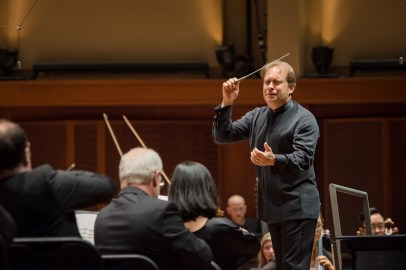
This week’s Seattle Symphony program culminates in one of music director Ludovic Morlot’s specialities: La mer, the finale to a program initially designed around orchestral color.

It opens with Escales (“Ports of Call”) by Debussy’s younger compatriot Jacques Ibert. This tripart travelogue from the early 1920s unabashedly exploits clichéd Orientalist and Spanish tropes, but the composer’s treatment of the orchestra is fresh, and Morlot found enough appealing nuances here to make it an enjoyable outing — and to pique interest in hearing more of this now-neglected composer’s considerable output.

The program had originally been slated to include a real rarity — Scriabin’s Piano Concerto, an early work that isn’t exactly in most pianist’s ready-to-go rep. Daniil Trifonov withdrew because of illness at the last minute, so it wouldn’t have been reasonable to expect Inon Barnatan to play the Scriabin when he agreed to save the day.

Scriabin’s synesthesia was meant to be a linking thread here — and perhaps something about Debussy’s Russian influences? — but the substitute turned out to be quite satisfying anyway: Mozart’s K. 488 Piano Concerto, which dates from just before the Figaro premiere.

I was impressed by Barnatan’s SSO debut two years ago (in Beethoven’s Third Piano Concerto). Once again, there was much to admire in his ultra-refined approach to the Mozart, which I heard on Thursday night — all the more striking, given that the concerto’s seemingly straightforward textures were surrounded by the complex hues and ravaging color fields of the rest of the program.

But I was puzzled by the shift from Classical poise to Romantic exaggeration of gesture in the minor-key slow movement, which contains some of Mozart’s most heart-rending music. Barnatan is such a naturally expressive interpreter that I think he would have been more effective without adding italics. Still, there were moments of that elevated beauty squeezed from the most commonplace phrase that set Mozart apart. The finale had all the joie de vivre of the Figaro that was waiting in the wings.

Morlot combined Respighi’s Pines of Rome with Debussy (Nocturnes) early in his tenure, and this time he took up the Italian’s Fountains. It’s hard to avoid the charge of musical padding here in Respighi’s opulent, neo-Richard Straussian scoring, but Morlot shaped the vignettes into miniature dramas that held interest. The SSO’s playing was at a high level, with especially fine ensemble from the strings.

It all seemed to set the stage perfectly for Debussy’s quasi-symphony La mer — including the times-of-day conceit of Respighi’s homage to Rome, moving from the sun’s fading at the Villa Medici to Debussy’s oceanic dawn.

But it soon became clear that Morlot wasn’t interested in “painting” with tone colors or the kind of pictorialism of Ibert — in other words, that he wasn’t treating La mer as another piece of program music that proves how clever Debussy was at conjuring mental images of aspects of the sea through his orchestration. In fact, and especially in contrast to the Ibert, it became obvious how much Debussy manages to do without resorting to standard musical tropes to suggest water.

Instead, the “colors” here seemed closer to the way we find them used in a Mahler symphony: expressions of an internal cosmos, building into a wordless drama of struggle and affirmation.

In his latest take on the piece, Morlot often went in surprising directions. Most remarkable of all was the intensity of the drama in the third panel, which exuded an almost terrifying ferocity I’d not heard in live performances of La mer.

The synergy with the SSO was exciting. Mary Lynch’s rendition of the ambiguous oboe phrase crowned an evening of stellar playing by the woodwinds. Morlot has internalized Debussy’s score to such a degree that he occasionally created the illusion of writing it on the spot. A moving tribute to Debussy’s continuing relevance.
–Review (c)2018 Thomas May. All rights reserved.

Filed under: Debussy, Ludovic Morlot, review, Seattle Symphony

Archive

Enter your email address to follow this blog and receive notifications of new posts by email.