MEMETERIA by Thomas May

Music & the Arts

Seattle Symphony Announces 2026–27 Season

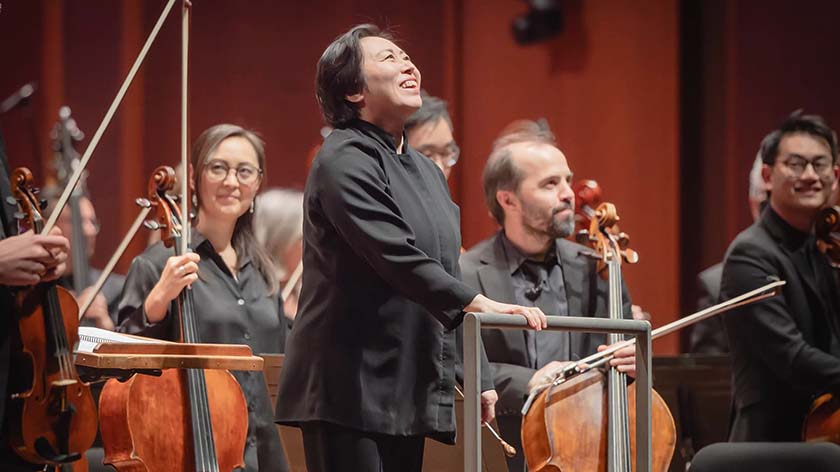
Xian Zhang with Seattle Symphony musicians; photo by Carlin Ma

Seattle Symphony has just announced its 2026–27 season, the second under music director Xian Zhang.

She describes the year as shaped by “two sources of inspiration… nature and community,” invoking Seattle as “a city embraced by mountains, water and forests.” The rhetoric frames a three-week spring festival devoted to “monumental works” inspired by landscape.

Beyond that framing, the season’s center of gravity lies in the late-Romantic and early 20th-century canon: Strauss, Tchaikovsky, Rimsky-Korsakov, Brahms, Wagner, Shostakovich and Mahler dominate the symphonic offerings, with Yuja Wang opening the season in Prokofiev’s Third Piano Concerto and appearances by Emanuel Ax, Gil Shaham, and Itzhak Perlman reinforcing a roster built on established appeal.

Zhang herself will lead twelve programs in all – including Tchaikovsky’s less frequently heard Manfred Symphony – and has cited Seattle artist Dale Chihuly as an influence on the season’s visual identity, another signal of her effort to root the orchestra’s presentation in local culture.

As for contemporary composers, the season includes co-commissions from Joe Pereira (a new concerto for timpani) and Steven Mackey – the latter now a recurring presence in the Symphony’s programming – alongside Samuel Adams, whose No Such Spring receives its Seattle premiere under Ludovic Morlot this fall, with soloist Conor Hanick. I’m especially interested to hear it in Benaroya Hall. Having studied the score around its world premiere by the San Francisco Symphony a few years ago, I know it’s a piece of real substance.

Adams’s presence extends into the Octave 9 series, where Conor Hanick joins percussionist Mari Yoshinaga and a quartet of Symphony musicians for Etudes and Devotions, featuring Adams’s Etudes for Piano and the U.S. premiere of his Devotions for String Quartet and Percussion.

The Elwha River project – a collaboration between flutist Claire Chase and composer Annea Lockwood inspired by the restoration of the Olympic Peninsula river – will be featured in April and stands out immediately to me as one of the season’s most compelling offerings. Adam Tendler’s Inheritances, built from commissions by Laurie Anderson, Missy Mazzoli, Nico Muhly, Pamela Z, Sarah Kirkland Snider and Devonté Hynes, also looks promising, and a centenary homage to György Kurtág is most welcome. (Why I’ve listed these in reverse chronological order is anyone’s guess.)

The series ranges further, from Pamela Z’s solo work for voice and electronics to a closing appearance by the Brandee Younger Trio (harp, bass, and drums).

The “community” emphasis also extends beyond the stage. The Symphony is set to reopen Benaroya Hall’s renovated public spaces at the start of the season, marking the completion of its Amplify capital campaign. The upgrades – new gathering areas, expanded concessions, and reconfigured lobby spaces — underscore an effort to position the hall as more than a performance venue at the outset of Zhang’s second year.

Music Director Xian Zhang and the Symphonic Series

  • Xian and James Ehnes (September 24, 26 & 27), featuring Bruch’s Violin Concerto No. 1 and Berlioz’s Symphonie fantastique.
  • Tchaikovsky’s First Piano Concerto and Zarathustra (November 12, 14 & 15), pairing Tchaikovsky’s Piano Concerto No. 1 with Strauss’ Also sprach Zarathustra.
  • Mozart’s Requiem with Xian (November 19, 21 & 22), presenting a Seattle Symphony co-commission and World Premiere of Joe Pereira’s Timpani Concerto, followed by Mozart’s Requiem with the Seattle Symphony Chorale.
  • Xian and Emanuel Ax (January 28 & 30), featuring Haydn symphonies and Mozart favorites, including his Piano Concerto No. 25.
  • Tchaikovsky’s Manfred with Xian (February 4, 6 & 7), with saxophonist Steven Banks performing a work by Ibert and his own composition, Come As You Are.
  • Xian Conducts the Sounds of Spain (February 11 & 13), spotlighting Lalo, Ginastera and Rimsky-Korsakov while featuring Concertmaster Noah Geller.
  • Xian Conducts Scheherazade (March 11 & 13), featuring Smetana’s The Moldau, Steven Mackey’s Concerto for Orchestra (a Seattle Symphony Co-commission and World Premiere) and Rimsky-Korsakov’s Scheherazade.
  • Grieg’s Peer Gynt with Xian (April 8 & 10), with music by Vaughan Williams, Webern, Scriabin and Grieg, and featuring Associate Concertmaster Helen Kim.
  • Beethoven’s Pastoral and Gil Shaham (April 15, 17 & 18), pairing Beethoven’s Symphony No. 6 with Dvořák’s Violin Concerto.
  • Pines & Fountains of Rome with Xian (April 22, 24 & 25), featuring Gabriela Montero’s Piano Concerto No. 1, “Latin” and Respighi’s Roman tone poems.
  • Xian Conducts Brahms (June 17, 18 & 20), encompassing Brahms’ Symphony No. 3 and his Violin Concerto.
  • Wagner’s The Ring Without Words (June 24 & 26), closing the season with Liszt’s Piano Concerto No. 2 and Wagner’s purely symphonic Ring cycle.

Filed under: music news, Seattle Symphony, Xian Zhang, , , , ,

Chaya Czernowin and Claire Chase in Lucerne

The amazing work of Lucerne Festival‘s Academy, focused on contemporary music, was on full display at Saturday morning’s concert featuring the incomparable Claire Chase, who joined members of the Lucerne Festival Contemporary Orchestra (LFCO) led by Vimbayi Kaziboni for the first Swiss performance of Chaya Czernowin‘s ‘The Divine Thawing of the Core’, which she premiered last month.

Czernowin’s gripping response to the political turmoil of the last several years in her native Israel, which she metaphorically imagines as ‘the forced thawing of a democratic society into a theocracy’ – hence the ironic title – ‘Divine Thawing’ is a substantial, 53-minute work for contrabass flute and an ensemble of six flutes, six oboes, six trumpets, trombone, tuba, percussion, piano, and three cellos. More than expressing pain, Czernowin’s astonishing score enacts it, with a devastating, claustrophobic sense of helplessness that presses on you like a physical weight. Rarely have triads sounded so terrifying.

‘It is a very elemental, naked and maybe an intimate beginning,’ remarks the composer, ‘which is forced to melt away through irony into an elemental brutality, in an uneven process, which includes a demonic waltz, in a gradual thawing of its features into a kind of a wholly different way of expression which is more coherent, ceremonial and brutally primitive.’

Chase’s contrabass flute anchored ‘Divine Thawing’ with an uncanny blend of ferocity and vulnerability. With her intense breaths woven into the texture, she seemed to live every extreme of Czernowin’s score, conveying its sense of struggle and resistance and raw endurance. A stunning performance.

Czernowin’s work also reflects her deep admiration of Galina Ustvolskaya‘s Symphony No. 2 from 1979 (‘True and Eternal Bliss!’), which was performed immediately preceding ‘Divine Thawing’, with Stefan Jovanovic as the reciter. The incredible originality of this music made a tremendous impact, uncompromisingly fierce, under Kaziboni’s guidance. The LFCO musicians are truly fearless.

Opening the program were the stark sonorities of Sofia Gubaidulina’s Trio for Three Trumpets from 1976, which summoned the audience into the unfamiliar terrain of the rest of the concert with a magnetic incantation.

Filed under: Claire Chase, Lucerne Festival, Lucerne Festival Academy, , , , ,

Salonen with the Parisians in Lucerne

Big news this week: just after Esa-Pekka Salonen wrapped up his Lucerne Festival visit with the Orchestre de Paris, it was announced that he has been named the ensemble’s Chief Conductor starting in 2027. Parallel to that, he’ll become the take up the new Creativity and Innovation Chair of the Philharmonie de Paris. Salonen’s collaboration with the orchestra in Lucerne offered a vivid taste of that future partnership in two very different programs last weekend.

In the first, Augustin Hadelich was the soloist in an account of the Brahms concerto notable for its shadowed lyricism and spacious pacing, illuminating the score’s darker hues. Hadelich played his own cadenza and his arrangement of a Carlos Gardel tango as a steam-vent of an encore following such intensity. If Salonen brought structural clarity to the Brahms, the suite from Prokofiev’s ‘Romeo and Juliet’ that followed surged with dramatic sweep. The episodes seemed to unfold as part of an inexorable tragic arc rather than a set of contrasting miniatures.

His second evening with the Paris musicians revealed a touch more humor alongside the testosterone of ‘Don Juan’. But all that Straussian horn-iness set the stage for the much-anticipated world premiere of Salonen’s own Horn Concerto written for Berliner Philharmoniker principal Stefan Dohr. It’s a big piece, heroic in its way and abounding in the composer’s deep knowledge of the literature across music history, especially Mozart, Beethoven, and Bruckner (Salonen also trained as a horn player). He colorfully remarked that these moments from the musical past ‘appear and disappear like fish coming to the surface to catch an insect before diving to the depths of the sea again’.

The concerto teems with exposed solo passages that seem to test the limits of breath and control — not to mention imagination, indispensable to giving expressive shape to Salonen’s fertile ideas. Around the horn, the orchestra cast a kaleidoscope of refined colors. The concerto will travel widely in the coming months, so I hope to get a chance for more encounters.

Horn sounds resounded still again, sublimely, in the Sibelius Fifth. Salonen’s control of the art of transition, with subtly judged but dramatically thrilling accelerando, was a marvel. For all the monumentality of the closing chords, I fancied amid their awe an echo of mortality, like the trees being felled at the end of ‘The Cherry Orchard’. But the solace of Sibelius’s glorious Swan Theme circled in the mind’s ear as the swans on Lake Lucerne outside the KKL glided serenely by in serene silence.

Filed under: Esa-Pekka Salonen, Lucerne Festival, music news, Sibelius, , , , ,

Happy Birthday to João Carlos Martins!

João Carlos Martins at Carnegie Hall Farewell Concert, 9 May 2025; photo: Jorge Gustavo Elias

Happy 85th birthday to o Maestro, João Carlos Martins! Born on 25 June 1940 in São Paulo, Martins established himself as one of the most brilliant keyboard interpreters of Johann Ses=bastian Bach in the second half of the 20th century.

Yet his Bach legacy is just one component of an artistic journey marked by both acclaim and adversity. João Carlos Martins’s story is as much about resilience and reinvention as it is about musical brilliance. Following prodigious beginnings – he made his Carnegie Hall debut at age 20 – repeated injuries to his hands forced Martins to step away from the piano, just as he was reaching the height of his international career. But rather than retreat from music, he redirected his focus to conducting, bringing the same fervor and eloquence to the podium that once defined his playing.

Martins additionally became an enormously influential cultural force in Brazil. Through his Bachiana Foundation, he has brought classical music to thousands of young people, many from underserved communities, creating access where there was none. Alongside this work with the Fundação Bachiana, Martins has also been a champion of Latin American composers.

His initiatives have blended high artistic standards with social impact, forging a vision of music as both an expressive art and a tool for transformation. Under his leadership, the Bachiana Filarmônica SESI-SP has become one of Brazil’s most dynamic cultural foundations – a platform for emerging talent and a vehicle for national pride, performing everywhere from favelas to major concert halls.

Martins’s late-career return to the keyboard – made possible by specially adapted bionic gloves – has added an inspiring new chapter to an already remarkable artistic narrative. Following his moving farewell concert at Carnegie Hall last month, Martins continues to extend a career that has continually defied limitation as he devotes himself to a broad new initiative to improve music education across Brazil.

Feliz Aniversário, Maestro! Your artistry continues to resonate far beyond the concert hall.

João Carlos Martins at Carnegie Hall Farewell Concert, 9 May 2025; photo: Jorge Gustavo Elias

An archive of JCM videos can be found here.

Filed under: Bach, Brazil, music news, , , , ,

Queer Baroque: Sound Salon Explores Identity in Baroque Music

Byron Schenkman, founder and artistic director of Sound Salon; photo (c) Shaya Lyon

Queer Baroque, the final program of Sound Salon’s season, salutes Pride Month with a blend of 17th-century drama and 21st-century insight to celebrate musical and personal otherness. Two performances: May 30 at 7.30pm at the Royal Room (5000 Rainier Ave S.) and May 31 at 7.00pm at the Good Shepherd Center (4649 Sunnyside Ave N.); tickets are “pay-as-you-wish, “with a suggested price of $36 and a minimum of $1.

Baroque music thrives on extremes. For harpsichordist Byron Schenkman, its emotional volatility and theatrical flair – hallmarks of a musical language that flourished in 17th- and early 18th-century Europe – hold special resonance for contemporary audiences and performers alike.

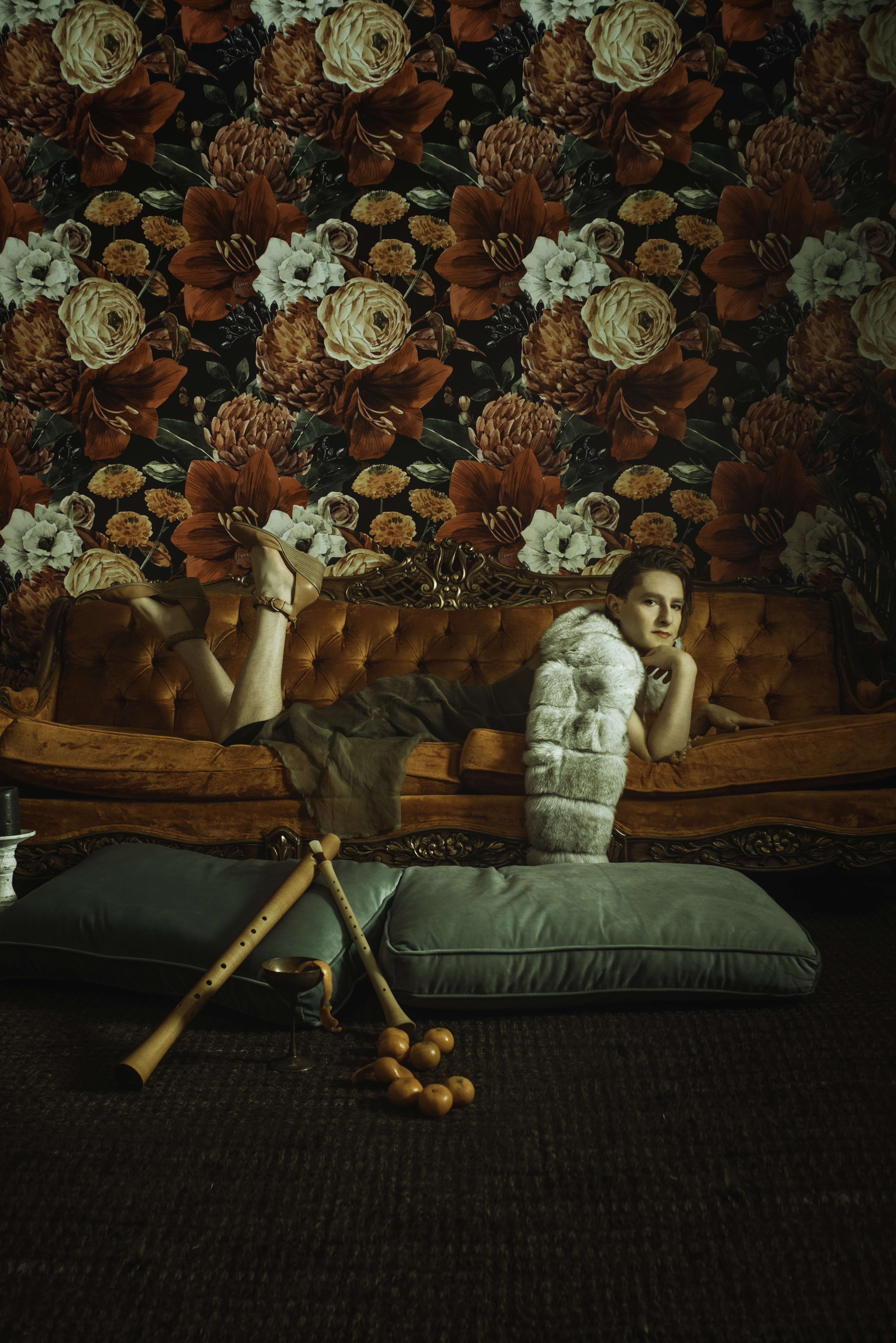
That belief underpins Queer Baroque, the final program of the season for the chamber music series Sound Salon, which Schenkman (they/them) founded and directs. They will be joined by multi-instrumentalist and composer Niccolo Seligmann (they/them) and male soprano Elijah McCormack (he/him) for two performances to mark the start of Pride Month with an imaginative – and often playful – exploration of identity and otherness through the lens of Baroque music.

The concept for the program goes back to the mid-1990s, spanning a period of profound cultural shifts – both in Seattle’s LGBTQ+ community and in the broader evolution of how queerness, and those who embody it, are seen, represented and understood.

“Thirty years ago, I helped plan a concert called ‘Queer Baroque,’ featuring musicians from Seattle Baroque Orchestra – and it nearly got canceled,” Schenkman recalls. When the presenting board at the time asked them to change the name in order to receive funding, they refused. “It generated so much buzz that the concert ended up being packed and was a big success. But one of the board members resigned over it.”

About a year and a half ago, as Schenkman began planning a version of the program updated to reflect a more expansive understanding of queerness, they assumed the moniker “Queer Baroque” no longer conveyed the edginess it once had. But in light of rising anti-LGBTQ+ rhetoric, particularly targeting trans communities, the title – and the conversation around it  –  feels urgent again.

Elijah McCormack

“At a time when we see ‘deviants’ scapegoated for so many social ills, I think this is an important program,” says McCormack, a transgender singer who specializes in early music. “Queer identities have been medicalized and classed as inherently disordered. It’s not new for these things to be pathologized or demonized.”

The program combines vocal and instrumental music from the 17th and 18th centuries to consider what it means to be seen as “other.” In the Baroque era, that otherness was often manifested in portrayals of madness in songs and stage works.

“This fascination with madness in the 17th century reflects a change in society’s attitude that led to people perceived as ‘crazy’ being put into institutions – behind bars – where the ‘normal’ people would come to look at them,” says Schenkman, who describes themself as “a queer Jewish keyboard player and scholar.”

By the 19th century, they add, “the idea of madness had become entangled with gender and sexuality: to be overly emotional, feminine or sexually expressive was often pathologized as insanity. Being queer, being feminine and being ‘crazy’ were increasingly seen as overlapping.”

That entanglement between emotional excess and perceived deviance plays out in several of the program’s vocal works. Barbara Strozzi’s cantata L’Astratto is a comic mad scene in which the singer cycles unpredictably through emotions and musical styles, unable to settle on one. “It’s also a kind of self-portrait of someone trying to locate themselves through art,” Schenkman says.

For McCormack, the piece culminates “in a touching sort of lament about the perils of losing yourself, even your own mind, in the love of someone else.”

He also performs Élisabeth Jacquet de la Guerre’s cantata Susanne, a retelling of the biblical story of Susanna and the Elders. “It’s so common for women – and people perceived as women  – to be punished for maintaining agency over their own bodies,” McCormack says. “I imagine that, for Jacquet de la Guerre, it was powerful to set a text about a heroine who defies the entitlement of men in authority. It’s still powerful today.”

Another vocal highlight is Henry Purcell’s From Rosy Bowers, a theatrical song in which a chambermaid feigns madness to trick Don Quixote. “Here we have a woman pretending to be crazy to manipulate a character created by a male writer and composer,” Schenkman says. “It’s like putting on a drag show: playing with the stereotypes and tossing them on their heads. Some of that happens musically as well.”

Not all of the program’s queerness is textual or narrative. Some of it lies in performance choices themselves – like Seligmann playing a movement from one of Jacquet de la Guerre’s violin sonatas on the bass viol, a bowed, fretted string instrument from the Baroque era that’s typically used for lower lines. Schenkman likens the transposition to subverting gender expectations: “What’s a high voice supposed to do? What’s a low voice?”

Niccolo Seligmann; photo: Anna Schutz

“This program uses Baroque music to celebrate that queerness is not just one thing,” Seligmann says. “It’s a rich panoply of experiences that intersect with other axes of identity, including the time period.”

Seligmann, whose playing has been widely heard both in live concerts and on soundtracks like the Netflix series The Witcher, also contributes an example of their work as a composer. McCormack will sing a scene from Seligmann’s Julie, Monster: A Queer Baroque Opera, inspired by the life of Julie d’Aubigny (1673-1707), a genderfluid opera diva and swordfighter. Seligmann describes the excerpt as “a queer seduction aria that proposes more egalitarian ways of sharing intimacy,” connecting Julie “with a herstory of gender rebels” and today’s audiences “with queer ancestors for us to honor and celebrate.”

For Schenkman, who has long blended scholarship with activism, the concept of “Queer Baroque” continues to resist classification. “We’re all a little queer, and a little not,” they say. “The problem isn’t difference. The problem is pretending there’s only one normal way to be. I want whoever’s in the room to enjoy looking at different ways people diverge from norms – and celebrate it.”

Filed under: Baroque opera, Byron Schenkman, early music, gay, queer, , , ,

Fire, Water, Secrets, and Memory: Tan Dun Returns to Seattle Symphony

Tan Dun conducting Seattle Symphony, with harpist Xavier de Maistre; photo (c) James Holt / The Seattle Symphony. 

A concert built around the artistry of composer, conductor, and cultural connector Tan Dun offers no shortage of conceptual fascination. This week’s concerts mark his turn to the Seattle Symphony podium after a memorable debut here two and a half years ago, when he led his monumental Buddha Passion.

Raised in a remote village in China’s Hunan province and shaped equally by Western classical forms and ancient Chinese traditions, Tan – who since 1986 has been based in the US – brings a theatrical imagination and a deep sense of ritual to the concert stage. He framed last night’s program with a pair of short but intensely colorful works by two early 20th-century composers he admires, serving as explosive preludes to two large-scale pieces from his own catalog.

A vivid reading of Manuel de Falla’s Ritual Fire Dance, from his 1915 ballet El amor brujo, crackled with rhythmic energy and flared with instrumental color, setting one element against another as water came into protracted focus in the ensuing Concerto for Water Percussion and Orchestra, composed by Tan in 1998 and dedicated to Tōru Takemitsu. 

Tan draws out music’s ritual origins in intriguing ways. Percussionist Yuri Yamashita not only performed the solo part but dominated much of the piece with an almost shamanistic stage presence – from the way she mindfully released droplets from her fingers to the immersive sound world she conjured using bowls of wood or glass, as well as gongs dipped mesmerically into one of two large water bowls over which she presided. 

At some moments she even softly vocalized, as if engaged in a conjuring. Enhancing the theatrical experience were three video screens suspended above the orchestra –- one large at center and two smaller flanking it – which projected close-up footage of the bowls and the rippling water, inviting the audience into the tactile, elemental, organic world of the piece.

The orchestra functioned as a kind of elemental chorus, not so much a counterpart as a kaleidoscopic resonator. Specific voices occasionally emerged from the fabric – most memorably in a luminous duet between Yamashita and principal cellist Efe Baltacıgil, whose tone seemed to bloom out of the water’s surface. A long, improvisatory cadenza captivated with its focus on the physicality of sound.

Still, the Water Concerto’s meditative pacing and episodic structure began to feel diffuse over the span of the piece – though whether this observation reflects a Western bias about form or a real imbalance in proportions is a fair question. In any case, this was a welcome opportunity to hear the work in live performance. 

After intermission came a brisk, glittering account of Stravinsky’s Feu d’artifice (Fireworks), a four-minute burst of orchestral color dating from a little before the young Russian’s leap to international fame with The Firebird.

To this taste, the highlight of the program was Nu Shu: The Secret Songs of Women – a 13-part multimedia concerto that unfolded with greater emotional clarity and formal cohesion than the Water Concerto. Nu Shu originated as a commission for a harp concerto from the Philadelphia Orchestra but, inspired by Tan’s immersive research into a little-known linguistic and social tradition from his native Hunan Province, grew into a sui generis fusion of concerto, orchestral narrative, and ethnomusicological-sociological documentary.

The “secret songs” in question have to do with the vanishing Nüshu tradition — a secret, invented language once used by women in rural Hunan to communicate among themselves in calligraphy and through chanting and song. Tan painstakingly researched the small community of remaining Nüshu speakers, capturing their voices and stories in multiple videos. 

Nu Shu unfolds in 13 short video portraits created by the composer and his team – shown on the three screens above the stage – each anchored in the landscapes of the women’s daily lives and their stories of isolation and solidarity, which are shared from generation to generation.

For Tan, the harp represents “the most feminine of instruments,” writes Esteban Meneses in his excellent program note, and serves as “an intermediary between what the composer imagines as the future – the Western orchestra – and the past, represented by the microfilms.”

Xavier de Maistre was the eloquent soloist, playing a kind of bard who mediates these stories and showing remarkable dynamic and expressive range. Tan likewise assigns a crucial narrative role to the orchestra, which acted as a bridge translating memory into something shared and immediate.

Repeat performance on Friday, May 16, at 8 pm.

(c)2025 Thomas May

Filed under: review, Seattle Symphony, Tan Dun, , , ,

A Dance, a Dream, a Riot of Color

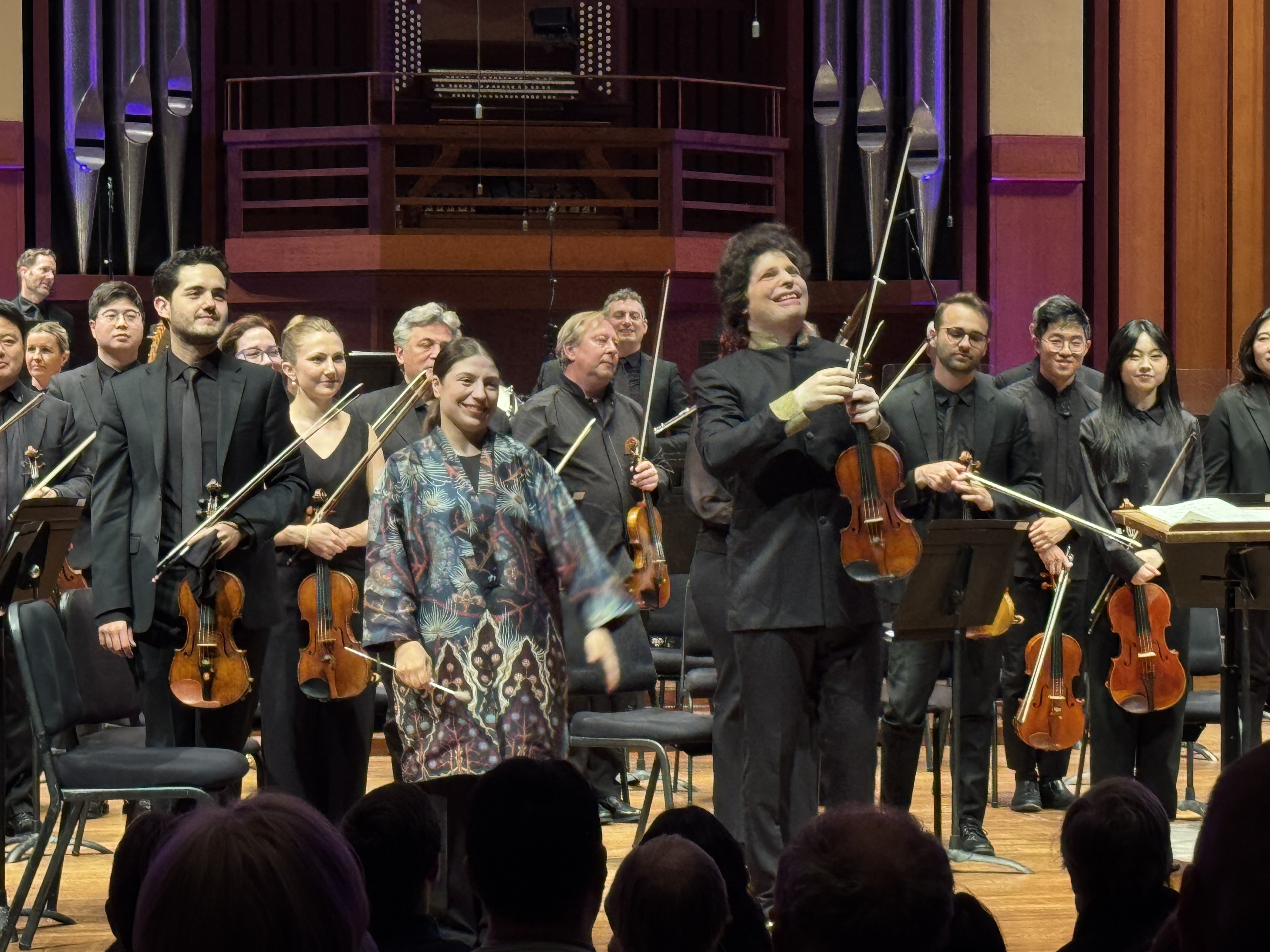
Dalia Stasevska and Augustin Hadelich with Seattle Symphony; (c)Jorge Gustavo Elias

Dalia Stasevska has returned to guest conduct Seattle Symphony this week with a relatively brief but refreshing program. Thursday night’s performance offered plenty of dazzling energy, albeit a curious combination of early Prokofiev sandwiched between two vibrant Latin American works. 

Alberto Ginastera’s Malambo from the 1941 ballet Estancia — music that put him on the international map – launched the concert with such kinetic force that it reminded me what a crime it is that his music remains so rarely programmed in the US. (Bravo to the Miró Quartet for recording the entire Ginastera string quartet cycle, forthcoming later this year as part of the ensemble’s 30th-anniversary celebrations.) Stasevska articulated the layered rhythms and boldly strident dissonances of Ginastera’s dance with razor-sharp clarity. Even at just a few minutes in duration, it left the audience breathless.

So did violin soloist Augustin Hadelich — though in a very different way. A Seattle favorite – he gave a deeply memorable account of the Britten Violin Concerto on his last stop with the orchestra two years ago – Hadelich brought his signature artistry Prokofiev’s precocious Violin Concerto No. 1. 

From his first phrases, which open the concerto, Hadelich astonished with the sheer beauty of his sound, caressing Prokofiev’s melodic line as if entering into a dream. Phrasing glissandi with effortless sprezzatura, he brought a transportive intensity to his account that was never schmaltzy. Hadelich embraced the concerto’s oneiric, fairy-tale character with personal warmth. Stasevska created a more integrated, immersive orchestral blend by positioning the brass stage right and offered sensitive, fluid support. 

Hadelich then delighted with an encore that nodded to the evening’s Latin American framing: his own arrangement of Carlos Gardel’s Por una Cabeza, proving, with wryly elegant melancholy, that it doesn’t always take two to tango.

The concert’s second half was devoted to Mexican composer Silvestre Revueltas’s La noche de los Mayas, a quasi-symphony fashioned from his score for the now-forgotten 1939 film of the same name, which uses a tragic love story to romanticize pre-Columbian Mayan culture. Stasevska underscored the piece’s rhythmic elan and churning colors, along with its touches of chaos a la Stravinsky Rite

The musicians seemed to thoroughly enjoy giving their all to the score – whether in the weighty brass chords evoking solemn ancient rituals, the mixed meter and collective revelry of a nighttime fiesta, or a  touching Mayan serenade duet for flute and percussion.

The last movement opened up into a tour de force spectacle for a massively expanded percussion section that calls for an orchestra-within-the-orchestra, complete with rattles, güiro, and conch shells. I came way impressed by Stasevska’s versatility—a world away from the Sibelius of her last Seattle appearance, and wholly in the spirit of the evening’s exuberance.

(c)2025 Thomas May

Filed under: conductors, Prokofiev, review, Seattle Symphony, violinists, , , , ,

RIP Sofia Gubaidulina (1931-2025)

“I am a religious Russian Orthodox person and I understand ‘religion’ in the literal meaning of the word, as ‘re-ligio’, that is to say the restoration of connections, the restoration of the ‘legato’ of life. There is no more serious task for music than this.”  – Sofia Gubaidulina

The great Sofia Gubaidulina has died at the age of 93. She passed away on 13 March at her home in Appen, Germany.

From her publisher, Boosey & Hawkes: “Sofia Gubaidulina, the grande dame of new music, has passed away on 13 March 2025, aged 93, at her home in Appen, near Hamburg in Germany. She was considered the most important Russian composer of the present day and a person who drew inspiration from a deep faith. Her interest in the world, in people and in the spiritual touched everyone who met and worked with her. In her work, she always focussed on the elementary, on human existence and the transformative power of music.

She is like a ‘flying hermit’, said conductor Simon Rattle, because she is always “in orbit and only occasionally visits terra firma. Now and then she comes to us on the earth and brings us light and then goes back into her orbit.” Conductor Andris Nelsons has noted that “Sofia Gubaidulina’s music – its intellect and its profound spirituality – is deeply touching. It really gets under your skin”.

According to NPR: “In a 2017 interview with the BBVA Foundation, Gubaidulina talked about the power of music in sweeping terms. ‘The art of music is consistent with the task of expanding the higher dimension of our lives,’ she said. A deeply religious artist, she once described her writing process as speaking with God.” She also said: “The art of music is capable of touching and approaching mysteries and laws existing in the cosmos and in the world.”


Filed under: Gubaidulina, music news, , , , ,

“Canon for Racial Reconciliation”

This weekend brings another of my picks for the first few months of 2025: Cappella Romana presents the world premiere of the complete Canon for Racial Reconciliation, a collaboration between composers Isaac Cates and Nicholas Reeves that fuses the sound worlds of Orthodox and Gospel church music.

Cates and Reeves have set a remarkable poem in the form of an ancient Byzantine canon written by Dr. Carla Thomas, one of the leaders of the Fellowship of St. Moses the Black, whose mission is “to share the Orthodox Christian faith with African Americans and people of color.”

Combining two choirs – each coming from Orthodox and Gospel traditions, respectively – Canon also calls for violin, trumpet, guitar, piano, a Hammond B-3 organ, and pre-recorded sound samples of sermons and related material.

James Bash has written an excellent preview for Oregon.live here, which includes this observation from co-composer Nicholas Reeves: “This piece was not a response to anything specific that is happening at the moment. It touches on issues that have been part of America for a long, long time. There are no political positions in the piece. The Canon of Racial Reconciliation comes from a compassionate and reconciliatory perspective. It recognizes misdeeds and violence and justice and tries to find a way forward that moves everyone ahead. The goal is healing in America. We move ahead even when there is no forgiveness or justice present. The music is an expression of mutual and peaceful co-existence.”

Performances are Friday 28 February at 7.30pm at Town Hall in Seattle and Saturday 1 March at 7.30pm at First United Methodist Church in Portland. Go here for tickets or call 503-236-8202 (use the code CANON for a 20% discount in advance). There will be a conversation with the composers and conductors right before the performances (free with registration).

Filed under: Cappella Romana, music news, , , , ,

Seattle Opera Announces 2025-26 Season

Today Seattle Opera announced the lineup for the company’s first full season with General and Artistic Director James Robinson at the helm.

I’m especially pleased to see Gregory Spears’s Fellow Travelers – more timely than ever – among the three company premieres. Last summer’s Santa Fe Opera season included The Righteous, a collaboration between Spears and poet Tracey K. Smith, and the production knocked me out. Fellow Travelers is set during the McCarthy era and is based on the Thomas Mallon novel about the “Lavender Scare” that affected workers in the federal government.

Budget tightening obviously plays a big role here, but the rest of the season is quite a mixed bag:  Seattle Opera’s first venture into Gilbert & Sullivan territory with The Pirates of Penzance; a Richard Strauss rarity, Daphne, but in concert format, which will star Heidi Stober as the mythic protagonist and with David Afkham conducting; and the perennial Carmen, which will star Sasha Cooke in her role debut (alternating with J’Nai Bridges in one of her signature parts). Another plus: Ludovic Morlot will conduct.

So we’re now done to just four mainstage productions, one of them in concert format, and no more season opener in August – when the Ring used to be the center of attention, so long ago.

Here’s the complete program:

Performance Information (see full cast lists at seattleopera.org)

The Pirates of Penzance
Music by Arthur Sullivan

Libretto by W.S. Gilbert
Conducted by David Charles Abell
Directed and Choreographed by Seán Curran
October 18, 19, 24, 26, 28, 29, November 1, 2025
McCaw Hall (321 Mercer St, Seattle, WA 98109)
seattleopera.org/pirates

Gay Apparel: A Holiday Show

December 12 & 13, 2025
The Opera Center (363 Mercer St, Seattle, WA 98109)
seattleopera.org/gayapparel

Daphne in Concert
Music by Richard Strauss
Libretto by Joseph Gregor
January 16 & 18, 2026
McCaw Hall (321 Mercer St, Seattle, WA 98109)
seattleopera.org/daphne

Fellow Travelers

Music by Gregory Spears
Libretto by Greg Pierce

Conducted by Patrick Summers
Directed by Kevin Newbury

February 21, 22, 25, 27, 28, & March 1, 2026
The Opera Center (363 Mercer St, Seattle, WA 98109)
seattleopera.org/fellowtravelers

Carmen
Music by George Bizet

Libretto by Henri Meilhac and Ludovic Halévy
Conducted by Ludovic Morlot
Directed and Choreographed by Paul Curran
May 2, 3, 8, 9, 10, 13, 16, & 17, 2026
McCaw Hall (321 Mercer St, Seattle, WA 98109)
seattleopera.org/carmen

Filed under: music news, Seattle Opera, , , , ,

Archive

Enter your email address to follow this blog and receive notifications of new posts by email.