MEMETERIA by Thomas May

Music & the Arts

New Moves with the NSO

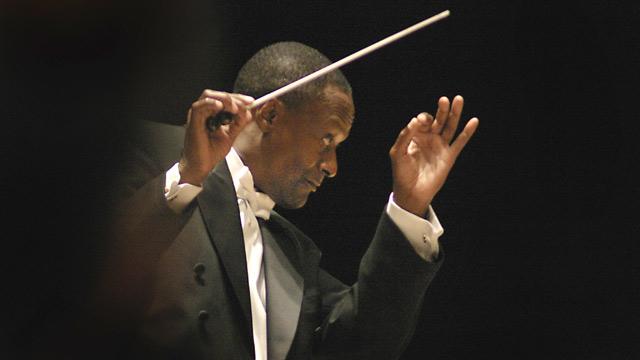
Thomas Wilkins

Thomas Wilkins

This weekend brings the next installment in the National Symphony Orchestra’s current NEW MOVES: symphony + dance festival. I enjoyed researching this material to write the program essays for all three programs, which are being conducted by the Omaha Symphony’s Thomas Wilkins. Each program pairs classic American rep with music by living composers.

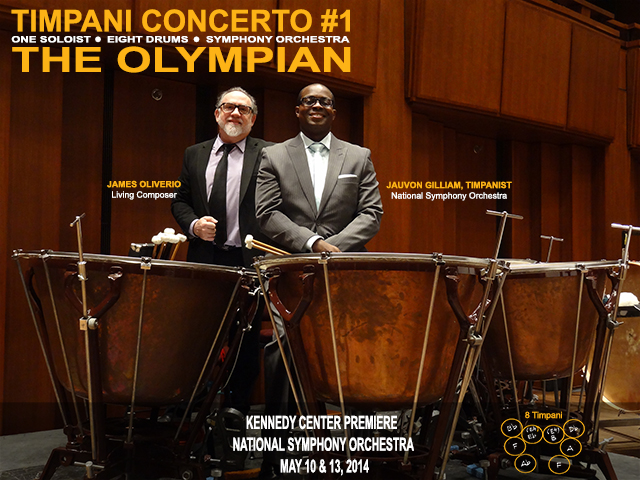
This second of the three programs features the Timpani Concerto No. 1 (“The Olympian”) by James Oliverio. Here’s a bit of my intro to his work:

The composer, educator, and new media producer James Oliverio (now based in Florida) has been redefining what it means to be a creative artist in the 21st century. “As composer there are two main ‘instruments’ that I work with: the symphony orchestra and the digital media studio,” he says, envisioning a music of the future that bridges the gap between traditional acoustic instruments and our rapidly evolving digital world. “Ultimately I want to unite them — to remove the distinction between my digital and orchestral endeavors,” adds Oliverio, an acclaimed pioneer of globally synchronized performing arts collaborations. (The rest can be found here.)

ONSTAGE_KC_640

More on the amazing Jauvon Gilliam, principal timpanist of the NSO, from Andrew Lindemann Malone’s blog post. Writes Malone:

Not everyone who attends orchestral concerts knows that the timpani is not a fixed-pitch instrument; drummers tune them through the use of a foot pedal. So to play the right notes, you have to have both your hands and your feet in the right spot. With the typical orchestral complement of four timpani, this is challenging enough; as Gilliam says, “it’s like a choreographed dance. You can overshoot it, you can undershoot it, it’s just like if you do a pirouette.” To really master the instrument, “you almost have to have four different brains or have your brain in four different compartments.”

[…]
It’s an unusual role for an instrument that normally sits in the back and makes everything sound fuller and more forceful, but Gilliam doesn’t mind the change. “My job is to support people. I really enjoy that, that’s what I love about my job,” he says, but performing a solo is a “different way of doing things, and it allows me to expand my talent. It allows me to be a better musician.”

The concerto is also, he says, “the hardest thing I’ve ever played” — a challenge worthy of the title “The Olympian,” and a summit only scalable for a man who’s sure on his feet.

Here’s Jauvon Gilliam’s own blog post on “The Olympian.”

And here’s a radio interview WETA’s Nicole LaCroix conducted with Wilkins (beginning), Gilliam (6:15), and Oliverio (at 9:15).

Filed under: American music, new music, programming innovation

In Praise of the Duke

It’s the birthday of one of my musical heroes, Duke Ellington (born on this day in my former hometown in 1899).

In his review of Terry Teachout’s new biography of the master, James Gavin describes the secret of his band’s sound:

Ellington played piano, but his real instrument was the orchestra. The sound he created was a tapestry of bluesy textures, lowdown swing and solo instrumental voices that growled, cried or wailed. Ellington led the band with a majesty that made him seem truly royal.

And here’s an excerpt from my essay for the National Symphony’s upcoming New Moves orchestral-ballet festival featuring music of the Duke — in this case, the giddy and infectious “Giggling Rapids”:

“Giggling Rapids” is a brief scene from Ellington’s belated debut as a ballet composer, The River. It dates from late in his career (1970) and was commissioned by American Ballet Theatre, with choreography by Alvin Ailey — his first large-scale collaboration with Ellington. The composer — uncharacteristically, notes Terry Teachout in his new biography — immersed himself in famous classical depictions of water to fuel his inspiration (think La mer, the “Sea Interludes” from Peter Grimes, Smetana’s own “river music,” the Moldau).

Like the mighty Mississippi, The River encompasses a multitude of meanings and perspectives. Ellington, in his memoir Music Is My Mistress, describes a guiding metaphor of life’s passage from birth to death and rebirth as the river courses on down to the sea. He likens the development of an individual to the river’s passage. “Giggling Rapids,” with its restless energy and catchy, joyous, ever-repeated motif, occurs more or less at the toddler stage, when this imaginary Everyman “races and runs and dances and skips and trips all over the backyard until, exhausted, he relaxes and rolls down the Lake” (the ensuing section).

Filed under: American music, jazz

John Adams’s Gospel

Gospel

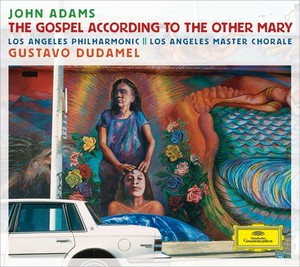
Since my essay is included in this recording, I have to recuse myself from offering a review, but I can say that I consider The Gospel According to the Other Mary among John Adams’s most profound accomplishments. It certainly probes new ground for this ever-evolving, brilliant musical mind.

As for the critical reactions I have seen, nothing yet has come to my attention that seriously grapples with the full complexity of this score.

A curious note: Gospel was among this year’s Pulitzer finalists. I think it’s a safe bet that this year marks the first time two composers sharing the same last name were up for the same prize, which in this case was taken by John Luther Adams for Become Ocean.

If you haven’t had a chance to explore this Adams/Peter Sellars collaboration, do yourself a favor.

Filed under: American music, directors, John Adams, new music, spirituality

2014 Pulitzer Prize for Music

John Luther Adams

John Luther Adams

And the winner is … John Luther Adams. This is especially exciting news, since Ludovic Morlot and the Seattle Symphony will be taking Become Ocean, the large-scale work they recently commissioned from Mr. Adams, to Carnegie Hall next month as the centerpiece of their Spring for Music program.

The Pulitzer Prize citation states:

Awarded to “Become Ocean,” by John Luther Adams, premiered on June 20, 2013 by the Seattle Symphony, a haunting orchestral work that suggests a relentless tidal surge, evoking thoughts of melting polar ice and rising sea levels (Taiga Press/Theodore Front Musical Literature).

In his review of the world premiere last June for The New Yorker, Alex Ross memorably wrote:

Anyone who has gone down a stretch of road and then reversed course knows that a landscape does not look the same when viewed from opposite directions. One mystery of “Become Ocean” is how different the material often sounds during the second half of the [overall] palindrome [structure]. The section after the first climax is thick with minor chords, particularly in the brass. Somehow, as these chords loom again in the buildup to the final climax, they take on a heavier, more sorrowful air. There is a sense of unwinding, of subsiding, of dissolution… That a piece constructed with such fanatical rigor can convey such potent emotion is the greatest mystery of all.

In an interview from 2011 with Molly Sheridan of NewMusicBox, Mr. Adams explains that his music is “never about representation or reproduction” but about “authentic personal experience, about the primary experience of being there and paying attention.”

Music is not what I do; music is how I understand the world. I hope that if I find myself in a singular place: wilderness, urban, indoors, outdoors, real, imaginary—doesn’t matter—if I find myself in a real place, a true place, and I am paying attention, then maybe I hear something that becomes music. If that happens, then I hope the music floats away, takes on a life of its own, and becomes something else to you when you hear it. What I may have experienced, what I may have been reading, or looking at, or listening to, or thinking about when I was in that place working on the music really doesn’t matter. What matters is the music and how it touches you.

Filed under: American music, culture news, new music, Seattle Symphony

Minimalist Jukebox in LA: Philip Glass

Philip Glass

Philip Glass

The Los Angeles Philharmonic is now presenting its 2014 edition of the Minimalist Jukebox Festival, curated by Creative Chair John Adams. I’m especially excited about the offering for Thursday, 17 April: the Rome section from the CIVIL warS, a Robert Wilson-Philip Glass collaboration. Here’s the essay I wrote for the LA Phil’s program:

Is it too far-fetched to compare Einstein on the Beach’s seismic effect with that of The Rite of Spring? At least in terms of the prospects for contemporary opera in America — in a moribund condition at the time — Einstein’s U.S. premiere in 1976 was a game-changer. And in the context of Minimalism itself, this groundbreaking collaboration between Philip Glass and Robert Wilson opened up a new world of possibilities for a composer who, as Glass has often repeated, up to that point had never dreamed of writing opera.

By the time of his second collaboration with Wilson on the CIVIL warS project, Glass had taken up the “conventional” rhetoric of opera — which is to say operatically trained voices, chorus, and full orchestra — and translated this into his unique style and idiom.

Glass himself considers Einstein to be both his first opera and an end point — the culmination of a long period of experimentation in abstract, instrumental forms with what is now generally regarded as “hard-core” Minimalist processes. This inaugural collaboration with Wilson was followed by Satyagraha, his first work written for an actual opera company (Netherlands Opera). Glass then undertook Akhnaten, completing his trilogy of “portrait operas” based on iconic figures in the period when he was working on the CIVIL warS.

The work we hear on tonight’s program therefore represents another important early step in cultivating a medium on which Glass has concentrated, with incredible productivity, up until the present. It is in opera that “Glass found a medium in which he could put his newly developed language to expressive use,” as the critic Allan Kozinn observed as far back as 1986. His turn “from abstract composition to representational music” has not kept Glass from continuing to write such abstract instrumental works as symphonies, concertos, and quartets, but the collaboration with Wilson in particular left a decisive mark on Glass’s conception of Minimalist language.

This language itself, it should be noted, was in its Glassian dialect initially rooted in “representational” projects from the composer’s early Paris years, when he made pivotal encounters with Indian music and the theater of Samuel Beckett. Through these projects Glass became fascinated by theatrical and musical sensibilities that posited an alternative to Western conventions of narrative linear time and space. Glass apparently first happened upon the work of Robert Wilson via the 12-hour-long The Life and Times of Joseph Stalin, which the Brooklyn Academy of Music presented in 1973.

That encounter had the effect of an epiphany. “I understood then, as I feel I have ever since, [Wilson’s] sense of theatrical time, space, and movement,” Glass has remarked. The composer once characterized the sense of time in his own music as existing outside “colloquial time,” with the result that audiences tend to perceive this music “as extended time, or loss of time, or no sense of time whatsoever.”

In Einstein Glass had his first opportunity to match his musical constructions to the vision of the maverick director from Texas. Wilson abandoned the business career intended by his father to instead take up a life in the performing arts, evolving his enormously influential brand of theater in New York City’s avant-garde downtown scene of the 1960s.

Through his idiosyncratic collages of surreal, dreamlike elements, stylized stage movement and gesture, and associative rather than plot-driven content, Wilson created a modernist counterpart to the Wagnerian Gesamtkunstwerk — only this is a “total work of art” that, unlike Wagner’s, reflects the intersecting visions of its collaborators rather than the vision of a single artist.

And, as Glass has emphasized over the years, its meaning is outside the control of the creators. Figuring out the relation of his own music to the words and images of the entire theatrical experience (or film, in the case of his collaborations with the director Godfrey Reggio) thus requires the active participation of the audience to be completed. “Early on in my work in the theater, I was encouraged to leave what I call a ‘space’ between the image and the music. In fact, it is precisely that space which is required so that members of the audience have the necessary perspective or distance to create their own individual meanings.”

Even in a cantata-like concert performance lacking the hallucinatory visuals that originally accompanied the full staged version, the Rome section (a Prologue and three scenes), affords the audience fascinating examples of this “intertextual” space, which might be contrasted to a more straightforwardly expressive “translation” of text and feelings into musical content.

The libretto prepared by Wilson and his collaborator Maita di Niscemi, for example, wasn’t intended merely to be “set” to music. Wilson had already constructed a multilayered verbal and visual text lacking only the musical layer. Glass’s contribution thus represented the final creative stage. He carpentered his score to align precisely with the timings from a pre-recorded read-through of the text as a stage play (though with the words delivered at an abnormally but operatically “true” slow pace).

All of this was meanwhile intended as the part of a still larger whole titled the CIVIL warS: a tree is best measured when it is down, to be performed in Los Angeles to celebrate the international spirit of the Olympics held here in 1984. Wilson began with a characteristically elliptical take on the American Civil War — in particular, Matthew Brady’s haunting contemporary photographs — and imagined a world historical juxtaposition of images and associations from antiquity to the Space Age. These riff on themes of war and peace, nation and family, civil and internalized struggle and enlightenment.

The peculiar typography of the title draws attention to a “struggle” between upper and lowercase letters as well as to the plurality of this phenomenon. “Civil Wars” also happens to be the customary translation of one of Julius Caesar’s writings. The subtitle quotes from Carl Sandburg’s canonical biography of Abraham Lincoln, for whom Wilson devised an unforgettable visual of a figure who is eventuality “struck down” (a singer suspended in a 16-foot-high harness, draped with a long black coat and sporting a stovepipe hat).

Never lacking for ambition, Wilson intended to stage a day-long ceremonial opera featuring composers, writers, and performers from around the world. Glass was one of several composers invited to contribute music for a different section of the vast five-act opus. The sections which were completed took their names from the locations of their separate premieres: hence the Rome section, envisioned as the final, fifth act of the CIVIL warS, was independently commissioned and staged (in March 1984) by the Opera di Roma. Glass also wrote the music for the Cologne section (scenes from Acts 1, 3, and 4), while David Byrne created connective pieces to link the scenes, known as The Knee Plays or the Minneapolis section.

At the last minute, the LA Olympic Arts Festival pulled the plug and canceled its plans to fund the complete staging. One of the commentators in Katharina Otto-Bernstein’s 2006 documentary Absolute Wilson observes that the director has since regarded this decision as the single greatest disappointment of his career. The Rome section, like the others, was thus left as a torso that has been occasionally performed on its own.

There is no story to synopsize. Wilson and di Nascemi’s libretto is largely a collage, an assemblage of texts from letters of the American Civil War period, ancient tragedies by Seneca for the Roman connection (in the original Latin and translated into Italian), and stream-of-consciousness word poems by Wilson himself, recited by a male and a female narrator. (On the Nonesuch recording, these parts are taken by Wilson and Laurie Anderson.)

It is for you, gentle listener, to generate what you will from the text’s recombination of historical, iconic, symbolic, and seemingly “automatic” elements. Figures we expect to see from the American Civil War — Abraham and Mary Lincoln and Robert F. Lee (who reappear in Glass’s more recent 2007 work for San Francisco Opera, Appomattox) share this dreamscape with the (French-born) leader of the Italian Risorgimento, Giuseppe Garibaldi, Hercules and Alcmene (the hero’s mother), and mythic Hopi characters, the “Earth Mother” and “Snow Owl.”

Glass’s very first notes, an ominously descending bass, happen to echo a similar gesture at the beginning of Einstein. But the original commission by Rome Opera — in the land where opera was born — led Glass to reflect on the power of the human voice itself and its central role in this medium. Whereas Einstein had featured relatively little singing, the Rome score is cast for huge, dramatically projected voices, with especially demanding high parts for the soprano and tenor soloists.

At the same time, Glass resorts to a Wagnerian sweep of orchestral sonorousness over which these voices float, as well as recurrent motivic ideas such as the brief trumpet call pervading the Prologue. Oscillation between major and minor provides the fulcrum for Glass’s idiosyncratic slant on tonality. The orchestral writing features primary-color effects, with fresh twists on conventional instrumental “imagery” such as military brass and drums or the floating arpeggios of bel canto accompaniment.

Indigenously American congregational hymn singing also informs some of the choral writing (Scene B), and elsewhere references to nineteenth-century Romanticism (Verdi and Tchaikovsky) color the choral and solo parts as well as the orchestral interludes. Creating a panorama of alternately turbulent and elegiac soundscapes, Glass recontextualizes familiar imagery in a way that’s reminiscent of Wilson’s process. Musically, the result is akin to the opera’s mingling of history and myth, of artifact and dream.

(c) 2014 Thomas May – All rights reserved.

Filed under: American music, directors, essay, opera, Philip Glass

No Joke

John Adams; photo (c) Deborah O’Grady

John Adams; photo (c) Deborah O’Grady

On the road: after being in the spotlight in Madrid for the Orquesta Nacional de España’s Carta Bianca Festival, John Adams is being celebrated this week by the Toronto Symphony with the New Creations Festival. The festival culminates on Friday with one of Adams’s most fascinating recent works, Absolute Jest. Here’s the essay I wrote for the original version of Absolute Jest on the occasion of its world premiere by the San Francisco Symphony and the Saint Lawrence String Quartet in 2012:

More than three decades have passed since the San Francisco Symphony gave its first world premiere of music by John Adams (the choral-orchestral Harmonium in 1981). The event marked the beginning of a longstanding relationship between composer and orchestra that has resulted in the commissioning of several landmark works: Adams’s breakthrough orchestral composition, Harmonielehre (a new recording of which the SFS has just been released), El Dorado, the millennial “nativity oratorio” El Niño, the opera A Flowering Tree, and My Father Knew Charles Ives.

continue reading

Filed under: American music, essay, John Adams, new music

Rising Up with Meredith Monk

Meredith Monk; photo by Masimo Agus

Meredith Monk; photo by Masimo Agus

Songs of Ascension is one of Meredith Monk’s creations of the past few years. If you don’t know her incomparable music yet, this is a wonderful place to start exploring it.

Monk’s unclassifiable art is grounded in a unique understanding of the flexibility of the human voice. She loves to create new contexts in which to fathom its expressive depths. The result is music that sometimes sounds as if it had been quarried from an archeological dig or beamed in from a distant future. Both impressions emanate from Songs of Ascension, the tenth project Monk has recorded for ECM since her path-breaking Dolmen Music was released three decades ago. That discography charts her intrepid forays “between the cracks,” as Monk likes to put it, where different ways of perceiving the world through art converge.

On one level, Songs of Ascension encapsulates Monk’s aesthetic outlook over a long career, one in which the voice serves as a guiding thread for her interdisciplinary performance pieces. But it also reveals the undiminished curiosity of her artistic quest by incorporating the expanded musical language Monk has evolved over the past decade. With Possible Sky (2003), her first work for orchestra, Monk began to apply her intuitive sense of the voice as a complicated instrument to larger ensembles, teasing out the feedback between singers and instrumentalists in ways that rethink the very bases of composition.

Songs of Ascension represents an ambitious example of this development in her work. One stimulus for the work was Monk’s encounter with poet Norman Fischer’s translation of the Psalms into a Zen-infused language. His imagery led to further reflections on the trope of worshipers ascending a mountain and pausing periodically to sing a psalm of praise. A simultaneous invitation to collaborate with visual artist Ann Hamilton further clarified her evolving musical images, adding a site-specific dimension. Hamilton’s project involved performing while ascending a new tower the artist had designed in Sonoma County, California, inside which a pair of staircases that resemble a double helix spiral upward. In this form Songs premiered in October 2008.

To explore her fascination with the connection between worship, transcendence, and images of ascension, Monk interweaves a fabric drawn from her recent experience writing for string quartet and the signature extended technique of her own vocal ensemble (with the added contributions of The M6 and the Montclair State University Singers). Other threads she includes are woodwinds, an array of percussion, and a blend of Western and Eastern sonorities (with a prominent role for the harmonium-like shruti box, which is associated with Indian music).

In place of a libretto the “text” consists of unpredictable patterns of abstracted phonemes, fluid vocalise, and shaman-like incantations. Yet even as non-sense replaces the logic of language, the vocalizations by Monk and her collaborators seem to imply the origin of speech rather than the disintegration of Babel.

The effect is especially enchanting at the beginning of the piece, which the string quartet inaugurates with sustained whispers of just a few pitches: a gentle fog which rises to reveal the echo of human voices. These “clusters” (in Monk’s terminology) set the stage for the sprouting of song, the blossoming of harmony. The interlinked sections are the first two of 21 that comprise Songs. Monk’s titles cue us in to recurrent patterns—and are also provocatively enigmatic (why are the seasons out of order, and why are winter and autumn instrumental-only while summer and spring include voices?).

Monk’s continual intercutting of highly varied textures builds a sense of larger-scale momentum. The section “mapping,” for example, suddenly introduces a new tone of festive tintinnabulation, while the gliding swoops of strings and voices in “falling” convey the curious sense of whimsical archaism that tempers the more meditative sections crisscrossing through the work. The range of Monk’s vocal idiom is literally breathtaking: a strangely beguiling repertoire of aviary microtones, robust yodels, insectoid whispers, and (in the penultimate “fathom,” a lengthy solo for Monk as she accompanies herself with a shruti box), dusky, low-range chanting. The final number, “ascent,” makes for an inspiring conclusion to the adventure, its layered sonic tapestry suggesting an endless procession/quest as solo lines leap in ecstatic figures from the drone-like foundation.

Though the original Songs of Ascension was conceived as an “immersive experience” with video and site-specific movement, Monk’s music is thoroughly evocative on its own terms. ECM’s engineering gives the music rich, warm resonance and even manages to convey something of Monk’s spatial acoustic. The recording was made in 2009 at the Academy of Arts and Letters in New York. The booklet includes a smart essay by composer Kyle Gann and a color-photo essay from the premiere in Hamilton’s tower. Songs is further confirmation of the musical treasure we have in Monk, who shows no signs of slowing down.

(c)2014 Thomas May. All rights reserved.

Filed under: American music, CD review, new music

What Makes an “American Composer”?

Piston
I was just researching an orchestral piece by Walter Piston and wondering why his music is hardly ever programmed nowadays. In the mid- twentieth century he was all over the place, winning TWO Pulitzers and getting prestigious commissions year after year from the Boston Symphony. Merely an adept player at musical politics?

In fact, Mr. hard-to-please Igor Stravinsky singled out Piston and Aaron Copland as exemplary American composers: “They have good musical ideas,” Stravinsky wrote in 1945. “They also have the requisite techniques. They are fine orchestrators, too.”

In the 1930s, Copland, six years younger than the New England-born and -bred Piston, listed a sort of posse of prominent American composers that (along with himself) included Piston, Virgil Thomson, Roy Harris, and Roger Sessions. (Thomson apparently liked to refer to this as Copland’s “commando unit.”) Yet of this bunch (“Les Six” made such bands fashionable at the time), it’s really only Copland who gets heard with any frequency today.

But Piston’s definition of “American music” may have actually been closer to today’s multicultural sensibilities than Copland’s — in the sense, that is, that there can be no grand “master narrative,” no single identifiable American style. Howard Pollack, who wrote his dissertation on Piston and a very fine bio of Copland, quotes the following from Piston, who, like Copland, had studied at the “Boulangerie” in 1920s Paris with Nadia Boulanger:

Copland and I had a friendly war about American music. Aaron and I were very thick. We practically grew up together. He had hopes of producing an American music that was just as recognizable as French and German music. I told him that America had so many different nationalities that it would be nearly impossible, I felt that the only definition of American music was that written by an American. He had to agree, but he felt there ought to be a vernacular.

(That obviously echoes – or was echoed by – Virgil Thomson’s famous dictum that American music was ““any music written by an American” — I don’t know who said it first.)

Piston certainly left an indelible mark through the students he influenced during more than three decades teaching at Harvard: the likes of Leonard Bernstein, Elliott Carter, John Harbison, etc. (not to mention his many-times-reprinted textbooks on theory and orchestration).

Piston’s stylishly neoclassical Toccata for Orchestra, a curtain raiser for Charles Munch and the Orchestre National de la Radiodiffusion Française (who played it at 41 stops on their 1948 American tour), gives you a good morsel-size sample of the fine craft that musicians like Bernstein valued. Bernstein admired his former teacher’s compositions for showing “the highest standards of craftsmanship and clarity of sonic intention.”

So here is Piston, an American composer, trying to evoke what he describes as “those qualities of clarity and brilliance which are so outstanding in the playing of French musicians.”

Filed under: American music, Bernstein

Bernstein’s Chamber Music

Leonard Bernstein in 1944; photo by Carl van Vechten

Leonard Bernstein in 1944; photo by Carl van Vechten

The “curse” of being Leonard Bernstein — of having to cope with too many talents and corresponding passions within a 24-hour day — is usually talked about as too-muchness on the macro level: Lenny the composer, say, becoming frustrated by the energy he had to siphon off into conducting gigs, ditto for Lenny the pianist, Lenny the teacher, etc.

Sometimes what’s shuffled into the Lenny-the-composer persona is broken down into the rubrics of “classical” versus Broadway undertakings. But it’s remarkable how many subcategories can be teased out here. For instance: chamber music.

While recently working on a piece about some of the early chamber works, I realized these comprise an entire subset of their own of unfulfilled potential, since, for the most part – and for obvious practical reasons – Bernstein pretty much abandoned writing chamber music despite the incredible promise shown by some of his earliest pieces.

His Sonata for Clarinet and Piano from 1941-42, which after all he chose as his first officially published composition, has become a mainstay in that sparse repertory. And with good reason. Here’s the second movement:

There’s a lone Sonata for Violin and Piano, from 1939, the year Bernstein graduated from Harvard – though the Sonata for Clarinet has also been reworked as a violin sonata. Written for a young Raphael Hillyer (future co-founder of the Juilliard Quartet), this piece also demonstrates Bernstein’s flair for abstract chamber writing, but he also made use of some of the ideas here in the ballet score Facsimile and the Age of Anxiety Symphony.

An even earlier treasure is the Piano Trio from 1937, also a product of his undergraduate years at Harvard. Already Bernstein shows his natural gift for absorbing a multitude of influences and turning them into something fresh. Notice the intriguing inclusion of then-fashionable Neoclassicism alongside the blues touch of the middle movement (later recycled as the tune “Gabey’s Comin'” in On the Town).

“I have a suspicion that every work I write, for whatever medium, is really theatre music in some way” — L. Bernstein in his prefatory note to his Symphony No. 2 (The Age of Anxiety).

Filed under: American music, Bernstein

Are American Orchestras Undermining Their Mission?

Orchestras
In a substantial and thought-provoking article in The New Republic, Philip Kennicott grapples with the issue of American distrust of “cultural authority” and how it affects the identity crisis suffered by today’s orchestras.

“The problems are financial and cultural, and the two are intertwined,” he observes. This year’s Pulitzer Prize winner for criticism, Kennicott compares the self-questioning undergone by American orchestras to a “protracted and painful Vatican II,” while the failure of the traditional subscription model has put orchestras in the same sinking boat as newspapers in the Internet era. As a last-ditch survival effort, orchestras have been forced to create a new paradigm based on audience segmentation, performing not just classical concerts but presenting a smorgasbord of watered-down “special events.”

But the most paradoxical and distressing result is the utterly generic quality of what most American orchestras now offer. By parsing audience taste to smaller fractions, the concert schedule in Oklahoma looks more and more like the concert schedule in Maine. At the League conference, the mantra was all “local, local, local”—that orchestras will survive only by catering in nuanced ways to their local constituents (not to audiences or listeners or music lovers, who are all passé). But a tendency toward groupthink across the field has led to the repetition of the same solutions, few of them successful or in any way particularly local.

Read the whole thing here.

(Above: American premiere of Mahler’s Eighth in 1916, with Leopold Stokowski conducting the Philadelphia Orchestra)

Filed under: American music, orchestras,

Archive

Enter your email address to follow this blog and receive notifications of new posts by email.